Come in! Come in!

"If you are a dreamer, come in. If you are a dreamer, a wisher, a liar, a Hope-er, a Pray-er, a Magic Bean buyer; if you're a pretender, come sit by my fire. For we have some flax-golden tales to spin. Come in! Come in!" -- Shel Silverstein

Showing posts with label LENT. Show all posts

Sunday, March 16, 2025

Your Citizenship is in heaven

Betty's Appalachian Sweet Corn Pudding
She was, without a doubt, the most genuinely kind, sweet, gentle soul I’ve ever met, so much so that, in my eyes, anyway, she sometimes rounded the corner of reality and almost became a caricature of herself - even to her, which made her giggle despite herself. Her husband, on the other hand, was a rumpled, crumpled, withered shell of a man for whom the adjective ‘cantankerous’ found a new depth of meaning.

Jack was my Hospice patient and like many on the Western side of Sussex County suffered from COPD (Chronic Obstructive Pulmonary Disease). After years of smoking unfiltered Lucky Strike cigarettes and inhaling farm petrol and Monsanto and God knows what else in the steel mills, his disease process was now classified as “end stage”. He was on continuous oxygen therapy, delivered via nasal cannula, and was now receiving nebulizer treatments - liquid morphine delivered via a supersaturated mist of water - four times a day.

Like my experience with many COPD patients, he, as Hospice professionals like to say, “had a few control issues”. Well, if you aren’t in control of your breathing, you’d have “control issues,” too. But Jack, well now, Jack’s issues with control were Black-belt level. He could bark orders laced with denigrating insults that would make a Drill Sargeant feel like a novice.

After 54 years of marriage, Betty was a pro at deflection. She reminded me of Emma Webster, Tweety Bird’s Granny, who seemed to manage the ongoing war between Sylvester the Cat, Tweety Bird, and Hector the Bulldog with nonplussed charm and delight. Nothing ever dampened her spirit.

Unless you crossed her. And then she could whip out a cast iron skillet from thin air, hold it up like a stop sign until, as she said in her cheeriest voice, you “changed your tune,” and then she’d go right back to dusting counters with the sweetest smile you ever did see, chirping her pleasantries if only to herself, if need be.

She seemed to be holding in her heart a secret interior story that she listened to rather than paying any nevermind to what was going on around her. I suppose, if she did, she’d just crumble and she knew that was simply not going to happen. Could not possibly happen. Not in this life.



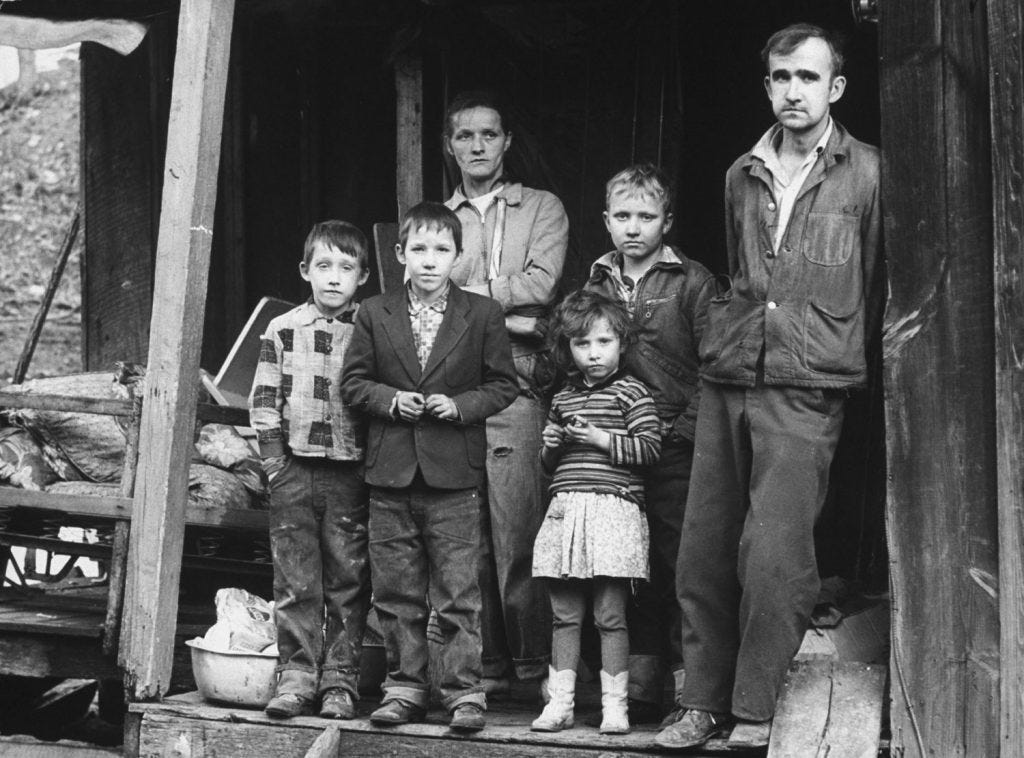
Betty and Jack were from “dirt poor” but “land tough” Appalachian stock. The genetics of Scotch-Irish, German, and English people who had fled the hardships and poverty of Europe, combined with the Native American tribal communities who had lived there for centuries, gave them not only the resilience and tough exterior they needed but an internal emotional and spiritual strength that helped them shape their own Appalachian culture through language, music, religion, and agriculture. And, food. More on that in a minute.

”Their people” - both Jack and Betty’s - had settled in Northwestern Pennsylvania where they worked the farms and then migrated to the East to work the coal mines or down to the steel mills in Pittsburgh or the textiles, shipbuilding, and iron production of Philadelphia. Like our biblical ancestors who wandered around wherever there was water and grass for their flock, they moved anywhere there were jobs. 

Jack and Betty had faired pretty well. Jack “lucked out,” Betty said and had gotten a good-paying job in the steel industry. Betty was able to stay home and raise their three girls, although she did work part-time in the school cafeteria when the girls got older. She carefully saved her small salary as the downpayment for their manufactured home in a trailer park outside the city limits.

Eventually, as the girls graduated high school (an accomplishment neither Jack nor Betty had been able to achieve) and left home, they sold their home in PA and moved to another manufactured home in Sussex County, Delaware, where the property taxes were low and the cost of living was more affordable.

The girls were all married and had kids of their own. They had good educations and good jobs and had married well. They had good cars and nice homes and enjoyed wonderful family vacations, living a modest middle-class life that was well beyond even the wildest dreams of their parents.

Jack and Betty were very proud of their family. You’d never know it by Jack, though. He seemed to have been in a perpetual bad mood for most of his life. One day was particularly bad. Betty and I had been talking about a documentary she had seen on television the night before about the slavery of “the Indians and the Blacks,” she said, “in Appalachia. Can you believe that? Slaves? In Appalachia?”

”Why,” she said, “I had no idea. I mean, we were all dirt poor. I didn’t have my own pair of shoes until I was 14 years old. Mama did her best but life was hard. Slaves? How could there be slaves? Who had the money to own them?” she asked in the purest innocent ignorance.

That’s when Jack exploded. “Oh, you feel bad for the Blacks and the Indians, do you? What about the White slaves? Huh? What about us? Do you feel bad for White slaves?”

Betty looked bewildered. “Joseph Arlo Smith, what are you talking about?” she asked.

That’s when Jack told the story that had been eating at his insides since the time he was seven years old and his mother died and his father sent him down to a neighbor’s farm to work his field.

“I was only seven years old but I worked like a grown man, plowing, planting, weeding, harvesting. I slept in the barn on the hay, just like the other work animals, with just a thin blanket to cover me. I ate the leftovers from the farmer’s table. I ate in the barn, just like the other work animals. I remembered some of the letters they taught me in school and I tried to read some, from the newspapers in the trash. I didn’t see my family except for Christmas and Easter Day.”
Jack started to have a bit of difficulty breathing. “Jack! Jack! Now, don’t get yourself all upset. Let me get your rescue inhaler.” Betty said. Jack shook his head. “No! Don’t give me that. I need you to listen to me, Betty. I’ve never told you this part before. You need to know this. You need to listen to this. Ain’t no one heard this before.”

”I always thought Daddy had sent me there because he couldn’t care for us, what with Mama gone. One day, the farmer came in and told me to get my stuff and leave. He couldn’t afford me anymore. And I thought ‘Couldn’t afford me’? What in the heck was he talking about?”

”So I walked home and Daddy was waiting for me in the truck. Drove me right down to another farm on the other side of the county but this time, he said I wouldn’t be coming home anymore. Not for Christmas. Not for Easter. This was going to be my new home and I’d better be good and I’d better work hard and behave.”

”I was 12 years old. I saw the man give my father some money. And that’s when I figured it out. I only had a little bit of education. I could read some, but I was pretty good at reading the writing on the wall. My father had sold me. He had been collecting my salary from the other farmer. This one had just bought me outright.”

”Do you know what that means, woman? White slavery! That’s what it was. White slavery. By my very own father! So, don’t go talking to me about the poor Blacks this and the poor Indians that! What about the poor Whites? We was sold into slavery, too. What about us, huh?”

There was no discussion this time. Betty got up and got his rescue inhaler. “Here now, puff on this, Jack, and calm yourself down.”

Jack took some puffs and then, wiping the tears from his eyes he looked up at her and said, his voice raspy and his breath labored, “And, you wondered all those years why I am the way I am. You always asked me why I couldn’t be more affectionate, especially to the girls. You asked why I never held your hand. You asked why I always had to be in such a bad mood all the time. You wondered why I wouldn’t go to church with you, even on Christmas and Easter, why I didn’t want the chaplain here to come visit.”

”Well, now you know. How can you show love when love’s never been shown to you? Why go to church when God never came to me, not one time in the field when my back was breaking? Not one time of the many times I cried myself to sleep at night, out in the barn, sleeping on the hay, with only the animals to hear me?”

”So, when I was 15 years old, I got up early one morning and walked down to the stream to wash myself. When I came up out of the water it came to me. I could just walk away. I could just walk and keep on walking. And so, I put on my clothes and I did just that and I never looked back.”

”But somehow, I found you, Betty. I want you to know that you are the one miracle I ever prayed for. You were more than any miracle I could have asked for. You gave me three beautiful girls. We have a good life. But, this . . . stuff . . . being so many years a white slave . . . well, it’s just been a cancer eating me up all these years. It’s killing me, Betty. Squeezing the air right out my lungs.”

”So, I had to get this off my chest. I didn’t mean to. But, you know, with all this stuff about the Blacks and the Indians . . . . and with the chaplain here, and all . . .I couldn’t hold it in no more . . . Forgive me, Betty. That’s what I mean to say. Forgive me, Betty. Understand, please. I do love you, Betty. You’re the best thing that’s ever happened to me in my whole life. I don’t want to lose you.”

Jack could hardly breathe. His lips were turning blue. He was holding on so hard to the armrest of his chair that his knuckles were white. Betty was comforting him as she set up his nebulizer. Wiping the sweat from his brow. Gently stroking his hair, wet with sweat, back from his face.

“There, now. Easy, now. Rest now, Jack.”

After a few minutes, Jack was breathing easier. He tilted his head back on the headrest of his recliner as Betty lifted the metal arm on the side of the chair which lifted his legs. “You stay right here, Jack, and I’ll fix you something. Okay?”

Jack nodded. Betty looked at me and said, “I’m going to need your help in the kitchen. You, my dear, are going to help me make Appalachian Sweet Corn Pudding.”

I followed her into the kitchen as she spoke, her voice lower than normal so as not to disturb Jack, but with that same, sweet, kind, gentle lilt that seemed not to have been disturbed at all by what we had just heard.

As we busied ourselves opening cans of corn and creamed corn and getting the eggs and milk from the fridge and the cornstarch and sugar from the pantry, Betty chatted merrily in her usual chirpy cadence.

I think I was more stunned than I realized. Jack’s story had shaken me to my core. The story and the raw honesty and emotional pain of it all were finally hitting me.

Just as I opened my mouth, Betty turned to me and said, “We are making Appalachian Sweet Corn Pudding because that’s the one thing Jack remembered his mother made and it’s the last thing she made before she died. I knew it was special to him for that reason, but I . . . I . . . I had no idea . . . . .”

And, with that, she collapsed into my arms and cried and heaved and sobbed. I whispered softly, “Of course you didn’t know. How would you know? He never told you. I’ve got you, Betty. You go ahead and cry. I’ve got you.”

She cried and cried some more and then, just as suddenly as she started, she stopped, took a deep breath, dried her eyes with a tissue she had retrieved from her pocket, and then shoved it back in, hard. She took another deep breath, and said, “So, we’re going to make my grandmother’s Appalachian Sweet Corn Pudding. Because it will make Jack feel better. It will make Jack know that he is loved. And, because it will help you know something about my people, and why we may be poor but we are strong and good and kind.”

”You’ll help me make this,” she said, in the kindest but firmest directive I think I’ve ever been given. “I’ll give you my recipe. You’ll go and see Mrs. Jones down the street and visit with her while the corn pudding cooks. And then, you’ll come back and have a dish with us. And, you’ll know what love tastes like.”

In this morning’s Epistle, St. Paul writes to the beloved people of Phillipi in Northern Greece from his jail cell in Rome - although some scholars say Ephesus or Caesarea - somewhere between 60-62 BCE.

He says something that has always caught me as a most beautiful way to talk about the power of The Resurrection. “But our citizenship is in heaven,” he says, adding, “He (Jesus) will transform the body of our humiliation that it may be conformed to the body of his glory . . . ".

I think I understood those words much better after I had tasted the first spoon of Betty’s Appalachian Sweet Corn Pudding. Cynics will say that it was probably the sugar but I felt instantly transported to my status as a citizen in heaven.

I also understood why Jack had been so transformed every time Betty made him some sweet corn pudding. For just a few moments, all the years of his humiliation were washed away as the memories of his mother’s love flooded every corner of his being.

“Salvation is of the Lord,” we are taught to say, meaning that salvation is a gift from God, not earned through human effort. In the Black church, you’ll often hear folks repeat the words of Nehemiah, “The joy of the Lord is my strength," meaning that finding strength and resilience in faith and joy in God's presence is crucial for navigating life's challenges.

Sometimes, the gift of salvation comes from unexpected sources. The joy of the Lord can be found in surprising places. I don’t know this for sure, but I suspect Jack and Betty were saved, in some small part, by the joy of the memories of love that were cooked into the Appalachian Sweet Corn Pudding.

I know I am, every time I eat a spoonful. Here, try some and see for yourself. It’s delicious as a side dish - I often make it at Thanksgiving - but it’s fine all by itself. When no one is looking I even eat spoonfuls of it - cold - right out of the dish in the refrigerator.

It’s my passport that tells me that, while I’m here on this earth, I’m just a resident alien. My Baptismal Certificate is my Green Card. My citizenship is in heaven.

I’m a citizen of heaven. I have tasted love.

Betty’s Appalachian Sweet Corn Pudding

3 eggs

½ cup melted margarine

½ cup white sugar

1 (16-ounce) can whole kernel corn, drained

2 (15-ounce) cans cream-style corn

2 teaspoons cornstarch

½ cup milk

1 teaspoon vanilla extract

Directions:
Preheat oven to 350 degrees F (175 degrees C). Grease a 9x13 baking dish; set aside.

Beat eggs until fluffy in a large bowl. Stirring constantly, pour in melted margarine. Stir in sugar, whole-kernel corn, and cream-style corn until well combined. Dissolve the cornstarch in the milk; combine with the corn mixture. Stir in vanilla. Pour the mixture into the prepared baking dish.

Bake in the preheated oven until the pudding is puffed and golden, and a knife inserted into the center comes out clean. It will take about 1 1/2 hours.


NOTE: Telling Secrets is a reader-supported publication. To receive new posts and support my work, consider becoming a free or paid subscriber. https://elizabethkaeton.substack.com You can also find me on BlueSky The Rev Dr. Elizabeth Kaeton @ekaeton.bsky.social

Tuesday, March 11, 2025

Consider the lilies . . .


One of my grandmother’s favorite Bible stories comes from Luke 12:22-34, sometimes referred to in shorthand as “The Lilies of the Field.” I first heard her recite it from memory when we were on the strike line in front of the factory where she was ladling out soup and I was handing out pieces of bread.

My family was very involved in the Labor Union Organizing Movement, mostly at the textile mills in Fall River, MA, where I grew up. They were part of the founding of the International Lady Garment Worker’s Union (ILGWU), on Third Street. My grandmother would make certain that, as the weeks and months of the strike continued, “the men” had something to eat.

She would make a huge vat of soup and many loaves of bread, load it up on my shiny red Radio Flyer wagon, and we would make the several-mile walk from her house down to the factories to meet the men at the strike line.

The memory that is keenest in my mind is the time we arrived and, not only were the men in line, but there, off to the side, were their wives and children who were also hungry and had come, hoping for something to eat.

There was no mistaking the tension in the air but it became very real when I heard my grandmother suck her breath between her teeth. I also heard her whisper a prayer to Jesus and one to Mary, to make sure her son got the message:

Hey there! We need a little help, here, sir. Remember what you did near Bethsaida near the Sea of Galilee, when you fed four or five thousand from five loaves of bread and two fish? Well, here we are, in Fall River, near the Taunton River. We’re going to need that kind of miracle now. Mary? Please make sure your son hears this. Okay? Amen.

The tension grew thick enough to cut with a knife. Anxiety was written over everyone’s faces, but you could almost hear the pleas from the eyes of the women and see the fear on the faces of the children.

My grandmother’s brow was furrowed. That’s when I started to feel scared.

I don’t know what happened, exactly. There was no bolt of lightning. No thunder. No chorus of angels, singing.

I remember feeling a gnawing in the pit of my stomach. It hurt. And then, it didn’t.

I looked up and saw my grandmother’s face. It was relaxed. She was smiling. I heard her say, “Okay, everybody! Get in line. We’ve got some good Portuguese Kale Soup here, and bread that I made this morning. Lots of people here today, but you know, it’s okay. Don’t worry. We’ll just add some water to the soup and everyone will eat hearty.”

The soft sound of human laughter seemed to reach the men who had been moving determinedly toward us. They suddenly stopped and, like the Red Sea, they parted. One of the men motioned to the women to come first, with the children. They were hesitant at first, but the hunger in their bellies animated and moved their feet and they came forward with a cup they had pulled from a place deep in their pockets.

I stood next to my grandmother, tearing off pieces of bread and handing them to the children and their mothers until they were fed. The men came next for their soup and bread. As she served, my grandmother recited the story from Luke 12:

“Therefore I tell you, do not worry about your life, what you will eat; or about your body, what you will wear. For life is more than food, and the body more than clothes.”

It was as quiet as a communion line in church. The soup ladle occasionally clanged against the pot like a sanctus bell. “Consider the lilies, how they grow. They do not labor or spin. Yet I tell you, not even Solomon in all his splendor was dressed like one of these.”

People were quiet but smiling, now, as they came forward in the line. As I struggled to tear off a piece of bread from the loaf, you could hear the “rip” in the silence of the crowds. “If that is how God clothes the grass of the field, which is here today, and tomorrow is thrown into the fire, how much more will he clothe you—you of little faith!”

I heard my grandmother’s voice over the scraping of the last ladle of soup was given out. ”And do not set your heart on what you will eat or drink; do not worry about it. . . . . . . But seek God’s kingdom, and these things will be given to you as well”.

Without logic or reason and despite this being the largest crowd ever, we realized that the last person had been fed.

We took a moment to let that reality sink in. Everyone had been fed.

Not much, to be sure. Just a half a cup or so of soup and a small piece of bread. Just enough to stop the rumbling in their stomachs. Just enough to fuel their body’s energy to keep on. Just enough to restore the hope in their hearts that God, at least, if not the owners of the textile mills, was hearing their prayers.

I realized then, two things. The first was that worry is a form of prayer. It is part of an ancient lament that has been part of the human enterprise for eons. My child’s mind wondered that if we did not lament, if we did not raise our minds and hearts and voices to God in a passionate expression of grief or sorrow or anxiety, how would God know that we need help?

St. Paul assures us that “The Spirit intercedes for us with sighs too deep for words.” The Psalmist wrote that even as “a deer longs for a water brook,” so do our deepest longings find their way to the ears of God.

I have come to know that the expression of raw emotion - the most piteous plea, the loudest, wailing cry - is heard in the deepest chambers of the heart of God. I believe that is what happened that day. God heard our worry. God heard our anxiety.

God can say, “Be not afraid.” And, “Do not worry about your life,” and “Consider the lilies,” because God knows that Jesus taught - and some of us listened - that when we feed the hungry and cloth the naked, we are feeding him.

Some of us have come to know the truth of what Teresa of Avila wrote in her poem, "Christ has no body but yours, / No hands, no feet on earth but yours".

So, no, I am not ashamed to worry. I am not ashamed to wring my hands and pace the floor. I am not ashamed of the occasional rising tide of anxiety in my soul. I know that these are forms of lament. I know these to be ancient prayers I share with my ancestors.

I know that God is listening. God’s time is not my time, but God hears.

I also learned something else that day. I learned that, sometimes, communion is not just bread delivered on a silver paten and wine administered from a silver chalice.

Sometimes, the holiest communion is provided from a large vat, administered in a tin cup, and delivered from one small hand to another in a jagged piece of bread.

As the government, which is once again presided over by little men of enormous incompetence and cruelty, runs perilously close to the brink of destruction, the tariff wars rage, and the dark clouds of a recession begin to gather, please consider the lilies of the field, yes, but know that our worries and anxieties are laments that are precious to the very heart of God.

Oh, ye of little faith! Know that God’s time is not our time but God knows the sound of the human cry because God has made it in the suffering and hunger, the cries and laments of Jesus.

Monday, March 10, 2025

Forgiveness: Part I

When is it time to say when?

Right out of the blue, it started appearing in my email inbox: Writer’s Almanac with Garrison Keillor. However, they were not recent postings. These were reprinted from, well, from “before the troubles”.

You may remember. It was after the height of the #MeToo Movement. Women were just beginning to feel some sense of power after the humiliation and disempowerment of having been sexually harassed in the workplace. People and organizations, governmental agencies, and even religious organizations were reacting quickly and strongly to the accusations women were making about sexual harassment.

The #MeToo movement began in 2006 as a grassroots effort by activist Tarana Burke to support survivors of sexual assault. The movement gained global attention in 2017 after actress Alyssa Milano tweeted #MeToo in response to sexual assault allegations against Harvey Weinstein.

A lot of good was done, nationally and internationally. #MeToo has helped to change attitudes towards sexual assault and harassment. It has also led to more people coming forward to share their experiences. The movement is now an international non-profit organization that continues to advocate for survivors and work to end sexual violence.

For the first time, the attitude of “boys will be boys” was no longer tolerated, and the unconscionably inappropriate behavior of grown men who felt neither cultural constraint nor legal accountability for being what could only be described as sexual predators was abruptly called into question.

Suddenly, swiftly, company heads were fired. Public figures were held accountable - most often by exposure of their behavior and public shaming on social and legacy media. Laws were written and passed mandating sexual harassment training in the workplace. Nondisclosure clauses in sexual misconduct settlements were banned in California, New Jersey, New York, Oregon, and Virginia.

Most importantly, the statute of limitations on sexual harassment and assault charges was lifted in many states and municipalities, and victims were allowed to seek legal remedy in a proper court of law. In New York, over 3,000 lawsuits were filed between November 2022 and November 2023 as a result of the Adults Survivors Act.

Even the Episcopal Church provided an open invitation to victims of sexual harassment and assault, no matter the year of the offense.

In 2018 the Episcopal Church held a "Liturgy of Listening" at General Convention in Austin, TX. to address the #MeToo movement. The liturgy focused on confession, healing, and lamentation and included first-hand accounts from victims of sexual harassment and abuse. Bishops - male bishops, some of whom had had rumors swirling about them for years - read the accounts.

The Bishops adopted a covenant to respond “more forcefully” to sexual exploitation and harassment and created a Task Force on Women, Truth, and Reconciliation. The church also removed references to gender from materials that clergy file with the Office of Transition Ministry.

To my knowledge, no Title IV complaints resulted from that liturgy or covenant.

And then, some stuff happened that seemed to have been engineered by lawyers to provide more “risk management” and “preventative litigation in the court of public opinion” than justice or, in fact, even concern for the victims.

In my opinion, Al Franken was one of those. Mr. Franken was a former entertainer who was the elected Senator from Minnesota. In November 2017, he was charged with forcibly kissing a woman a decade before. Seven other women came forward to say they had experienced unwanted advances from him. Many Democratic senators demanded his resignation, and he complied.

Many asked, then and now, did the punishment fit the crime?

In that same month and year, Minnesota Public Radio cut ties with Garrison Keillor after learning of allegations of inappropriate behavior with someone who worked with Keillor. The decision meant that Keillor's "The Writer's Almanac" and "The Best of A Prairie Home Companion" would no longer be broadcast.

I, like many others, was conflicted and yet devastated. On the one hand, I felt personally betrayed by someone who had entertained me and inspired me for decades. His “News from Lake Woebegon,” the weekly monologue laced with homespun stories and humor and often stitched with strong threads of morality and theology, had become my Saturday night sermon before I had to preach the next morning.

How could you not long to visit the fictional town? The original founders of what became Lake Wobegon were described by Keillor as “New England Unitarian missionaries, at least one of whom came to convert the Native American Ojibwe Indians through interpretive dance.

Who didn’t want to shop at Ralph's Pretty Good Grocery, where the motto was "If you can't find it at Ralph's, you can probably get along (pretty good) without it." Or, The Chatterbox Café, "The place to go that's just like home." Or, The Sidetrack Tap, run by Wally and Evelyn; "The dim little place in the dark where the pinball machine never tilts, the clock is a half-hour slow, and love never dies."

How could a man from a town in Minnesota where "all the women are strong, all the men are good-looking, and all the children are above average" behave inappropriately with women?

It absolutely goes without saying that the women who had the courage to speak out about inappropriate behavior ought to be believed and supported. Without question.

Keillor defended himself against the allegations. In an email to the Star Tribune, he reported that he meant to pat a woman on her back when she told him she was unhappy. He says her shirt was open and that his hand went up it about six inches. He says he apologized after she recoiled. He writes that he thought they were friends until he got a call from her lawyer.

Keillor was publicly shamed and humiliated and was fired from his job with NPR, the Writer’s Almanac, and The Poetry Foundation in disgrace.

Many asked, then and now, did the punishment fit the crime?

As we enter more deeply into the Season of Lent, my question has to do with forgiveness. When is enough, enough? When is it time to say when?

As a Christian, forgiveness is a central component of the teaching of Jesus. He emphasized that forgiveness should be limitless and not counted. “Seventy times seven,” he answered Peter when asked how many times he should forgive someone’s transgression.

I have always taken that to mean that forgiveness is a process that involves many layers. It often feels like peeling the impossibly thin layers of onion skin, one layer at a time, with all the attendant tears and emotions. “Seventy times seven.”

It is not anyone’s right to impose a timeline of healing on someone who has been hurt, betrayed, or assaulted. Some may need seventy; others only the seven. I’m wondering if the same timeline ought to be imposed on the public.

I will say this, there is something in my heart that was very happy to see the release of previous editions of The Writer’s Almanac in my inbox. I am delighted to find him writing again in a column here on Substack (Garrison Keillor and Friends). I am excited to learn that there is a digital (and CD) copy of the 50th Anniversary tour of A Prarie Home Companion, which features Garrison Keillor and some of the old favorites of that show.

I continue to hold in my prayers the woman who was inappropriately touched. I support her in her healing and recovery. I’m sure she felt even more deeply hurt and betrayed for many of the same reasons I did when I first learned of the incident. I don’t know if she’s found forgiveness. That’s not for me to know or determine. I don’t know if there’s been a reconciliation. That is a private, personal matter.

I only know that for me, forgiveness is now. “When” is now. For me, it is enough.

For this member of the public who felt betrayed by a public figure, the pastoral math assignment has been completed. Seventy times seven.


Friday, March 07, 2025

The Route of Stone and Water

Finding the way back to the light

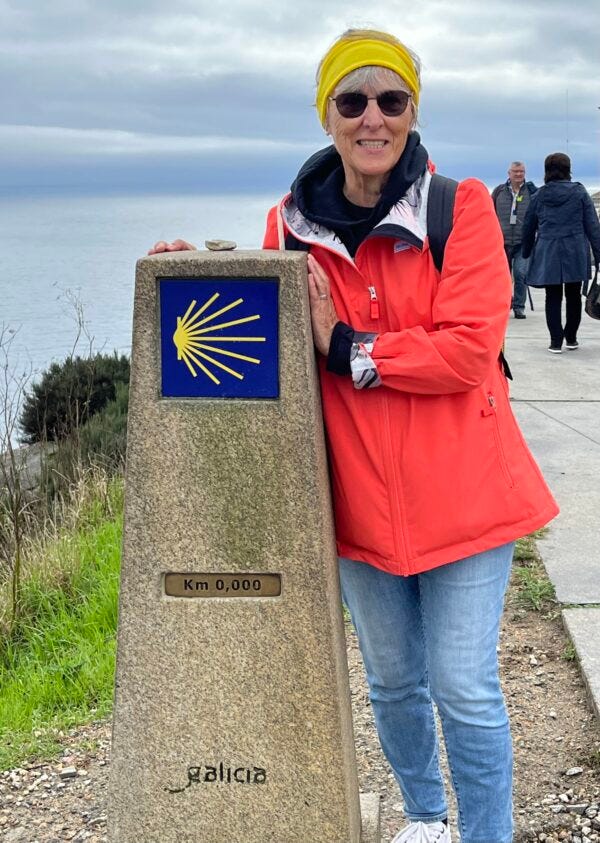
The author at Finisterra - the end of the world - the traditional end of the Camino.

NB This essay recently appeared in The Delaware Communion Magazine, Spring 2025, a quarterly publication of the Episcopal Church in Delaware.

As you read this, we will be in the midst of walking the pilgrim’s way we call Lent. For many of us, the world has never felt darker and more confusing and chaotic. This year, this Lent, we seem to be in the midst of an especially foreboding and disquieting pilgrimage.

How is it that pilgrims can walk through the darkness, feeling confused and lost, and then find their way to the light and back on the path?

I have walked The Camino de Santiago (The Way of St. James) as a pilgrim twice. In 2018, I walked from San Sebastian in the Basque Region of Spain, on the border of France. My second pilgrimage was on the Camino Portuguese, from Lisbon to Santiago, Spain, in 2022.

I was on the “Ruta da Pedra e da Agua” (Route of Stone and Water), a few kilometers from Armenteira, in the province of Pontevedra, Spain, in the region of Galicia where we had spent the night. Without a doubt, this is one of the most beautiful parts of the entire Camino. The path from Armenterira to Vilanova de Arousa is referred to as The Spiritual Variant, a path that leads mostly downhill to the sea; a gift for sore feet and aching knees.

I confess that I could never be considered a hiker. I am more of a walker with a definite penchant for strolling. I always smile when I hear about those who have walked 18–20 kilometers of the Camino in one day. I’m that person who literally has to stop and smell the flowers. In that area of God’s realm, it’s more like the small blue, pink, or white buds of rosemary that cover the border walls of farmland and the periwinkle hydrangea that seem to burst into huge, glorious pom-poms just about everywhere. Oh, and the eucalyptus trees in the Souto da Retorta forest and along the coast!

To paraphrase Ms. Shug in The Color Purple, I think it really pisses God off if a pilgrim does not notice (and smell) the rosemary and hydrangea and eucalyptus.

So, typically, I start the day with other pilgrims after breakfast, but then an hour or so later, they have all moved on and I am on my own, which suits me just fine. Indeed, I was often designated The Sweep, i.e. the person at the end who makes sure the folks we started with are in the designated place at the end of the day. This nickname is better than Pokey Little Puppy, the other term of endearment bestowed upon me by my fellow pilgrims.

Never mind. There are lots of pilgrims on the Camino from all over the world. Language? Not a problem when you can point and embellish with a few newly learned words. Also, the ubiquitous yellow Camino arrows or stylized shells are always pointing you to the right path; sometimes they are painted on a stone with the number of kilometers to Santiago.

How is it that pilgrims can walk through the darkness, feeling confused and lost, and then find their way to the light and back on the path?

It is very hard to get lost on The Camino — except on The Route of Stone and Water. This area was more like an enchanted forest, with charming little bridges over babbling brooks under which I fully expected a troll and three Billy Goats Gruff to appear. That morning a light, persistent rain bowed the limbs of some of the saplings that provided playful little splashes as I walked past them. It was early October, so the cold rain landed on the still-warm earth, gaving rise to small puffs of misty clouds, the stuff on which fairies love to perch and flutter their gossamer wings.

It was easy to get lost in all that beauty and magic and imagination. And so, I did. No worries. Someone will be by soon. I stood at the intersection of the path, where one way went down and seemed to follow the river, while the other went up a hill and through the ruins of an ancient water house. I looked all around for a yellow arrow or shell. Perhaps, it was on that fence? No. Ah, here, on this rock, covered with moss? No. On the ground, I wondered, as I moved dirt and dry leaves around with my walking boots. No such luck.

Ah, this must be a message from The Camino, telling me to stop and enjoy. So I did. For about 10 minutes. And then, I began to worry. Just a little. No one was coming by. This was my second Camino. This was unusual. Someone always comes by.

Fifteen. Twenty. Thirty minutes. No one. Trying not to panic, I struggled to swallow my pride and called our guide, Marco, from my cell phone. He would laugh. Silly American. But, he would hug me when he saw me and have something profound to teach me.

I didn’t have to wait that long.

“Marco? It’s Elizabeth. I think I’m lost.”

(Soft laughter) “You are not lost. You are on the Camino. Tell me what you see.”

(Belying my anxiety with some humor) “Stones and water.”

(Not amused) “Very funny. Tell me what you see. Maybe I can tell where you are.”

“One path goes down and follows the river. The other goes up by the ruins of a water house.”

“Yeah, I don’t know where that is. You’re right. You are lost.”

(Full panic now. It didn’t take much). “But, Marco, I have looked everywhere for a yellow arrow. I have looked back where I came. I’ve looked all around me. I have looked ahead on both paths. There’s nothing here. Oh my God. I AM lost. Whatever am I to do?”

“Stop. Elizabeth, stop. Now, take a deep breath and listen to me. Are you listening? Now, when you are lost, do not look back. That will only tell you where you’ve been. Do not look around. That will only tell you where you are. And, don’t look ahead. That is the unknown, yet to be discovered. Elizabeth, when you are lost, look up. When you are lost, always look up. When you look up, you will always find your strength. You will always find your way. For our strength and our help always come from above.”

I had started to cry but I looked up and, through my tears I saw it. There! On the tree! Just above my head. Someone had carved a bit of the bark off the tree, and painted there a yellow arrow. Up. Go up. Walk up by the ruins of the water house. That was The Way. The Camino.


This Lent, when things feel darkest and you feel lost and alone, know that this is just an illusion. We are not alone. Not really. You just have to swallow your pride and call someone and ask for help.

There will not be a bright yellow arrow, pointing you to the way out, but thre is yet to come, after the darkest Good Friday, a bright light which we call Easter. 

And, don’t forget, as you travel through this Lent, past the stones of our faith and the waters of our baptism, when things seem their worst, to look up. There you will find your strength and your help. At the end of this Lenten Season, we will arrive on Easter Day, having learned anew the deep spiritual lesson that Jesus is The Way and The Truth and The Life.

After two Caminos, following the stars on The Milky Way of the Compostella de Santiago, I have learned this: Sometimes, you have to reach way down in order to touch the stars.


Thursday, March 06, 2025

The Temptations of This Lent

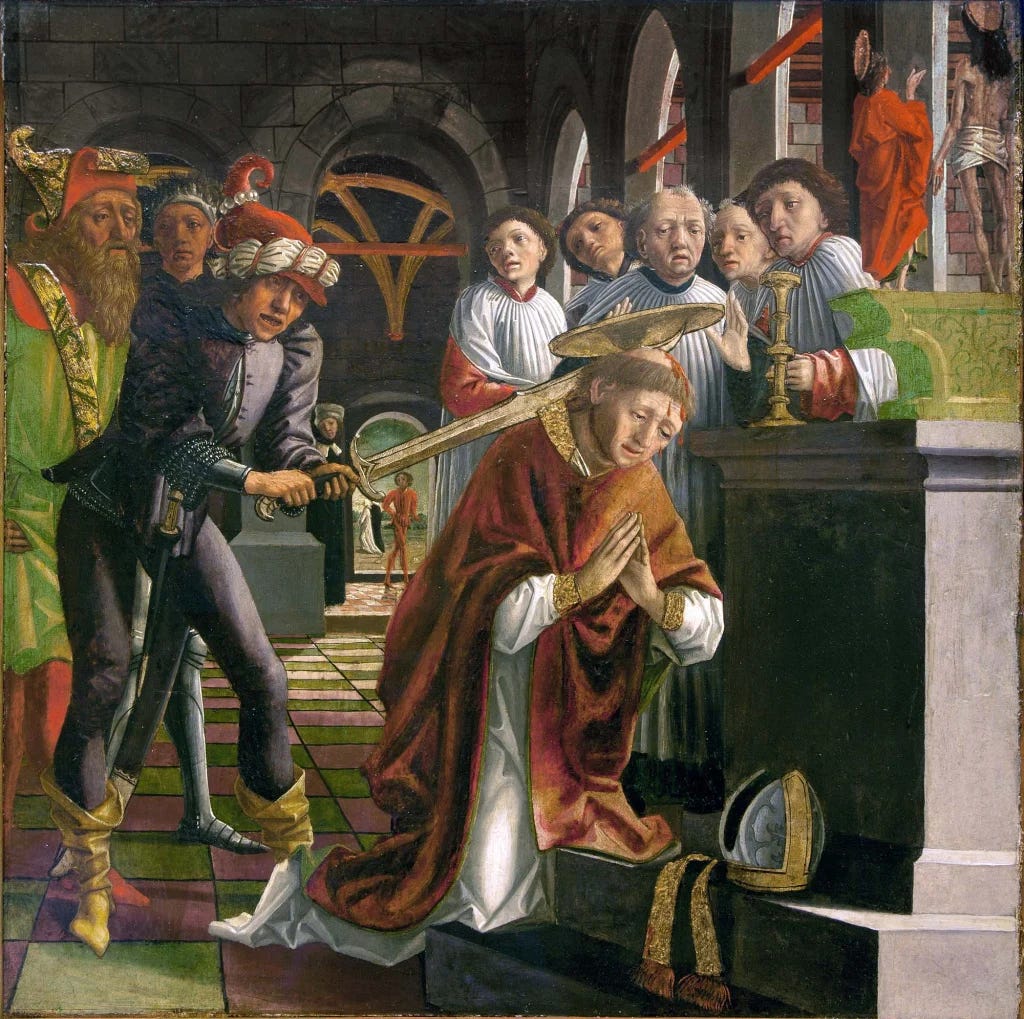
Image: Pacher, Michael. Legend of St. Thomas Becket. 1470/80.

Now is my way clear, now is the meaning plain:
Temptation shall not come in this kind again.
The last temptation is the greatest treason:
To do the right deed for the wrong reason.

That is the last stanza of the poem in T.S. Eliot’s 1935 Murder in the Cathedral.

It’s Lent, so I’ve been thinking a lot about Temptation. In Western Christendom, in those churches that follow the Lectionary, the gospel for the first Sunday in Lent is Luke’s reporting of the Temptation of Jesus in the Wilderness.

I’ve been thinking of my own Temptations, especially in these times of chaos and confusion. Especially in these times when our Democracy is being intentionally dismantled, stone by bloody stone, plank by bloody plank, pillar by bloody pillar.

Here is my Great Temptation: I’ve found myself - no, literally ‘found myself’ as the action was not thought out or intentional but ‘found myself’ - standing in front of my library shelves reading Greek myths, studying them, comparing and contrasting them, with this sole purpose: To learn how it was that the ancients killed monsters.

Murder in the Cathedral? Pshaw! Apparently, my subconscious has been searching for ways to do murder at the White House.

I am horrified and ashamed. What have I allowed myself to become? Turns out, the greatest temptation of evil is to repay evil with evil.

In T.S. Eliot’s verse drama, the play portrays the assassination of Archbishop Thomas Becket in Canterbury Cathedral during the reign of Henry II in 1170.

As the scene of his Temptation begins, Becket knows that his martyrdom is eminent and has embraced it as inevitable. Three priests are the voices of Temptation, offering a parallel to the Temptation of Christ.

The first tempter offers the prospect of physical safety. The second offers power, riches, and fame in serving the King. The third tempter suggests a coalition with the barons and a chance to resist the King. Finally, the fourth tempter urges him to seek the glory of martyrdom.

When the Tempters have done their work, Beckett’s “mind is clear.” He says,

The last temptation is the greatest treason:
To do the right deed for the wrong reason.

Greater minds than mine or yours have considered the weight of those words. ‘To do the right deed for the wrong reason’. To perform an action that appears morally good on the surface (in Beckett’s case, to seek martyrdom), but the underlying motivation behind it is not pure or virtuous (for his glory).

Essentially, it is doing something considered "right" but with a self-serving or ulterior motive, like helping someone only to gain favor in return, not out of genuine kindness.

There seems to be a lot of that goin’ ‘round these days. Congress seems to be a chamber teeming with Temptations. It may be that it was ever thus, but it certainly feels to be at a greater level of intensity and intentionality. That is not, however, to excuse my own soul from considering Temptation, albeit subconsciously.

At the close of the play, the knights address the audience to defend their actions. They maintain that while they understand their actions will be seen as murder, it was necessary and justified so that the power of the church should not undermine the stability of the state.

” . . . . the power of the church should not undermine the stability of the state.”

Talk about the last temptation! Or, perhaps it was that they had it in reverse. Perhaps their confession is that they believed they were doing the wrong thing for the right reason. Nevertheless, it sounds like a prescription for Appeasement. We know where that once got us.

And yet, this particular year, this Lent especially, I feel compelled to do something, to avoid some small temptation as a way to prepare myself for the Temptations I know are coming.


I do believe that theologian Dietrich Bonhoeffer, in his collusion with a plot to assasinate Hitler, was led to the gallows in a German concentration camp because he was Tempted by the defense to do the wrong thing for the right reason. In turn, his executioners were no doubt guilty of doing the wrong thing for the same right reason as Beckett’s soldiers -”the power of the church should not undermine the stability of the state” - even if the state was doing great evil in the name of Jesus.

That was 1945. Shortly before he was hanged, Bonhoeffer reportedly said to a fellow prisoner these last words, “This is the end. For me, the beginning of life”.

Here’s the thing I’ve been wrestling with, thus far this second day in Lent: I don’t think giving up chocolate or wine is going to change one iota of the trajectory of either my salvation or that of the world. And yet, this particular year, this Lent especially, I feel compelled to do something, to avoid some small temptation as a way to prepare myself for the Temptations I know are coming.

Temptations for me. Temptations for my church. Temptations for the church. Tempations for every person who claims to follow some religion or a Great Teacher on the path to being a better human. A moral person. A person who, perhaps, does the wrong thing for the right reason.

Ultimately, the only way I know that ‘the state’ has ever been stabilized. It is a great Temptation facing the church today.

The challenges of this particular Lent seem enormous and occasionally overwhelming to me. If they are to you, as well, then I want to suggest that you consider the importance of being part of a community of people who are also curious and troubled and seeking to navigate their way through the Temptations of Life.

I am hearing a line from the musical, Hamilton: “History has its eyes on you.”

Soon and very soon, we’ll be called to actions that will be questioned by generations to come. I am haunted by these words from Bonhoeffer: “The ultimate responsible question is not how I extricate myself heroically from a situation but how a coming generation is to go on living.”

As I’ve thought and prayed on this, I’m thinking that, while giving up chocolate or wine for 40 days and 40 nights might not save my soul, I’m considering that there might be great wisdom in starting small. With the seemingly insignificant. And, with great intention and purpose and prayer.

Sort of like the Karate Kid thinking “wax on, wax off” was a meaningless task to polish Mr. Miyagi’s cars, only to discover he was practicing an important defensive move.

It occurs to me that the act of giving up chocolate - or something seemingly insignificant that I love, like an entertaining TV program or a particular creature comfort - is not enough to save my soul. Rather, it is the intentionality of using it to prepare myself for the overwhelming task of avoiding the last Temptation: To do the right deed for the wrong reason. Which includes the Temptation of the misguided notion that I can save my soul 40 pieces of chocolate.

It’s the clarity Beckett had that I’m aiming for. (“Now is my way clear, now is the meaning plain.”) That’s going to take at least 40 days and nights to figure out.

The hope is that it will redirect the energy I’ve been spending considering how the Greeks killed their monsters. Come to think of it, that might just save my soul.

I hope something good happens to you today.

Bom dia.


Wednesday, March 05, 2025

Ash Wednesday: Freedom Song

Art: Flying Edna   

Remember that you are dust and to dust, you shall return.

Later on today, I will impose ashes on the foreheads of those who are ancient of days and live in what used to be known as "Nursing Homes" but are now called "Extended Care Facilities" (ECF) or "Long Term Care Facilities" (LTCF).


They have long ago moved from - and some have long forgotten - the homes they once lived in, and loved in, and made love in, and birthed and raised children in, and paced the floors one interminable long night, and cooked fabulous meals in, and celebrated holidays and holy days in, and wept in and laughed in and cursed in and sang in.

And now, they share a room no bigger than their former living room with a stranger who is also ancient of days, who cries out in the middle of the night for her children, or his comrades on the battlefield, or just simply, "Help me. Help me. Help me." until their voices are hoarse, yet they continue in a whisper until the light of a new day filters in their room.

Maybe that's not so much the cry of the demented. Maybe they have seen something and know something we don't yet know and haven't yet seen.

Maybe asking for help is the most courageous thing they've ever said in the whole of their lives.

Maybe they are finally free to say it. Out loud.

All of their earthly possessions have been reduced and are now contained in one small closet, one four-drawer dresser, a bedside table, and a hospital bed.

And, implausible as it seems to ones who are younger than them, it is enough.

When I impose ashes on their foreheads and say the ancient words of this day, some will look away, others will look bored, but a few will look me right in the eye, silently accusing me of redundancy.

But there's always one - one ancient soul - whose memory has been replaced with wisdom (which may be the wisest thing), whose watery eyes will dance with some happiness, deeply hidden in the wrinkles and crevices of her face.

I will say, "Remember you are dust and to dust you shall return," and he will pat my hand and say, "Yes, yes, child," as if I am singing a freedom song.

And, perhaps I am. Perhaps that is the greatest wisdom scattered and hidden in the ashes I carry.

This pilgrimage has a destination that is contained within itself. When we come to know that the journey is our home while we are here, there is a wonderful liberation.

Or, so it would seem.

All caution, disturbing memories, and soul-wracking anxieties are thrown to the wind, where they will be carried and scattered and, somewhere, mingled with the light feathers of hope.

And, they want nothing more than to go back home from whence they first came: Help me. Help me. Help me.

Remember that you are dust and to dust, you shall return.

Scattered amidst the song of the limits of our mortality is the song of our liberation as children of God.

If you quiet yourself and still your wildly beating heart, you will hear it, and then you will know the freedom to love wildly, generously, lavishly, and wastefully, the way God loves us.

And you will find forgiveness for yourself and others.

And your heart will be brave enough to ask for help.

And your soul will be free.

May that be your prayer as you begin this Lenten Journey.

Remember that you are dust and to dust, you shall return.

Tuesday, March 04, 2025

Fat Tuesday


Note: You can also find this reflection on TELLING SECRETS on my SUBSTACK page where all my other reflections are kept. If you subscribe to Substack, these reflections will be emailed to you automatically. There is no subscription fee. Substack will suggest it, but it is not required.


I live in Sussex County, Delaware. It has a nickname. “LSD”. That stands for “Lower, Slower, Delaware.” The locals think the “slower” part refers to the pace of life of the rural farmers in the west and the resort life in the east, near the ocean. Some of the folks “up North,” and “above the canal,” hear it a little differently.


”Lower” is not just a reference to a geographical location. It has to do with the perception of a social demographic. ”Slower” has to do with a perception of the mental acuity required of farmers. Chicken farmers. Cash crop farmers. People who have lived on the land and from the land for generations. Indeed, many are considered “land poor”. People who may not own a suit, except maybe the one they wore for their wedding or their parent’s funeral. Maybe.

People who talk with a distinctive accent which is an amalgamation of particular inflections spoken in Delaware, Maryland, and Virginia, for which the Delmarva (Del -Mar-VA) Peninsula also gets its name. The ‘r’s’ are hard but the vowels get swallowed.

The famous “M R Ducks. M R Not. O S A R.” (Translation: “Them are Ducks. Them Are Not. Oh, yes they are.”) is credited generally to “The Eastern Shore” but there are similar variations of it here, “below the canal”.

”Lower”. And, ”slower.” See? At least, that’s how many of the folks “above the canal” and some of the people who have moved here, primarily from Pennsylvania, New Jersey, and New York to escape the high real estate taxes, see their new neighbors.

I’ve been stunned and a bit shocked to see it in the attitude of some of the Kent and New Castle County clergy and how that is reflected in the conversations and discussion concerning some of the resolutions that come up at the annual Diocesan Convention - especially those that would empower small congregations. (There, now I’ve said the quiet part out loud.)

As the “land poor” farmers have been pushed out of their land by The Developers, the difference between people who are “from away” who live in McMansions and those who have lived here in Sussex all their lives in Manufactured Homes is more sharply drawn around lines of class, educational and economic status.

Lower Slower Delaware - LSD - is the polite way to say PWT (“Poor White Trash,”) or TPT (“Trailer Park Trash”). Except, everybody knows that it’s not polite. At. All.

It’s not exactly the stuff of JD Vance’s “Hillybilly Elegy” but then not too many around here have had the opportunity to go to Harvard and then sell their soul for the company store. But, the resentment is real. It smolders just underneath the surface. It’s gotten worse - much worse - in the past decade.

We bought this house in 1998. I moved here in 2008. Ms. Conroy and I commuted for 18 months from a friend’s house in New Jersey until she could transfer to a position here. I have worked as a Hospice Chaplain all over Sussex County since 2008. I (finally) retired in June of 2024.

In those sixteen years, I’ve worked on both sides of Sussex County. I’ve been privileged to have been invited into homes where three and four generations live together in a small, single-wide Manufactured Home, plopped down on a quarter or half-acre piece of land that was left to them when Daddy or Auntie sold off the rest of the farm and the bank (and then) The Developers took the rest.

Treatment for one heart attack or stroke, COPD, or lung cancer (thank you, Monsanto), without health insurance, can wipe out an entire profit margin from the sale of your property.

The thing that has impressed me, over and over, as I’ve had the privilege to be invited into the homes and lives of the families to whom I’ve ministered, is the love and the joy I’ve experienced in those families.

Oh, sure, many of these families put a Capital D in dysfunctional. They are also no strangers to another D word. Drama. Lots of drama and not just for yo Mama.

D also stands for Disease - mostly lung and heart (Thank you, Monsanto.) And, unfortunately, D stands for Drugs. And, Death.


Despite all of these challenges, there is love and joy. Sometimes, you have to listen closely and set aside your assumptions and expectations before you can see them, but love and joy are at the center of their lives.

O S A R. 

 
I’ll never forget one Hospice patient. He was 74 but he looked closer to 90. End-stage COPD and lung cancer. Cash crop farming will do that to a body (See also: Monsanto.). He lived in a pop-up tent camper in the driveway of his daughter’s rented single-wide Manufactured Home where she lived with her husband and their daughter, granddaughter, and her newborn, a great-grandson.

He had his own Manufactured Home but was no longer able to tend to himself, so his son-in-law borrowed a popup tent camper from a friend at the chicken factory. They ran an electric cord from the house to the camper and plugged in a small electric heater which warmed things up nicely.

He also had a small refrigerator which kept some of his medications and some food and drink easily accessible. He had everything he needed, including his oxygen tank and a spare for backup, a bedside commode, and a pill planner that his Hospice nurse would come twice a week and fill for him.


The Hospice Social Worker had arranged for Meals On Wheels to deliver food daily but I quickly learned that he “shared” most of it with two of his grandchildren when they came home from school.

One day, I arrived just as the Meals On Wheels driver was delivering the day’s fare: a cheese sandwich, a bag of potato chips, a small plastic container of mixed fruit, a large, chocolate chip cookie in a plastic baggie, and a small, wax covered cardboard carton of whole milk. There was also a plastic bag with plastic utensils and a small portion of salt and pepper in a paper container.


The kids came in right after me, hugging and kissing Grandpa who lit up like a light bulb as they showered their affection on him with the lavish abandon of childhood. They took the white Styrofoam container which held their grandfather’s only meal for the day and set about to cut the cheese sandwich in half.

Suddenly, the older girl looked at me and then looked at her grandfather. They exchanged a glance and a nod and then she took her half and cut it in half and offered it to me.

“Oh no,” I said, “thank you, honey, but I’m fine. I had a great big lunch not long ago (I lied). You have it.”


The child continued to slowly push the quarter of a cheese sandwich my way as she cast a questioning glance at her grandfather.

He looked at me and said, “No, you take it,” and then, with a warm smile that revealed the image in the back of his mind that had come to him from a time, long, long ago, when he was a child, said, “Mama always said you’re never too poor to share what you have.”

I pushed back gently, one last time, “Oh, thank you, sir, but honestly, I’m really not hungry (that was truth).”

He smiled gently, tenderly, and said, softly, “Oh, I think you have no idea just how hungry you really are.”


I could feel my eyes well with tears as the realization of the truth of his words found a place deep in a place in my heart. I nodded, swallowed hard, and took the quarter piece of cheese sandwich with a gratitude I had never felt - or tasted - before.

”Son of a gun,” I said, “and here I am supposed to be ministering to you.”

”Aw, now child,” he said, “Jesus said we’re supposed to minister to each other. You just do it with fancier words than I do. Now, I want you to tell my grandkids here a Bible Story. Which one do you want to hear, children? Maybe Noah? Maybe David in the lion’s den? I’ll bet this chaplain can tell us a great story from the Bible.”


Tomorrow is Ash Wednesday. Many of us will go to church and get a smudge of ashes on our forehead and be reminded that we are “dust and to dust we shall return.” And, while that’s true, I think we miss the point if we forget that in between the dust from which we are formed and the dust to which we return, there’s a lot of love and joy.

I think, this year - especially this year - my Lenten discipline will be to concentrate on finding the love and the joy in the midst of the dust and ashes. I suspect I’ll find there the riches of my life amidst what I might see as poverty. I’m betting solid money I’ll find that I’m hungrier than thought I was, but it won't be due to any fasting on my part. I’m hoping that I’ll choose to stop eating the Bread of Anxiety and begin to feast, instead, on the Bread of Love and Joy.

I think Lent is a great time to go back and reread some of the stories from the Bible that captured my heart and imagination when I was a child. I’m hoping it will spark something in me that I felt then.

There’s a real shortage of religious imagination these days. There’s more to life and politics than the cost of a dozen eggs.

I suspect we’ve been so focused on scarcity and not having enough that we’ve forgotten the abundance of our God.

There’s a lot of work to do. Good thing we’ve got forty days and forty nights.

Have a Holy, Blessed Lent.

I hope something good happens to you today.

Bom dia.

Sunday, March 02, 2025

Change. Transform. Transfigure

Kelly Latimore Icon


The last pilgrimage I took before the beginning of the COVID pandemic in 2020 was to Israel-Palestine. There were many places there that deeply affected me, but none so much as visiting the Basilica of the Transfiguration on Mt. Tabor.

This morning's gospel for the last Sunday after the Epiphany and the Sunday before the beginning of Lent on Ash Wednesday is the gospel story of the Transfiguration, which takes place on Mt. Tabor, where there was a sweeping view of the beautiful Jezreel Valley, one of the most important travel routes connecting Africa, Asia, and Europe.

In the ancient world, you couldn’t get much of anywhere without passing through it. Whoever controlled the Jezreel Valley controlled intercontinental trade. For 7,000 years, many important, historic battles have played out there.

Jezreel is a feminine Hebrew word that comes from the words zara', which means "to scatter seed", and 'el, which means "God", so "God sews," or "May God scatter seeds." It has become a metaphor for "spreading the word of God." Jezreel is also the name of the first son of Hosea and Gomer, and became symbolic of God's judgment against Israel.

It is also known as the Valley of Megiddo, after the important administrative center in ancient Canaan, in Gallilee, in what was then ancient Palestine but now claimed as part of Northern Israel. Megiddo may be translated to mean "invading" or "instrument/place of exposure". 

The Jezreel Valley was the scene of many important battles – those waged by Egyptians against Canaanites and by Philistines against Israelites. A victory was led by Deborah and Barak against the Canaanites. The city of Jezreel was the site of many murders by Ahab and Jezebel. Jehu, the founder of a dynasty that put Jeroboam II on the throne, massacred all the descendants of Ahab in Jezreel.

Saladin defeated the Crusaders there. Napoleon conquered the Ottomans in that place. The Book of Revelation predicts that Armageddon, the final battle between good and evil would happen in the Jezreel Valley.

The Jezreel Valley is a place not only of war and death, but also of beauty and life. Two million years ago, the Jezreel valley was an underwater channel that connected the Mediterranean Sea to other major bodies of water. As geological forces raised this land upwards out of the water, it became the best farming land in the region, the very “heart” of the Holy Land.

Mt. Tabor
As I stood on Mt. Tabor, overlooking the Jezreel Valley, it was easy to imagine that Jesus must have visited this place as a child as it is only 8 miles from Nazareth.

Jesus changed as a child, growing older to become a young man. As Jezreel Valley grew lush with a wide variety of fruits and crops, Mt. Tabor remained unchanged as it had for the millions of years since the tectonic plates deep in the earth moved and shifted to transform the geography and landscape.

It was from Mt. Tabor, a place that overlooked the change and transformation of the Jezreel Valley, that Jesus chose his transfiguration.

I don't think that is insignificant.

Yes, it is a reflection of the transfiguration of Moses when he stood before God on Mt. Sinai. The face of Moses shone after he came down from the mountain where he had spent 40 days and 40 nights receiving two tablets of instructions from God, known as The Ten Commandments.

Jesus, of course, has spent 40 days and 40 nights in the wilderness, having been sorely tempted. He did not emerge with instructions for his disciples, but with clarification about the mission of his life, leading to the transfiguration he would need for his earthly pilgrimage to the final spiritual battle he would endure, which would take him - and us - to the glory of Easter.

As we begin Lent, we are asked to consider what we will change and how that might change us, spiritually. However, if we stop there, just changing the way we eat, giving up wine or alcohol, chocolate or sweets, we'll have missed the opportunity to make the deep spiritual symbolism of the Lenten pilgrimage one that not only changes and transforms us, but transfigures our very souls.

Image: Mike Moyers
God knows, as a nation and as the world, we are walking into a time of chaos and confusion, a time when all of what we believed to be right and good, noble and true, is being challenged.

It feels to many as if we are brinked on a dangerous precipice of an epic spiritual battle of good and evil. If the heated, vulgar exchange between two bullies and the actual Leader of the Free World that took place in the Oval Office last Friday didn't convince us of that, I don't know what will.

There is no doubt in my mind that we will emerge from this time changed and transformed and we may never again be the same. And, that might not be a bad thing, as an ultimate result.

I am more concerned, for myself and for my country and the world, that we take this time - Ramadan for Muslims (Feb 28, 2025 – Sat, Mar 29, 2025), Lent for Christians (Wed, Mar 5, 2025 – Thu, Apr 17, 2025), and Passover for Jews (Apr 12, 2025 at sundown; ends at nightfall on Apr 20, 2025) - as an opportunity for the change, transformation and transfiguration of our lives, our hearts and our very souls.

Change. Transformation. Transfiguration. It's an amazing, dangerous pilgrimage. The tectonic plates in the earth are shifting again. The earth is rising. Mountains are appearing. Epic spiritual wars are being waged and moral battles are being fought. The threat of
Armageddon looms large in the minds of many. 
 
And yet. . .  and yet . . . The Jezreel Valley is also at our feet, lush and rich with a wide variety of nourishment for our souls.

It is important to hold this image of the transfigured Jesus before us as we begin this Lenten pilgrimage. The Light of Christ has not extinguished but grows deeper, guiding us to the destination  we know as Easter morning.

We are not alone. Like Peter, James and John, we will make this pilgrimage together. In community. More important than what you give up or take on, being in community is the best way I know to walk the spiritual path that is before us.

I hope something good happens to you today.

Bom dia.