Come in! Come in!

"If you are a dreamer, come in. If you are a dreamer, a wisher, a liar, a Hope-er, a Pray-er, a Magic Bean buyer; if you're a pretender, come sit by my fire. For we have some flax-golden tales to spin. Come in! Come in!" -- Shel Silverstein

Thursday, February 14, 2013

Capezzoli de Venere

These delightful, provocative little confections are called Capezzoli di Venere - or Nipples of Venus.

You might have first heard of them when watching that great film Amadeus. If you've seen it you may remember the scene. It's the treat offered to Constanze Mozart - Wolfgang's wife - by his nemesis, Antonio Salieri, when she brings him some of her husband's original compositions.

I immediately searched for the recipe, but that was long before Google made it so easy. I was finally blessed with this recipe by a friend who had it among his Italian great grandmother's recipes, but you can find other variations all over the Internet. I understand that the brown versions are more commonly made - probably because it's easier.

If you enjoy cooking and baking and like to make candies, this is not a difficult recipe. Okay, so it's not as easy as picking up a box of chocolates, and its definitely more complicated than hand-dipping your own chocolate covered strawberries, but trust me, it is well worth the time and effort.

You can even get away with just grilling up some steak or fish, steaming some veggies and baking a potato or boiling some rice. Candlelight. Some flowers. A glass of red wine. And, a plate of Capezzoli de Venere and your St. Valentine's Day will be one to remember.

I confess, I didn't make them this year. I simply ran out of time for time in the kitchen - and it's probably too late for you to make them for this Valentine's Day for your sweetie, but do think about saving this recipe for next year.  You will get "Oooh's" and "Aaah's" left and right.

You may even get lucky.

Happy Valentine's Day!

This recipe makes about 60 truffles 
 
Ingredients:
 
12 ounces high quality dark chocolate, chopped
16 ounces canned whole chestnuts, drained
6 tablespoons butter, softened
1/2 cup white sugar
1/4 cup brandy
1 teaspoon vanilla extract
12 ounces high quality white chocolate, chopped, divided
1 dash powdered red food coloring

Directions:

  1. Place the dark chocolate into the top part of a double boiler over simmering water, and let the chocolate melt. Turn off the heat and let the chocolate cool.
  2. Place the chestnuts into the work bowl of a food processor, and process until the chestnuts are smoothly pureed, about 1 minute.
  3. Beat together the butter and sugar with an electric mixer until the mixture is light and fluffy, about 3 minutes. Stir in the chestnuts, brandy, and vanilla extract until the mixture is smooth. Stir in the chocolate, and pinch off about 1 tablespoon of filling per truffle. Roll the mixture into balls about 1 inch in diameter. If the mixture is too soft to hold its shape, chill for several minutes in refrigerator.
  4. Reserve about 1 ounce of white chocolate for tempering, and about 1 ounce for coloring. Melt the remaining 10 ounces of white chocolate over simmering water in a double boiler until the chocolate is melted and warm but not hot (about 105 degrees F (40 degrees C)). Remove the pan containing the melted chocolate from the double boiler, and add about 1 ounce of chopped, unmelted white chocolate. Stir the chocolate until the unmelted pieces of chocolate melt, and the temperature drops to 80 to 82 degrees F (27 to 28 degrees C)).
  5. Carefully dip each center in the melted white chocolate, and gently place the truffle onto a piece of parchment paper or waxed paper to cool and harden, about 15 minutes.
  6. Melt the remaining 1 ounce of chopped white chocolate over simmering water in a double boiler until the chocolate is melted and warm but not hot. Stir in a very small amount of powdered red food coloring until you get a desired shade of pink. Dip a little colored chocolate out with a spoon, dot each truffle with a pink dot, and allow the pink chocolate dots to set, about 15 minutes.

Wednesday, February 13, 2013

Pencils


I had just passed over the sign-in sheet to my colleague at a Hospice Team Meeting and realized that she did not have a writing implement. So, I also offered her my pencil.

She looked at my pencil and then at me and, with a mixture of surprise and mild annoyance said, "You ALWAYS use a pencil. Every time I sit next to you, or watch you take notes, you either use your computer, iPad or a pencil and paper. Never a pen. Why is that?"

I hadn't noticed, really. Never gave it a thought.

And then, I did.

I began to take inventory of my desk at work and the one at home. I have lots of pens. I rarely use them. When I do write - I've even started to journal on my computer - it's usually a grocery list (because the container with pens and the pad of paper are in the kitchen). I also use a pen to write out a personal note - thank you, condolence, birthday - to friends. That's if I haven't sent them an e-card.

I didn't always, but I've noticed that, more and more, I'm using a pencil for everything else. Appointments in my calendar. My 'to do' lists. My Hospice visit schedule. These days, I even doodle my primitive art with a pencil.

The nifty thing about a pencil is that it comes with an eraser.

Nothing is permanent. Not anything or anywhere in life. With a pencil, you can change things easily enough with a few vigorous swipes of the little piece of rubber at the end of it. And, if things change and you're a bit upset about it, the erasure rids you of the annoyance or memory of it. 

I suspect that working as a Hospice Chaplain has something to do with this new behavior.

On Ash Wednesday, I will be visiting people in their homes and in Skilled Nursing Facilities and imposing ashes on the foreheads of those who know their time on this earth is very limited.

"Remember that you are dust, and to dust you shall return," I'll say, as I smudge ashes in the sign of the cross on their foreheads.

As if they weren't already acutely aware of that fact.

It's always a bit unsettling to me, when the recipient of the ashes looks up at me and says, "Thank you." I mean, I've essentially said, "You're going to die, you know." And, they say, "Thank you."

I'm never sure if they're being polite or thanking me for the reminder.

I stopped in to see one of my patients who is in a Skilled Nursing Facility - a devout Roman Catholic - and asked if she needed me to bring her ashes. "Nah," she said, "the deacon from the church in town will bring me some."

She thought for a moment and then said, "Ashes to ashes, dust to dust. Isn't that what you say?"

"Actually," I said, "I will say, 'Remember that you are dust, and to dust you shall return.'"

She smiled and said, "And, ain't that just the truth?"

She thought for awhile and then said, "It won't be too much longer for me. Before long, I'll be sitting in a jar on my kids' mantle, right next to my husband, until this summer when they take our ashes out to the ocean and scatter them both and we sail away together. "

I stopped for a moment, thinking about the current fad of 'Ashes to Go', and silently giggled a wicked giggle about her and her husbands 'ashes to go' together in the ocean. Bad joke, I know. Hospice can do that to you.  Bad jokes are a survival mechanism.

I wondered what she thought about the call of Joel and Jesus to repentance - not death - which is at the heart of the observance of Ash Wednesday, and the basis of my distress over "Ashes to Go".

Yes, the ashes are a sign of our mortality - the finiteness of human existence - which is the reason to repent. But, the compelling prophetic call from Joel and Jesus is to repentance.

What does repentance mean to someone who is watching the face of death move closer and closer to their own face?

My thoughts were broken by the voice of my patient. "I always brush off the ashes from my forehead, anyway," she said.

"Really?" I asked, "Why is that?"

"Well," she said, "I've always thought of the ashes as the church's need to remind us of our mortality - how really short our little lives really are -  as well as our sins. Yeah, we're here one day and gone the next and tomorrow isn't promised to anyone - blah, blah, blah...But, the thing of it is that, if you confess your sins, God wipes it off the books. As if it never happened. We are forgiven. Forever."

"You know, the way a pencil leaves a mark on a paper, and then the eraser wipes it all away."

Ah, there it is, I thought. In Matthew's Gospel for Ash Wednesday, we hear Jesus say,
"And whenever you pray, do not be like the hypocrites; for they love to stand and pray in the synagogues and at the street corners, so that they may be seen by others. Truly I tell you, they have received their reward. But whenever you pray, go into your room and shut the door and pray to your Father who is in secret; and your Father who sees in secret will reward you. . . .  .

. . . .  .Do not store up for yourselves treasures on earth, where moth and rust consume and where thieves break in and steal; but store up for yourselves treasures in heaven, where neither moth nor rust consumes and where thieves do not break in and steal. For where your treasure is, there your heart will be also."
Suddenly, I began to understand my change in behavior and preference for pencils. In a way, it's my own subconscious statement of faith.

Life is short. Yes, we sin and fall short of the mark. We repent. And, God wipes away our sins.

The mark of ashes on our forehead is no where near as important as the message of repentance and forgiveness and reconciliation with God and ourselves and each other.

So, get out your #2 pencils and make sure they've got an eraser on the top.

It's Ash Wednesday.  The beginning of forty days and forty nights of Lent.

Know that your life is but a pencil mark on the page of life.

Repent. And, know that God will wipe away any sin that has been authentically confessed.

We may hold the pencil, but God holds the eraser. 

Monday, February 11, 2013

No dumb dogs!


If you travel in circles Episcopalian and say the letters G.O.E. (for General Ordination Exam) you will get some very interesting, usually very strong reactions. 

Some will say, "they are a waste of time, energy and money." Others will describe them as a throw-back from the "Old Boys Network" and describe them as "rite of passage" or a form of "hazing". Still others will point out that the GOEs came into being in 1972 - some say, in anticipation of the advent of the Ordination of Women (in 1974). 

According to the General Board of Examining Chaplain's  web site:
People are ordained in their particular dioceses, but they are ordained on behalf of, and for service throughout, the whole church. Before 1972, each diocese had its own process of examination, and testing varied widely from place to place. The exams' contents depended upon the interests and concerns of individual dioceses and people within them. Some Candidates had lenient examiners and easy questions while others suffered with quirky examiners and inappropriate exams. The GOE is the same for all Candidates no matter where they come from. Evaluators do not know Candidates' identities and have no connection with their Commissions on Ministry, their seminaries or their bishops. The GBEC executive director/GOE administrator and his staff, Readers, the Board, and Editors, as well as diocesan officials, carefully review evaluations, so Candidates have the benefit of a series of independent evaluations.
Sound reasonable? I think it does. Then again, I took the GOEs in 1986 and, for the last two years, I have had the privilege of being a Reader for GOEs.  

Did I like the GOEs when I took them? Absolutely not. Who would? Back in those days - you know, when dinosaurs roamed the earth - they were held over five days, with Sunday off.  There were "closed book" questions which we took in our study carrel and "open book" questions, which we took either in our carrel or at home. 

We were handed the "open book" questions at 9 AM and expected to return them at 9 AM the next morning, only to be handed the next question, which was to be returned at 9 AM the next morning....and so on for five days, with a day off in between. That would have been Sunday. When we were expected to return to and be fully present at our Field Ed Sites (Churches). 

Some of us finished our questions at a reasonable hour and slept soundly through the night.

Others of us well, didn't. 

Back in the day...... few of us had computers but most of us had typewriters and hired typists who acted as our editors. They made certain our sentence structure was correct and there were no typo's. Nowadays, there's "spell check" and "grammar check". Back then, we paid someone to do it. 

It was difficult, but then, as a former nurse, I was used to having to take an exam in order to be licensed to function in that capacity. Let me rush to add that GOEs are no a licensing exam, but a standardized test that helps Bishops and Standing Committees make decisions about a candidate's proficiency for ordination.

And, that's the thing that makes GOEs different from other qualifying, licensing exams for nurses or doctors or lawyers. GOEs are not a licensing exam. They are a diagnostic tool to help those who have had a minimum of a 3-5 year relationship with the candidate determine if the person - who, after all, has canonical status as a candidate - is academically 'proficient' for ordination. 

That group includes the members and Vestry of the candidate's sponsoring congregation, the Commission on Ministry, the Dean and faculty of the seminary (if the candidate has been to seminary - not a canonical requirement), the C.P.E. (Clinical Pastoral Education) Supervisor's report (also not a canonical requirement but more and more dioceses require it), and a statement from the Field Education Supervisor.

All of these things, together with the GOEs, provide different aspects of the candidate's readiness and proficiency for ordination. It is the bishop who has the authority to ordain - well, with the concurrence of the Standing Committee.

On the whole, the majority of the responses to the exam questions I read demonstrated proficiency. My reading partner and I read seven sets of seven questions. That's 49 essays of approximately 1,500 words each. We read them - each one - at least five times. Each. One. 

Of the 49 essays we read, we found several that were not proficient. There were at least a few more that were boarder line but we tried to err on the side of generosity.

For the most part, what each question looked for was three things: knowledge, analysis, and application. The question looked to see what the candidate knows, how the candidate is able to analyze and integrate the information into a personal theology and demonstrate that the candidate can apply the knowledge to circumstances every day life.

That's what a priest does. Every day. Six times before breakfast.  More on Sunday.

You can read the questions to this year's exam here. When the question was not proficient, the biggest problem, more often than not, was that the candidate didn't answer the question. Or, didn't answer it fully. If the question asked for the "theological, historical and practical aspects" of an area, then, that's what should have been answered. Not just one or two areas. All three. 

Please do remember that the exams are completely anonymous. All the readers have is a number. We don't know the candidates name, diocese, bishop, seminary or COM members. Which is a good thing. I might have been tempted to search for that candidate just to smack some sense into him/her.

There was one question that caused a buzz throughout the tables where the readers gathered for their meals.
For three years you have been the clergy person in charge at St. Christopher’s Church, a congregation in a populous community. You receive a phone call from a chaplain working with one of the local hospice programs. She shares with you that a 12-year-old girl has been admitted into the hospice facility with a terminal disease. She is being kept as comfortable as possible but is approximately a week from death and is unresponsive.
The family has indicated to the chaplain that they are members of St. Christopher’s. They say they have been inactive at St. Christopher’s for at least five years and do not know the clergy person there, though they still consider it their spiritual home. You do not recall ever meeting the family. The chaplain tells you that she would be willing to continue to minister to the family but also feels it important to at least let you know of the situation.

In an essay of approximately 1,500 words, clearly identify and explain the theological, pastoral and practical issues that inform what you choose to do or choose not to do. Include in the essay any other people or resources you might consult to help you reach your decisions.
I thought this was a great question.  I thought this would be a place where a spiritual leader could shine, demonstrating knowledge, analysis and application in a not-uncommon pastoral situation. 

No, clergy do not get calls every day - or week or month - concerning a 12 year old child who is dying. But, pieces of this story form pieces of the stuff of parochial ministry. This is stuff that ought to have been covered in field education, pastoral ministry courses and/or a CPE experience.


Another question concerned the formulation of a liturgy for a special occasion that had arisen in the community. To my disappointment, most chose to write about Blessing of Animals, but there were some very original situations and wonderful responses to the question.

The question about the Trinity was very tricky - preaching on the Trinity at least once a year is always a chore, often assigned to unsuspecting seminarians - but the answers, for the most part, took seriously the "unity of Being" of the three natures of the Trinity,

If there was ever a case to be made for the importance of GOEs as a diagnostic tool, these  question surfaced it and made it abundantly clear.

For each "not-proficient" score, the readers had to write a 400-600 word response, detailing why the essay was determined to be non-proficient.

In most cases, it was easy to make the case for "non proficiency", simply by quoting from the essay itself. Oh, and by the way, you should know that every essay determined by the reader teams to be either proficient or not proficient had to be read and approved by a Supervising Chaplain, a member of the board.

If any essay was deemed "not proficient", the essay itself and the response from the readers had to be read by a team of three bishops before the 'not proficient' decision held.

I didn't hear of one reversal of a 'not proficient' determination.


Let me hasten to add that there were many, many more responses that were more than adequate. Some were brilliant, actually. And, they clearly "made the heart glad" and gave great hope for the state of the church.

Can the GOEs be a better, more effective diagnostic tool of proficiency for ordination? No doubt. Indeed, the board of the GBEC works hard, every year to make them better. This year was no exception. And, the board is already hard at work on next year's exams.

I know I haven't persuaded those who have had bad experiences with GOEs in the past that they are necessary and important to a process of the formation of spiritual leaders in The Episcopal Church.

That really wasn't what I was trying to do. Everyone is entitled to their own opinions. I simply wanted to share my experience this year and have you judge for yourself.

Martin Luther, one of the shining lights of The Reformation, was a huge proponent of educated clergy. He was reportedly horrified by the fact that so many priests could not even find the Lord's Prayer in scripture.

"No dumb dogs" he said.

Known for his harsh insults, I don't think the GOEs need to be - or are - that harsh. I think there's always room for improvement and I think the GBEC works to make them more professional and more proficient as a diagnostic tool. Indeed, I think the readers worked very hard to be compassionate and kind and instructive to the candidate as well as those who have canonical authority and responsibility of that candidate's future.

I don't know how you discern if someone has a pastoral heart, I only know that you can tell if they don't have one beating somewhere, pumping the Love of God through veins and arteries to feed the mind the body and the soul.

No dumb dogs, these, but the present and future of our church.

Lord, have mercy on us, one and all.


Saturday, February 02, 2013

You go, girl!

Okay, so she looks tired these days.

So would you, had you traveled to a record-breaking 112 countries in the past four years, spent 401 days on overseas travel and almost three months in the air.

No wonder she's earned the undisputed title of the hardest-working Secretary of State - evah!

She's also suffered from a nasty stomach virus while returning from a week-long trip to Europe, exhaustion, severe dehydration, a faint, a fall and a concussion that led to a brief hospitalization when doctors discovered a blood clot near her brain.

It was a rare sign of vulnerability from an otherwise seemingly invincible 65 year old woman. 

She roared back from that bit of a sideline, just as she had after a searing defeat for the 2008 election against Barack Obama, as well as the embarrassment of her husband's notorious infidelity with a young White House Intern, Monica "I Hate Linda Trip" Lewinsky," in 1998.

Some critics suggested she was faking a "diplomatic illness," as John Bolton, a former U.N. ambassador for President George W. Bush, put it, to avoid testifying on Benghazi.

Bolton seemed to be echoing columnist William Safire who famously labeled her "a congenital liar." Congenital. As in, she's a woman - a "daughter of Eve". We know what happened to "poor Adam" - and the whole world has been suffering for Eve's "deception" ever since. 

Le sigh! Can anyone say, "sexism"? Again!

Diplomatic illness, my left foot! I know it's hard to believe that Hillary was actually sidelined, but then again, John Bolton - or too many men - have never worked as hard - or as effectively - as Hillary Rodham Clinton.
On January 23rd, she endured not one but two Congressional Committee Hearings on the same day about her knowledge of the attacks on the American consulate in Benghazi.

I think that's probably a violation of the Geneva Convention, but Hillary was at the top of her form.

I loved the quizzical look and the tone of incredulity when she responded to Republican Rand Paul's question: "Is the U.S. involved in shipping weapons out of Libya to Turkey."

Clinton's response: "To Turkey?" She seems stunned by the question - for a second, I wasn't sure if she was referring to the country or the Senator - but then simply, quietly and calmly responded that she'd never heard that.

And, then, of course, Rand Paul said, "People who make judgement errors should be fired and replaced. ... Had I been president ... I would have relieved you from your post."

Hillary just looked at him with the best poker face I've ever seen but you could tell she was thinking exactly what many of us were screaming at the television set, "You? President? Of The United States? And, Hillary? Working for YOU? Don't make me laugh."

I also loved it when she totally went off on Senator Ron Johnson,  and said, her voice rising and quivering in anger. "What difference, at this point, does it make?" she demanded. "It is our job to figure out what happened and do everything we can to prevent it from ever happening again, Senator."

In her last one-on-one interview as secretary of state, she seemed to underscore that point: "There are some people in politics and in the press who can’t be confused by the facts. They just will not live in an evidence-based world. And that’s regrettable. It’s regrettable for our political system and for the people who serve our government in very dangerous, difficult circumstances."

Whatever the merits of the arguments, Clinton’s responses confirmed she had lost none of the vigor that had taken her from defeated Democratic Party presidential candidate to one of the world’s most popular and recognizable women.

Indeed, her popularity rating stands at 67%, according to a recent Washington Post-ABC survey, indicating that the polarization that marked her years in the White House, seen again in the 2008 campaign, has been overcome.

Indeed, no Democrat is better placed right now to unify the party. With instant national appeal and the highest approval ratings of her political career, she would also presumably have a head start on any Republican candidate in a general election. And at age 69, she’d hardly be too old to lead. She’d be five years younger than Vice President Joe Biden, a possible party rival.

She has a little over a year to rest up and make a decision about whether or not she'll run for POTUS. I imagine she and Joe Biden will need to have a serious sit-down-come-to-Jesus talk about this.  I'm thinking she has 18 months - tops - to think this through and make a decision.

She'll have to determine if it's worth the time coupled with the enormous expense and effort. That having been said, she'll also have the benefit of the backing of the Obama Election Team.

I'm hoping that the thought of become the first woman POTUS - never mind being the First Lady to become the POTUS will prove irresistible for her.  I know it will be irresistible for many voters - not just for the novelty, but because she is better qualified than anyone on either side to be Leader of the Free World - bar none.

The possibilities are enormously exciting, even though they are four years away, and we're just beginning to see President Obama coming into his own.  He's roaring through immigration, women on the battle lines, the debt ceiling, and a host of other social issues - like reversing DOMA - which he had put on the back shelf to the Affordable Health Care Act and the economy.

I keep thinking about that first debate between Hillary Rodham Clinton and Marco Rubio, which - if her performance at not one but two Congressional Hearings are any indication - she will no doubt win with one hand tied behind her back.

As she prepared to leave office, she imparted some advice to anyone who might be considering a career in politics: "Get into the arena, stand up for what you believe and put together the arguments that can win the day."

"I am making no decisions, but I would never give that advice to someone that I wouldn’t take myself, she said. "If you believe you can make a difference, not just in politics, in public service, in advocacy around all these important issues, then you have to be prepared to accept that you are not going to get 100 percent approval."

Well, I'm only one person, but you've got my 99.9% approval. There are millions more of us, just waiting for you to make your decision to run for the White House.

But, no pressure.

So, rest up, Hillary. Take the time you need to do the things you want to do. Update your 2003 memoir, "Living History" - although I must say, I thoroughly enjoyed the first installment. Travel to the places around the world you'd like to visit as a private citizen.


You deserve the time off.


Just come back to us with your 'traveling pants' on and your running shoes laced up.

You go, girl!

Thursday, January 31, 2013

Geography and Identity

One of these days, I'm going to remember to make time, in my travels as a Hospice Chaplain around the western part of Sussex County, DE, to stop, get out of the car, and take some pictures.

Let the reader understand: Sussex County (AKA "Lower, Slower Delaware" or "LSD") is the southernmost, largest and oldest geographical county of the three counties in the "first state" of Delaware. The first European settlement in the state of Delaware was founded in 1631 near the present-day town of Lewes - in the eastern part of the county.

The three counties in Delaware are Sussex, Kent and New Castle. The three major cities in each of those counties are Georgetown, Dover and Wilmington.

The eastern portion of the county is home to most of Delaware's beaches and many seaside resorts.  Almost 23% of the entire county is made up of water. The western side of the county is the center of Delaware's agriculture industry with more acres of arable land under cultivation than anywhere else in the state.

I believe someone once told me that Sussex County, DE is the largest geographical county east of the Mississippi. I believe it.

I once had a patient in Gumboro - in the west - and had to "rush" to a patient in Bethany Beach who was actively dying and whose family was calling for the chaplain. It took me over an hour and a half - almost two hours - to get there.  Yes, I was doing the speed limit (25 mph in some places, but mostly 50 mph). No, I didn't get lost - although my GPS system doesn't always discriminate between "streets," "lanes," "roads," and "avenues".  Sometimes, the directions on the patient's chart say, "turn into the driveway next to the rusted, bent, unmarked mailbox".

You can get there from here. It just takes some time, is all.

It's also the most conservative part of the state. Here's a clue: Sussex County was the only county of three to vote for Christine "I'm not a witch" O'Donnell.

Can you say, "Tea Party"?

You can still spot people proudly sporting their "Christine O'Donnell for US Senate 2010" T-shirts at the market or gas station.

These folks are nothing if not loyal.

One patient explained it to me this way: "People who live off the land live close to nature. We know how nature is supposed to work. We understand the natural order of things. Killing your own baby 'fore its born ain't natural. Neither is homosexuality. And, every man's got a right to a gun."

I just smile and nod my head and say, "Ah." Just, "Ah." And then I say, "Is that your wedding picture there on the wall? You look so happy. Tell me about that day......"

Driving around the eastern and western portions of Sussex County sometimes feels like you have fallen off the map and are in a different reality altogether.  The east couldn't be more different from the west. While the east has its share of farms, it is mostly oriented to the resort areas. The west includes miles and miles and miles of farms - chicken, mostly, but dairy, horse, goat and even one fairly large bison farm. There are also acres and acres of corn and cash crop. 

Much of it looks fairly idyllic, but some of it just screams of poverty. Trailer homes with rusted downspouts and fallen down porches and patched up roofs with untold numbers of "dead vehicles" and rusted automotive parts and chickens and cats in the front yard. I feel sad just looking at it.

Sometimes, I have patients in those homes. Some are amazingly clean and homey - lots of pictures of family everywhere - with wonderful, strong, loving families who live there.

Others are beyond filthy - stacks of old newspapers everywhere, cluttered with plastic laundry bags filled with "stuff", reeking to high heaven of stale cigarette smoke, grease, body odor and cat excrement - where people with limited education (6-10th grade), basic skills (car mechanics and woodworking and canvass repair and alterations and truck drivers), with less than basic coping mechanisms to deal with illness and the grinding poverty they've known for generations and will most likely never escape.  And lots and lots of all the attendant drama.

So now you know where I spend most of my days.

I'm especially intrigued by the signs that are in front of some of these homes and the untold stories waiting to be told behind their messages.

There's this one sign outside a home. Wooden. Hand painted. On the left is the message: "Antique and vintage guns. Ammunition. Fireworks." On the right is the message: "Pretty Curls Hair Salon." Across the bottom is the message: John 3:16.

Besides the picture it paints of the family in that house, that sign brings a whole new definition to "Mom and Pop store," right?

There is no paucity of small, community, non-denominational churches that seem to pop up out of nowhere. Ex nihilo.  In the western part of the county, nearer the Maryland border, there seems to be a plethora of Mennonite Churches. And, near them, hardware stores and automotive repair shops, gas stations and woodworking shops and stores that sell handmade furniture.

When I'm out in the western part of the county, I frequently pass by this one Mennonite Church with a very intriguing sign which I've grown to love. Indeed, I look for it when I'm in that particular neck of the woods. It says.
Church is an identity, not an activity.
I keep meaning to take a picture of it and send it around to a few churches and dioceses, but I fear I'll just be wasting my time.

"Church is an identity, not an activity." What if we all began to understand that? And, live it out?

The earliest Creedal statement was very simple but highly radical and particularly dangerous to the People of the Way: "Jesus is Lord. We are the Body of Christ." (1 Corinthians 12 - especially vs. 27).

That profession of faith proclaims that no earthly leader has more power or authority than Jesus. And, because of the gift of the Holy Spirit given to us at the Resurrection, Jesus lives in us.

As I said, at the time, that was a very dangerous statement of faith.

Christians who embrace the catholicity of the church understand that our identity flows from the Nicene Creed's statement of the identity of the church as being "one, holy, catholic and apostolic."

From this foundational identity flows three characteristics - or, what Pope Benedict called "the church's deepest identity" - Proclamation (of the word). Celebration (of the sacraments). Charity (caring for the poor, the hungry, those in prison, and those in any need AKA Mission and Ministry). 

Benedict says that these three elements of the "deepest identity" of the church “presuppose each other and are inseparable.”

In other words, if the Church’s charitable works are disconnected from the others - proclaiming God’s word and the sacraments - it becomes disconnected from the whole and takes on another identity.

It remains a "good work," to be sure, one which can be - and, indeed, is often - done by those in the secular arena - but it is not part of the "deepest identity" of the church.

And, and, ..... AND.... if the sacraments are not accompanied by carrying out the mission of the church, it, too, is disconnected. So, too, with the Proclamation of the Word.

Now, I'm not a big fan of "Papa Bennie," and this might not happen again in my lifetime, but I find myself in strong agreement with him on this one.

I'm also in strong agreement with the Mennonites: "Church is an identity, not an activity."

What great company, right? Smack dab between the Mennonites and the Pope.

These two visions of the church are signs and symbols of life and vitality and faith.  Our charitable activity (mission and ministry) flows from who we know ourselves to be ("Jesus is Lord. We are the Body of Christ"), which is shaped by how we pray (celebration of the sacraments).

Proclamation. Celebration. Charity.

Identity. Prayer. Mission.

One without the other just isn't authentic. Not if you call yourself a church.

Whether we know it or not, whether we intend it or not, we reveal more about ourselves than we imagine without ever even opening our mouths.

Whether there's a sign outside our homes or how we just go about our lives, living the best we can, we send powerful messages about our understanding of who we think we are and our vision of who and what we can become.

It's a little like this: You couldn't get more different that the eastern part of Sussex County than the west. It just wouldn't be authentically Lower, Slower Delaware without them both. 

Georgetown. Dover. Wilmington. Three very different cities in three very different counties.

Sussex. Kent. New Castle.

Each one adds to the richness and diversity of the entire "First State".

Church is an identity, not an activity.

That'll preach!  It'll also work. If we let it. 

Tuesday, January 29, 2013

Buh-bye!

It was not exactly a big-ticket news item, but my ears certainly perked up when I heard the news.

Sarah Palin's million-dollar contract with Fox News has not been renewed.

Or, to use a word from the Palin Lexicon: She has been refudiated.

That's a word she created on Twitter when she wrote, "Ground Zero Mosque supporters: doesn't it stab you in the heart, as it does ours throughout the heartland? Peaceful Muslims, pls refudiate."

She says she created the word that was named "Word of the Year" by the New Oxford American Dictionary when:
"I pressed an F instead of a P and people freaked out," said Sarah, pointing out that her blunder was the second-most-searched word on Google trends. "Make lemonade out of lemons," said Sarah.
Except, of course, that the 'F' and 'P' keys on a QWERTY keyboard are not near each other.

That never stopped Our Sarah. That kind of creativity can only come from Ms. Palin, when asked in a 2008 interview with Katie Couric, which newspapers or magazines she read, and her response was: "All of 'em, any of 'em that have been in front of me over all these years." 

She's also the undisputed Queen of Teh Stoopid, earning her crown when she wrote about Benghazi:
"Why the lies? Why the cover up? Why the dissembling about the cause of the murder of our ambassador on the anniversary of the worst terrorist attacks on American soil? We deserve answers to this. President Obama's shuck and jive shtick with these Benghazi lies must end."
Yup. She said that about the President of the United States. Who happens to be a Black man.

When she explained herself, however, she earned a jewel in her crown:
"I’ve been known to use the phrase most often when chastising my daughter Piper to stop procrastinating and do her homework. As she is part Yup’ik Eskimo, I’m not sure if this term would be deemed offensive when it’s directed at her or if it would be considered benign as in the case of Chris Matthews’ use of it in reference to Rachel Maddow," she wrote. "Just to be careful, from now on I’ll avoid using it with Piper, and I would appreciate it if the media refrained from using words and phrases like igloo, Eskimo Pie, and 'when hell freezes over,' as they might be considered offensive by my extended Alaska Native family."
Even Teh Stoopid has its own sort of brilliance, as amply demonstrated in this quote.

See, she was just talking to the Leader of the Free world the way she to her daughter.  Just stop procrastinating and do her homework. And, further demonstrating her firm grasp on that which is at least politically correct, she even asked the media to refrain from using words that might be offensive to her extended Alaska Native family. 

Like: Igloo. Eskimo Pie. And, 'when hell freezes over'.

Makes you wonder why Fox let her go, right?

I'm hoping that this means we'll be hearing less and less from Ms. Palin, and she will become a mere footnote on the pages of American History - in the chapter entitled, "When America Lost Its Mind."

I doubt it.

She'll become famous for once being famous.

Or, infamous.

I can't imagine her running for political office - at any level - ever again.  She would never take the chance of running and losing, and her chances of winning are pretty slim.

I think certain factions of what was once grand about the Grand Old Party have realized that she has seriously tarnished their "brand". My goodness, the Republicans have even capitulated on the Debt Ceiling and now, immigration. Of course, they've only done that because they know they need the Hispanic vote in order to win elections.

It's just politics.

To apply a word coined by George "Dubya" Bush, another leading intellectual of the GOP, don't "misunderestimate" Ms. Palin: she'll reappear somewhere.  The Political Theater needs her like, well, like an Eskimo needs an igloo.

Her leaving Fox News - or, Fox News leaving her - is just one more positive sign of the amazing victory won in the last Presidential Election. Yes, we won re-election of Barack H. Obama - an important achievement in an of itself - but we also won an ideological struggle that has had its grip on this country since the "game change" of 2008.

No need to get all "wee-wee'd up" - as Our Sarah likes to say.  She'll be fine. She's a Mama Grizzly. She can take care of herself and her young.

With apologies to Ms. Palin's extended Alaska Native family, she'll only disappear completely when hell freezes over.

Let's just say a polite but meaninful "Buh-bye" to Ms. Palin and wish her well.

And, breathe a sigh of relief.

That sound you just heard is this country, getting back on track.

Friday, January 25, 2013

Valor Knows No Gender

Slowly, slowly, slowly, the revolution is quietly but surely happening. 

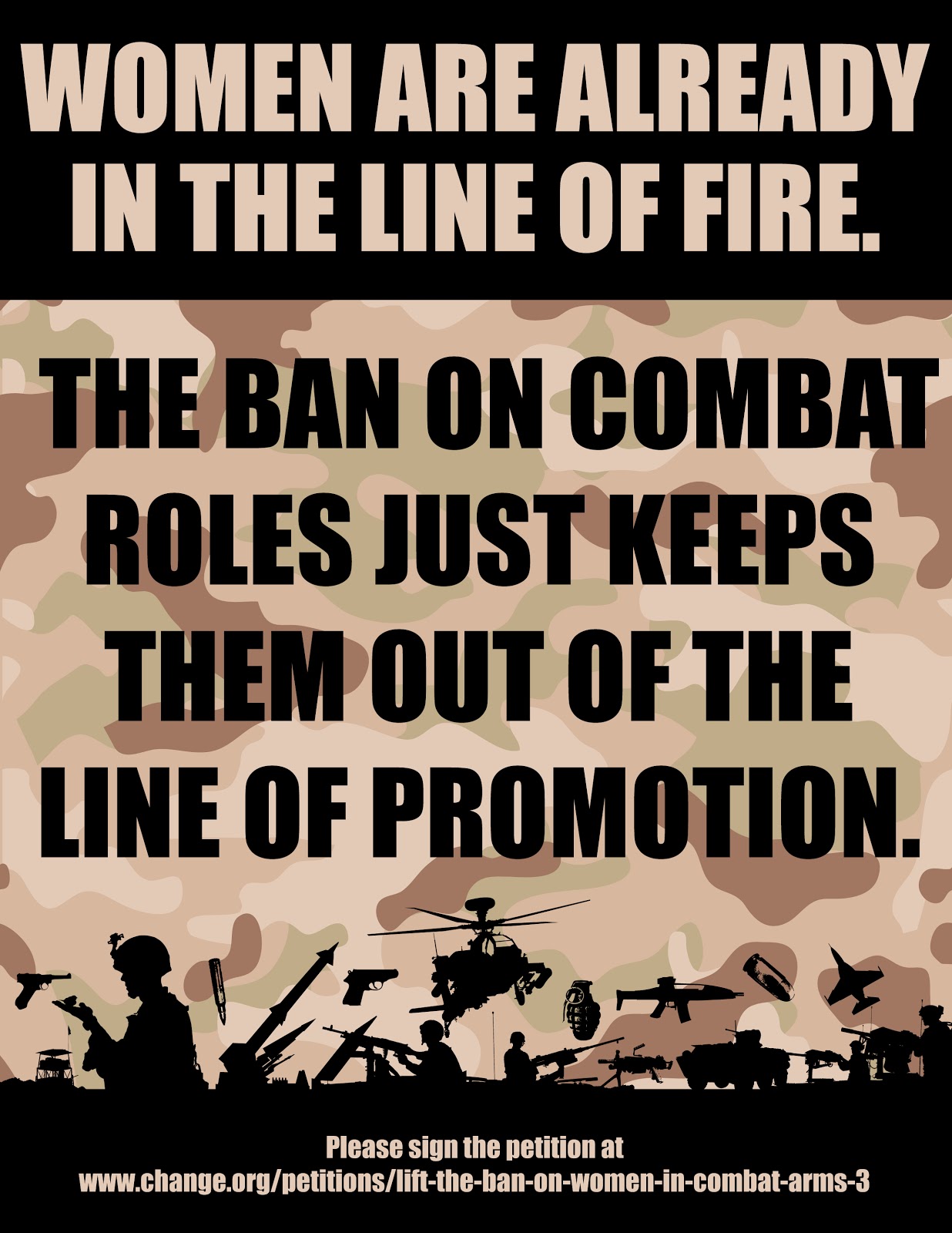
Women are now officially allowed in combat roles - on the front lines of the battle.

That's because the lines are changing - or, perhaps, blurring.

Truth is that women have long been "in harms way," laying down their lives for their country.

 Truth is that, active-duty female personnel make up roughly 15 percent -- or 207,308 members of the more than 1.4 million members -- of the armed forces.  Since 2001, 280,000 women have been deployed to Iraq and Afghanistan. Of that number, 152 women have been killed in combat in the two wars, and 946 were wounded, according to the latest Defense data.

Veterans such as U.S. Rep. Tammy Duckworth (D-IL) — the purple heart recipient and the first woman injured in combat to be elected to national office in November — applauded the move as a broadening of opportunities for women and said it will improve the nation's armed forces.

But several older veterans said most women are not physically strong enough to participate directly in combat.

To reassure them, Secretary of Defense, Leon Panetta, said,  "If members of our military can meet the qualifications for a job -- and let me be clear, we are not reducing qualifications -- then they should have the right to serve."

He says that like this is a new concept. 

General Dempsy said that the ban was a "technical correction" that, "may help stem sexual assault."

I get the first part. It is a "technical correction," especially in face of the facts about women serving in Afghanistan and Iraq. I honestly don't see the new rules stemming sexual assault.

The "corrective," I fear, doesn't get that "technical".

I'm not sure, exactly, what the good General means, except that I think it's important that he raised that particular flag. It's an admission of the truth that, while women have been keeping the country safe, the military has not done much to keep women safe.

That was an unintended, additional benefit of the announcement. 

I confess that I am decidedly ambivalent about women in combat. I confess that I don't understand why a woman - or, for that matter, a man - would want to be in combat. That being said, I support equal access to employment, even if it's work in the midst of combat.

Of course, the new order doesn't go into effect until January, 2016, but it will open up hundreds of thousands of jobs for women.

Although the Defense Department opened 14,325 jobs to women in May 2012, some 237,854 (roughly 19 percent) of the 1.2 million positions available throughout the military remained closed to women.

Of these, 53,000 are jobs for which women would qualify -- as medics or mechanics or intelligence specialists -- but for the fact that the openings are in combat units, such as special operations forces and small infantry units.

Another 184,000 jobs involve specialties, such as tank crewman, that have also been closed to women.

All these jobs will officially open up to women January 2016.

Women who qualify - mentally and physically.

The standards have not been lowered, the qualifications have not been reduced and the requirements have not changed. 

Because valor knows no gender.

Wednesday, January 23, 2013

We the people, bending the arc

Yes, I was privileged to be at the Inauguration of President Barack Obama and Vice President Joe Biden on Monday.

Yes, of course, I collected souvenirs: my ticket, my commemorative Metro pass, my "I was there!" button, a few pens to share with family, my refrigerator magnet, and my coffee mug. No T-shirt. Got too many of them, anyway.

Yes, the crowds were....well...crowded. Estimates are between 800,000 and one million. People. In one place.  The Metro was excellent in terms of moving people along. Trains ran about every 2-3 minutes.  The people, however, were very cooperative and polite and festive.

This was the second inauguration of Barack Obama. We were "Fired up! Ready to go!"

The diversity was amazing. Old and young. Mink coats and puff jackets. Tights and Hajibs. Weaves and pony tails. Beards and clean-shaven faces - no matter, mouths and faces were covered with scarfs. African, Afro-Caribbean, African-American, Native American, Asian American, Hispanic American, Caucasian, people from the Pacific Rim, Arab, Jews, Muslim, Christians, and every creed.

Waiting to enter the TSA Security Tent
Security, of course, was tight.  The National Guard, the Army, and the Boarder Patrol were everywhere. In uniform.

Roads were closed and there was a HUGE tent set up just before Constitution Ave. where we all had to have our tickets checked and empty our pockets, endure having our bags gone through, and walk through a metal detector.

And yes, we had to walk. And, walk. And, stand for a long while. And then walk again.

It didn't matter. We, the people, were on a journey. We were not about to let a cold day in DC stop us from celebrating our victory.

Yes, it was Very Cold on the Mall in Washington, DC, but there were several moments that so warmed my heart that I only realized just how brutal the temperature outside had been once I was back at the hotel, all warm and snug.

Bundled - and fired - up!
My heart first began to soar when Myrlie Evers-Williams gave the Invocation. Just seeing the widow of Medgar Evers asking "blessings upon our leaders, the president, vice president, members of Congress, all elected and appointed officials of the United States of America," brought tears to my eyes and a lump to my throat.

She prayed:
One hundred fifty years after the Emancipation Proclamation and 50 years after the March on Washington, we celebrate the spirit of our ancestors, which has allowed us to move from a nation of unborn hopes and a history of disenfranchised [votes] to today’s expression of a more perfect union. We ask, too, almighty that where our paths seem blanketed by [throngs] of oppression and riddle by pangs of despair we ask for your guidance toward the light of deliverance. And that the vision of those that came before us and dreamed of this day, that we recognize that their visions still inspire us.
Their visions still inspire us. Indeed, they do. If you needed any evidence of that, all you had to do was listen to President Obama's Inaugural Address.

If you didn't hear it on Monday morning, you can certainly read the transcript by clicking the link above, or you can even find a video of it and watch it for yourself.

I, myself, watched it on the Jumbotron - along with all of the people in my section, which was just behind the reflection pool. What I would have missed, had I stayed home and watched the whole thing on TV, was the reaction of "we the people".

I wish you could have seen the electricity in the crowd when President Obama said:
We, the people, declare today that the most evident of truths —- that all of us are created equal —- is the star that guides us still; just as it guided our forebears through Seneca Falls, and Selma, and Stonewall;
People all around me looked at each other to make sure we heard it right. Did he say, "Stonewall"? Really? Yes! Yes! He said, "Seneca Falls, and Selma, and Stonewall"!

Oh, my!

We were all still letting that soak in when we heard the President say:
Our journey is not complete until our gay brothers and sisters are treated like anyone else under the law —- (applause) -- for if we are truly created equal, then surely the love we commit to one another must be equal as well. (Applause.) 
People - from all races and creeds and ages and walks of life - were fist-bumping and hugging and laughing and hooting and crying.  The joy of the young people around me was especially palpable.

Yes, he also talked about immigration and voter suppression and women's rights. But, he not only said, "Stonewall". He said "gay brothers and sisters". And, he talked about our love being equal.

Oh. My. God!

It was then that I heard it. It was an unmistakable sound - one I'd heard only faintly before - but I instantly knew what it was.

With my chaperone, Doug Condit
It was in the sound of the words once spoken by Dr. Martin Luther King, Jr.

It was the sound captured in a vision that still inspires us. 

It was this: The sound of the arc of history bending toward justice. 

"The arc of history is long," said Dr. King, but it always bends toward justice."

Yes, we were watching history unfold and, in fact, participating in it, but we were also watching the future opening up in the same vision of freedom and justice for all that inspired the men and women who founded this nation.

And, we were being inspired, once again, to participate in the shaping of that vision for the future.

We. The People. 

It was a remarkable experience, and I feel so blessed to have been able to have been there to experience a piece of our history - and to catch a glimpse of a future in which we were all invited to participate and live with liberty and justice for all.

Yes, it was cold and yes, my feet and legs and back are still sore.

But my heart is still strangely warmed and my soul is still singing, "We the people."

Monday, January 21, 2013

Choose Life!


Walking With Love, Justice and Action
At the RCRC 40th Anniversary of Roe v. Wade
 Washington, DC – January 20, 2013
The Rev’d Dr. Elizabeth Kaeton

Note: These remarks were delivered at the RCRC (Religious Coalition for Reproductive Choice) Interfaith Service of "Blessing and Welcome for our friends in Congress, the returning Administration and their staffs" at the First Congregational United Church of Christ in Washington, DC.


Choose life.

That’s a religious mandate for many people of many different expressions of faith.

I don’t know about you, but I am sick and tired of being sick and tired of being clobbered by scripture.  I am sick unto death of having this particular piece of scripture used – by some folks – as a guilt trip when I explain to some that I work for reproductive justice.

“But, what about what scripture says?” they ask. You know, 'Choose LIFE'?”

I’ve made a New Year’s resolution to take back scripture from the misuse and abuse of people who choose to use it for their own purposes. So, what I’m about to offer are a few of my thoughts about “Choose Life” as I reflect on the 40th Anniversary of Roe v. Wade.

Choose life.  Choose what is good. Choose what is right. For you. For your life. 

In a very short, two-words sentence, we are asked to cherish the two great gifts of the human enterprise: Free will and the goodness of our creation.

“Choose life.” Not “Let someone else make the choice for you.” Not, “This is what life is and when it begins and how I define it for you.”

No, the directive is simply, “Choose life.” We are invited to discover the wonder and mystery and complexity of that simple sentence the rest of our whole lives.

Choose what gives you life. What enhances your life. What contributes to your life. For, in so doing, we contribute to the well being of the rest of the world.

Unfortunately, the ability for an individual – especially women – to define and decide what is good for their life is being limited by the definitions and decisions of others.

We have been in this place before.  

In June of 1969, a 21-year-old Texas woman named Norma McCorvey found herself pregnant for the third time. She had left home at the age of 14 and had lost custody of her first child to her mother and had placed her second child for adoption. She was living in Louisiana with her father and working several low-paying jobs.

She grew despondent and depressed and desperate as she began to understand that she would be unemployable as a young mother with a child and no support. Moving back to Texas seemed the only option left open to her. At least there she could claim she had been raped and be allowed to have an abortion. At least, that’s what her friends told her.

Due to lack of documentation and evidence of rape, her scheme did not work. She tried to obtain an illegal abortion at several clinics she and her friends knew, but found that the police had closed them down. The only other option was to seek out non-medical, non-professional “back alley” abortion – a procedure performed by persons either lacking the necessary skills or in an environment lacking the minimal medical standards or both.

It is important to know that, according to a 2002 study by Planned Parenthood, estimates of the annual number of illegal abortions in the United states during the 1950s and 1960s range from 200,00 to 1.2 million. During that same period of time, as many as 5,000 American women died annually as a direct result of unsafe abortions.

Indeed, Leslie Reagan chronicles many of these stories in her book, “When Abortion Was A Crime”. Women often tried to induce abortion or cause a miscarriage by throwing themselves down stairs or inflicting violence on themselves. They ingested, douched with or inserted into themselves a chilling variety of chemicals and toxins – from bleach to potassium permanganate to turpentine to gunpowder and whiskey. Knitting needles, crochet hooks, scissors and coat hangers were all tools used by women who had not choice but to resort to these means.

As Frederica Matthews-Green is quoted as saying, “No woman wants an abortion as she wants an ice cream cone or a Porsche. She wants an abortion as an animal caught in a trap wants to gnaw off its own leg.”

Every young woman, no matter her age, knew a story about a woman – a friend or a friend of the cousin of a distant relative – who had had an abortion. Rarely was the outcome good – which included either the death of the woman or her inability to conceive. Seeking to choose life for herself and her family, McCorvey did seek out legal assistance, turning to attorneys Linda Coffee and Sarah Weddington. Ultimately, she gave birth to the child three years before the U.S. Supreme Court finally heard the case.

On January 22, 1973, Roe (AKA Norma McCorvey) v. Wade (AKA Henry Wade, Dallas County DA) became an historical, landmark decision by the United States Supreme Court on the issue of abortion.  The Court ruled 7-2 that a right to privacy under the due process clause of the 14th Amendment extended to a woman’s decision to have an abortion, but that right must be balanced against the state’s two legitimate interests in regulating abortions: protecting prenatal life and protecting women’s health.

In the midst of the tension of these two concerns, the country was plunged into the midst of a passionate national debate which has hardly abated over the last 40 years.

Meanwhile, Norma McCorvey went on with her life, choosing to live quietly and privately with her long-time life partner, Connie Gonzales. In 1995, she was befriended by evangelical minister Flip Benham and was baptized by him in August of that year. She also publicly announced her remorse for her involvement in Roe v. Wade and became an advocate of Operation Rescue’s campaign to make abortion illegal.

She changed her mind. She made another choice. I still shake my head whenever I hear people who are opposed to abortion defend the change of her choice, claim that it is “a woman’s prerogative” to change her mind. They say this without any evidence of an awareness of the irony of that statement. 

Twenty-two years after Roe v. Wade, Norma McCorvey made a different choice about the life-altering choice of abortion.  She was able to make that choice because she was free – she had the civil and spiritual right – to make another choice. How ironic that her choice includes restricting the rights of others to Choose Life for themselves. 

I confess that the logic of that position completely escapes me. When former Alaskan Governor Sarah Palin discovered that the child she was carrying had Trisomy-21 – a condition formerly known as Down’s Syndrome – she reports that she briefly considered abortion, but then proudly states that she “chose life.”

Yes, she chose the life that was best for her, which included the choice to continue with her pregnancy. However, she and others like her seem not to understand that their choices do not include limiting the choices of other women to choose life for themselves in the way that is best defined for them.

Choose life. That’s why we’re here. That’s why we do this work. We choose to do this work because we want to guarantee that a woman has a choice about what happens to her body. We choose to do this work because we want to guarantee that a woman has a choice about what happens to her family. We choose to do this work because we want to insure that a woman has a choice about her own future. We choose to do this work because we know that what we do is life-giving to millions of women in this country and around the world.  Can somebody here give me an, “Amen”?

According to the World Health Organization, in countries where abortion remains unsafe it is the leading cause of maternal mortality, accounting for 78,000 of the 600,000 annual pregnancy-related deaths worldwide.

According to the Alan Guttmacher Instituted, approximately 219 women die worldwide each day from an unsafe abortion.  219. Women. Worldwide. Every. Day.

Six months after abortion was legalized in Guyana in 1995, admissions for septic and incomplete abortion dropped by 41%. One year after Romania legalized abortion in 1990, its abortion-related mortality fell from 142 to 47 deaths per 100,000 live births.

Legalization of abortion allows women to obtain timely abortions, thereby reducing the risk of complications. In 1970, one in four abortions in the United States took place after 13 weeks gestation. Today, according to the Guttmacher Institute, approximately 88-92% of all abortions in the US take place before the end of the first trimester.

To keep abortion safe and legal for women is to choose life. It is choosing life for women whose life choices are already limited by poverty, unemployment, substandard housing or homelessness, limited access to quality education and few quality health care options.

For those who would choose to reduce or limit the number of abortions, I ask that you consider this choice: Put down your placards and posters that carry grotesque images and dire scriptural judgments and warnings. Seek not to pass laws to make abortion illegal. 

Choose instead to change the reasons women have abortions. Work to end poverty. Work to improve education. Work to create jobs. Work to improve health care. Make these choices and you will improve the choices women have and reduce the need for abortion.

Work to repeal the Hyde Amendment which prevents the very women who need it most – women who live in desperate poverty like Norma McCorvey once did and have no support much less resources for themselves and their families – from attaining reproductive justice.

Work to make real the acceptance of contraception as a normal part of a woman’s preventative health care. (Can somebody PLEASE tell me why we are still having this conversation in the year 2013?)

Work to dismantle the underlying oppressive, interlocking systems of racism and sexism and heterosexisms, so that – to paraphrase the great words of Martin Luther King, Jr., whose spirit continues to guide us and lead us in all matters of justice – a woman’s life may be judged, not by the color of her skin or the contents of her uterus, but on the content of her character.

Choose to understand that, long before a collection of cells grows into and is born and takes that first breath of life and becomes a person, the pregnant woman in whose body those cells gathered and grew was and is a living person whose dignity and free will and civil rights must be respected.

Her life, her intelligence, her integrity, her ability to make choices for herself and her family, her status as a citizen of these United States must be respected, and her freedoms must not be denied.

The choice is really simple: Choose life.

We choose life when we choose to walk together in Love – respecting the dignity of every human being. 

We choose life when we choose to walk together in justice – insuring that the civil and spiritual and religious right of free will is protected and guaranteed for all.   

We choose life when we choose to walk together in action – moving ourselves out of our complacency and past our illusions of security.

Choose life, my sisters and brothers, that we may walk together as children of God. 

And let all God’s children say, “Amen.”

Thursday, January 03, 2013

Writer's Block

The irony has not escaped me that I am writing this blog about writer's block.

In case you haven't noticed, I have it. Writer's block, that is.

I understand that some of the contributing factors to writer's blog include stress, sickness, lack of sleep, overwhelmed by projects and deadlines, having lots of creative demands, and (speaking of irony) having to have something to write.

I understand professional writers and journalists get this from time to time. I'm neither. I don't have to write. I write because it keeps me sane, not to put food on the table.

I've not been unusually stressed, or ill (well, a few days of the sniffles). I've been getting my usual hours of sleep. And yes, we're in the middle of Christmastide. I think that counts for "being overwhelmed by projects and deadlines" as well as "having lots of creative demands".

Truth is, I have been writing. A lot. Well, journaling. Which is how most of my blogs begin anyway. It's just that this is really personal stuff - yes, even more than what I normally write about on this blog. I mean, I DO have some boundaries!

Most of it is sorting through some of the stuff I deal with as a Hospice Chaplain. No, I'm not overwhelmed by dealing daily with people who are dealing with dying and death.

If I'm overwhelmed about anything, it's the ability of the human spirit to soar as death approaches. Sometimes, it's the patient. Other times, it's a family member or the entire family.

I'm amazed - no, really amazed - at the capacity of the human spirit to forgive -  and/or hold grudges.  Sometimes, I've heard expressed - with the last few breaths of life - such pure love or pure rage that it takes my breath away.

And yes, you can have a 'peaceful death' taking your last breath while spewing out the name of a person who has hurt or betrayed you. Forgiveness? Yeah, well, that's nice, but, you know, it's not my death. Thankfully, no one has to live up to my expectations of what it means to have a "peaceful death" - and, I don't have to live up to anyone else's expectations.

Everyone has to walk their own path.

I figure it's none of the patient's concern if it's my need to have him/her leave this planet with everything all neat and tidy and wrapped up with a nice big bow.

Sometimes, it's a real tribute to real life if it isn't. We all come into this world naked, raw, messy and screaming. Some of us need to leave that way, too.

I'm astounded - no, really astounded - by the way words fail to describe some of the things I've witnessed. Words like "amazed". And "astounded". And, how "awful" can be "awesome".

The best way to do that is to tell the story - paint a word picture so you can see what I see and experience what I've experienced - and let you all be amazed and astounded.

I can't do that. Not without giving away too much information and jeopardizing the identities of my patients. I would be a bad chaplain - the worst - if I broke the sacred trust and confidentiality of the patients entrusted to my care even in the smallest way.

I've tried to write in generalities - like I'm doing right now - but I only get frustrated. I want so much to tell you about what I see and hear and feel. To let you into this part of the world.  To see how all the things we think are so important mean little or nothing - or, absolutely everything - when death begins to knock on your door.

Oh, I could write something that would be analytical and theological. With appropriate professional distance. Sanitized. Impersonal.

I'm just not in that place. My heart and my head and soul are still with my patients and their families.

How do you write about awe?

So, you understand my writer's block. Well, on this blog. I'm still writing. A lot. I just can't print it here in this public space.

For those of you who may have had or may one day get writer's block, I'm told there are things one can do.  Read more. Talk to creative people. Change your environment - get up and take a walk. Or, take a trip. Go to a place that gets your creative juices flowing: The ocean. The mountains. A lake. New York City. Or, you could drink coffee. Hi octane caffeinated. Or, take a nap.

I've been reading. A lot. I'm three-quarters of the way through "Team of Rivals" by Doris Kearns Goodwin. She is highly talented at drawing word sketches so thorough you can see the characters in front of you. I'm also fascinated by the way she treats the reports of homosexuality in that age and time. I've just finished reading "Proof of Heaven" and can't wait to start "Gone Girl", the breakthrough murder mystery novel by Gillian Flynn.

No, I'm not a murder-mystery fan, but I understand this one is so well written it's irresistible. So, I'm giving it a try. I mean, the NY Times review said this:
It is wily, mercurial, subtly layered and populated by characters so well imagined that they’re hard to part with — even if, as in Amy’s case, they are already departed.
See what I mean? 

When I'm not reading well-written books by highly skilled and talented authors, I am blessed to hang out with amazingly creative people - many of whom are in my own family.

Besides,  I'm going to be in New York the end of this month and North Carolina for a week in February.

This will lift. I'll be able to write here about other things. Or, I may find a creative way to write about what I've been seeing and feeling and doing.

Thanks for bearing with me through this time. 

I'm thinking it's not so much 'writer's block'.

It's more like ''writer's break'.