Come in! Come in!

"If you are a dreamer, come in. If you are a dreamer, a wisher, a liar, a Hope-er, a Pray-er, a Magic Bean buyer; if you're a pretender, come sit by my fire. For we have some flax-golden tales to spin. Come in! Come in!" -- Shel Silverstein

Thursday, April 16, 2020

Liturgy, Love, Questions & Pandemic

So, I've been meaning to write about this for a while now, but a question earlier today prompted me, like the Prophet Habakkuk, to sit down and "write it and make it plain."

For all of the Sundays in Lent and the days in Holy Week, I presided and preached at a service of Morning Prayer via Facebook Live. On Easter Day, I presided at a service of ante-Communion. This Sunday, the Second Sunday of Easter, I will return to Morning Prayer with Sermon. And, at the request of the bishop, I will be live-streaming all Sunday morning services and Wednesday evening Anglican Prayer with Anglican Prayer Beads from Christ Church, Milford's, Facebook page. 
I've been asked lots of questions - by laity and clergy - which include:
+ Why am I not presiding at Holy Eucharist?
+ Why ante-Communion or one of the Daily Offices? 
+ Aren't we a Eucharistic church? Isn't Eucharist at the center of our identity as Christians who are Episcopalian and Anglican? 
+ Aren't I concerned that people will want to "go back" to Morning Prayer and not Eucharist for the principal Sunday service of worship after the pandemic? 
+ Don't I know that there is this thing called "Spiritual Communion"?
And, my favorite question: 
Why should you, a priest, get compensated for something I, a layperson, can do?
That last question is my favorite because it is based on the assumptions that (1) only priests can preside at sacramental acts; (2) the only sacramental acts are those the church narrowly defines and controls; (3) there are not sacramental aspects of Scripture and Worship - that we only live our faith "by bread alone" - and that the true presence of Jesus is somehow absent apart from Eucharist.

(4) It is also based on the assumption that clergy, as leaders of and in community, function apart from the act of leading public worship; that their lives are not lives of prayer. And, we do it for the compensation.  
 
Nothing could be further from the truth - well, for the largest percentage of clergy, anyway.

The Presiding Bishop has written a short essay on his feelings about the matter. Here's the link. I encourage you to read it because I think it answers many of the questions I've been asked.

Here's where I am: I have decided not to preside at or partake of the elements of Eucharist until we can all be together again in one place and celebrate together as a community of faith.

Please do not hear that as anything other than what it is: This is an informed, carefully discerned, thoughtful, prayerful, theological position that is well with my soul. This is not a judgment on anyone who thinks differently. I hope those who hold other positions will not judge me for my position.

It really comes down to this: I am choosing to stand in solidarity and hunger and thirst with those who are also hungry and thirsty but do not have access to Eucharistic bread and wine.

I am choosing the sacramental nature of solidarity over the sacramental nature of bread and wine. I am choosing to break open Scripture so that we all might feed on and be nourished by The Word.

And, I am choosing to use my institutional and spiritual power in an attempt to empower the spiritual, sacramental and institutional lives of others during this time when incarnational presence as a worshiping community is not possible, all in one sacred place.

As I said, this is just me. I'm not arguing with anyone. I'm not judging anyone. 
 
You may think me wrong; that's okay with me. I've been in this position before with "Ashes to Go". I would be fine if the liturgy were done outside the church building. I don't like what I experience as separating the central liturgical act from the rest of the service of worship. 
 
I've been sharply criticized for it. So be it. 

Doesn't change the fact that Jesus loves me as well as those clergy who impose ashes at bus stops and bakeries and train stations. 

God knows what's in our hearts.

I also have an aversion to "Drive-by Eucharist/Distribution of Palms" and "Parking Lot Communion". 
 
It's not that I'm opposed to creativity or innovation. Some may remember that I'm the one who baptized a convert from Judaism in a hotel fountain during General Convention. And, some may also recall that I recently presided at a Civil Wedding via Zoom. 
 
Both of these liturgies were performed after careful thought and prayer and conversations with several bishops, priests, deacons and laity, some of whom were specialists in liturgy and church history. Neither liturgy was innovative and creative for the sake of innovation and creativity; rather it was with the utmost regard for the pastoral needs of the people and the tradition, rubrics, liturgy, and canons of the church. 

We made the decision over time and in community. 
 
It's important, as Anglicans, to be proactive vs reactive, which means praying and thinking things through, together, as a community of faith. 
 
I remember one woman, a priest who was first ordained a minister in another denomination and has never really embraced the Anglican Ethos, who decided, all on her own, to move the location of the baptismal font and ordered up a new "portable" baptismal bowl. 
 
She talked to a few folks about this novel (to her) idea that excited her. It's not that she was totally offbase. She wasn't, actually. What grieved me was that she totally missed the opportunity to educate the congregation (and, herself) about why we believe what we do and how that gets acted out in our liturgies. 

It became all about her and her insecurities and desperate need to be liked and her newly-found power to affect change on her own. It was very sad. 
 
And, the earth did not quake, the heavens did not fall, the stars remained in the sky, the planets are still in their orbits and I'm certain Jesus loves her every bit as much as He loves me. Maybe more.

Here's the thing: We Anglican/Episcopalians put the "common" (shared by, coming from, or done by more than one) in "common prayer". 
 
This is why I, for one, am so grateful that the bishop in this diocese has put a halt on liturgical creativity and innovation for the time being - until we can discern together liturgical adaptations not only for our present situation but how this honors our tradition and impacts our future.
 

What I love about this time in which there is not much to love is that it is given rise to so many questions. I love it that all assumptions are off the table and we are, once again, questioning why we do things and what we believe about what we do and say.

We like to say that Anglican liturgy is based on the principle of "lex orandi, lex credendi" (as we pray so we believe). We may have allowed ourselves to get a wee bit 'theologically flabby' over the years about thinking that through. This time of #stayathome and #shelteringinplace has provided us with time to more vigorously lift up and look under the foundations of our beliefs and the ways in which we pray what we say we believe.

There are two things I know to be true. The first is from Rainer Maria Rilke: 
"Be patient toward all that is unsolved in your heart and try to love the questions themselves, like locked rooms and like books that are now written in a very foreign tongue. Do not now seek the answers, which cannot be given you because you would not be able to live them. And the point is, to live everything.
And, the second, from St. Paul, is like unto it: 
"All things work together for the good for those who love God." (Romans 8:28).
In my moments of deep sadness about not being able to worship God together, I try to allow myself to think, instead, on the "new normal" that will emerge from the formerly empty tombs of our church buildings.

I'm remembering the words of the prayer we always say at the Great Vigil:
" . . . that which had grown old is being made new, and all things are being brought to their perfection through Jesus Christ."
May it be so.

Amen. Alleluia!

Sunday, April 12, 2020

For the Time Being

I have intentionally chosen this slightly irreverent but wonderfully humorous image for my FB banner to celebrate Easter.

I read somewhere that this is being called "The Easter of Empty Churches". It is also "The Passover of Empty Synagogues" and will be "The Ramadan of Empty Temples."

And yet, empty or not, Passover has happened and the Counting of the Omer has begun in earnest. it is still Easter, and Christ is risen. It will be Ramadan and the fasting and reflecting and prayers will continue as they have for centuries.

I know it is expected that religious folk will say something profound and meaningful about this pandemic. Something about the moral lessons we are learning because we clearly needed to learn them - that's why all this bad stuff is happening.

We are expected to say something that is a slightly more sophisticated version of how we've displeased Big Daddy or Big Mama in the Sky and so 'bad things happen to good people' who have just forgotten whose planet this is, anyway and that's why we can't have nice things.

Well, I got nothin'. Not anything that's deep or profound or even remotely meaningful.
Not today. Probably not tomorrow, either. Or, the day after that.

Here's what I got, which will amply demonstrate that I have a firm grasp on the obvious: This pandemic was caused by a virus. Viruses don't have intellect. Neither do they have reason. They do seem to have skill, however. They are quite skilled at what their evolutionary process has given them.
It is we who have intelligence and reason and skill to marshall those God-given gifts to tame this wild, invisible beast who has gotten out of control and doesn't have the capacity to understand whose planet this is, anyway.

Meanwhile, religious people will still observe the important dates on the calendar. The calendar is an interesting human invention that was created to give us some sense of control over this thing called 'time'. Which, by the way, is not at all linear, as the calendar and the clocks would have us believe.

The wonderful, delightful, irreverently humorous thing about the illusion of control of calendars and clocks is that Easter, of all religious observances is about God's message to us that time - or, rather, capital T. i. m. e. - is in God's hands. The Resurrection is about how our time as mortals is finite but God's time is infinite, and Jesus came to shatter our sense of control and open our minds to the limitlessness of the universe.

And so, I think at least a wee bit of irreverent humor and laughter is in order for this day.
Meister Eckhart is one of my favorite mystics. I've always loved what he says about laughter:
“When God laughs at the soul and the soul laughs back at God, the persons of the Trinity are begotten. When the Father laughs at the Son and the Son laughs back at the Father, that laughter gives pleasure, that pleasure gives joy, that joy gives love, and that love is the Holy Spirit.”

I think, if you drilled down to the center of the earth, the sound you would hear is laughter. And that laughter is there not because life is absurd but because we are. And our human absurdity gives enormous pleasure and joy to the One who created us in the most absurd of all human emotions: Love.

So, I think the greatest statement of faith we can make on this Easter of the Empty Churches is to laugh.

To laugh with a God who can not be destroyed by monstrous suffering, nor contained by stone graves.

To laugh with a God whose laughter can be heard in the joy of the jonquil and the color of tulips and the soft, subtle beauty of the willow.

To laugh with a God who absolutely melts in the delight of our inventions of calendars and clocks and other illusions of control and allows us to live out of and into our illusions with impunity.
To laugh with a God whose empty tomb taught us centuries ago about a lesson of God's fullness which we are still trying to understand.

To laugh with a God who is both timeless and timely, who is the very essence of the paradox of breath - two opposite truths, both inhale and exhale, without which we will most certainly die - which is wrapped in a conundrum and sealed in mystery.

So, my friends, my wish for you this Easter Day is that exquisite, unspeakable, unfathomable joy that the disciples first knew - Mary and "the other Mary" first among them - the joy of God and Jesus and Ruach who is laughing with sheer delight that maybe, just maybe THIS year - of all years - this year of the COVID-19 Pandemic, we will come closer to understanding the gift of Resurrection, and so more deeply cherish the gift of this one limited, finite yet eternal life.

At 10 AM this morning - well, it will be 10 AM where I am but it may be an hour or, perhaps two or even three hours different where you are, time being what it is - it will be my privilege to preside at a service of ante-Communion. My fast from Eucharist will continue until we can all be together again and all have a foretaste of the heavenly banquet.

The service will be broadcast on Facebook Live - in something called "real-time" which I'm sure makes Jesus giggle uncontrollably - over at Christ Church, Milford, DE's page. C'mon over and share in a little Easter joy!

Alleluia! The Lord is Risen!
The Lord is Risen, indeed! Alleluia!

The Easter of the Empty Churches


The Easter of the Empty Churches
Easter Day - April 12, 2020
Facebook Live Broadcast

I have to admit, the idea of empty churches at Easter has had me rather bummed.

"Glum". That's the word I've been using. Glum sort of captures the mood better than sad.

Churches are always at their most beautiful at Easter. The floors and the silver are always polished to a fare thee well, the white vestments and altar hangings with gold trim have been freshly cleaned and the folks who arrange the lilies and tulips, the lilacs and jonquils, the hyacinths and forsythia branches always outdo themselves.

I understand that some are calling this The Easter of Empty Churches. Apparently, it’s not ever happened before. Not during any of the other calamities or catastrophes like war and epidemics and natural disasters that have beset creation and its creatures. This year, churches around the world are as empty as the empty tomb on Easter Day – well, at least, for those who are wise.

Which got me to thinking about the empty tomb and how its emptiness filled up so many people’s lives. Indeed, that empty tomb started a worldwide movement known then as “The Way” and its adherents “The People of the Way”. Today, of course, that movement is known as Christianity, and the churches and its people are known as Christian.

So, this year, as I sat at the empty tomb with “Mary and the other Mary” and listened to the angel, I came with this question: How did so much fullness come out of emptiness? As I sat with that question, a memory – well, actually two memories – resurfaced for me.

One of my preaching classes was a joint effort between the Episcopal Divinity School, Harvard and Weston School of Theology. It was called “Ethical Themes for Relevant Preaching” and was taught by none other than Dr. Katie Geneva Cannon, a leading ethicist and one of the founders of Womanist Theology. A requirement of this very rigorous course was that we each had to preach at least once and be evaluated by our students.

I was terrified. I was not alone. At one of the breaks, as we commiserated with each other, one of the students from Harvard told a story that has come back to me a time or two.

He was an ordained Presbyterian minister who was working on his doctorate. When he was in seminary, before he was ordained, his homiletics course required that every student had to preach “on-demand” – in other words, the professor would read a passage from scripture and then point to a student and say, “Preach.”

The time came for one student to preach. Terrified, he got up from his seat, stood in front of the podium, took some deep breaths and then said, “Do you know what I’m going to say?” His classmates shook their head no.

And he said, “Neither do I. The service is ended go in peace.” And he sat down.

The professor wasn’t very happy, and said “I’ll give you another chance tomorrow.”

The very next day, the professor read another passage of scripture then pointed to the young man and said, “Preach.” The young man moved slowly to the podium, took a deep breath and said to the congregation, his fellow students, “Do you know what I’m going to say?” 

They all shook their heads ‘yes’. He looked at them and said, “Then, there’s no reason for me to tell you. The service is ended, go in peace.” And, he sat down again.

The professor was infuriated and he said, “Tomorrow is your last day at this seminary if you don’t preach the gospel.’

The next day came and, just like the day before, the professor read another section from scripture, looked at the young man and said “Preach.”

The young man made his way again to the pulpit, took a deep breath and said, “Do you know what I’m going to say?” And some of the students shook their head yes and others shook their head no.

And he said, “Okay, then. Those who know, tell those who don’t know.”

And the professor came up to the student and put his arm around him and said, “Today, the gospel has been proclaimed here.” Oh, and PS: That student got an A for the course.

Those who know tell those who don’t know. You know, that’s what good parents do. In a good congregation, that’s what makes them vital and alive. 

It’s not about the ordained. It’s about the priest and the deacons and the bishop empowering and equipping those who know to be able to tell those who don’t know. 

That’s what makes an excellent church school or adult education program. Those who know tell those who don’t know. That should be the largest line item in the church budget – Christian education and formation - right after mission and outreach.

That’s what we see happening in today’s gospel. (Matthew 28:1-10) Mary arrives at the tomb with the other Mary and finds it empty. She doesn’t know what is going on. But, an angel meets her there who says to her, “Do not be afraid. I know you’re looking for Jesus. He’s not here. He’s been raised.” 

He tells them to come and see that he’s not there.

And then, now that they know, he tells them to, “Go quickly and tell his disciples. They will see him in Galilee.” Those who know tell those who don’t know. And, their lives are changed.

The disciples meet the Risen Lord in Galilee and it changed their lives. From there they went out into the world and told what they knew to those who don’t know. And, lives are changed.

And, I think maybe, just maybe, this Easter of the Empty Churches and the sadness it makes us feel teaches us something about what Mary and the other Mary and the disciples felt when they saw the empty tomb.

I think what they know that they are teaching us today is that it’s not about the tomb or the building. It’s about the Resurrection. It’s about how we meet the Risen Lord in our lives today and how we tell the story of how our lives have been changed.

But mostly, it’s about making sure that what we know, we tell those who don’t know. 

Some people call this ‘evangelism’, but really, all it is is the irresistible, transforming power of the Resurrection.

We have the opportunity, this year, this Easter, to consider how the temporary emptiness of our church buildings might fill us with the same spirit, the same excitement, the same joy that Mary 'and the other Mary' and the disciples knew.

For that is the message of Easter: Christ is risen! For this movement called Christianity to continue, for the church to be healthy, those who know, must tell those who don’t know. 

Alleluia! Christ is risen!
The Lord is risen indeed! Alleluia!

Amen.

Friday, April 10, 2020

Live Broadcast: Stations of the Cross for Children and Their Families


Children and their families walk with Jesus


A word about the art: I took pictures of the Eight Stations of the Cross which we hang in the bays of the church. They were commissioned in 1984 by my predecessor, John Branson. The artist is a man named Carl Henry who was born in Baton Rouge but moved to Hartford, CT where he became, by an action of the Great Cosmic Comic, a parishioner at Trinity Church, Hartford Connecticut, where John Branson was then rector.

I understand these paintings were considered controversial in 1984. They remain controversial today, which is why we use them every other year. People either love or hate them, which, in my estimation, is the true testimony of art. I hope you enjoy them.

There is a note at the end about how this meditation came to be. You are free to use and adapt them. Proper attribution would be appreciated.


Stations of the Cross:
Children and Their Families Walk with Jesus

Introduction

Stations are places where people wait while they are going from one place to another. A school-bus stop is like a station. People wait at train stations or bus stations or airports.

Stations are also places where people take time to think about Jesus as he went to die on a cross. They are “Stations of the Cross.” They show us how much Jesus loved us.

We are about to walk the Stations of the Cross. People have done this for centuries in places all over the world. People who take a spiritual journey are often called ‘pilgrims’. We are pilgrims who are walking the Stations of the Cross, stopping briefly at each Station to look at Jesus and look into our own hearts.

Christian pilgrims everywhere join together on Good Friday to walk this Sacred Path. We walk the same path with Jesus, through the eight stations that are reported in the Gospels, to remember this part of the Sacred Story of Jesus with our whole minds and hearts, our whole souls and bodies.

You may want to think of these Stations at other times during the year. You do not have to think of all of the Stations of the Cross on one day. You may want to come back over this journey and stay at one Station with Jesus for a few moments before you move to another Station. Whatever you decide, Jesus is with you and he loves you.

Before we begin, let us pray:

Be with us, O God, as we walk the Way of the Cross. Help us to look at you and look into our hearts that we might find there the path to mercy and love, compassion, peace and truth. Help us to be better people in your world. In Jesus name we pray. Amen

All sing the first two verses of "Sing, my tongue, the glorious battle." 
Or  the first verse of "Were you there when they crucified my Lord?"


First Station: Jesus stands before Pontius Pilate


We adore you, O Christ, and we bless you:

Because by your holy cross you have redeemed the world.


Reading: Matthew 27:15-19, 20-24
Now at the festival the governor was accustomed to release a prisoner for the crowd, anyone whom they wanted. At that time they had a notorious prisoner, called Jesus Barabbas. So after they had gathered, Pilate said to them, “Whom do you want me to release for you, Jesus Barabbas or Jesus who is called the Messiah?” For he realized that it was out of jealousy that they had handed him over. Now the chief priests and the elders persuaded the crowds to ask for Barabbas and to have Jesus killed. The governor again said to them, “Which of the two do you want me to release for you?” And they said, “Barabbas.” Pilate said to them, “Then what should I do with Jesus who is called the Messiah?” All of them said, “Let him be crucified!” Then he asked, “Why, what evil has he done?” But they shouted all the more, “Let him be crucified!” So when Pilate saw that he could do nothing, but rather that a riot was beginning, he took some water and washed his hands before the crowd, saying, “I am innocent of this man’s blood; see to it yourselves.”
Look at Jesus

Jesus is standing before angry people who are yelling and saying mean, hurtful things to him. They scream at him. Some of them tell lies about him, saying that he did bad things.

But Jesus stays quiet, even though he knows that he will be hurt. He knows that God is with him. He even asks God to help him forgive the people who are yelling and telling lies about him.

Look at Your Heart

Has anyone ever said mean or hurtful things about you, or has anyone ever told a lie about you? If someone did that to you, look at your heart and see how you felt. Maybe you were scared, or hurt, or maybe you felt very angry.

When you see how you felt, show your heart to Jesus. See Jesus loving you when you show him what happens in your heart. Then, when you are ready, you can ask Jesus to help him make your heart more like his. Maybe you want to ask Jesus to help you to remember that God is always with you.

Holy God,
Holy and Mighty,
Holy Immortal One
Have mercy upon us.

Second Station: Soldiers make Jesus
carry a heavy cross


We adore you, O Christ, and we bless you:

Because by your holy cross you have redeemed the world.
Reading: Matthew 27:27-31
Then the soldiers of the governor took Jesus into the governor’s headquarters, and they gathered the whole cohort around him. They stripped him an dput a scarlet robe on him, and after twisting some thorns into a crown, they put it on his head. They put a reed in his right hand and knelt before him and mocked him, saying, “Hail, King of the Jews!” They spat on him, and took the reed and struck him on the head. After mocking him, they stripped him of the robe and put his own clothes on him. Them they led him away to crucify him.
Look at Jesus

When the soldiers put a big, heavy cross on Jesus' shoulders, Jesus doesn't fight with them or say angry words to them. He knows that he has to carry this cross a long way, and he knows that the way will be very hard for him at times. But Jesus knows that God is with him, and he asks God to help him to carry this cross, even though it is heavy.

Look at Your Heart

Have you ever had something happen that was very hard for you? Sometimes children are very sick, or someone in their family is very sick. Sometimes adults or older children do not treat younger children nicely. Sometimes we just can't have things the way we want them.

Take some time to look at what your heart is like when this happens. Then, when you see what your heart is like, show your heart to Jesus. See Jesus loving you when you show him what happens in your heart. When you are ready, you can ask Jesus to help make your heart more like his.

Holy God,
Holy and Mighty,
Holy Immortal One
Have mercy upon us.

All sing verse three of “Sing, my tongue the glorious battle”
Or, another verse or two of "Where you there?"

Third Station: A man named Simon helps Jesus carry his cross


We adore you, O Christ, and we bless you:

Because by your holy cross you have redeemed the world.


Reading: Matthew 27:32-34
As they went out, they came upon a man from Cyrene named Simon; they compelled this man to carry his corss. And when they came to a place called Golgotha (which means the Place of the Skull), they offered him wine to drink, mixed with gall; but when he tasted it, he would not drink it.


Look at Jesus

Jesus is so tired that the soldiers know he cannot carry the heavy cross by himself. So they look around and see someone who looks strong enough to help Jesus carry this cross. This person's name is Simon.

Jesus just looks at Simon and quietly whispers, “Thank you” to Simon. Then they continue on the long road, carrying the cross together.

Look at Your Heart

Sometimes helping someone can be difficult, for so many different reasons. Maybe you haven't finished something that you like to do, when someone asks you for help. Or maybe you just don't feel like helping that person.

Can you think of a time when you were asked to help someone and did not want to help? Show Jesus what it was like when that happened, and picture Jesus loving you as you show him your heart. Maybe you can even hear Jesus whisper, “Thank you for helping.” When you are ready, you can ask Jesus to help you to have a helping heart. (5)

Holy God,
Holy and Mighty,
Holy Immortal One
Have mercy upon us.


Fourth Station: Jesus meets women who are crying


We adore you, O Christ, and we bless you:

Because by your holy cross you have redeemed the world


Reading Luke: 23:27-31
A great number of the people followed him, and among them were women who were beating their breasts and wailing for him. But Jesus turned to them and said, “Daughters of Jerusalem, do not weep for me, but weep for yourselves and for your children. For the days are surely coming when they will say, ‘Blessed are the barren, and the wombs that never bore, and the breasts that never nursed.’ Then they will begin to say to the mountains, ‘Fall on us’; and to the hills, ‘Cover us.’ For if they do this when the wood is green, what will happen when it is dry?”

Look at Jesus

After Jesus gets up, he continues on the road carrying his heavy cross. He passes some women who are crying because they are so sad to see Jesus suffer.

But instead of thinking only of himself and how bad he feels, Jesus tells the women not to keep crying because of him. He tells them, instead, to take care of others, and especially to take care of their children.

Look at Your Heart

Sometimes it is easy to just think about ourselves -- about what is not going the way we want it, or about problems that we have. It is very hard, then, to think about other people. How does your heart look when you do that, when you think only about yourself?

Show your heart to Jesus, and picture Jesus loving you with your heart that way. When you are ready, can you ask Jesus to help you have a heart like his, a heart that thinks about other people and remembers other people? That’s the kind of heart Jesus has. (8)

Holy God,
Holy and Mighty,
Holy Immortal One
Have mercy upon us.

All sing verse 4 of “Sing, my tongue, the glorious battle.”
Or, another verse of "Where you there?"

Fifth Station: Jesus’ clothes are taken away


We adore you, O Christ, and we bless you:
Because by your holy cross you have redeemed the world.

Reading: John 19:23-25a

When the soldiers had crucified Jesus, they took his clothes and divided them into four parts, one for each soldier. They took his tunic; now the tunic was seamless, woven in one piece from the top. So they said to one another, “Let us not tear it, but cast lots for it to see who will get it.” This was to fulfill what the scripture says,
“They divided my clothes among
themselves,
and for my clothing they
cast lots. (Psalm 22:18)
And that is what the soldiers did.


Look at Jesus

Finally Jesus reaches the hill that is the end of the road he has to walk. Jesus knows that he will die here. But before he dies, the soldiers will do more to him. They pull off his long robe, and almost all his clothes are taken from him.

Jesus stands in front of the crowd with only a small piece of cloth covering part of his body. Jesus asks God to help him remember that he is not alone, that God is with him through all this.

Look at Your Heart

Is it hard for you to share or to give away something that you like? Do you sometimes like to keep everything for yourself? Do you ever let something of yours be the reason for bad feelings or bad words between you and someone else?

If you remember a time when something like this happened, remember how your heart felt. Then, show your heart to Jesus. You can ask Jesus to help you to have a heart that is like his heart. (10)

Holy God,
Holy and Mighty,
Holy Immortal One
Have mercy upon us.


Sixth Station: Jesus is nailed to the cross

We adore you, O Christ, and we bless you:

Because by your holy cross you have redeemed the world.


Reading: Luke 23:33-34a


When they came to the place that is called The Skull, they crucified Jesus there with the criminals, one on his right and one on his left. Then Jesus said, “Father, forgive them; for they do not know what they are doing.”
Look at Jesus

How much Jesus hurts as the soldiers nail him to the cross. He hurts all over; he is tired and thirsty; he knows that he is going to die. But he looks at the people who have hurt him and, instead of saying bad things to those people, Jesus asks God to forgive them.

He looks at his mother and tells her to take care of others. Even when he is dying, Jesus is thinking of other people.

Look at Your Heart


Can you think of a time when someone hurt you with unkind words or actions? Was it hard for you to forgive that person?

Jesus knows that forgiving is hard to do. That's why Jesus will help to change your heart when you ask him to help you to forgive someone. See how your heart looks after you ask Jesus to do this. (11)

Holy God,
Holy and Mighty,
Holy Immortal One
Have mercy upon us.

All sing verse 5 of “Sing, my tongue, the glorious battle.” 
Or, another verse of "Where you there?"

Seventh Station: Jesus dies on the cross

We adore you, O Christ, and we bless you:

Because by your holy cross you have redeemed the world.


Reading: John 19, 26, 30


When Jesus saw his mother and the disciple whom he loved standing beside her, he said to his mother, “Woman, here is your son.” When Jesus had received the wine, he said, “It is finished.” Then he bowed his head and gave up his spirit.”


A time of reverent silence is held.
Look at Jesus

Finally, after the long walk, after falling three times, after having the men beat him, after being nailed to the cross and suffering on the cross, Jesus bows his head and dies.

Now this part of his life is over. There is nothing left for Jesus to give or to do. Jesus has given his life for all of us.

Look at Your Heart


Did you ever feel that you wanted to make something better, or that if you only tried harder, something would change that you want to change? Or maybe you felt that you did not try hard enough at something, and something bad happened.

If you can think of a time like that, then show Jesus your heart, and let him love you. When you are ready, you can ask Jesus to help your heart be more like his heart. (12)

Holy God,
Holy and Mighty,
Holy Immortal One

Eighth Station: Jesus is buried

We adore you, O Christ, and we bless you:

Because by your holy cross you have redeemed the world.


Reading Matthew 27:57-61


When it was evening, there came a rich man from Arimathea, named Joseph, who was also a disciple of Jesus. He went to Pilate and asked for the body of Jesus; then Pilate ordered it to be given to him. So Joseph took the body and wrapped it in a clean linen cloth and laid it in his own new tomb, which he had hewn in the rock. He then rolled a great stone to the door of the tomb and went away. Mary Magdalene and the other Mary were there, sitting opposite the tomb.

Look at Jesus

Jesus’ friends wash his body and wrap it in a clean sheet. They touch his body gently, and then they put his body into a tomb. When they are finished, they push a very large stone over the entrance, so that no one can go inside.

Now there is darkness in the tomb where Jesus’ body lies, and all of his friends go home because they are very sad and tired.

Look at Your Heart


Can you remember a time when you were very sad to say “Good-bye” to someone? Maybe you were leaving the person for only a short time, or maybe it was for a long time. Maybe you said “Good-bye” to someone you loved when that person died.

Take a few moments to think about one of those times you were sad saying “Good-bye,” and show Jesus how your heart felt then. Try to picture Jesus loving you, and being with you with your sad heart. Let Jesus love you a lot; Jesus knows how sad your heart is. (14)

Holy God,
Holy and Mighty,
Holy Immortal One
Have mercy upon us.


Concluding Prayers before the Altar

Let us pray:

Holy God, we stand before your altar where, week after week, we celebrate the true presence of our Risen Lord. Help us always to remember that as a seed falls into the earth to die before it blooms to new life, Jesus is alive in a new way for us, bringing us to new life. When we look into our hearts, help us to find thanksgiving for the gifts you give to us, that we might become, more and more, the people you created us to be. Help us find you in our hearts and in the hearts of others, that together we may make the world a better place for everyone. We ask all these things in the name of Jesus, whose sacred body we are. Amen.

All sing verse 6 of “Sing, my tongue, the glorious battle.”
Or, the last verse of "Where you there?"

+++++++++++++++++++++++++++++++++++++++

About the Stations of the Cross

These Stations of the Cross, meditations and prayers were adapted by the Rev’d Dr. Elizabeth Kaeton, rwhen she was ector of The Episcopal Church of St. Paul, Chatham, NJ, from a work by Lucille Perrotta Castro, with consultation from Melissa Brandes, Linda Coogan, Brandon Dumas, Randy Johnson and Tim Wong, staff members at St. Paul.

They are designed to help children and families re-discover tradition of The Stations of the Cross and sacred hymns of the church for a new day and time in a personal walk with Jesus during Holy Week and throughout the year. It replaces the Service of the Word and the Reading of the Passion for the Traditional Good Friday Service. However, it can be used as a private meditation.

When this is used as part of the Good Friday liturgy, the verses of Hymn 166 “Sing My Tongue the Glorious Battle” (Or, "Where you there?" or any other appropriate hymn) are sung as the congregation moves to the first station.

© Elizabeth Kaeton 2009

Tuesday, April 07, 2020

Virtual Renewal


It happens this time every year, whether we need it or not.

If today is Tuesday in Holy Week, it must be time for the Annual Renewal of Ordination Vows.

In some places, it is known as The Chrism Mass. Or, The Mass of Chrism, depending on how obtuse or mysterious and therefore important those in charge want it to sound. 

Any other year, every priest in the diocese would get all gussied up in our clergy shirts and suits and schlepp off to the Cathedral - or the chapel at a "diocesan center"  or, perhaps, a church in the diocese with a Very Large sanctuary.

Generally, the festivities begin at 9-ish with a yummy but very unhealthy "Continental Breakfast" of an assortment of sugary pastries and the omnipresent, peripatetic bagels and cream cheese. 

And, coffee. Lots of coffee. And a few tea bags. And, sugar. And, chemical milk. 

We'll stand about in the Parish Hall in what always feels to me like the last vestige of the way 'the old boy network' used to work. Or, perhaps because there's this queasy feeling that this is a possible manifestation of clericalism, fueled by the low self-esteem or narcissism which often runs rampant in the ranks of the ordained. 

And, to be truthful, my most serious vocational crisis always comes when I'm in a room filled with other clergy. At some point, the following thought usually crosses my mind: "Dear Lord, what's a nice girl like me doing in a place like this?"

It's all "hail fellow, well met" when you know damn well that some of these boys are hanging on by threads. Six months from now, someone will have had a heart attack or their wife will have left them, or their church will have suffered a major financial loss that they knew was coming. 

Some of the women are also very adept at playing hardball with the boys. They are not, however, as adept at compartmentalization. 

Women rarely are. You can see it in their eyes, and the sadness that hangs about their shoulders like an old worn-out sweater. 

It may or may not have anything to do with their personal life. Mostly, they've just been listening to the stories and confessions of the people who have come into their office or the ones they've seen at home or hospital, in the living rooms of the Assisted Living Facilities or at the bedside of Extended Care Facilities. 

Some of us look around at the assembled and silently play the annual game of "Who is the healthiest neurotic in the room?" I mean, other than me. Because, if you aren't neurotic when you started the ordination process, it won't take too many years later of living into what John Snow called "The Impossible Vocation" to get tossed right onto your kiester by the impossibilities of it all. 

After that, it's just a short, slippery slope into neurosis. Some of us pick ourselves up, dust ourselves off, and try to maintain a healthy balance between living into the Gospel promises with confidence and living into the fear of being discovered an imposter. 

Some of us do that quite well, actually. There are always those clergy in the diocese who can't help but stand out as shining examples of everything you understand the priesthood to be. Their vocation is just obvious - in a marvelously understated way - whether or not they are in clerical collar. 

They help me to remember just why it is I do this work - even though some will insist on the Church Pension Group's definition of "active" vs "retired" clergy. 

I hate it. Not the designation as "retired" clergy. I earned that status, damn it, and I'll take my paltry monthly pension, thank you very much, and then do the work I love to do. No, it's the assumption that, as someone who thankfully retired from parochial ministry, I'm no longer "active". 

Truth is, I more "active" these days than many days when I was a full-time rector of a suburban congregation with a staff of eight. I know many clergy who are "retired" who are in the very same situation. Many of them work harder than they did when they were "active" because the combined income of their pensions and social security payments are not sufficient to keep body and soul together, much less food on the table. 

No one talks about that, though. You can see it, bubbling there under the surface of the very surface conversations and chatter that fill the room.

But mostly at these gatherings, among this august body of clerics, breathing in the air thick with what one clergy colleague called "priest-osterone'" it will be, "Fine. Fine. Doin' just fine. Great to see you. Call me, we'll have to have coffee or lunch and catch up."

And, we never will, of course.

I think that's the saddest part of the day.  

And then, the possibilities of the rest of the morning vary from bishop to bishop and year to year. 

Sometimes, there's a bible study or "topic of conversation". 

Other times, the bishop will use the time to "pontificate" - as a pontif is o'ft wont to do - on his (usually his) thoughts on a particular theological matter or diocesan goals for the year. 

And then, it will be off to the church to renew our vows and celebrate Eucharist. The Oils of Chrism for anointing and healing will be blessed and then distributed. Lunch will be served. More polite conversation will be had. And then, it will be home again, home again, jiggidy-jig. 

What would I like to see? Why, I thought you'd never ask!

I'd love us to gather in silence, a time of contemplation on the past year. I'd love for us to make silent confession for all the things "done and left undone". I'd love for us to have an opportunity to rejoice at the things we've been able to accomplish, even through adversity.

I'd love for us to then arise and wash each other's feet - led by the bishop, of course, who models the behavior by having his feet washed.

Then, we'd celebrate Eucharist together, to be fed so that we can feed and blessed so that we can bless.

Then, we'd arise again and take to the streets to do some corporal act of mercy: Perhaps make some sandwiches and assemble a lunch bag to distribute to the neighborhood needy. Or, make and serve the regularly scheduled hot lunch for those in need. 

If there are too many of us for that, perhaps we could help sort clothing at a local Thrift Shop. Or, distribute those bag lunches to the neighborhood needy. Or, help out for an hour at the local Boys/Girls Club or YM/WCA. Or, do some yard work around the diocesan center or Cathedral. 

And then, we'd gather back at the Diocesan Center/Parish Hall and share a meal together and talk about all the things we saw and did. Maybe get a blessing from the bishop. Pick up our vials of blessed oil. Go back to our churches or places of ministry renewed for ministry.

Something like that. Anything other than the "talking heads" approach to renewing our sacred vows.

Honestly? I don't know why I do it every year. 

But, I can't ever seem to stay away. 

Even this year.

Today will be different. Very. Different. Today, we'll be renewing our Ordination Vows via Zoom Conference Call. That means it looks like we'll just cut to the chase and join in - as best we can using the "miracles of modern technology" - and participate in The Chrism Mass. 

We've all been mailed a service bulletin, although we've been told that will still need our BCP. 

So, why do I do this, every year?

Perhaps I'm simply a creature of habit. Perhaps I have more loyalty than intellect. Perhaps I'm still "the best little girl in the whole world" I was brought up to be and simply do what's expected of me (stop laughing).

Perhaps it is because the liturgy and ritual are powerful enough, in and of themselves, to be compelling. Something happens when we gather together to break bread - even "virtually" - from a distance. Something that is more powerful than our most passionately held assumptions and biases. Something that is transformative - even if only subtly, gently - that renews the spirit despite our resistance.

Perhaps enough of all that is true, and maybe, just maybe, enough good happens, once a year, to make me go back again. And, again.

Besides, it's only once a year.

Every Tuesday in Holy Week, whether we need it or not.

Sigh!

As my sainted grandmother - she who I accompanied on our daily morning walk to Eucharist - would say, "Oh, the things we do for Jesus."

Whether He needs it or not.

Sunday, April 05, 2020

Passion, Palms and Belief

A Sermon for Palm Sunday - The Sunday of The Passion
April 5, 2020
Broadcast on Facebook Live


What does it take for you to believe? Why do you believe what you believe?

Whenever I read Matthew’saccount of the Passion, I find myself asking that question of every single character. From the governor to the people in the crowd; the two bandits crucified with him, and the bystanders and the centurion, Matthew describes each on as not just disbelieving but some are sarcastic, some are mean, others are cruel.

The people of Jerusalem greeted Jesus with shouts of Hosanna! They believed him to be the Messiah, the Savior, but not of their souls. They believed he was coming to save them from Roman occupation and oppression. When they saw that he was not able to save himself, they no longer believed what they wanted to believe and their excitement and fervor turned cold and cruel.

It’s hard to know what to believe when things are happening quickly. It’s even more difficult to know what to believe when what’s happening involves suffering and death. And, when it’s not the message you want to believe, or have come to expect, the sense of disbelief can lead to a sense of disorientation.

We see that dynamic over and over again in Matthew’s narrative of the Passion. It’s a very human response, unlimited and unencumbered by culture or class, religion or creed, race or ethnicity. We recognize it because we have seen it in our own lives – especially in the past few weeks of the COVID-19 pandemic.

I don’t know about you but not being able to be together for Palm Sunday and Holy Week is not just devastating it is disorienting. This week known as Holy Week is one of my spiritual and emotional anchors. Without all the familiar readings, all the familiar rituals and sacred ceremonies, well, it has not been well with my soul.

I have found myself re-examining why I believe what I believe. Is it just a force of habit? A convenience? Just the way I’ve always done it? Or, do I really believe the stories that have given shape and form to my faith?

I am learning that my faith is strong enough to carry me through these strange days of “social distancing” and worship outside of the church building. Indeed, I’m discovering that my faith is strong enough to risk doing something creative in order to give a new, different liturgical expression to the stories that are the foundation of my faith.

I have come to believe that we will emerge from this terrible time of anxiety and fear, suffering and death with a stronger faith, and a deeper appreciation for the stories upon which our faith is built.

I’m remembering a less stressful time when I first learned this. It was my first year as a Chaplain at Lowell in MA. Palm Sunday and Holy Week coincided with Spring Break that year. I didn’t think any students would come to a special afternoon service I was holding on Palm Sunday, but I gathered up some palms and sat in my office, promising myself that I would wait no more than 20 minutes and then lock up and head home.

His name was James. He actually came in 5 minutes early. Alone. So, he and I decided to read the Passion not in parts, but alternating paragraphs, which made sense. When we began to read about the scourging, his voice got thick and his pace slowed. Finally, he stopped. When I looked up at him, he had tears streaming down his face.

“I never knew,” he sobbed. “I’ve heard this story in church but never realized. . . until I read it for myself . . . until I walked in his suffering with him . . . and took the story not just in my head but into my heart . . . . This . . .,” he said, “This.. . . Changes.. . . Everything.”

Palm Sunday is also known as The Sunday of the Passion. When we walk in the ways of Christ’s suffering, when we take it into our hearts, it is transformative. Our lives change. We are never again the same. By entering more deeply into the suffering of Jesus, we share more fully in his resurrection.

There’s an old saying that faith isn’t faith until it’s all you’re holding onto. It’s in times such as these that the truth of that aphorism is revealed.

I hope you are able to explore the sense of disconnection and disorientation and find new ways to understand the bond and bearings of your faith.

I hope you take this time of separation from the church building and our friends in our faith communities to read again, for yourselves, the story of the Passion of Jesus. I hope you are able to hear the story in a new way, without listening to someone else tell it to you.

As you read Matthew’s narrative of the Passion of Jesus and watch the very human drama unfold in ancient times, I hope you take this time to ask yourselves, “What do I believe? Why do I believe what I believe?”

May we all come through this most Holy Week changed and transformed and never again the same.

Amen.
 

Wednesday, April 01, 2020

Anglican Prayer Beads: Celtic Prayer

Anglican Prayer Beads with Celtic Prayers from John Newell.

Week of Lent V - April 1, 2020


Sunday, March 29, 2020

Magic and Miracles

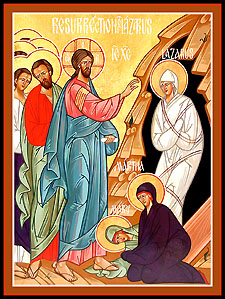
Russian Icon

Magic and Miracles
Lent V - Lazarus Sunday - March 28, 2020
Morning Prayer on Facebook Live

“Unbind him and let him go.” (John 11:1-45)

When our kids were little, they heard the story of Lazarus in church and were absolutely enthralled by it. I'm not sure why, but I think, to a child's mind, it was closer to hearing about a Zombie in church than they imagined possible. 

I remember one occasion, the fifth Sunday in Lent, when the kids came home from church and, after lunch, re-enacted the story in our living room.

They slightly adapted their ‘sofa fort’ for the performance. Now, if you don’t know what a ‘sofa fort’ is, you might want to learn. It’s a great place to sit while you shut out the rest of the world and, perhaps, read a book or listen to music, or take a nap.

One way is to take all the pillows off the couch – back and bottom – to form a structure. Or, you can take two chairs from the kitchen and put them on either end of the sofa. Then throw a large, preferably king sized sheet or blanket over the sofa and chairs and, voila! You have a sofa fort.

In our kid’s version, one of them was chosen by short straw lottery to be Lazarus and got all bound up with another sheet and had to lie in the sofa fort.  As I remember it, there was a scene where Jesus came in and the ones who played Mary and Martha were quite adept at wailing loudly.

At the appointed time, Jesus stood in front of the sofa fort . . . I mean tomb. . . and yelled, very loudly, “Abracadabra!” 

I winced and considered whispering the appropriate words but, before I could muster the courage, two of the kids whooshed off the blanket with great dramatic flare and panache and helped the little pint-sized Lazarus stand upright and emerge from the . . . er, um . . . tomb.

And then Jesus yelled, “Man, do you stink! Take that stinkin’ sheet off him!” And, they did and then everyone yelled, “Hooray!” and “Welcome back!” and they applauded and then took great deep bows.

I did try to tell them that what Jesus actually said was, “Lazarus, come out!” and not “Abracadabra!” and, “Unbind him and let him go!” and not “Take that stinkin’ sheet off him,” but they weren’t buying it. They insisted that what we heard in the gospel lessons was the ‘cleaned up’ adult version and what they were saying was closer to the truth.

I let it go, figuring that, when they got older, we’d have a conversation about antiquity and modernity and the difference between magic and miracles.

These days, these past three weeks, have sometimes seemed like a scene out of antiquity, hasn’t it? So many things we’ve taken for granted have been taken from us. Simple things, like: 

Having coffee with a friend at a café, Meeting someone at the diner for lunch. Going to the movies. Heck, going to work! Shopping for a special something for Easter Day. Easter Day. Actually, the whole of Holy Week and Easter Day.

We’d love nothing more than for someone to wave their arms around and say, ‘Abracadabra!’ and roll the heavy stone of this COVID-19 virus and quarantine and – just like that – make this whole pandemic go away.

That’s the difference between magic and miracles. As we grow older and mature, we come to know that there really isn’t much magic to magic. It’s a matter of convincing the observer or participant that the person – known as the magician – has harnessed supernatural forces to make impossible things happen. 

Sometimes, good things. Sometimes, not so good things.

A miracle, on the other hand, is defined as “a surprising and welcome event that is not explicable by natural or scientific laws and is therefore considered to be the work of a divine agency.”

Here’s a very shorthand difference: Magic points to YOU. Miracles point to GOD.

There’s a great deal of magical thinking in these days of the pandemic. I don’t know about you but my email and Facebook messenger and other Social Media feeds are filled with easy answers to get rid of the complicated and confounding new virus. The effects of COVID-19 is much like one of the plagues we read about in scripture and history.

The logic of modern magical thinking goes something like this: COVID-19 came about in the midst of the cold of winter, therefore, COVID-19 must hate heat. So, the best way to not get COVID-19 is to stay out in the sun or move to a sunny, hot climate. One of my friends says he’s gotten invitations from his friends in Africa to come and stay with them. Or, if you can’t travel, one should just sip hot liquids every 15 minutes.

Except, of course, people in Florida and Louisiana have very high rates of COVID-19 infection and the infection and death rates in Africa are, unfortunately, exploding.

Magic points to YOU. Miracles point to GOD.

There are three things about this story of Lazarus that always strike me. The first is that Jesus asked the people to roll away the stone that was covering the tomb. Now, had he wanted, Jesus could have moved that stone all by himself. And, that would have been impressive. Magical, in fact.

He could have just waved his arms and shouted “Abracadabra!” Instead, Jesus asks for the stone to be rolled away. It takes several very strong people to do that.

Secondly, Jesus calls to Lazarus to come out. Ever wonder why Lazarus didn’t just hear the stone rolling away (I would have made lots of noise), and see daylight come into the tomb and get up and start walking out on his own? No, actually, Jesus calls him out.

Finally, once Lazarus is out of the tomb, Jesus calls to the people, “Unbind him and let him go.” Now, a good magician would have already had two scantily clad women come out from behind the tomb, each taking part of the stinky rags that bound him, and, with great dramatic flare and no small amount of panache, whirled him out of his burial cloth. Ta da! Instead, Jesus again asked the people for their help, their participation in the miracle.

I think there are three very important lessons we can learn from this ancient miracle story that we can apply in this time of pandemic.

First, we are all going to have to do some heavy lifting. Each and every one of us is a participant in the story that will be told about this pandemic. We're all going to have to roll the stones away that keep us bound in anxiety and fear.

Governor Cuomo of New York has said that each one of us is a first responder. By that, he means that each one of us can help “flatten the curve” of the incidences of infection and disease by staying home, practicing “social distancing,” washing our hands – and, well, you know the rest of the drill.  Be a first-responder in this pandemic. It's not easy, but #Stayhome.

Second, there is a spiritual vocational aspect of these days of pandemic. I believe we are being called by Jesus, out of the tombs of the parts of our faith which have died and into the Light of the Gospel.

Our vocation is to call on our families, friends and neighbors to see how they are doing, if they need anything; to check in on the kids and make sure they are being fed; to stretch ourselves and learn new ways to stay in touch – like this Facebook live way of being in worship together.

This is a call from Jesus to us, “Come out!” of the darkness of our old, ingrained ways of thinking. Come out into the daylight of compassion and care. Come out into the new light of critical thought and use your creativity and imagination to do good, to be kind, to bring justice and peace.

Finally, Jesus is asking us to participate in the miracle of healing. Indeed, I would go so far as to risk blasphemy and say that the miracle is incomplete without the help of the community. Jesus heals, but it is our hands that care for the one who has been healed. The miracle can still be bound in the shroud of death. We are called to unbind the miracle and make it known.

Just as Jesus required the participation of the whole community in the miracle he performed, so, too, are we all required to participate in the healing of the nation, the healing of the world, from the effects of this pandemic.

We all have work to do. It’s not magic. But, it is a miracle. That’s because, ultimately, this does not point to YOU or ME or US. The healing of this pandemic points to God.

So, here’s my thought for whatever time that lies in front of us until this ends. Build a sofa fort

Just a little bit of whimsy in the middle of your home where you can go alone or with your partner or spouse or the kids. 

Turn the TV off and take turns in it, or pile the whole family in, just for a session of tickles and giggles.

Make it a ‘safe place’ where you can retreat from time to time. Where you can, as my aunts used to say, “Take a load off.” Take a breath. 

Whether a soft fort or not, create a safe place where you can stimulate your brain cells that have been temporarily suspended by the free-floating anxiety in the air. A place where you can fire your imagination and set loose your creativity and ability to play well with others and do good for others.

Create in your home a place where you can take some time away from the fretting and anxiety and pray and listen to what God might be calling you to do.

For I believe we each have been placed here, unlikely a choice as we are – just as Esther was – for such a time as this. So, listen to Jesus. Unbind yourself and let yourself go deeper into the miracles that await us. 

For I believe that we will emerge from the tomb of this pandemic changed and transformed and will never again be the same, with new life and a new vision for a new world.

Amen.