Come in! Come in!

"If you are a dreamer, come in. If you are a dreamer, a wisher, a liar, a Hope-er, a Pray-er, a Magic Bean buyer; if you're a pretender, come sit by my fire. For we have some flax-golden tales to spin. Come in! Come in!" -- Shel Silverstein

Sunday, September 07, 2014

What you say to one another is eternal.


Pentecost 18A – September 7, 2014 
St. George’s Chapel, Harbeson, DE
(the Rev’d Dr) Elizabeth Kaeton 
Track 1

Exodus 12:1-14

Psalm 149

Romans 13:8-14

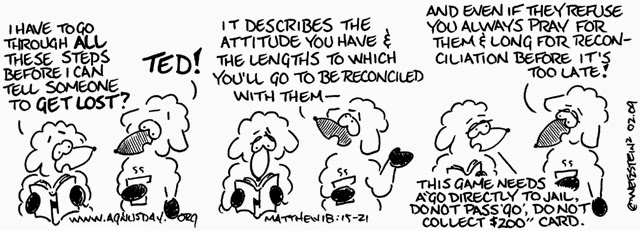
Matthew 18:15-20


So, let me put this morning’s gospel into context for you.

Jesus and his disciples have been traveling all over Israel. They’ve been up to the very northern part of the country, way up in Caesarea Philippi – an area known for pagan worship where, interestingly enough, Peter made his confession that he thought Jesus was the Messiah (we heard that story last Sunday). It's also where Jesus took a few of the disciples alone to a mountain top and he was Transfigured.

After that, they returned south to the region of Galilee, stopping at Capernum. All along, Jesus is teaching his disciples by parable and ‘ground rules’, about what it means to be his disciple.

They are now back in Judea, making their way beyond the Jordan, on their way to Jerusalem, and Jesus gives them the ground rules for resolving conflicts among church members.  This is so important to hear, I want you to listen to this passage again, this time in Eugene Petersen’s translation which we find in The Message:
Matthew 18:15-20 (The Message)

   15 "If a fellow believer hurts you, go and tell him—work it out between the two of you. If he listens, you've made a friend. 16 If he won't listen, take one or two others along so that the presence of witnesses will keep things honest, and try again. 17 If he still won't listen, tell the church. If he won't listen to the church, you'll have to start over from scratch, confront him with the need for repentance, and offer again God's forgiving love.

   18 "Take this most seriously: A yes on earth is yes in heaven; a no on earth is no in heaven. What you say to one another is eternal. I mean this. 19 When two of you get together on anything at all on earth and make a prayer of it, my Father in heaven goes into action. 20 And when two or three of you are together because of me, you can be sure that I'll be there."
So, this passage is important because it provides the ground rules for resolving conflicts among members of the same community of faith. The Body of Christ. The Church.

Wait a minute! Hang on!  Church members have conflicts?!?!

Get out of town! Church members don’t’ have conflicts! Right? That’s just for people on Soap Operas or SitComs or Reality TV like The Kardashians, or the Atlanta or New Jersey or LA (or wherever) Housewives, right?

Any actual, true, followers of Jesus have so much love in their heart and peace like a river flowing in their soul and the sweet song of Kumbya on their lips that there are no conflicts in church!!! 

There's no conflict in church, just like there’s no crying in baseball!!!

Right?

Ahem! WRONG! (Especially if you're a Red Sox fan but we'll talk about that later.)

For some reason, people - even people in the church - think that following Jesus is easy.

Everything Jesus ever taught is easily understood by one and all; easily agreed on by one and all; and all the consequences and specific actions are easily followed by one and all. Right?

And our individuality is washed away at baptism and we leave our intelligence on the church steps and we all think alike and act alike and walk alike and talk alike and become cookie cutter clones of one another.  Right?

Ahem! Not so! Well, maybe in a cult somewhere, but clearly not in The Episcopal Church..

Here’s a newsflash: Real churches have - or should have, actually - real conflicts.

Partly these will arise from individual human faults and failings that need to be confronted for the sake of the well-being of the community.

And partly these will arise from good people simply disagreeing about exactly what following Jesus requires of them in their particular context.

The only real harm that will come to a church community is to refuse to deal with conflicts.

UMC pastor and writer David Ewart writes “Conflicts do not kill churches. Refusing to deal with conflict kills churches. And, in fact, Jesus knows this, and gives specific instructions for dealing with conflict and offensive behavior - including telling members to leave as a last resort.”

This is an especially important ground rule because, as I mentioned, Jesus is coming from the northern parts of Israel down to Judea on his way to Jerusalem. And, we know what is going to happen in Jerusalem, right? There will be conflict of major proportion. Indeed, the disciples will squabble amongst themselves and abandon Jesus in his hour of need, Judas will betray him and Peter, who we heard last week confess Jesus as Messiah will deny him, not once, but three times.

Jesus will be charged with blasphemy by the religious leaders of his day and trumped up charges of treason by the political leaders of his day. He will be beaten, mocked and tortured, paraded through the streets of Jerusalem while being whipped and made to carry the cross on which he will be crucified and on which he will die.

Conflict? In the church? The Body of Christ? 

It’s in our DNA.

As Pastor Ewart says, “Conflicts do not kill churches. Refusing to deal with conflict kills churches.”

As many of you know, I’m a Hospice Chaplain. When someone asks me what I do, I often find myself offering a list of activities.

Well, I have lots of patients - most, actually - who aren't Christians, or who disavow themselves of any denomination or set of beliefs. Lots of "former Roman Catholics". Or, "Well, I was baptized in a non denominational evangelical church and I love the Lord, but I don't go to any church."

And, why is that so? Mostly they've left the church because - you guessed it - conflict.

What I hear myself say for those who are Christians, and for those who request them, is that I administer the sacraments, I anoint dying persons and hold prayer vigils at their bedside with family members.

But, you know, I have found that, for lots of Christians – even some who have gone to church all their life, including some Episcopalians – it’s not the “activities” of the church – the sacraments and anointing or even the prayers, that bring comfort and lead them to a peaceful death.

I have found that what people want most – for themselves and for others – is precisely what Jesus is talking about this morning. It’s all about forgiveness and reconciliation. 

Dr. Ira Byock, in his book, “Dying Well," writes that there are five key things that people need to say before they die. They are:
I love you.

Please forgive me.

I forgive you.

Thank you.

Goodbye.

Saying “I love you,” is, not surprisingly, the easy part for most people. Which is good, because that’s an important place to begin. It’s the next two – the, “Please forgive me” and the “I forgive you,” – that often provide the most difficult terrain and landscape to travel in the last days of our earthly journey. They are important, however, if a person – the one with the terminal illness, is, as well as the people who are left behind are – to get to a place of gratitude for what has been in order to find the strength and courage to say “Goodbye”.

Last year, I was visiting a patient, an elderly man with cancer, who was very near death. He had stopped eating and was sleeping a great deal, but was having moments of being awake and alert. His wife had called me because, she said, her husband wanted to talk with me and it seemed important.

When I arrived, he had been sleeping, but, after a few moments, he was awake and smiling. He asked his wife if he could have a cup of tea – and one for the chaplain and you, please. His wife smiled at me sadly, knowingly. Clearly, whatever the man wanted to tell me, he didn’t want his wife to hear. She left the room quietly, and I could hear her putting the kettle on and fixing a tray with the tea pot and china.

The man looked at me and said, “I want you to promise me something.”

I smiled and said, ‘You know, I learned long ago never to make promises I know I can’t keep. So, why don’t you tell me what you need to tell me and I’ll let you know if I can promise it.”

“Well,” he said, “I want you to tell my wife that I’m sorry. I’m so very sorry. You see, about 25 years ago, I had an affair with someone in my office. My wife never knew about it. It didn’t last long. It was just . . .something stupid . .. .but, I’ve felt guilty about it all these years and I want to tell her how very sorry I am that I did that and betrayed her and my marriage vows to her.”

I looked at him sadly and said, “You know, that’s not my story to tell your wife. It’s not my confession. It’s not my place to ask her for her forgiveness for you. You still have time to tell her and ask for her forgiveness. But, you know, I suspect that, if she knew of your affair, she already has forgiven you. She obviously loves you and has taken such very good care of you these past few months. That wouldn't have happened if she were hurt or feeling betrayed.”

“Do you really think so?” he asked.

“From what I've come to know about your wife, she's a very loving, very forgiving woman,” I answered, “But you really need to tell her what's on your heart, so you can be at peace and leave this earth with a heart filled with gratitude for the life you’ve been given to live.”

“Here’s the one thing I can promise,” I said, “You have expressed remorse for your deeds. God has already forgiven you for what you did. That’s a promise you can take to heaven with you. I have every confidence that one of the first things that Jesus will do when you get there is to open his arms widely and say, “I love you. All is forgiven.”

Just then, I heard his wife coming back into the room. She was having a bit of trouble juggling all the things on the tray so I got up to help her. It only took a few minutes but when we got back to the bedside, it was clear that her husband was taking his last few breaths.”

We stood there, she and I, each holding one of his hands while we held each other’s hand. His wife wept softly, said, “I love you,” a few times while she brushed away the tears. Then, she sighed deeply and said, “Oh, I wish I had told him that, long ago, I forgave him for that silly affair he had with that woman in his office.”

I smiled at her and said, “You know, the nurses I work with say that the ability to hear is the last sense to leave the body. Why don’t you tell him yourself?”

She looked at me a bit quizzically but then she turned to her husband and told him that she knew about the affair.  And, she said, “I forgive you.” And, she said, “I love you.” And, she said, ‘I’m so grateful for everything we had together – the good stuff always outweighed the bad.”

And then, he took his last few breaths and died. And, we said goodbye.

After she composed herself, she said to me, "Do you think he heard me?"

"Well," I said, "we'll never know for certain, but I just love the thought that the last thing he heard before he left this earth was your voice saying, 'I love you. I forgive you.' And, the first thing he heard when he got into heaven was the voice of Jesus saying, 'I love you. I forgive you.'".

"I love that, too," she said, as she squeezed my hand and dried her tears.

This morning, Jesus offers us some ground rules for living together as a beloved community of his disciples. He doesn’t promise us nirvana. He doesn’t promise us paradise – not while we’re on this side of Eden.  

 Because Jesus understands our humanity, and understands that there will always be conflict among us, he offers us a way to find forgiveness and reconciliation.

And, because he understand that we all have a divine spark within us, he reminds us that ”Whatever you bind on earth is bound in heaven and whatever you loose on earth is loosed in heaven.”

Or: “A yes on earth is yes in heaven; a no on earth is no in heaven. What you say to one another is eternal.”

There’s still time. Don’t wait till the last minute. Make sure you seek forgiveness of any wrong you have done. Make sure you offer forgiveness for any wrong done to you.

Jesus has given us the structure – shown us the way – to find the gifts of forgiveness and reconciliation, which are pathways to gratitude. And, a heart filled with gratitude is a heart that which understands a “sacrifice of praise and thanksgiving” which is the very heart of Eucharist..

It is in that heart-breaking place of praise and thanksgiving and Eucharist that we are able to have a foretaste of the banquet that awaits us in heaven where, we are promised, we will find forgiveness and reconciliation and feast on Divine Love for eternity.

Yes, we all believe that are still many miles left to our earthly journey. It’s also true that yesterday is gone and tomorrow is promised to no one. All we really have is today. This day. The present. Which is why it is such a gift.

All we get is this one life, here on this earth, before we complete our earthly pilgrimage and return to the One who loved us into being, loves us unto death, and will love us for eternity.

It’s not too late. You still have time. You don’t have to have a diagnosis with a terminal implication to say the Five Key Things everyone needs to say before they die.

I love you.

Please forgive me.

I forgive you.

Thank you.

Goodbye.

If you can't remember all that, remember the words of Jesus: “A yes on earth is yes in heaven; a no on earth is no in heaven. What you say to one another is eternal.”

Amen.

Sunday, August 24, 2014

But, who do you say that I am?


St. Philip’s Episcopal Church, Laurel, DE
(the Rev’d Dr.) Elizabeth Kaeton
Proper 16 A – Track 2
Isaiah 51:1-6
Psalm 138
Romans 12:1-8
Matthew 16:13-20

So, did you hear the story about the time Jesus decided to give St. Peter a day off from welcoming everyone at the Pearly Gates?

Peter was really glad to have some time for himself. He called together a few of his old buddies– Andrew, James and John (AKA the "Sons of Thunder"), Mark, that wild man, John the Baptist and even Judas (after all, to err is human, to forgive is divine). 

They made some sandwiches, packed a few cold brewskies, and they all went fishing out on the boat, just like the old days. They got up real early and tiptoed past St. Paul’s room so as not to awaken him. It wasn’t that he wasn’t one of the original twelve. He was just way too serious to enjoy a fishing trip with the boys. Always spouting theology. He could be such a downer!

 As for Jesus, he was really excited to have a change in duties for the day.  His mother said she’d cover the baptisms and salvation by faith for the day, and a few extra angels were placed on prayer duty. Jesus was just excited to be practicing hospitality again.

Just as the Pearly Gates opened, Jesus saw three clergy making their way up the streets lined in gold: A Roman Catholic priest, a Lutheran pastor, and an Episcopal priest. (Stop me if you've heard this before.)

Jesus greeted the Roman Catholic priest and said, “Welcome! Yes, it’s me! Jesus. Well done, thou good and faithful servant.” And, the RC priest smiled broadly and was well pleased. 

“Tell me,” said Jesus, “who do you say that I am?”

The RC priest looked startled and said, “Well, the Pope says . . ..  . .”

And, Jesus said, “Yes, yes, I know what the Pope says about me. I know what ALL the Popes have said about me. Never mind. Come in, come in. Welcome!”

Then, the Lutheran pastor came forward. “Welcome,” said Jesus. Then, putting his arm around the pastor, he asked, “Tell me, who do you say that I am?”

The Lutheran pastor looked a bit bewildered and said, “Well, the Bible says . . .. “

And Jesus, a bit disappointed said, “Yes, yes, I know what the Bible says. Never mind. Come in, come in. Welcome!”

Then, the Episcopal priest came forward. Again, Jesus greeted him warmly, put his arm around him and asked, “Tell me, who do you say that I am?”

The Episcopal priest smiled broadly and said, “Why, you are the Christ! The living Son of the eternal Triune God! You are the Prince of Peace and The Messiah! You are the King of King and Lord of Lords!”

Jesus smiled a dazzling smile, blushed a bit, and said, “Yes, you are absolutely correct.”

The Episcopal priest looked a bit troubled and said, “Then again, others say . . . . .”.

There’s a lot of truth in that self-effacing humor, and here’s the thing: I don’t think it’s necessarily bad. It’s important to know what you think about Jesus.  It’s also very important to be mindful of and respect what others believe about Jesus.

A few years ago, I did some post-doctoral work as a Proctor Scholar at The Episcopal Divinity School in Cambridge, MA. I took a course with Dr. Patrick Cheng entitled “Christology” which covered what different people have thought and think about Jesus. 

We spent the entire semester examining the question, “Who do YOU say that I am?”.

We discovered that the understanding of Jesus changes a bit when He is seen through various cultural and ethnic and racial lenses. For the sake of brevity, I’ll give you three examples. 

For many in the variety of the Hispanic communities, Jesus is Liberator, which lays the foundation for Liberation Theology and the necessity of praxis, putting one’s faith into action – including political action – and always reflecting on thought and action in base communities. 

For many in the varieties of Asian communities, Christ is universal but Jesus is particular, His cross seen as the lotus. His full humanity and divinity seen in the Yin-Yang. 

For Africans, Jesus is the Healer, but He is also seen as the One who has power over oppression and spiritual dominion.

There’s more to it than that and there are many more examples from other cultures and even variations based on gender, but I’ll leave that to whet your curiosity.

The point of this morning’s Gospel, however, is not what others think about Jesus. The disciples easily recounted to Jesus that others thought of him as "John the Baptist, but others Elijah, and still others Jeremiah or one of the prophets.”

 Jesus did not seem impressed with any of that. 

He wanted to know: What do YOU believe about Jesus?

In our baptismal covenant, we promise to “seek and serve Christ in all persons", loving our neighbor as ourselves, and to “respect the dignity of every human being”. St. Paul reminds us “do not think of yourself more highly than you ought to think, but to think with sober judgment, each according to the measure of faith that God has assigned.”

I’ve been thinking about all these things as I’ve considered finding the face of Jesus in all of the images that have been coming to us out of Ferguson, MO. Are we able to see the face of Jesus in Michael Brown, the unarmed, 17 year old Black man whose last words have become part of a chant of those who protest his death, “Hands up. Don’t shoot.”

Some of us are able to see the face of Jesus in the protesters who demand answers to their questions and the speedy administration of justice.   

But, can we also see the face of Jesus in those who take their anger about the daily injustices they live with and protest by looting stores – taking things they can’t afford because, if they make minimum wage it is not a living wage?

Can we see in their faces the angry face of Jesus turning over tables?

Can we see the face of Jesus in the police and national guardsmen who carry their rifles not on their shoulders to use if necessary but pointed at the unarmed crowds, ready to shoot at any infraction? 

Can we see the face of Jesus in the fear those whose job it is to "protect and serve” and “keep the peace”, but dressed for warfare and undermined by a military posture? 

The prophet Isaiah calls us to “look to the rocks from which you were hewn, and to the quarry from which you were dug,” as well as to “lift up your eyes to the heavens, and look at the earth beneath.”

That was good advice for the people to whom Isaiah first spoke these words as they are for us today.  Some of us have an idea of what it means to be Christian, but I wonder if we are able to say who Jesus is, for us, in our day and our time.

Yes, Jesus is as St. Peter says, “The Messiah, the Son of the Living God,” but who is he for YOU? Look to the rock from which you were hewn. How does who you are, and where you come from - your culture and ethnicity - influence your understanding of Jesus?   

When you lift up your eyes to the heavens and look at the earth beneath, where do you see Jesus today? How is Jesus manifested in your life, in your neighborhood, in the work that you do, in the world in which you live? 

As you move through these difficult and dark days: Wars and rumors of wars in Gaza, Ukraine, Iraq, Iran, Syria, Lebanon and Ferguson, MO; the rise of ISIS in the Middle East; the barbaric beheading of an American journalist; the plague of Ebola in West Africa; where do you see the hand of God?   

Where do you see the unconditional love of Jesus?

I believe that we will all, one day and in God’s good time, get to heaven. All. Not some. All. 

Maybe you’ll arrive on St. Peter’s day off, and Jesus will be there, waiting to greet you warmly as you pass through the Pearly Gates to receive your eternal reward.

If Jesus asks you, “Who do you say that I am?” How will you answer? What will you say? 

Not that it will make a real difference, because I believe with all my heart that you’ll be welcomed into heaven, no matter what.   

As actress Elaine Stritch says, “So much of life is so unfair. I believe someone’s got to play fair at the end.” As a Hospice Chaplain, I believe that, too.

It’s not for heaven’s sake that we need to answer the question. It’s for Christ’s sake – the Christ that lives in me, and the Christ that lives in you.  

Because, as Jesus reminds us in this morning’s Gospel, “Whatever you bind on earth will be bound in heaven and whatever you loose on earth will be loosed in heaven.”

So, with that thought in mind, who do you say Jesus is? 

Amen.

Sunday, August 17, 2014

The Fruits of Compassion

A Sermon preached by the Rev'd Dr. Elizabeth Kaeton
All Saints Episcopal Church, Rehoboth Beach, DE
Pentecost X - August 17, 2014
Genesis 45:1-15
Psalm 133
Romans 11:1-2a, 29-32
Matthew 15: (10-20), 21-28

Well, those of you who were here last week and tolerated that rather long sermon about the DNA of Jacob and Joseph and Jesus are being rewarded. As you read and listened to the story of Joseph this morning, I hope you were better able to understand the compassion Joseph showed to his brothers, the self-same brothers who, we learned last week, had sold him into slavery.

For those of you who weren’t here last week, I urge you to read the story of Isaac and Ishmael, Jacob and Rebekah and Leah, and all their children, including Joseph and Benjamin who are featured in today’s reading.  It’s part scriptural soap opera, to be sure, but it’s also an important context for understanding the limits of our own humanity as well as the excellence to which we are called through our baptism in Christ Jesus. 

I think rereading our baptismal covenant is a good thing, especially this week. The bad news seems unrelenting and coming from all over the world: Gaza, Iraq, Ukraine, and, God help us, Ferguson, MO. To make matters worse, many of us are still reeling at the news of the suicide of Robin Williams, which has sparked a national conversation about suicide, depression, addiction and Parkinson's Disease. 

If ever we needed to stay clear and focused on the promises of our baptismal covenant, it is in these days. If ever we need to stay centered in the unconditional love of God in is now. And, into these very dark days comes two more stories from scriptures about compassion.

It’s a remarkable thing, isn’t it, this finding the divine spark in ourselves, which helps us to find the divine spark in others? This change of heart leading to compassion is like watching a miracle unfold.

We see this in the story of Joseph in the scripture from Genesis as well as in today’s gospel from Matthew (15:21-28). Both are stories of how prejudice hardens the human heart but the divine spark that is part of our baptismal DNA can allow compassion to shine through even the darkest human impulse.

Jesus is approached by a Canaanite woman who comes after Jesus and his disciples, shouting and calling and pleading with him to heal her daughter. The disciples try to shoo her away but she is also persistent – as any mother would be whose daughter was ill.  But this mother refuses to accept Jesus’ first response of exclusion.

She pushed and persisted and reached down, deep down, past her anxiety, past the fear she knew came from years prejudice against her ethnicity as a Canaanite and her gender as a woman, pushed way down until she reached that place where she knew God’s love and found the voice of her own intelligence.

When Jesus, in his humanity, insulted her by saying, “It is not fair to take the children’s food and throw it to the dogs,” she said, “Yes, Lord, but even the dogs eat the crumbs that fall from their master’s table.”

And, in that moment, Jesus was able to push and persist and reach down, deep down, past the limits of his humanity, past the human arrogance that blinded him to the fullness of the woman’s humanity, pushed way down deep into that place of his own divinity where he could see the goodness and the wonder of all of God’s creatures and creation.

 And, in that moment, not only was the woman and her daughter healed, but so was the human side of Jesus. 

In that moment, Jesus recognizes that his mission and ministry in new and profoundly different ways. He begins to understand that his ministry is to all persons – not just those who are like him. 

In touching his divinity, Jesus finds compassion for the woman and her daughter and he says, “Woman, great is your faith! Let it be done for you as you wish.” And, Matthew’s Gospel tells us, her daughter was healed instantly.

In that moment, Jesus himself was changed and transformed and would never again be the same.  And, he went on to change and transform the world.

I’ve been thinking a great deal about this Gospel story as the stories and images pour out of a little town just outside of St. Louis, Missouri I’m sure you have been as distressed as I’ve been about Michael Brown, a young, 18 year old, unarmed, African American man who was shot to death by a town policeman in Ferguson, MO.

All the details are not yet in, of course, and there has been the usual media spin, first to make him a saint by talking about how he was scheduled to go off to college in two weeks and then to demonize him by showing security tape of him appearing to steal cigars from a convenience store.

Truth is, like most boys his age he was probably not a saint. We don’t have enough information yet to know how bad a sinner he really was. 

Did he deserve death?

The question hangs in the air like a noxious cloud, filling us with toxic uncertainty. 

How 'bad' do you have to be to "deserve" death?

You have likely seen the photo of Brown’s mother staring into the camera, her husband encircling her neck with his arm, her eyes swollen to slits after what must have been hours of crying and asking questions that went unanswered.

I have no doubt she has, many times this past week, cried her mother’s cry to Jesus, asking for healing, begging for understanding, pleading for justice.  

 If Jesus were here today, what do you suppose he would do?  What would he say to this woman who, like her Canaanite sister, is judged by the color of her skin?

What does the church, the Body of Christ, have to say to any mother who loses her child to the injustice of bigotry and hatred? Or, the insanity of gun violence and war. Or, modern plagues caused by the Ebola virus? Or, the depression that ends in suicide?

In moments like these, I don’t believe we are called to judge. That is for the courts. In moments like these, I don’t believe we are called to respond with violence. That is for fools. 

In moments like these, I don't think simple answers make complicated situations any easier. 

In moments like these, I do believe we are called to push past our own anxiety and fear, to push and persist and reach down, deep down, past the limits of our humanity, past the human arrogance that blinds us to respect the fullness of what our baptismal vows calls “the dignity of every human being”; to push way down deep into that place wherein the spark of own divinity dwells, where we can see the goodness and the wonder of all of God’s creatures and creation.

It is in that moment that we will find compassion. 

And in that compassion, we will find, like the Canaanite woman, healing for our daughters and sons. 

And in that healing we will find reconciliation, such as Joseph and his brother Benjamin and all of his brothers found, even after unspeakably cruel infidelity and betrayal. 

And, in that reconciliation we will know the peace of God which passes all human understanding.

Vaclav Havel, was a Czech playwright, essayist, poet, philosopher, dissident and statesman. He was the first democratically elected president of Czechoslovakia and the first president of the Czech Republic after the Czech-Slovak split.

Shortly after his election, he gave an address to the United Nations, in which he said a few most remarkable things. He began by saying that his new nation had much yet to learn, and he asked the nations of the world to help this new nation learn what it needed to know, but he also pointed out that, given the struggle for freedom his country had just been through, it had much to teach other nations who might have begun to take their freedom for granted.

And then he said this: “The salvation of this human world lies nowhere else than in the human heart, in the human power to reflect, in human meekness and human responsibility.”

You see, the miracle of compassion which we see in Joseph and his brothers and in Jesus and the Canaanite woman is not about having power and might.  Indeed, the miracle of the compassion which leads to healing and reconciliation is nothing less than a deep, confounding mystery.

It is this:  Like Christ, we can become victorious by virtue of our defeat. 

I don't pretend to understand that. I just know it to be true. 

Jesus said that we are to love God with all our heart and all our soul and all our mind and all our strength and to love our neighbors as ourselves. And, he gave us a new commandment. He said, love one another as I have loved you.

That sounds pretty straightforward to me. Not easy. Not simplistic. But, straightforward.

It's our 'mission' statement as Christians. That's important to remember in these dark days.

Love God. Love yourself. Love your neighbor as yourself. Love one another as Jesus has loved us. 

And, with that love, with that love, that compassion, I believe we are changed and transformed.

I believe that with that compassion and love, we can change and transform the world.

Indeed, I don’t know anything else that ever has – or ever will.

Amen.

Sunday, August 10, 2014

The Genetics of Compassion

-->The Genetics of Compassion
A Sermon Preached at All Saints Episcopal Church, Rehoboth Beach
(the Rev'd Dr) Elizabeth Kaeton
Genesis 37:1-4, 12-28
Psalm 105, 1-6, 16-22, 45b
Romans 10:5-15
Matthew 14:22-33
 
Well, there’s no ignoring it, so I won’t. I want to bring your attention to the stained glass window here, behind the altar. I’ll have to verify this later with Fr. Max, but I suspect it’s either a depiction of the Gospel story of Jesus calming the storm (Mark 4:35-41), or, it’s a point in the Gospel story we just heard (Matthew 14:22-33).

It just might be the moment in the story when the disciples thought it was not Jesus but a ghost. Some of them look a bit bewildered and wide-eyed, don’t they?  Or, perhaps, they are frightened because the wind has picked up and the waves are beginning to lap at the side of the boat, and there is Jesus, for goodness sake!

Someone at the 8 o’clock service wondered why the hair of the disciples in the boat appears to wind blown and not a hair on the head of Jesus is out of place. I think I know the answer: Hairspray.

Like all good art, it may evoke a variety of emotions and responses in you. So, I’m curious to know – when you look at this window, now, having listened again to the Gospel story of Jesus and Peter, walking on water – what is it you think of?

What thoughts and emotions come up for you as you look at this depiction of the Gospel story?  Does it bring you comfort? Or, does it provide you with inspiration? Does it remind you that a life of faith is a matter of knowing your place in the boat?  Or does it give you courage to risk and dare stepping out into a dream of your own?

This is a sermon about the genetics of compassion.  Yes, compassion. 

More often than not, when I look at that window, Sunday after Sunday – or when I steal away into the church in the middle of the week when I am in town and need a bit of a spiritual pick me up before I continue to see the rest of my Hospice patients – I see in the eyes of Jesus, and in the open hand of Jesus, the compassion of Jesus.

This is a sermon about St. Matthew’s Gospel story and the compassion Jesus had for Peter who decided to test his faith by walking on water. I’m going to do that by way of the compassion of the story of Joseph, the son of Leah and Jacob and his scoundrel brothers,

In order to understand the compassion of Joseph and the compassion of Jesus, we must understand the compassion of Jacob, the father of Joseph. In order to understand that compassion, we have to take a wee course in what I call “Biblical Dysfunctional Families 101.”

So, if you think YOUR family is bad, huhboy!  Just read the Bible! Scripture is full of dysfunctional families, from the first family of Adam and Eve and their sons, Cain and Able.

So, as we explore the genetics of compassion, I’d like to welcome you, my friends, to the summer, Biblical Soap Opera. (See how many your remember. And, yes, I mean you guys, too. Don’t even try to tell me that you’ve never tuned into a Soap Opera in the middle of the afternoon during the week when you’re home sick or on vacation.).

For, these are the Days of Our Lives of The Young and The Restless,,who follow The Guiding Light in Search for Tomorrow, As The World Turns in the Dark Shadows of The Edge of Night during the Secret Storm of All My Children who have One Life to Live.

Seriously, though, it’s really not too much of a stretch to see these biblical stories as Ancient Soap Operas. In fact, it makes it sort of fun – and a bit more memorable – if you do.

Let’s start with Jacob, bless his heart. He’s the son of Isaac and Rebecca. You remember Isaac, of course. Isaac was the son of Abraham and Sarah. Except, he wasn’t really the firstborn son of Abraham. That would have been Ishmael, the son of Abraham and Sarah’s slave, Haggar – the first recorded surrogate mother. 

Ishmael and Haggar were banished into the wilderness because of the jealousy of Sarah. And Isaac was tricked by his father into almost becoming a human sacrifice in a moment that some describe as a test from God and others describe as a moment of religious delusion.

After being freed from this traumatic experience of almost being killed by his father, Isaac goes off and dwells in the wilderness – some Rabbis think he might have sought out the company of his stepmother, Haggar and his half brother Ishmael. After his mother Sarah’s death, his father Abraham sends out his servant to find a proper wife for Isaac.

And lo, Isaac loved Rebekah and they have twin boys, Essau and Jacob.

Jacob – ah, Jacob!, bless his heart – a man so desperate for attention that he was born holding onto his brother Esau’s heel, as if to pull him back into the womb so he could be the first-born son. Then, with a little help from his mother, Rebecca, Jacob stole the blessing of his father, Isaac, from his twin brother.

Essau was his father’s favorite. Jacob was his mother Rebekah’s favorite.

Someone cute the Smother’s Brothers routine: ‘Mom always liked you best.”

So, let me stop here and ask: Can you begin to see a pattern emerging here? Birthright. Trickery and deception?  Jealousy. Hatred. Favorite sons? Sibling rivalry? Banishment?

Is any of this sounding even vaguely familiar? I’m remembering a cartoon in the New Yorker which depicted the “Annual Convention of Functional Families.” There was one man on stage and three people in the audience. Sounds about right, doesn’t it?

Okay, back to the story: Because of this trickery and deception, Jacob was estranged from his brother Esau for many years, but he also was, of course the object of some trickery himself.  If you remember the story, Jacob really, really wanted to marry Rachael but her father, Laban tricked him into working 7 years for her and then proclaimed that he first had to marry Leah, his firstborn daughter, as was the custom of his clan. If Jacob wanted Rachael he had to work another 7 years for Laban. Which, he did.

When Jacob was finally able to leave Laban with his two wives and family and go back home, he prepared for battle with his brother Esau. We heard about this part of the story last week when Jacob wrestled all night with an angel and came away from that encounter changed and transformed.  Not only did he receive a new name, Israel, but he also acquired a permanent limp.

Indeed, the Zohar (the foundational literature of the Kabbalah) says that when Jacob received the name Israel after wrestling the angel, that this was in order to allow Jacob to become attached to the quality of compassion. And, the Talmud teaches that this rachmanim, this quality compassion, is what distinguishes a real Jew. Indeed, the Talmud even goes so far as to say that someone who claims to be a Jew but doesn’t show the quality of compassion is not really a Jew.

Hold that thought. More on this later.

Now, as if your dance card wasn’t already full, there are a few more names to add.  In addition to Rachael and Leah, Jacob also had two other wives (although sometimes they are referred to as concubines or maids) Bilhah and Zilpah, They had four sons whose names are Dan, Naphtali, Gad, and Asher . However, the brothers that will be at the center of this morning’s story are rather sons of Leah, particularly Reuben and Judah.

Joseph, of course, is the youngest son of Jacob and Rachael. The woman who was his second wife. The one Jacob wanted to marry first but was tricked into marrying Leah, with whom he had two sons named Reuben and Judah. 

Are you beginning to see the unfolding of the genetics of trickery and deception?  Can you hear William Shakespeare say, “Oh what a tangled web we weave when first we practice to deceive?”

The very first thing we learn about Joseph, is that he is a tattletale, a spy sent to tell the father what the other boys are up to! No reason is given for this trait directly – except maybe it has something to do with that whole thing in the Garden (“The snake made me do it!”) – but, the very next sentence may offer insight. "Now Israel (Jacob) loved Joseph more than all of his children, because he was the son of his old age, and he had made him a long-sleeved coat" (Gen 37:3).

What the special garment is, of course, is not at all clear. The KJV named it famously "the coat of many colors”.  This morning’s lesson names it a robe with sleeves.

The point is that Jacob has singled out the son of his old age by making for him something that he fails to offer to any of his other sons. Scripture says, “But when his brothers saw that their father (Jacob) loved him (Joseph) more than all his brothers, they hated him and could not speak peaceably to him.”

Yup, you guessed it. Joseph is the “spoiled baby of the family”.  Which is richly ironic since his father Jacob was also the younger of the twins but tried to have all the rights and privileges of the first born. I know. Go figure.

The brothers then plot to kill Joseph  – not only because he is the favorite son, but also because he seems to have a talent for interpreting dreams. Indeed, they call him “The Dreamer”. Even more notable is that Joseph not only shows off his ability to interpret dreams, but flaunts his coat made especially for him by his father, an outward and visible sign of his favored status with his father. Add “tattletale” to this repertoire, and you can see why his brothers began to scheme and plan for his demise

But Reuben, the eldest son of Jacob and his first wife, Leah, talk them out of killing Joseph; rather, he puts him into a pit where they would later sell him into slavery to the Ishmaelites. Reuben might have been trying to set himself up, as the firstborn son of this clan, to be the hero with his father, but it may have had something more to do with the fact that he had had sex with one of his father’s maids just a few days before and he needs to be seen more favorably in his father's sight .(Gen 35:22) 

I know, right? You can’t make this up!

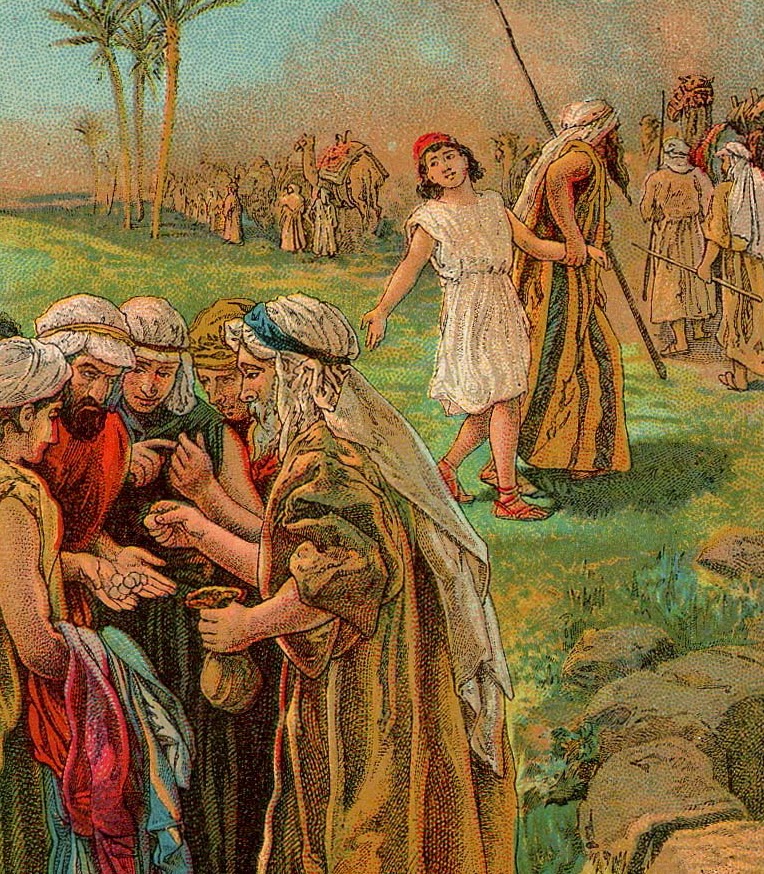
The trickery, however, seems to have no end; some Midianite traders find Joseph, lift him out of the pit, and sell him to the Ishmaelites for 20 pieces of silver. And, they took Joseph to Egypt, where he served as a slave.

The story doesn’t end there, of course. You can read ahead in the chapters in Genesis, and discover that Joseph is Abraham and Isaac and Jacob, all over again. He is his father and grandfather and great grandfather’s son. 

Family patterns of trickery and deception and hatred and banishment and abandonment seem to repeat themselves. But, there is one positive characteristic that is also present. Joseph also learns compassion, much in the same way his father Jacob did. He learns it through his own suffering, being in touch with his own humanity, his own faults and failures, his understanding of his own finiteness and mortality and the infinite and unconditional love and compassion of God.

On his way to achieving his dream, Joseph learned some humility. He began to learn something about how God refines us – or, as today’s psalmist writes “until his prediction came to pass, the word of the Lord tested him”.  (Psalm 105:19).

Joseph is a dreamer, but he has to go through a refining process in order to achieve his dream. 

Many of us discover that truth as we pursue our own dreams. And, in the midst of that refining process, Joseph captures something that is also in his DNA and learns the greatest lesson of all: compassion. Indeed, without compassion for others who are also struggling to live into their dreams, our achievement can deceive us into thinking we made it all on our own.

The truth is that all of our achievements are dependent upon the help of God who helps us through others. There is no such thing as “A Self Made Man”. That’s a myth and an illusion. If we trick ourselves into believing that “we did it by ourselves” we open the door for our own arrogance, and that opens us up to be vehicles of our own brand of trickery and deception.

If we have compassion in our hears for others, it is because we have learned that we can do nothing without the help of God. We may not always see it, it may not always be clearly evident to us, but it is there. God is always stretching out God’s hand to give us a lift out of the messes we create in our lives. Or, as the folks in Twelve Step Programs put it, some times, the only way to begin to ‘bounce back’ is to hit bottom. What we discover is that God is there. At the bottom.

In today’s Gospel, Peter also learns a bit of humility and is refined. He sees Jesus walking on water and seeks to do the same. “Lord,” he says, “If it is you, command me to come to you on the water.” Peter actually achieves that dream – at least for a little while – until he noticed that this walking on water thing is a little harder than it looks and he becomes frightened by the strong waves. Peter begins to sink, but Jesus extends his hand and helps him.

Jesus, we believe, is fully human AND fully divine. In this Gospel story – in the midst of the divine ability to walk on water – Jesus displays the compassion that is part of the human genetic make up of his DNA. He is the son of David, and yes, a son of Abraham, Isaac and Jacob. He is a man of great compassion.

We all have within us the potential to do evil. We are all capable of petty jealousy and hatred, deception and trickery, duplicity and dishonesty, betrayal and abandonment.

We all have dysfunctional family patterns of relationships. We all have the choice to live our lives in the constant state of the high drama of a soap opera, or to simply live our lives being true to the goodness we also know is part of how God made us.

The key is to explore and examine and learn from all the patterns of our lives – the good and the destructive – and find the patterns in ourselves that lead us to the potential to do great acts of kindness and compassion. And, because we are not helpless victims, we have a choice. God has given us the great gift of free will. We can choose to live out those positive patterns, and live into the genetics of that which is good in each of us. 

It’s a choice we can all make. Along the way, we’ll make mistakes. No doubt. That’s part of the cost of free will. We’re not perfect, just free to make choices. But, the other thing that is free is grace. Grace to say, ‘I’m sorry.” Grace to say, “I forgive you.” Grace to say, “Let’s wipe the slate clean and start over.” Grace to find the courage to pick yourself up, dust yourself off, pull up your socks, blow your nose, and begin again.

As St. Paul reminds us in today’s reading from Romans, “The word is near you, on your lips and in your heart.” God is as close to us as our next breath. We are not helpless victims. We have been baptized into the royal priesthood of all believers in Christ, Jesus.

There’s a series of billboards around Route One for a local builder that talk about success. My favorite one is “Success does not lead to happiness, happiness leads to success.” I have found that to be true in my own life. When we find that thing that makes us happy – truly happy – and we follow the path that leads to that happiness, success will not be far behind.

It’s important, however, to remember that God does not expect us to be successful. God does not even expect us to be happy. God does expect us to be faithful. And, in being faithful to the goodness we know is in us, we can find our own happiness and our own success.

We cannot hope to bring compassion to the world if we don’t have compassion in our hearts for other people—all of them. We cannot hope to bring peace to the world if we haven’t yet become peace—towards everyone.

When you stake your life on a vision for the way things can be different, it will “keep testing you.” We seem to be tested over and over again these days, in a nightmare news loop from which we never seem to be able to awaken. In Gaza and Ukraine and Iraq. In the Ebola outbreak in Africa. In the Game of Sanctions between the West and Russia. In the unaccompanied children at our border.

It may take years for the vision of God’s compassion and peace and justice and freedom to really awaken inside us, but it’s there, in the DNA of our baptism. Yes, some will argue that we are “miserable offenders” from birth, hopelessly corrupt. Anne Frank once said, “Despite everything, I believe people are really good at heart.” I choose to believe that, too.

We have centuries of dysfunctional patterns of behavior and relationships to overcome – in our own families of origin as well as in the human family. But when we do, when the dream of God takes hold in us, when we become the compassion and peace we long for in this world, then we will be truly “living the dream” of our unconditionally loving and compassionate God.

Amen.

Sunday, August 03, 2014

Anatomy of a miracle

St. Paul's Episcopal Church, Georgetown, DE
Genesis 32:22-31
Psalm 17: 1-7, 16
Romans 9:1-5
Matthew 14:13-21

It was my privilege and joy to preach and preside at St. Paul's, Georgetown, this morning. I did so as a favor for my colleague who is the rector and one of the hardest working priests I know. He and his spouse took a rare, long weekend away.

I did the same for him last year. That's two years in a row. And, as everyone in The Episcopal Church knows, after two consecutive years of anything, it's now tradition.

No, I don't have a manuscript of my sermon.

Yes, I normally always do.

This time, I preached from the center aisle, with just a few notes. I did that because I knew that this congregation is small in size and elderly in age, and that they would most appreciate a short, personal, Gospel presence closer to them, in their midst, instead of from a distant pulpit.

I preached about miracles - of Jacob wrestling with the angel and Jesus feeding 5,000.

Turns out, while I was preaching about miracles, another one was happening.

I preached without a manuscript.

Not the first time I've done that, of course. The first time at the principle Sunday morning service.

Ms. Conroy was there, along with my dear friend and brother of my heart, Bill. They said, with no small amount of notable surprise, that I did "very well". Well, at least by their standards, and they both have pretty high standards. They seemed to have two major bars which I passed.

Ms. Conroy said I didn't pace back and forth or up and down the aisle at a pace so as to induce nausea. (A real pet peeve of hers.)

Bill and Ms. Conroy said I didn't say "Umm . . .".  Not once. (Also a pet peeve of Ms. Conroy)

And, here I was, wanting to simply preach the Gospel coherently and with relevance to the lives of the people to whom I was preaching.

What I remember saying - the main point I wanted to convey - was that, inside every miracle is human compassion.

The Talmud says that the Jews are a compassionate people (rachmanim), and that someone who claims to be Jewish but doesn’t show the quality of compassion is not really a Jew. Indeed, the Zohar (the foundational literature of the Kabbalah) even says that when Jacob received the name Israel after wrestling the angel, that this was in order to allow Jacob to become attached to this quality of compassion.

Matthew's Gospel reports that Jesus had retreated to a deserted, lonely place, but that the crowds followed him on foot from the towns. When he went ashore, he saw a great crowd; and he had compassion for them and cured their sick.

I told a story about my grandmother who had compassion on the factory workers in our town who were part of the early labor union organizing movement which was started by my grandfather, father, uncles and cousins.

Several times a week, she would gather up the vegetables from her garden and the meat from her larder and make a few huge pots of soup and many loaves of crusty Portuguese bread. She would bring the soup and bread to the strike line so that the men would have something to eat.

St. Paul's, Georgetown, DE
As one particular strike went on and on - much longer than anyone expected - we began to see women and children in the soup line. As more people appeared on the strike line, the anxiety level began to rise exponentially. As did the potential for violence.

I am convinced that it was her compassion that caused the miracle of having enough to feed everyone.

She would call out over the crowd, "Not to worry. We'll add a cup of water to the soup and we'll all eat hearty."

And, we did.

I believe that inside every miracle is human compassion.

There can be a miracle in Gaza if the people there remembered something about their true nature and identity; that as children of Jacob, they are a compassionate people (rachmanim). 

There can be a miracle at our borders with thousands of  "unaccompanied children" if the very same American people who insist that we are a "Christian nation" remembered the compassion of Jesus who told his disciples not to send away the 5 (or 10 or 20 thousand, if you add women and children) people who had gathered to be healed and fed but said to them "you give them something to eat."

There can even be a miracle when a certain priest who is pretty wed to her manuscript takes a risk for the Gospel and preaches it from "a prepared heart". 

I do believe that inside every miracle is human compassion. 

I know it not just because I preached it.

I've lived it. 

And, seen it.

Amen.

Tuesday, July 29, 2014

Call

Presiding Bishop Katharine Jefferts Schori at Church of the Advocate, Philadelphia, PA
Happy "Philly 11" Day - a day to celebrate 40 years of the Ordination of Women to the Priesthood and 2,000 years of women in ministry.

I offer this in praise and thanksgiving to all the amazing women in my life: 

- from my beloved Grandmother and the nuns of my youth and childhood, many of whom were the first priests I knew and became role models for me of the priesthood by whispering in my child's ear, "Never doubt that Jesus has a mighty work of justice for you to do."

- to Martha Blacklock, the first woman I saw in a clergy shirt and collar which broke through the protective coating I had built up around my heart and allowed me to hear my own call. Your work all those years ago on Mother Thunder liturgy continues to break barriers and calls us to be mindful of the images and language we use for God and humankind.

- to Brooke Alexander, the first woman of the Diocese of Maine, ordained in the Diocese of Maine, now numbered among the saints, who taught me the incarnational truth that "Your mind may fool you and your heart may deceive you, but your body never lies. Learn to listen to your body." 

- to all the women of the Philadelphia Eleven and the Washington Four. Oh, my sisters, to the grace that lead you to your courage, I am forever a grateful debtor. 

- to Elsa Walberg, first woman ordained deacon in 1973 in DioMA who was invited to be one of the "Philadelphia Twelve" but declined at the last minute. Called "a good deacon" publicly by her bishop for this, she wrote to him, "Don't you ever again put me in a position where I have to choose between my sisters and the church." (Hear what the Spirit is saying to the church.)

- to my professors and mentors at The Episcopal Divinity School - all of them, but especially Carter Heyward and Sue Hiatt, Fredrica Harris Thompsett and Kwok Pui Lan for teaching me what I need to know to be an effective minister of the Gospel and strive to be an institutional person with integrity. 

- to Ellen Barrett (now Sr. Bernadette), first lesbian woman ordained in New York and Jane Garrett (VT), first clerical deputy (along with lay deputy Pat Waddell, El Camino Real) to 'come out' on the floor of the 1991 General Convention in Phoenix; two lesbians who are priests who live the simple truth of their lives and know more about courage than I'll ever hope to know.  When I think of how you laid down your lives for us in the "long littleness"of  everyday acts of justice, my heart overflows with gratitude. 

- to the women of The Miserable Offenders, Ana Hernandez and Deborah Bly (who now sings with the heavenly chorus of angels and archangels), whose music not only put the wine of old hymns into the new wine skins of musical arrangements, and so became the musical metaphor of the ministry of women, but also provided the soundtrack of those hard, early years of continuing to beat back the second and third waves of sexism and misogyny in the church. 

- to Margaret Rose, who fulfilled the unlikely role of teaching me how to chant Eucharistic Prayer B in good Anglo-Catholic style for the first time I presided at Eucharist at St. John's, Bowdoin St., Boston. I still hear you calling softly to me over the notes, like a midwife to a woman giving birth to herself: "Breathe. Easy. That's it. Breathe."

- to Marge Christie and Sallee Buckley, two members of the laity who knew well their membership in the priesthood of all believers and grounded their lifelong commitment to the work of justice in their baptismal vows. Like Mary of Magdala, whose Feast Day it was on July 23rd, you taught me that "meet, right and proper" are lovely liturgical words, but the real work of the Eucharist is in that which is broken and poured out and is a scandal to the prevailing culture. 

- to Barbara Clementine Harris, first woman consecrated bishop in the Anglican Communion, who continues to teach me how to gather up my annoyance and agitation about continued injustice, bring it before the God-given-and-blessed place of a sense of humor in us all, and turn the joke on oppression. (To wit, at Lambeth, 1998: "If assholes could fly, this place would be an airport.")

- to Jane Holmes Dixon, second woman consecrated bishop who bore the heat of the day and the scars of battle with misogynists with grace and style and intelligence, laced with deep spirituality and just enough Southern spice to earn the unlikely title, "Kick-Ass Bishop".  I know you aren't 'resting in peace', Jane. Keep kicking my butt from on high when we need it. (Oh, do I miss you!)

- to Katharine Jefferts Schori, first woman Presiding Bishop and Primate in the Anglican Communion, who continues to model what it is to be a strong woman in institutional leadership, and how to take the rap for that with grace and style and an air of mild bemusement (which speaks of humility) that you - even you, of all people - are called to do this work at this time. 

- to the "Too Women" in ordained ministry - deacons, priests and bishops - and those who have felt called to ordination but did not "make it through the process" who have been dismissed and marginalized by the institutional church as "too" - Radical. Angry. "Out there". Emotional. Aloof. Inexperienced. Wounded. - and have not been able to fulfill your ministry in the institutional church.  You are the 'baroque' pearls of great price. You let in more of the Light and Truth than some people can stand. You know who you are. More importantly, God knows. God sees. And, God loves you more than the institutional church ever has and you will ever know.  You bring me hope and inspiration when all the "good girls" who have "made it" bring me to despair.

To all the countless and unnamed and "anonymous" women (too many to be named here, but kept close in my heart) who have built a bridge with their very backs over the raging Rivers of Misogyny and Sexism and Homophobia for us to walk upon and follow the path which God has set out for us. 

You continue to call to us to be true to our vocation in whichever of the four orders of ministry - laity, deacon, priest, bishop - we are called to pursue, whether in the institutional church or outside the institutional church. Or, both. 

Sometimes the sound of that call is a mighty roar.  Sometimes it sounds like tears and laughter, which roll over and over onto, into and out of each other. Most times, it sounds like a whisper, almost inaudible, causing us to lean in, focus, pay attention, and hear it more clearly. Even if that takes all of our whole lives.

Thank you for your obedience to your call, and for teaching me to be obedient to mine.

Together, may we move mountains of prejudice, bigotry and oppression so that all the children of God may one day soon be free.
Call

There is a new sound
of roaring voices
in the deep
and light-shattered
rushes in the heavens.

The mountains are coming alive,
the fire-kindled mountains,
moving again to reshape the earth.

It is we sleeping women,
waking up in a darkened world,
cutting the chains from off our bodies
with our teeth, stretching our lives
over the slow earth—

Seeing, moving, breathing in
the vigor that commands us
to make all things new.

It has been said that while the women sleep,
the earth shall sleep—
But listen! We are waking up and rising,
and soon our sisters will know their strength.

The earth-moving day is here.
We women wake to move in fire.
The earth shall be remade.
From Womanpriest by Alla Renée Bozarth, Paulist Press 1978,revised edition Luramedia 1988, distributed by the poet; Gynergy by Alla Renée Bozarth, Wisdom House 1978; audio cassette Water Women by Alla Renée Bozarth, Wisdom House 1990, distributed by the poet; and Stars in Your Bones: Emerging Signposts on Our Spiritual Journeys by Alla Bozarth, Julia Barkley and Terri Hawthorne, North Star Press of St. Cloud 1990. All rights reserved.

Inspired by “Mountain Moving Day, ” 1911, by Japanese Feminist Poet,Yosano Akiko.