Come in! Come in!

"If you are a dreamer, come in. If you are a dreamer, a wisher, a liar, a Hope-er, a Pray-er, a Magic Bean buyer; if you're a pretender, come sit by my fire. For we have some flax-golden tales to spin. Come in! Come in!" -- Shel Silverstein

Tuesday, July 12, 2011

Freedom from Religion?

I've been watching the effects of the recent Marriage Equality in New York State in the six Episcopal Dioceses there. It presents an interesting snapshot of the Episcopal Church with regards to its theology of marriage as well as its understanding of the Christian understanding of justice, pastoral generosity and radical hospitality.

The six Episcopal Dioceses in New York are New York (Sisk), Long Island (Provenzano), Western New York (Franklin), Rochester(Singh), Central NY (Adams)  and Albany (Love).

Five of the six bishops are supportive of Marriage Equality, with different shades of gray defining them and their definition of the canons of The Episcopal Church.

The one who isn't supportive is very clearly not supportive.

So, here's a very brief summary of where everyone is, to date.

Bishop Larry Proenzano
On July 8th, Bishop Larry Provenzano in Long Island issued a "A Theological Perspective and Practical Guideline on Marriage in the Diocese of Long Island."

Provenzano has been supportive of Marriage Equality and is permitting the clergy in his diocese to preside at and bless the marriages of ALL people, and function as an agent of the state in terms of signing the marriage certificate.

In the spirit of 'sauce for geese and gander', the bishop has announced that all clergy - gay or straight - who are living with a partner have nine months (from July 9th) to be legally and sacramentally married.

He writes, "I deem it to be honest and fair, and I do so direct and require, now that it is legal, that only married couples may live together, either in rectories or elsewhere as a clergy couple living in the midst of our faith community.

What's 'honest and fair' to one is not so much to others.

Bishop Mark Sisk
Bishop Mark Sisk, of the Diocese of NY, said in a letter to clergy about their options for marrying same-gender couples under the law that "in the spirit of the opportunity provided by this new law, it is my expectation that all those who are currently living in committed relationships, will, in due course, have those relationships formalized by the state of New York."

Sisk said, "This is an especially high priority for priests and deacons because in their ordination vows they promised to pattern their lives and that of their families and households "in accordance with the teachings of Christ" so that they may be "a wholesome example" to people.

"... in due course".

Is that more "honest and fair"?

Here's why I raise the question.  Over at "Friends of Jake, Susan writes,
"Demanding that LGBT couples marry or "union" often has negative consequences (based largely on DOMA), including increased tax liability, increased expenses, and my personal favorite, the ever-present threat that you need to file a gift-tax statement for the "rent" your same-sex spouse doesn't pay you for the house you own in your name and live in together....yes, that really can happen."
Bishop Tom Shaw
Allow me to jump over to my home state of Massachusetts where they have been living with Marriage Equality since 2004. It might be interesting to see how one diocese is living with the reality of a still un-level playing field.

The Rev. Canon Mally Lloyd, Diocese of Massachusetts canon to the ordinary, Bishop Tom Shaw, said in a comment e-mailed to ENS July 11 that
". . . in general the bishops' practice during this time of transition and change has been to treat situations with pastoral care whenever possible because the fact that marriage is now legal for gay and lesbian people is a quantum shift in identity and possibility for many of them, and to put a timeline on a couple's readiness for the sacramental rite of marriage when that has never been available to them before seems arbitrary and unpastoral."
In 2004, the State of Massachusetts was the first state to issue licenses for same-gender marriages. The diocese does not have a written policy on the issue.

"We feel it is important to hear the voices and experiences of gay and lesbian people on this subject, and that takes time," Lloyd continued. "The standard here has been that unmarried people should not live together in church-owned housing, but there is no written policy.”

Bishop Prince Singh
Meanwhile, over in the Diocese of Rochester, "the bishop formerly known as Prince" Singh, a longtime advocate for Marriage Equality has issued a statement which clearly celebrates the new law in the State of New York.

He writes,
"I want to assure members of my Diocese that no priest will be forced to bless the civil marriage of the LGBT parishioners. We already practice a provision in our polity that does not mandate a priest to officiate in the marriage of a heterosexual couple for any reason. I will be setting up a task force in our Diocese to help us chart our course to engage this journey reverently, deliberately and in congruence with Church Law. I pray that the all New Yorkers, those who support and those who oppose this Act, will celebrate the fact that the human rights of a community have been affirmed by the state. Since no one is free until everyone is free, Marriage Equality takes us closer to our pursuit of a more wholesome society".
Apparently, the task force is expected to report its findings and recommendations to the bishop within a four week period of time. Until then, I'm told, clergy are not compelled into a 'shotgun wedding' and are free to preside at and bless marriages - but, wait for it - not sign the marriage certificate.

Someone has been spending too much time with his Chancellor, me thinks.

Okay, NY is a Very Big state. Hang in there with me. We've just three more bishops and dioceses to go.

Bishop 'Skip' Adams
In the Diocese of Central New Your, Bishop Gladstone B. ("Skip") Adams III wrote, in a pastoral letter dated June 27th, that "I am hereby giving permission, deferring to your pastoral judgments and local application, for the possibility of you presiding over same-gender marriages."

He also wrote:
"The people of Central New York are not of one mind on this matter. The decision of the State has prompted rejoicing for some and deep sadness for others.  This is true among the faithful of our Diocese and my own decision as Bishop will cause similar response.  Whatever your response to these decisions, I encourage you to be measured as you care for one another, for as a community of faithful people in Christ, we are still called to support one another as we seek to be "The passionate presence of Christ for one another and the world we are called to serve."
Nothing about signing the marriage certificate or the expectation of LGBT clergy who are living with a partner to marry.

Apparently, the bishop will take up the conversation with diocesan clergy in October.
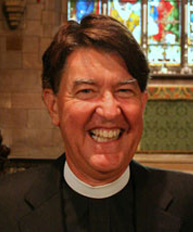
Bishop William Franklin
In the Buffalo-based Diocese of Western New York, Bishop William Franklin, also welcomed the new law.

Franklin said he is writing a policy statement for the diocese, which will be issued before the law goes into effect.

That works comes as the bishop finished a series of meetings with various groups of clergy and diocesan leaders to listen to their views on the topic of marriage equality.

No word, as yet, as to any of the particulars of what that policy will look like in terms of LGBT clergy living together in the rectory or elsewhere in the community, or whether or not clergy can preside and officiate at marriages and whether or not they can act as agents of the State of New York and sign the marriage certificate.

In his statement, Franklin wrote:
I personally see gay marriage as a matter of human rights and social justice. I believe today’s vote in the New York State legislature to approve gay marriage was the right thing for the legislature to do, and I welcome the decision. At the same time, I recognize that there are many in our community who disagree. Their thoughts, like my own, are prayerfully and honestly held and deserve to be heard respectfully.
 Is that  "honest and fair"?

Bishop William Love
I hate to end on a sour note, but I'll conclude this brief survey with Bishop William Love of Albany, who obviously defines "honest and fair" in a manner most peculiar to Christian love.

Bishop Love issued a Pastoral Letter which was to be read in all congregations on Sunday, July 3.

Openly Episcopal in Albany reported the response in one congregation in that diocese:
When the letter noted that "New York has now joined five other states in redefining marriage," there was loud and sustained applause from the congregation. Where the letter referred to diocesan canon that "specifically bars any other union" than that between one man and one woman, there arose an audible hiss. When the Bishop expressed his expectation that all "the clergy and laity of the Diocese Albany" will support him in upholding diocesan canon over the law of New York, more than one head was shaking in disbelief.
The resolutions which changed diocesan canon were previously reported by Openly Episcopal:
Resolution #5 passed, but the number of votes for and against were not noted. This is the amendment to Diocesan Canon that bans the celebration or blessing of a marriage "or any other union, except between one man and one woman." The associated Resolution #6 was also adopted. In a vote by orders, clergy weighed in with 110 yeas, 9 nays. the lay delegates voted 70 for and 20 against, with 4 abstentions. This was the amendment of canon which specifies that "a member of the clergy must live within the covenant of Marriage between one man and one woman."
So, there is Marriage Equality in New York, but in at least one diocese in that fair state, while the principle of 'religious freedom' has been upheld, there is no freedom from religion to continue to oppress based on prejudice and bigotry.

As I look at the whole picture, I'm struck by the celebratory but deeply cautionary tone taken by these bishops.  I suppose that is to be expected, given the present reality of our canon law.

I'm also deeply struck by the fact that, with five "yeses"  - one with clear polices and four "in process" - and one firm, clear, absolute, resounding "No way, Jose" - this presents a pretty clear reflection of the present reality of The Episcopal Church.

It bodes well for General Convention to accept the work done by the Standing Committee on Liturgy and Music to work with the House of Bishops to collect and develop theological resources and liturgies for blessing same-gender relationships.

The commission is to report to the 77th General Convention in 2012 in Indianapolis.

Meanwhile, the Church Pension Group wrote in a July 11th statement that it decided nearly a month ago to follow the requirements of the New York law and provide "parity of benefits for legally-married same-gender spouses." A letter explaining the change was recently sent to all participants.

The CPG wrote:
" . . . under the laws of the State of New York, employers subject to New York State law must recognize same-gender marriages that are validly solemnized within or outside the State of New York for the purposes of providing benefits to employees."
The rule changes apply to participants in the Church Pension Fund Clergy Pension Plan, the defined-benefit Episcopal Church Lay Employees' Retirement Plan and the Church Pension Fund Clergy Post-Retirement Medical Assistance Plan (known as the Medicare Supplement Benefit).

So, here's the deal: If Ms. Conroy and I, who live in the State of Delaware, where there is not presently but will be, effective January 1, 2011, Civil Unions (but not marriage), get married in New York (or anywhere where there IS Marriage Equality), neither our marriage nor our present domestic partnership will be recognized by the State of Delaware.

Indeed, even if we did marry in NYC, we would have to trade in both our NJ Domestic Partnership AND our NY Marriage Certificate for a Civil Union in Delaware.

Yes, we'd have to apply for the Civil Union, go to our local Town Hall, and "get unionized".

But wait . . .there's more . . . (here's where the insanity begins) . . . the Church Pension Group will honor our Marriage Certificate in New York City because, well, because "marriage is marriage" and the law of NY is the law of NY and the CPG is based in Manhattan. That would be New York.

Right.

Except, of course, for this little problem with the Federal Government which is still laboring under DOMA (Defense of Marriage Act), even though the Obama Administration has ruled it 'indefensible".

Oh, and the canons of The Episcopal Church and the rubrics of The Book of Common Prayer still define marriage as "between one man and one woman".

Stay tuned for a resolution to General Convention in 2012 to change those canons. You'll be able to tell when that happens when the fireworks start in Indianapolis.

The Anglican Covenant Contract will simply have to wait. You know. Just like the rest of us are waiting for the church to recognize and celebrate and bless Marriage Equality. Which, of course, would be 'an offense in the Anglican Covenant Contract which would have "relational consequences".

Until then, of course, Ms. Conroy and I would be legally married in NY where the State would recognize our marriage but neither the State of Delaware nor The Episcopal Church would or could, but we would be married in the eyes of the Church Pension Group.

And you thought being Queer was for sissies.

One would think that the Church would be ashamed of itself.

Imagine! State governments are changing the laws in the name of "justice and freedom for all" but the Church, which is supposed to have been built on the justice of God is still "listening" and "praying" about what to do.

I suppose one could applaud the good bishops for being "wise and prudent" men who are "listening to the will of the people" before setting policies and procedures into place.

I know. I understand. I've been in the church most of the whole of my life. I've been ordained for 25 years. I get it. This is the way the institutional church works.

You'll excuse me if I hold the applause. Indeed, you'll understand if I pull the plug on the blinking 'Applause' sign - at least the one in the church sanctuary.

Discrimination is very ugly. It is hideous when dressed in religious garb, posing as "God's plan" and "the will of God for you in your life."

Some of you are sighing disgustedly and asking, "Oh, for goodness sake, Elizabeth! Won't you ever be happy? You're side has won. Is winning. Just be patient. What more do you want?"

Oh, I don't know. How about this?

I suppose I not only want 'freedom of religion' but freedom from prejudice that masquerades as religion - especially those who profess to follow in the footsteps of Christ Jesus.

I've been waiting for the justice of Marriage Equality for a long time.

Indeed, if you had asked me thirty-four years ago when we lost custody of our kid solely based on the fact of our sexual orientation, I never would have guessed that the very state that took away our parental custody would be the first to enact Marriage Equality.

There's a lovely poetic justice about that - one I truly celebrate.

Just please don't expect me to fully rejoice until Marriage Equality is the law of the land for everyone. Everywhere. 

And.... and.... AND . . . that every Christian, Muslim, Jew and any other religious denomination can celebrate and bless that which God has brought together and no one should cast asunder.

At that time,  I will raise my voice with all the choirs of angels and archangels and all the company of heaven and sing at the top of my throat and from the bottom of my heart, "Glory, glory Hallelujah!"

Until then, I will continue to follow Mother Jones' advice:

"Pray for the dead and fight like hell for the living."

I at least still have that right.

Sunday, July 10, 2011

The Sower Keeps Sowing

'Wheat Field behind St. Paul Hospital with Reaper' - Vincent Van Gogh

“The Sower Keeps Sowing” 
Matthew 13:1-9,18-23
IV Pentecost – July 10, 2011 
St. George’s Chapel, Harbeson, DE
(the Rev’d Dr.) Elizabeth Kaeton

The task of the preacher is to preach the Good News of Jesus Christ, but before I get to the gospel, I first need to put the parable Jesus tells of ‘The Seeds and The Sower’ into the context of the story of Jacob and Esau.

If you’ve been following along these past few Sundays, we’ve heard the story of their grandparents, Abraham and Sarah, so we might not be surprised by the fertility problems of their son Isaac and his wife Rebekah.

Indeed, Sarah was having such infertility issues that she gave her slave Hagar to her husband Abraham so that they would have a child (and you thought surrogate pregnancy was a modern idea). Which they did. They had a son named Ishmael. 

HOWEVER, Sarah finally got pregnant in her old age – somewhere around eighty years old, were told – which is probably the genesis of the Jewish phrase, “Oye veh!” (or at least a good enough reason to say the words, no matter your ethnic background).

Actually, when Sarah heard the news that she was going to conceive, she laughed. So, we’re not surprised to learn that she named her son “Isaac”. I’m told by my Rabbinical friends that the name Isaac is, in and of itself, a little inside joke because it sounds like chortled laughter: “Izick, Izick, Izick.” 

I think that’s a “Rabbi joke”, but isn’t that cool? I’m betting you just can’t wait to share that tidbit of information with your friends while you are attending smart summer cocktail parties.

I’m sorry. I digress. I just get so excited to tell you the story of our ancient relatives and how that fits in with the gospel that I sometimes get caught up in these little bits of bible trivia. Where was I? Oh, yes, SooOOoo . . . 

Sarah gave birth to Isaac and thought the only way to make certain that he – Isaac and not Ishmael – was seen as the rightful heir of Abraham was to banish Hagar and Ishmael, which she directed her husband, Abraham to do. Post haste. Which he did.  Foolish man.

The next thing we know, Abraham is having a meltdown and takes his son Isaac up to a mountain because he hears God calling him to sacrifice his firstborn son. Thankfully, before he actually slaughters the child, he hears the voice of God telling him not to do it. WHEW!

However, no one escapes without a scar. Scripture leaves us to assume that Isaac and Abraham never spoke again after that incident. Sarah dies shortly thereafter – I suspect, of a broken heart. Isaac did not come home for his mother’s funeral. 

One can only imagine the trauma brought upon Isaac as well as the whole family by this moment of madness. It is one of the most poignant moments in scripture to read that, when Abraham died, Isaac and Ishmael returned to bury their father (Genesis 25:9)

Before his death, however, Abraham tries to atone for this atrocity by finding a wife for Isaac. Enter Rebekah, an independent young woman from his own kinfolk in Haran. Scripture tells us that Isaac loved Rebekah. 

Nowhere else in the whole of Scripture is that said of any other couple. Isaac loved Rebekah. (This is where you all say, “Aww!) 

Indeed, as far as we know, Isaac did not take another wife other than Rebekah, which was highly unusual in that day and time when men had hundreds of wives and children.

Even so, Rebekah also finds herself with fertility issues (probably Isaac inherited this problem from his father) but Isaac prayed for his wife and lo and behold, Rebekah did conceive. Twins (another Oy Vey moment. Be very careful what you pray for.) They were two boys whom she named Esau and Jacob.

We are told that Isaac loved Esau but Rebekah loved Jacob – and so the seeds of discontent and deceit, which Isaac knew from childhood, were sown from their birth. Just like the half-brothers, Isaac and Ishmael, these two boys represented “two nations…. divided… one shall be stronger than the other and the elder (Esau) shall serve the younger (Jacob)”.

And, it was so.

Esau, a skilled hunter, sold his birthright to his younger brother, Jacob, a quiet man, we are told, who lived in tents. We read in this morning’s lesson that Jacob tricked his brother, who was famished nigh unto death, out of his birthright with a pot of lentil stew and some bread. Later, as his father lay dying, Jacob conspired – this time with his mother – to trick his older brother out of his father’s blessing and inheritance.

Ah, the seeds of deception and deceit are buried deep in this family tree! But, before I go on to connect the Gospel with this story, one more fun scriptural fact with which to dazzle your friends. 

Shortly after Esau and Jacob were born, there was a famine in the land and the family moved to Gerar where Isaac was blessed by God and grew many crops.

He also dug a well that had been closed up by the Philistines and there was much water. But the herders of Gerar quarreled with the herders of Isaac over who owned the well. So, Isaac dug another well. Again, quarreling ensued so that Isaac dug a third well and they did not quarrel over it, so Isaac named the well . . . anybody know? Anybody?

Isaac named the well Rehoboth, saying, “Now, the Lord has made room for us, and we shall be fruitful in the land.”   

So, now you know why Rehoboth is so named – room for us all. (I’ve always wanted to include that little tidbit in a sermon. I'm so delighted to finally have had the chance!)

And, you thought you were coming to church today and might catch a nap during the sermon! See how much fun we’re having? Okay, again, I digress. Back to the Gospel. But first, a quick trip over to Rome to hear what St. Paul wrote to the ancient church there.

Here’s the thing: We were made of the dust, but the miracle of our lives is that we were born to shine in the Light that is Jesus. St. Paul tells the ancient church in Rome, “But you are not in the flesh; you are in the Spirit, since the Spirit of God dwells in you.” And, if God dwells in you, you are not defined by your genetic code or which branch you occupy on your family tree.

Now, listen closely to what St. Paul is saying: You are defined by the word of God that dwells within you – not your genetic code or family tree.

The Word of God, says Jesus, is like seeds scattered by the sower. Some of it falls on ears that are as deaf as rocks or prickly as thorns. But the one who hears the word of God and understands it has ears that are “good soil” that will bear much fruit. 

Here’s the thing: Whether good soil or bad soil, the Sower keeps on sowing.

I don’t know about you, but sometimes, I go through periods of real spiritual drought. My soul feels as hot and dry as the desert sand. Other times, all is well with the world and I feel at peace. In those times, I can truly sing 'it is well with my soul'. Other times, my soul is so choked by the weeds of the world – the wars, the debit ceiling, unemployment, the murder of innocent children – that I can barely swing my feet off the side of the bed and get up to face a new day.

Even so, the Sower keeps sewing seeds. 

Sometimes, they land on good soil. Other times, not so much. That doesn’t stop God from trying to get something to grow in my soul.  

 It has ever been thus. It was so with Abraham when he tried to repent for his actions by trying to find a wife for his son Isaac. It was so with Isaac when he returned with Ishmael to honor his father in death. God kept trying with Jacob when he eventually reconciled with Esau. 

And, God keeps trying with you and with me. 

The Sower keeps sewing seeds.

There is a long recorded history which is evidence that The Sower keeps trying to plant Gospel seeds of the Good News of Jesus Christ in our souls.

Which is precisely why I wanted to tell you about the story of Abraham and Sarah and Hagar, Isaac and Ishmael and Rebekah and Esau and Jacob. They are part of our Godly lineage, our ancient relatives in Christ.

They are ordinary, broken people – just like you and me. Scoundrels and liars and thieves, some of them, skilled in the art of deception and deceit. But, the word of God still found its way into their lives. There was hope for them and there is hope for you and me. There was plenteous redemption for them as there is plenteous redemption for you and me. 

It all has to do with the seeds we sow in our lives, and how closely we listen to the Word of God, made flesh in Christ Jesus.   

Biology is not destiny. 

We may be ‘of dust and to dust we shall return’ but the miracle of our baptism is that we were born again to shine in the Light of Jesus.

Our redemption – our hope – comes from allowing the Word of God to find its way to us – not just into our ears, but way down deep into our souls, so that we may bear much fruit and yield, as Jesus says, “in one case a hundredfold, in another sixty, and in another thirty”. 

It begins by putting the stories of scripture into context so that you can put the story of your life in context with the story of God’s unbounded and unconditional love for absolutely everyone. Which is why it is so important to know the whole story of God’s abundant love for us – a love that is beyond our wildest imagination.

And, you know, even in the heat of the summer sun, and in the midst of all the unhappiness in the world, the Good News just doesn’t get much better than that.

Amen.
 

Friday, July 08, 2011

All the news that fits, we print

Anybody else out there sick unto death hearing one more blessed word about Casey Anthony and the death of her daughter Caylee?

Anyone else disgusted and horrified by the News of the World journalism scandal of journalists hacking in to the cell phones of missing children or deceased soldiers in order to "get the scoop"?

How many are so thoroughly disgusted with the local 'evening news' which consists primarily of a visual montage of "on the ground coverage" of the latest weather catastrophe of fire, flooding, tornado or hurricane interspersed with musings about climate control, the state of disaster readiness, and the latest angle to find the most heartwarming story of volunteer efforts to help with the disaster?

I know I'm going to sound like an old curmudgeon, but I'm going to risk it and ask "When did 'the news' become entertainment?

I suppose the OJ Simpson trial heralded the court room drama as "The Trial of the Century". That was, of course, followed by the daily shenanigans of Michael Jackson's trial for charges of sexually abusing children.

Which has rapidly been replaced by the new Trial of the Century in the sad saga of Casey Anthony, now "The Most Hated Mother in the World."

She was found "not guilty". That doesn't mean she's innocent. It just means that the prosecution did not prove its case.

End of story.

Literally. 

When you're talking about capitol punishment, you damn well better prove the case beyond a shadow of a doubt. Otherwise, the judge and jury and prosecution are committing murder.

Then there's Lindsay Lohen and Charlie Sheenhan, two celebrities of dubious distinction, whose mental instabilities have been trotted out for the 'entertainment' value of the viewing audience.

Then there's The Arnold and John Edwards and a host of Republican congressmen who defend "family values" and deny the civil rights for universal Marriage Equality while having bathroom trysts with other men.

There are two wars going on. The Middle East is in the midst of an historic revolution. There's genocide in sub-Sahara Africa. AIDS is a pandemic on every continent except North America. Economies in Greece, Portugal, Ireland, England and these United States, among others, are teetering on the brink of bankruptcy. Unemployment is at record highs. Then, there's the deficit.

Oh, wait. Those things don't make us feel good about ourselves. And, that seems to be the point of journalism these days - make ourselves feel good about ourselves, even if that's at the expense of others.

That's what sells papers. Selling papers makes money. Money is always the bottom line.

And that, it seems, is the real point of journalism.

The Church seems to be following suit. Have you noticed? More and more diocese - indeed, The Episcopal Church's publications - seem to be abandoning print media for electronically communicated news.

I have no real problem with that - if it were "news" they were communicating.

Most of it just serves as a "house organ".

Gone are the days of thoughtful, theologically provocative or spiritually insightful essays by bishops or church leaders. Most church publications sing their own verse of the same tired, old, relentlessly positive and cheerful hymn about the 'good news' of what's happening around the church.

It's not that I don't appreciate hearing about churches that are involved in mission and creative ministerial responses to the Gospel. I do. I also appreciate being informed on the outcomes of various important meetings around the church and the Anglican Communion.

It's just that I long for honest, articulate, intelligent analysis of the Christian perspective on what is happening in the church and in the world.

Is that so much to ask?

I know. I know. Some of us can get that on some of the blogs. Unfortunately, most of them - with rare exception - are personal opinions masquerading as analysis. If you happen to trust the opinions and POV (point of view) of the author, you may be getting close to something that comes close to analysis.

I still deeply lament the loss of publications like The Witness and The Other Side, which only serves to make me even more deeply appreciative for publications like Christian Century which offer timely articles, news reports and analysis, poetry, religious cartoons, and insightful, intelligent spiritual reflections.

I am stunned by the growing trend in many diocese which now require the position of Director of Communication to have skills of technology, fundraising, and stewardship.

Oh, and walk on water and then, at the end of that stroll, change the water into wine - and all at a salary well below professional standards because, well, because it's the church.

It's like the new slogan for the church is the same as Target: "Expect more for less." What they don't say, however, is that most of the commodities they sell "for less" are done at the expense of overseas manufacturing and substandard salaries for their employees which equals higher profit margins and greater bonuses for the people at the top of the organizational food chain.

Meanwhile, the masses get fed "happy news" about all the "good things" that are happening around the church with people who are "Doing more with less."

I'm thankful for the gift of my satellite radio which allows me to listen to NPR and BBC as well as local stations which provide me with local news and weather.

I can also listen to religious broadcasting on BBC which seems to know its audience quite well and speaks with eloquence and intelligence about what's going on in the church, mosques and temples, as well as in the world.

For my money, audio newscasters are far superior to anything in print or visual media.

In 2008, Gallup provided a sampling of negative news gathering trends:
a 40% drop in every issue readership by the weekly news magazines
only 8% get weekly news from the news magazines
a 25% drop in daily readership of local newspapers
47% never or only occasionally read local newspapers
51% never or occasionally watch nightly network news programs
84% never or occasionally read national newspapers
74% never or occasionally watch Sunday morning TV news programs

Drilling down to a younger demographic, the seismic shift in information gathering looks bad for most information outlets other than the Internet and the possible exception of local TV news. The latter is still strong but declining.

Here is how 18 to 29-year-olds gather daily news:

36% use the Internet (up from 26 % in 2007)
36% watch local TV news (down from 44% in 2007)
22% read local newspapers
12% read national newspapers
18% watch nightly network news
24% watch cable news networks
That was in 2008. I suspect, three years later, the news isn't any better.

Perhaps I'm not as old a curmudgeon as I thought.

The slogan of the NY Times was: "All the news that's fit to print."

Mad Magazine
riffed on that with their slogan: "All the news that fits, we print."

I'm beginning to think that the inmates are now running the asylum.

Given all that has happened with the exposure of the journalistic corruption at News of the World - which I'm sure is just the tip of the iceberg - isn't it time that we returned to some journalistic standards of excellence and honesty, inquiry and analysis, eloquence and decency?

I, for one, would feel a whole lot better about that, even if the news didn't make me feel good.

Thursday, July 07, 2011

Speaking of God

"Am I speaking with God?" - Zosimo
The United Church of Christ, at its recent biannual governance meeting in Tampa, FL, amended its bylaws to replace "Heavenly Father" with "Triune God".

Please note: It did not change the language of any of the historic Creeds. This was a change in the language of its bylaws.

I note that to correct Terry Mattingly, one of the darlings of the so-called "orthodox Christians", who headlined his piece at GetReligion.Org "Adios to God the Father".

Mattingly chided the "lame stream religious media" for not reporting this as a "major story".  He also wrote:
... since editing the ancient Christian creeds is a highly symbolic act -- even for flocks as hyper-Protestant as the UCC. Of course, this denomination also serves as the home base for a very articulate and important layperson -- President Barack Obama.
Ahem, Mr. Mattingly? Excuse me, sir, but this was about bylaws, not Creeds.  See, the UCCs are neither a 'catholic' nor 'confessional' church but a congregational denomination. Each level of the church operates more or less independently. 

And, oh, by the way, Mr. Obama hasn't been part of any particular denomination since he left the Rev. Jeremiah Wright's UCC congregation years ago.

What is it with these guys who think only 'they' have 'the truth' to report' and then unfailingly get it wrong? Does it seem to you that "Fox News" has a franchise of religious journalists in the institutional church who share talking points and phrases with each other?

Why is Mattingly so apoplectic about a change in the bylaws of a religious denomination which has a long history of advocating for gender-neutral terms for God?

The poor man looks like one of those soldiers who hasn't heard that the war is over and he's the only one left on a deserted hill, still polishing his rifle and shining his boots and ever-ready for the battle that ended years ago.

As National Convener of The Episcopal Women's Caucus, I have been listening to the growing buzz of conversation among men and women in The Episcopal Church about changing the language we use about The Holy Spirit.

Actually, many people simply want the language of our Prayer Book used in our worship to reflect the feminine pronoun used by growing numbers of people in the pew to describe the Holy Spirit. Some are advocating for a resolution at General Convention which directs that all future authorized BCPs and/or Supplemental Liturgical Texts use the feminine pronoun for the Holy Spirit.

One woman, a former long-time deputy and national leader in The Episcopal Church (not The Caucus), wrote me this note:
I am no longer involved in the national church. I am upset always that our current prayerbook in the Nicene creed refers to the Holy Spirit as "he"! There are 59 times in Jewish Bibles where the H.S. is SHE! You are a feminist leader in our church. I urge you to take this issue up!
Okay, my sister. You got it. However, if we're talking revision of the Prayer Book, I must tell you that language about the Holy Spirit is just the beginning of the conversation. 

Some folk feel strongly that the time has come and now is for the BCP to remove the italicized "he" to now read "s/he".

Still others are asking that we change the canons of the church to formally authorize what is happening formally and informally in worship in many churches around The Episcopal Church: the use of expansive language in terms of images of God and humankind.

Note, please, that I used the term "expansive" rather than "inclusive".

I am keenly aware that many people desire the use of pronouns because it is more reflective of their personal relationship with the individual and collective members of the Trinity.

Many other people also earnestly desire to keep pronouns out of the picture, using words like "Holy One" or "The Great Compassion" as more reflective of their relationship with God. Admittedly, it also carefully sidesteps the whole gender-based controversy rather nicely.

I'm not advocating saying "adios to God the Father". I'm talking about expanding it to include Father/Mother/Creator, Son/Child/Word and Holy Ghost/Spirit/Sustainer.

I'm talking about expanding our limited, human understanding of God - drawing the circle large enough - to include all expressions of our individual and collective images and language for God and humankind.

One former long-time deputy, now retired but still active in the local church (again, not a member of The Caucus) wrote:
At one General Convention I remember vividly a discussion with a priest who worked with prisoners. He said that he often talked to these men about praying to the Holy Spirit. When they had been horribly beaten and abused by their fathers, these men were totally unreachable when presented with a father God. Exploring the fullness of our faith would bring great rewards and help for those who need to find a way to God!
So, what do you think?

Is it time to amend our canons to authorize churches to have the flexibility to change the language of the BCP to be more reflective of the reality of "Common Prayer" that is already happening in our pews at at the altar?

Remember, please, that in the strictest sense of our canon law, not following the rubrics of the BCP is considered  a serious offense. No one really pursues that, thanks be to God. Most clergy who have devised creative liturgies and music not found in the authorized texts of the church do quietly check with the diocesan chief liturgical officer - that would be the bishop - for approval.

However, I should note that concern for the rubrics and canon law is the basis of some bishops decision, for example, that clergy in states with Marriage Equality not sign the marriage certificate, even though said clergy have presided at the marriage ceremony and blessed the covenant made in the presence of God and the people of God.

Some of them call that a "gracious, generous pastoral response". Others speak of "radical hospitality". 

I know, I know. It's pretty schizophrenic, right, but there's the truth of it.

Also remember that this discussion would turn all the ecclesiastical volume knobs to 11 when it comes to messing with the words of the Ancient Creeds or the formula for baptism.

Is it time to name and claim the reality of many who worship in our churches? Would that be the healthy, responsible, adult thing do or should we just keep doing what we have been doing and not upset the applecart which is already teetering under the discussion of Marriage Equality and the Election and Consecration of Queer people?

Is language a matter of justice, as many feminists suggest? Do we commit unintended acts of spiritual violence to people's souls - male and female - by limiting the public expressions of their relationship with God or not publicly affirming the variety and diversity of that expression in public worship?

How do you speak about God? And, does it matter to you how freely you are allowed to express your relationship with God in acts of public worship? Or, that the person leading the public worship uses language that expands the traditional church thinking about our Triune God?

What do you think?

Tuesday, July 05, 2011

The Cross and the Skate Key

I was in my first year of seminary when I first met Kip Tiernan.

I had been invited to hear the founder of "Rosie's Place" preach at the Jesuit Center in Boston. I had been told that she was "feisty" and "prophetic".

Yeah, she was all that - and more.

She preached for less than five minutes, her raspy voice and heavy Boston accent sounding a bit discordant if not slightly irreverent in that hallowed space. She first thanked the Jesuits for their works of corporal mercy in their financial support and other contribution, including their volunteer efforts at Rosie's Place.

She was, however, more concerned with justice. God's justice. The justice of God as embodied and made incarnate in the life of Jesus Christ.

Here's the line I'll never forget. She said, "Justice is not 'three hots and a cot'. Justice," she said, "is having your own key to your own home."

"When you're willing to work for justice," she said, "call me." And then, she walked out of the chapel and back to work at Rose's Place.

See what I mean?

73,000 nutritious meals served annually
Rosie's Place is the nation’s first shelter for homeless women which Kip established in 1974. Here's how their own web site describes their work:
Rosie’s Place, a sanctuary for poor and homeless women, offers emergency and long-term assistance to women who have nowhere else to turn. Rosie’s Place welcomes each guest with respect and unconditional love. Rosie’s Place accepts no government funds, and relies instead on committed volunteers and private supporters to accomplish its effective and innovative work.
Emergency and long-term assistance.

Respect and unconditional love.

No government funds.

Committed volunteers and private supporters.

Effective and innovative work.

Sounds like the embodied and incarnate gospel of Jesus Christ to me.

I first got involved with Rosie's Place when the wife of a seminarian who volunteered there invited me to join her as she worked one of her shifts. Mostly, we just talked with some of the women there who were just happy to have 'three hots and a cot' in a place that offered safety and shelter for them and their children.

It wasn't home and they didn't have their own key but it was "almost heaven" when compared with the alternative "shelters" available at that time.

No men in altered states of consciousness, reeking of cheap wine, who leered salaciously at them and their children.

That was the night I met Viola. She was sitting off in a corner of the room, quietly watching her three children play with some toys. When she saw me walk over to her, she rolled her eyes.

Just another White girl trying to make a difference.

Yup, that would be me.

The first five minutes of our "conversation" was decidedly one-sided. She allowed a few "Uh-huh's" and nods of her head in response to my banter about the children, the weather, the food . . .

At one point, the shawl she had over her arms slipped down as she shifted her body in the chair. That's when I saw the bruises on her arms. She immediately saw me looking at them and closed her eyes tightly as she replaced the shawl over her arms,  silently hoping that, if she couldn't see me, I couldn't see her.

I allowed silence to fill the space between us for a few moments, then took a deep breath and said, "Some of mine were worse."

No response but a raised eyebrow.

I forged ahead and said, "You know, one of the most difficult lessons I learned from my own days of abuse were about courage. I thought I was being brave by staying in my marriage "for the sake of the children". I thought it took courage to stay true to my marriage vows, even if it meant that, every couple of weeks, I had to get into a cage and tangle with a drunken lion."

"I learned that that's not courage," I said quietly, as she watched her children play. "I learned that the three most courageous words I ever said were, 'I need help'. That takes real courage."

"You'll find that courage here," I continued. "Just give yourself a chance. Give the staff a chance to help you. If you can't do it for yourself, do it 'for the sake of the children'."

At that point, one of the little ones came running to his mother with a book, asking her to read. She said, "Mommy is too sad to read right now."

"I'll read it to you, son," I said, as the child jumped into my arms to settle in.

On the third page of the book, Viola started to weep. She chocked back the tears, but they would not be denied. "Mommy's going to the lady's room," she said to her children. "You stay here a minute with this nice young lady."

As we watched her walk away, I knew that she had taken the first steps to find the place of courage within her self.

First, you cry.

Tears become the road you walk on to ease the journey over the broken bits and pieces of your hope and allow you a measure of protection from the pointed shards of shattered dreams. Tears cleanse the path so you can see more clearly who you are and what you want from your life.

Creating permanent solutions
I kept touch with Viola over the next three years I was in seminary. Rosie's Place assisted her in completing her GED and watched her children while she enrolled in a certificate training program to become a nurse's aid.

She went on from there to become an LPN. When I left Cambridge, she was working at a nursing home while attending a Community College to become an RN.

Rosie's Place was with her every step of the way.

I lost touch with her after that, but I had seen enough to know that Viola was but one example of Kip's prophecy. Yes, yes, give people 'three hots and a cot' when they need it. That's the charitable thing to do.

Charity is just the beginning. It's a nice start, but it won't get you anywhere except feeling good about yourself. Which is 'nice' and all, but as Kip would say, 'nice' is not the goal of the work of the ministry of Jesus Christ.

Justice is the goal of the Gospel. And, sometimes the work of justice isn't about 'nice'. You can't get to the justice that is vision of the Realm of God without changing the system that brings women like Viola to Rosie's Place in the first place.

Kip Tiernan died of cancer last Saturday in her South End apartment. She was 85.

Usually clad in a canvas hat and work pants, a cross and a skate key dangling from a leather strap around her neck, Kip described herself as "an angry daughter of Christ".

"Speaking out is empowerment. A closed mouth won't get fed!"
Along with Fran Froehlich, her partner in advocacy for more than 35 years, Ms. Tiernan founded, helped found, or was a founding member of a number of agencies and panels, including Boston Health Care for the Homeless, Boston Food Bank, Community Works, Aid to Incarcerated Mothers, Finex House, Food for Free, John Leary House, My Sister’s Place, Transition House, the Greater Boston Union of the Homeless, and Boston’s Emergency Shelter Commission.

The range of suffering was such that “sometimes you think there aren’t any tears left,’’ Kip told the Globe in 1988, “and you find yourself sobbing.’’

Froehlich said that Kip combined compassion with “a pragmatic approach to solving issues, like: Hungry? Food. Homeless? Housing. And she challenged people with that clarity.’

On behalf of housing, health care, and an array of social justice issues, Kip lobbied, fasted, marched in protest, and was arrested during sit-ins at government offices. In November 1990, she began a fast in Arlington Street Church and explained why in an op-ed essay for the Globe.
“We should atone for what we have allowed to happen to all poor people in this state, in the name of fiscal austerity or plain mean-spiritedness. . . . We have, as citizens, much to repent for, for what we have and have not done, to ease the suffering of our sisters and brothers who have no lobby to protect them.’’
Kip was an orphan by the time she was eleven years old. She also was expelled from a Catholic boarding school, telling the Boston Globe she had failed math and asked too many difficult moral questions.

Tour Rosie's Place
A recovering alcoholic by the time she was 19, she was also an accomplished advertizing copier who knew how to fly a plane and play jazz piano. Her "long time companion of decades" was Edith Nicholson, who died in the 1990s.

Kip helped raise Nicholson’s three children and leaves one of those children, Peg Wright of Saugerties, N.Y.; seven grandchildren; and three great-grandchildren. For the past 15 years, Ms. Tiernan and Donna Pomponio have been a couple. They married in 2004.

About that cross and skate key around her neck: Kip wore the cross as a symbol of a radical condemnation of an unjust world. "You have to stay with the one crucified," she said, "or stand with the crucifiers".

The skate key was a symbol, for her, of the liberation promised of Christ. When you stand with the Crucified One you don't just stand. You glide, feeling the winds of liberation in your hair. Once you have experienced that liberation, you want it for everyone.

In her obituary in the Boston Globe, Mayor Thomas M. Menino is quoted as saying,
"Every day of her life she lived for social justice, and the lives she saved were untold. She always said that someday we will stamp out homelessness, but until that day we have to make sure everyone understands that a homeless person could be one of us. She was a very special person, and there’s a big hole in our lives today because Kip’s not here. This nation is going to miss Kip Tiernan because of her fight for social justice."
When a Giant of Justice like Kip leaves this earthly plane, I suspect there's a big hole in the veil that separates heaven and earth.

My hope, my prayer, is that, through that hole more angels will descend - perhaps even a few of them who are 'angry daughters of Christ' - who will, one day, become themselves Giants of Justice.

We'll know them by their works - and the cross and the skate key they wear around their necks.

Monday, July 04, 2011

The Right to Exercise Intelligence

I probably wouldn't have known anything about it if Theo hadn't needed to go out.

It was 11:30 PM. I had just gone out the door with Theo on his leash. I could hear my neighbors across the way. I remember thinking that their laughter had that decided sound which you know is alcohol induced.

The next thing I remember was the loud BOOM! Then, a blaze of light in two distinct arcs which skirted my way from the next yard, one arc hitting the tops of the trees above our cars and the other arc flying under both cars and landing near the house.

I barely got out a gasp when a gaggle of three young adult women came running out of the yard and into the road. They were giggling like eighth graders who had been caught smoking in the girls' room.

Well, smoking and drinking.

One young woman fell on the street, spread eagle on her back, and yelled in a slurred voice, "Am I on fire?" which brought on paroxysms of laughter from the half dozen more men and women who came out of the yard and onto the street.

Without even thinking, I found myself yelling, "No, idiot (I may have used another word which is unsuitable for public consumption), but the trees and my car are. Get up! Get up! Get up and somebody get some water."

My next memory is something that looked like something out of a Marx Brother's movie. Suddenly, young men with buckets were throwing water on the trees and the pavement under and onto our cars. The owner of the house suddenly appeared with a garden hose, soaking down the grass, trees, both cars and the pavement.

The "woman of the house" came over to me - wreaking of beer and a little wobbly on her feet - and said, "It will be okay. They really are good, responsible kids."

I looked at her and said, "Too bad their parents aren't," and started to walk away from her and over to assess the damage.

Except for a few singed branches in the trees, and a swath of singed grass, all was well. The "man of the house" - also wreaking of beer and speaking in a voice just a tad above 'conversational level' - apologized profusely as we carefully checked both cars for evidence of any damage.

I looked at him and said - as calmly as I could and without raising my voice, "You were really, really lucky. No one got hurt, but if that rocket had gotten stuck under the low carriage of my VW Bug, there would have been an explosion. Look, there's the rocket there, next to my house. My whole house could have gone up in flames."

My words seemed to sober him up. He looked at me and said, "You're right. Oh. My. God. You are so right. I'm so sorry. So very sorry."

I'm sure he was - and, I'm sure he is feeling very sheepish this morning in addition to feeling his head pound with a hangover.  Well, I can only hope. It's pretty quiet over there this morning.

Each year
in the United States approximately 10,000 people are medically treated for fireworks-related injuries. More often than not it is the bystanders that sustain the injuries.

ALMOST HALF OF THE INJURIES OCCUR AMONG CHILDREN AGES 14 YEARS AND YOUNGER.

Males sustain about 72% of the injuries. Parts of the body most frequently injured are hands and fingers (26%), eyes (21%), and head and face (18%). More than half of the injuries involve burns (63%). Injuries are most commonly associated with fire-crackers (24%), sparklers (21%) and rockets (18%).

MANY PEOPLE THINK OF SPARKLERS AS HARMLESS FIREWORKS THAT ARE SAFE FOR CHILDREN TO USE. THEY ARE NOT!

Sparklers can heat up to 1800 degrees (hot enough to melt gold) and can easily catch fire to clothing or hair.

When fireworks are placed into the hands of people who have been drinking alcohol, well, suffice it to say that the danger of mishap increases exponentially.

This is a great country where we believe in "life, liberty and the pursuit of happiness". You do not have to pass an IQ or sobriety test in order to exercise those "inalienable rights".

Watching fireworks can serve as a wonderful enhancer to the pursuit of the happiness of the celebration of our life and liberty in these United States.

If you know someone who will be using sparklers or fireworks tonight, please urge caution. Have a bucket of water readily available. It wouldn't hurt to have the garden hose connected and ready to rock 'n roll - just in case.

And, someone needs to be the 'designated sober person' who makes certain that no one gets hurt amidst the fun and frivolity.

Have a wonderful - and safe - Independence Day celebration everyone!

You have the absolute right to exercise your God-given intelligence.

Please do.

Sunday, July 03, 2011

Our Lady of the Harbor

“Come to me . . .” 
A Sermon for III Pentecost
July 3, 2011 - Independence Day Weekend
St. Martha’s Episcopal Church, Bethany Beach, DE
the Rev’d Dr. Elizabeth Kaeton
“Not like the brazen giant of Greek fame,
With conquering limbs astride from land to land;
Here at our sea-washed, sunset gates shall stand
A mighty woman with a torch, whose flame
Is the imprisoned lightning, and her name
Mother of Exiles. From her beacon-hand
Glows world-wide welcome; her mild eyes command
The air-bridged harbor that twin cities frame.”
Does anyone know the source of these words that begin a famous poem?

You may recognize them as the beginning of the poem “The New Colossus” by Emma Lazarus. The entire poem is actually a sonnet which she wrote to raise money for the building of the base and is now engraved on a bronze plaque and contained inside of the Statue of Liberty.

The Statue of Liberty was erected in New York harbor in 1886 as a gift from France to the United States, ten years after we had celebrated our centennial anniversary.

Chances are pretty good that, when your grandparents or great grandparents or, perhaps, great-great grandparents immigrated here from another country, this was the first sight they saw.

My grandparents came to this country from Portugal – my grandfather at age 18 and my grandmother at age 13 – but they came here through Boston Harbor. Indeed, missing the sight of the Statue of Liberty was a great disappointment in my grandmother’s life. She had read about the “Lady of the Harbor” and had, in fact, memorized Ms. Lazarus’ poem.

Indeed, she used to recite it to me when I was a child, pointing out to me that Ms. Lazarus' mother was Portuguese and a good Christian who had echoed the words of Jesus in her poem.

Well, except there was this one little problem.

Ms. Lazarus’ father was a Jew and her mother was a Portuguese Sephardic Jew. I never had the heart or the courage to disabuse my grandmother of her inaccuracy or her prejudice. I knew what the back of my Grandmother’s hand felt like.

Did you hear the echo of Ms. Lazarus’ poem in this morning’s Gospel lesson? Jesus says,
"Come to me, all you that are weary and are carrying heavy burdens, and I will give you rest. Take my yoke upon you, and learn from me; for I am gentle and humble in heart, and you will find rest for your souls. For my yoke is easy, and my burden is light."
Here is the ending of Ms Lazarus’ poem:
"Keep ancient lands, your storied pomp!" cries she
With silent lips. "Give me your tired, your poor,
Your huddled masses yearning to breathe free,
The wretched refuse of your teeming shore.
Send these, the homeless, tempest-tost to me,
I lift my lamp beside the golden door!"
I fear too many of us too easily forget the stories of our grandparents and great grandparents and great-great grandparents who left the security of their homeland and families and came here as immigrants to establish a new life.

In so doing, we forget the stories we all have in common, stories of the struggle and sacrifice of our ancestors that are written in the DNA of our bodies and have become part of the genetic code of this country.

Their struggles, their sacrifices, are the cost of our freedom

So many of us – indeed, our children and our children’s children – take for granted the many freedoms we have today. It has ever been thus. Jesus said to the crowd,
"To what will I compare this generation? It is like children sitting in the marketplaces and calling to one another, `We played the flute for you, and you did not dance; we wailed, and you did not mourn.'”
The next generation is frequently a source of disappointment to the last – and vise versa.

Many of us will go home from church today and finish making the potato salad, put the lounge chairs out on the deck, and get the grill ready for a great celebratory feast with our families.

I want to suggest to you that your celebration will be richer and more satisfying if you gather your children and grandchildren ‘round and tell them the story – as much as you remember – of when your grandparents or great grandparents, as far back as it goes in your family – came to this country.

Tell them the story of the Statue of Liberty and read them Ms. Lazarus’ poem.

Then, read them this gospel passage so they may hear the words of Jesus which were so precious to so many of those who immigrated to this country that they could heard the echo of Jesus’ promise in the words of Ms. Lazarus’ poem.

Even though she, herself, was not a follower of Jesus, Ms. Lazarus certainly knew the teachings of a good Rabbi when she heard one.

Liberty and justice for all is a marvelous notion, a grand idea which, once we have attained it, we sometimes hear the part about ‘liberty and justice’ and forget the ‘all’ at the end.

This marvelous idea of ‘liberty and justice for all’ finds new life, new passion, new meaning, in the stories of the lives of those who made great sacrifices for those who would follow them.

Just as our children need to learn the their history and their family stories of the personal sacrifices made for their freedom, so do they need to know the stories of Jesus and the sacrifices He made for our liberation.

Jesus says,
"Come to me, all you that are weary and are carrying heavy burdens, and I will give you rest. Take my yoke upon you, and learn from me; for I am gentle and humble in heart, and you will find rest for your souls. For my yoke is easy, and my burden is light."
Because we believe in religious freedom, you don’t have to be a Christian to be an American, thanks be to God, and not all Americans are Christians, but I think Emma Lazarus’ poem can inspire those of us who are Christian citizens of these United States – as well as those who are not Christian – to be better Americans.

In Psalm 19 we hear the psalmist say:
“I will make your name to be remembered from one generation to another; *therefore nations will praise you for ever and ever." 
May the names of all the saints in your family and in all the families of everyone whose sacrifices made this country great, through the mercy of God and the grace of Jesus, be remembered today.

Amen.

Saturday, July 02, 2011

Liberty and Justice for All

I love this country. I love the celebration of the independence and freedom many of us enjoy in this country. I love the idea of "liberty and justice for all".

The fullness of my celebration of 'Independence Day' is always tempered by the history of slavery in this country, and the stain and stench of racism, which is its legacy.

I am inclined not to be so enthusiastic in all the celebrations when I remember that there are, according to the latest State Department statistics, as many as 14,500 - 17,500 people in the United States who are in bondage and perhaps 27 million people worldwide.

Let me repeat that: As many as  people 14,500 - 17,500 in the good old USofA are in bondage.

And you thought the 13th Amendment ended slavery.

In 2000, the United States enacted an antitrafficking law and the United Nations adopted the Palermo Protocol.

Both call for countries to criminalize trafficking, punish offenders and provide shelter to victims.

In its 2011 trafficking report, the State Department concluded that last year only 32 of 184 countries fully complied with the standards set by the American law.

The number on the list of the worst violators rose to 23 from 13. Two close United States allies, Saudi Arabia and Kuwait, joined that list of shame.

Actually, the United Nations "Palermo Protocol" is one of three protocols adopted by the UN in 2000 in Palermo, Italy. The first is The Protocol to Prevent, Suppress and Punish Trafficking in Persons, especially Women and Children (also referred to as the Trafficking Protocol) is a protocol to the Convention against Transnational Organised Crime , the second one being the Protocol against the Smuggling of Migrants by Land, Sea and Air, and the third being the Protocol against the Illicit Manufacturing of and Trafficking in Firearms, their Parts and Components and Ammunition. Countries must become parties to the Convention itself before they can become parties to any of the Protocols.

The United Nations Office on Drugs and Crime (UNODC) is responsible for implementing the Protocol. It offers practical help to states with drafting laws, creating comprehensive national anti-trafficking strategies, and assisting with resources to implement them.

In March 2009, UNODC launched the Blue Heart Campaign to fight human trafficking, to raise awareness, and to encourage involvement and inspire action.

The fund also helps Governments, as well as intergovernmental and non-governmental organizations, to protect and support victims of human trafficking so that they can recover from their physical and psychological scars.

Those physical and psychological scars run deep. The stories are heartbreaking. The Cambodian girl sold to a brothel who was stabbed in the eye by the brothel’s owner when she fought back. The Middle Eastern woman hired as a domestic in London whose employers seized her passport and locked her away in the house. The teenager in Dallas forced into prostitution.

The stories make me shudder when I'm not scratching my head and wondering if the Calvinists may have something right when they speak of "total depravity".

As you prepare to gather with family and friends and watch parades by day and fireworks by night, I ask you do consider those estimated 100,000 people in this country alone - and the perhaps 27 million around the world - who are living in the bondage of the modern day form of slavery known as human trafficking.

I ask you to enter into conversations with this subject while you're eating your hot dog or hamburger or enjoying the cool, refreshing sloppiness of that watermelon.

Not to put too much of a damper on the celebration, but to ask how it is we can celebrate our freedom while 14,500 - 17,500 people in this country are still bound in slavery.

Ask yourself why there is a market for this.

Why is there such a market for killing, for sexual trafficking, for child abuse?

Why is there a giant market for child pornography?

Who is driving this vehicle of abomination?

Who is ruling this spiritual wasteland?

'Liberty and justice for all' is not just a great idea. It's one of the foundational building blocks of this country.

When it starts to crumble, the whole structure is in jeopardy.

Or, in the words of Abraham Lincoln: "Those who deny freedom to others deserve it not for themselves."

Friday, July 01, 2011

Lessons and Hymns for Independence Day #3

Note: This is the third appearance on this blog of this Service of Lessons and Hymns for Independence Day.

I will be using it this Sunday when I cover for my friend and clergy colleague at St. Martha's, Bethany Beach.

You are, of course, free to copy this Service, with proper attribution to its source. To my count, there are now about four dozen churches around The Episcopal Church that have used this service at least once.

I hope it helps you to celebration our nations birth while inspiring you to continue to work for "liberty and justice" for ALL.


A SERVICE OF LESSONS AND HYMNS FOR INDEPENDENCE DAY

Organ Voluntary


Entrance Hymn: 718 "God of Our Fathers"

Blessed be God, who Creates, Redeems and Sanctifies.
And blessed be the Realm of God, now and forever. Amen.

BIDDING PRAYER: Hear the words of The Declaration of Independence, signed on July 4, 1776. “We hold these truths to be self-evident, that all men are created equal, that they are endowed by their Creator with certain unalienable Rights, that among these are Life, Liberty and the pursuit of Happiness.” As Christians who are Americans, we gather this day to thank God for the gifts of our freedom and liberty, to honor those whose vision, wisdom and sacrifice secured these ‘unalienable Rights’ for us and every generation, to confess that while we believe that all are created equal, we have not always allowed others to enjoy that freedom or those rights; we ask God’s forgiveness and call upon God’s unconditional love and boundless mercy to grant that we may be given the strength and courage to live more fully into our faith and beliefs. Let us pray:

O Lord our Governor, bless the leaders of our land, that we may be a people at peace among ourselves and a blessing to other nations of the earth.
Lord, keep this nation under your care.

To the President and members of the Cabinet, to Governors of States, Mayors of Cities, and to all in administrative authority, grant wisdom and grace in the exercise of their duties.
Give grace to your servants, O Lord.

To Senators and Representatives, and those who make our laws in States, Cities, and Towns, give courage, wisdom, and foresight to provide for the needs of all our people, and to fulfill our obligations in the community of nations.
Give grace to your servants, O Lord.

To Judges and officers of our Courts give understanding and integrity, that human rights may be safeguarded and justice served.
Give grace to your servants, O Lord.

And finally, teach our people to rely on your strength and to accept their responsibilities to their fellow citizens, that they may elect trustworthy leaders and make wise decisions for the well-being of our society; that we may serve you faithfully in our generation and honor your holy Name.
For yours is the kingdom, O Lord, and you are exalted as head above all. Amen.

Hymn 720 (verse 1) "National Anthem"

Let us now remember our history, that our past may inform our future.

A READING FROM THE MAYFLOWER COMPACT 1620

"In the name of God, Amen. We, whose names are underwritten, the Loyal Subjects of our dread Sovereign Lord, King James, by the Grace of God, of England, France and Ireland, King, Defender of the Faith, &. Having undertaken for the Glory of God, and Advancement of the Christian Faith, and the Honour of our King and Country, a voyage to plant the first colony in the northern parts of Virginia; do by these presents, solemnly and mutually in the Presence of God and one of another, covenant and combine ourselves together into a civil Body Politick, for our better Ordering and Preservation, and Furtherance of the Ends aforesaid; And by Virtue hereof to enact, constitute, and frame, such just and equal Laws, Ordinances, Acts, Constitutions and Offices, from time to time, as shall be thought most meet and convenient for the General good of the Colony; unto which we promise all due submission and obedience. In Witness whereof we have hereunto subscribed our names at Cape Cod the eleventh of November, in the Reign of our Sovereign Lord, King James of England, France and Ireland, the eighteenth, and of Scotland the fifty-fourth. Anno Domini, 1620."

Hymn 433 "We Gather Together to ask the Lord's blessing"

A READING FROM THE PREAMBLE TO THE CONSTITUTION

We the People of the United States, in Order to form a more perfect Union, establish Justice, insure domestic Tranquility, provide for the common defence, promote the general Welfare, and secure the Blessings of Liberty to ourselves and our Posterity, do ordain and establish this Constitution for the United States of America.”

Hymn 720 "National Anthem" (verse 2)

A READING FROM ABIGAIL ADAMS TO JOHN ADAMS,
MARCH 31, 1776

"I long to hear that you have declared an independency. And, by the way, in the new code of laws which I suppose it will be necessary for you to make, I desire you would remember the ladies and be more generous and favorable to them than your ancestors. Do not put such unlimited power into the hands of the husbands. Remember, all men would be tyrants if they could. If particular care and attention is not paid to the ladies, we are determined to foment a rebellion, and will not hold ourselves bound by any laws in which we have no voice or representation. That your sex are naturally tyrannical is a truth so thoroughly established as to admit of no dispute; but such of you as wish to be happy willingly give up -- the harsh tide of master for the more tender and endearing one of friend. Why, then, not put it out of the power of the vicious and the lawless to use us with cruelty and indignity with impunity? Men of sense in all ages abhor those customs which treat us only as the (servants) of your sex; regard us then as being placed by Providence under your protection, and in imitation of the Supreme Being make use of that power only for our happiness."

Hymn 716 "God Bless or Native Land”


A READING FROM CHIEF SEATTLE’S RESPONSE TO A GOVERNMENT OFFICIAL’S OFFER TO PURCHASE THE REMAINDING SEATTLE LAND, 1845.

We will ponder your proposition and when we decide we will let you know. But should we accept it, I here and now make this condition that we will not be denied the privilege without molestation of visiting at any time the tombs of our ancestors, friends, and children.

Every part of this soil is sacred in the estimation of my people. Every hillside, every valley, every plain and grove, has been hallowed by some sad or happy event in days long vanished. Even the rocks, which seem to be dumb and dead as they swelter in the sun along the silent shore, thrill with memories of stirring events connected with the lives of my people, and the very dust upon which you now stand responds more lovingly to their footsteps than yours, because it is rich with the blood of our ancestors, and our bare feet are conscious of the sympathetic touch.

Our departed braves, fond mothers, glad, happy hearted maidens, and even the little children who lived here and rejoiced here for a brief season, will love these somber solitudes and at eventide they greet shadowy returning spirits.

And when the last Red Man shall have perished, and the memory of my tribe shall have become a myth among the White Men, these shores will swarm with the invisible dead of my tribe, and when your children's children think themselves alone in the field, the store, the shop, upon the highway, or in the silence of the pathless woods, they will not be alone. In all the earth there is no place dedicated to solitude.

At night when the streets of your cities and villages are silent and you think them deserted, they will throng with the returning hosts that once filled them and still love this beautiful land. The White Man will never be alone.

Let him be just and deal kindly with my people, for the dead are not powerless. Dead, did I say? There is no death, only a change of worlds.

Hymn 385 "Many great, O Lord, are thy works"


A READING FROM A LETTER FROM THE BIRMINGHAM JAIL
MARTIN LUTHER KING, JR. April 16, 1963

Oppressed people cannot remain oppressed forever. The yearning for freedom eventually manifests itself, and that is what has happened to the American Negro. Something within has reminded him of his birthright of freedom, and something without has reminded him that it can be gained.

Consciously or unconsciously, he has been caught up by the Zeitgeist, and with his black brothers of Africa and his brown and yellow brothers of Asia, South America and the Caribbean, the United States Negro is moving with a sense of great urgency toward the promised land of racial justice. If one recognizes this vital urge that has engulfed the Negro community, one should readily understand why public demonstrations are taking place.

The Negro has many pent up resentments and latent frustrations, and he must release them. So let him march; let him make prayer pilgrimages to the city hall; let him go on freedom rides -and try to understand why he must do so. If his repressed emotions are not released in nonviolent ways, they will seek expression through violence; this is not a threat but a fact of history.

So I have not said to my people: "Get rid of your discontent." Rather, I have tried to say that this normal and healthy discontent can be channeled into the creative outlet of nonviolent direct action. And now this approach is being termed extremist. But though I was initially disappointed at being categorized as an extremist, as I continued to think about the matter I gradually gained a measure of satisfaction from the label.

Was not Jesus an extremist for love: "Love your enemies, bless them that curse you, do good to them that hate you, and pray for them which despitefully use you, and persecute you." Was not Amos an extremist for justice: "Let justice roll down like waters and righteousness like an ever flowing stream." Was not Paul an extremist for the Christian gospel: "I bear in my body the marks of the Lord Jesus." Was not Martin Luther an extremist: "Here I stand; I cannot do otherwise, so help me God." And John Bunyan: "I will stay in jail to the end of my days before I make a butchery of my conscience." And Abraham Lincoln: "This nation cannot survive half slave and half free." And Thomas Jefferson: "We hold these truths to be self evident, that all men are created equal . . ."

So the question is not whether we will be extremists, but what kind of extremists we will be. Will we be extremists for hate or for love? Will we be extremists for the preservation of injustice or for the extension of justice? In that dramatic scene on Calvary's hill three men were crucified.

We must never forget that all three were crucified for the same crime--the crime of extremism. Two were extremists for immorality, and thus fell below their environment. The other, Jesus Christ, was an extremist for love, truth and goodness, and thereby rose above his environment. Perhaps the South, the nation and the world are in dire need of creative extremists.

Hymn: "We Shall Overcome" (insert)


A READING FROM LINCOLN’S 2ND INAUGURAL ADDRESS, 1865

With malice toward none, with charity for all, with firmness in the right as God gives us to see the right, let us strive on to finish the work we are in, to bind up the nation's wounds, to care for him who shall have borne the battle and for his widow and his orphan, to do all which may achieve and cherish a just and lasting peace among ourselves and with all nations.

Hymn 597 "Oh Day of Peace that Dimly Shines" (vs. 1)


The Holy Gospel of our Savior Jesus Christ, according to Matthew 11:16-19, 25-30

"But to what will I compare this generation? It is like children sitting in the marketplaces and calling to one another, 'We played the flute for you, and you did not dance; we wailed, and you did not mourn. 'For John came neither eating nor drinking, and they say, 'He has a demon'; the Son of Man came eating and drinking, and they say, 'Look, a glutton and a drunkard, a friend of tax collectors and sinners!' Yet wisdom is vindicated by her deeds."

At that time Jesus said, "I thank you, Father, Lord of heaven and earth, because you have hidden these things from the wise and the intelligent and have revealed them to infants; yes, Father, for such was your gracious will."

"All things have been handed over to me by my Father; and no one knows the Son except the Father, and no one knows the Father except the Son and anyone to whom the Son chooses to reveal him.
"Come to me, all you that are weary and are carrying heavy burdens, and I will give you rest. Take my yoke upon you, and learn from me; for I am gentle and humble in heart, and you will find rest for your souls. For my yoke is easy, and my burden is light."

Hymn 597 “Oh Day of Peace that Dimly Shines” (vs. 2)


Let us pray: Almighty God, who hast given us this good land for our heritage: We humbly beseech thee that we may always prove ourselves a people mindful of thy favor and glad to do thy will. Bless our land with honorable industry, sound learning, and pure manners. Save us from violence, discord, and confusion; from pride and arrogance, and from every evil way. Defend our liberties, and fashion into one united people the multitudes brought hither out of many kindreds and tongues. Endue with the spirit of wisdom those to whom in thy Name we entrust the authority of government, that there maybe justice and peace at home, and that, through obedience to thy laws, we may show forth thy praise among the nations of the earth. In the time of prosperity, fill our hearts with thankfulness, and in the day of trouble, suffer not our trust in thee to fail; all which we ask through Jesus Christ our Lord. Amen.

Prayers of the People – Form III Book of Common Prayer, page 387


The Exchange of Peace


The Announcements


Offertory Anthem: "Battle Hymn of the Republic" (insert)


The Prayer of Great Thanksgiving Prayer C Book of Common Prayer, page 369


Sanctus: Holy, holy, holy Lord Hymnal, S-125


The Lord’s Prayer Book of Common Prayer, page 364


The Fraction and Invitation Book of Common Prayer, page 364


Post-communion Hymn 607 "O God of every nation" (kneeling as you are able)


Let us pray: O God, you made us in your own image and redeemed us through Jesus your son: Look with compassion on the whole human family; take away the arrogance and hatred with infect our hearts; break down the walls that separate us; unite us in bonds of love; and work through our struggle and confusion to accomplish your purposes on earth; that, in your good time, all nations and races may serve you in harmony around your heavenly throne, through Jesus Christ our Lord. Amen.

Final Blessing


Closing Hymn: 719 "O Beautiful for Spacious Skies"


Dismissal


Organ Voluntary