Come in! Come in!

"If you are a dreamer, come in. If you are a dreamer, a wisher, a liar, a Hope-er, a Pray-er, a Magic Bean buyer; if you're a pretender, come sit by my fire. For we have some flax-golden tales to spin. Come in! Come in!" -- Shel Silverstein

Monday, October 10, 2022

Camino: Day 8


The above reflection by Jan Phillips
 

Day 8: Monday, October 10
7th Stage Armenteira – Vilanova de Arousa (24 km / 14.9 mi)

Today will be a long but much more gentle day. There’s one little hill we have to climb. Not bad. Not bad at all.

Besides, there is a beautiful little church halfway down the hill, San Miguel de Deiro, in the little village of Arousa, which is also our checkpoint.

So, we’ll have water and grapes and bananas and, perhaps, a few pieces of chocolate and then stop over to explore one of those sweet village churches – this one established in the 9th century. I’m not sure if it houses an active church community, but our guides Bea (pronounced BAY-ya) and Marco will have the scoop and fill us in.

Can I just say a word about our team – Bea, Marco, and Jose Francisco – from Marley Camino?

That word would be this: Fabulous.

I mean that sincerely. The three are clearly professionals. They know their stuff. They know the Camino. They clearly love the Camino and are dedicated to making sure that everyone has at least as good a Camino as they have had.

This is their fifth or sixth Camino – on this particular way (the Coastal Camino Portuguese) – but Bea has been working for Marley Camino for 7 years and Marco for 9 years. Jose Francisco has been driving for them for 10 years and is a marvel. They have both done many of the routes – especially El Norte, the other coastal route.

They provided foot care (so important) and advise about the importance of tending to the body. They check in frequently. They encourage. They cheer on. They walk alongside and tell parts of their stories and ask you to share parts of yours. I have fallen in love with all three.

Yesterday, when I was on my own in the city, I did miss Bea and Marco, Jose Francisco, and, of course, our amazing guide, Valerie. That said, I had such a great day off the beaten Camino. I feel so ready to take on this day – so ready for all it has to teach me. So excited about all the things I’ll learn I didn’t know I needed to know.

At the end of this day’s journey, we will rest at another Parador and then start Day 9 by taking the ferry at Vilanova de Arousa to Padron, as we approach the final journey into Santiago.

Padron is reportedly the place where the disciples of San Iago came with his remains and then carried them inland. So, it's a place of veneration for many of the faithful.

I have wonderful butterflies of transformation fluttering in my stomach.

Here’s a wonderful meditation from Jan Philips which arrived yesterday just when I needed it most. It suits me quite well as I head into today and all it holds and promises.

Buen Camino!

Sunday, October 09, 2022

Camino Day 7: Evening notes

Bascilica de Santa Maria la Mayor


Sunday, October 9, 2022

Pontevedra, Galicia, Spain.

I went to church today.

It’s Sunday, and I’m an Episcopal priest, so that shouldn’t come as a great surprise.

There is a surprise, however, even for me. I was supposed to be on the Camino trail. Instead, another part of The Camino called to me. The part that wasn’t marked.

The more I thought about what I was going to be doing today – skipping the Very Large Hill – the more I realized that what I would be doing for ½ the day would be spending it inside the van. Reading. And, listening to Audible books. And, meditating. And, napping.

And, the more I thought about that, the more I thought I needed to go to church. And, explore more of Galicia – specifically, the “Pontevedra boa vila” – The Good City of Pontevedra.

So, I simply told my fellow Peregrino my plans which they blessed and I blessed them and the day opened up in different ways for us both.

I was a bit late for mass at Bascilica de Santa Maria la Mayor. Which was fine. I really didn’t understand a lot of what was said, although, thanks to “the shape of the liturgy” I could figure out my place in it – which was pretty much as an observer in a liturgical museum.

Now, the liturgy and music were – straight up, no question – perfection. Which was the problem. I don’t think liturgy is supposed to be perfect. I’m a really big proponent of the Ancient Rule of the Modern Acolyte: “It’s all fun and games until something goes wrong, and then, it’s hilarious.”

Respectful, of course. And there are clearly times for solemnity. But I have to say that it gives me the heebie-jeebies when everything is perfect.

I mean, I’ve been in some pretty stuffy nosebleed high Anglo-Catholic churches where the liturgy was pristine but it was also pretty clear that the humans were doing their best.

Like, when the crucifer was about to sneeze because the incense was especially pungent (get that image in your head – pretty hilarious, right?).

Or, when the wee-little person who was the boat bearer just couldn’t take her eyes off the bird which had flown into church through an open window and she was being gently but firmly guided by the hand of Thurifer on her shoulder to the altar.

Or, when one of the torch bearers had a face that looked like the last 100 miles of his life had been pretty rough – because they had – and yet there he was, in a lovely, white, clean, starched alb, holding the torch like it was the most significant, most expensive thing he had ever held in his thick, beefy hands – because it probably was.

You know, human stuff. It makes worship a bit more real. More accessible. More – dare I say it? – inclusive, and, I’m obviously not talking specifically about issues and language of gender.

This was none of those things. Which was fine. The language was enough of a barrier. And, I knew I wouldn’t be invited to Eucharist, and, in this case, I didn’t feel welcome enough to even consider breaking the(ir) rule.

It felt good just to be wandering around on my own. Listening. Listening. Listening. Following where I was being called – or lead – or, nudged.

In a pew under a beautiful picture of the Blessed Virgin Mary, I saw a momma teaching her young daughter how to bless herself. Over in one of the side pews, under an incredible sculpture of one of the stations of the cross, I saw a papa teaching his young son how to say the rosary.

This was all going on while “Father” was up there, prating on and on about whatever it was he was saying. I figured, if it wasn’t worth listening to in Spanish, it probably wasn’t worth trying to break my brain with translation.

Which got me thinking again about the institutional church. I honestly wonder why we work so hard to continue its survival. I mean, near as I can figure, many bishops are still coming ‘round, beating the dead twin horses of “vitality and sustainability” while showing absolutely no evidence of role modeling on the diocesan level, or providing any metrics to define or measure success.

They and their staff get all excited about “new models of ministry” but those who attempt them are pretty much like a tight-rope walker, high above the norm, carefully balancing with the long pole of expertise and political finesse, skill and creativity, and all without a net!

I don’t see too many in the institutional church contributing to the “vitality and sustainability” of Christianity. Indeed, it’s pretty much just the opposite. The institutional church, like most institutions, seems pretty much invested in its own life and longevity.

And the result? Well, it’s fairly predictable: mediocrity.

So, there I was, in the midst of this outrageously-expensive-to-repair, crumbling architecture which was originally designed to give glory to God through its beautiful shape and form, its art and liturgy and music while a mom and a dad were sitting in the pew, passing along the ancient forms of Christian praise and prayer to their children.

It was, I think, what the Camino called me to pay attention to today.

I was also able to get about 6 miles of walking in today, all around the city. Not bad. My feet don’t hurt. My calves are not pounding. My head doesn’t hurt.

It was a good day.

A good Camino.

A multo Buen Camino.

Camino Day 7 (October 9)


Camino Day 7 (October 9)

6th Stage: Pontevedra – Armenteira (23.4 km /14.5 mi)

I already know I’m not going to walk 14.5 miles today.

It’s not the miles or the kilometers.

It’s the hills. Or, more accurately, The Hill.

It starts at Comboro – about 11.5 km in a pretty standard Camino path with some “moderate elevation”. I’ve come to understand that “moderate elevation” means something entirely different when you are in your 40-50s than when you are in your 60-70s.

And then? And then it goes up. And, up. And, up. And, up, and then it crests just before Mirador do Loureiro and ends at Armenteira. (Do you see it there? On the map?)

I’m not having any of it. Not even one “up”. Nosireebob.

I will walk until it starts to go "up" and then I will ride in the van/bus and listen to one of my podcasts or Audible Books.

I just finished listening to “Finding Me” by Viola Davis on the airplane and in taxis. Sometimes, when we’re traveling in the van/bus, I’ve been listening to “Caste: The Origins of Our Discontents” by Silvia Wilkerson. It’s a stunning book. Everyone should read/listen to that very first chapter about spores. (Seriously.)

That should do me in good stead while other folks are climbing up that hill. Not all. Most will, though.

God bless them, one and all, but it ain’t me, babe. No, no, no, it ain’t me, babe. It ain’t me you’re lookin’ for, babe.

Not on that hill. Nosireebob.

Not to worry. I don’t listen to Audible books when I’m walking Camino but I see many who do. I don’t know how to concentrate on what The Camino has to say to me AND listen to an Audible Book.

I can listen to an Audible Book anywhere. I’m here on the Camino just this once.

I have come to understand that the Camino has many lessons to teach, one of them is to listen to your own body, which has its own intelligence and wisdom.

In many cultures, there is a strong belief that the body - the muscles and bones - hold memories, some you have experienced, some which your ancestors pass down to you through the composition of your blood and tissue and what we now call DNA.

When the psalmist sings that "I was knit together in my mother's womb" s/he's not making a case for the folks on the so-called "right to life". It is beautiful poetry for the way our bodies are fashioned with the yarn of creation and the fabric of our ancestors, all fused together with a spark of the Divine.

We have so much to learn from the bodies in which our spirits are "Estimado Cliente" - a dear guest. The Camino provides time and space - a classroom - where we can pay attention and learn from what St. Paul called "this earthen vessel."

My work is to listen. Listen. Listen. And then, to open the ears of my heart and hear deep into my soul. And, let what I have heard transform me.

So, here is the meditation which Valerie has given us for the day. It was written by Sham Tabrizi. It speaks of such deep truth that it made me gasp with I first read it.

It makes me weep every time I read it.
When I run after what I think I want,
my days are a furnace of stress and anxiety;
if I sit in my own place of patience,
what I need flows to me, and without pain.

From this I understand that what I want also
wants me,
is looking for me and attracting me.

There is a great secret here for anyone who
can grasp it.
May all the hills you climb today be ones you have the option to either take on or turn away from; may you find satisfaction and peace, insight and wisdom in either choice.

Buen Camino!

Saturday, October 08, 2022

Camino Day 6 October 8


Camino Day 6 (October 8)
5th Stage: Redondela – Pontevedra (21 km/13 miles)
 
Exhausted. There aren’t too many of us who aren’t exhausted. Yesterday’s hills knocked the stuffing out of several of us - me included. Three people didn’t come down for dinner, saying they needed rest and sleep more than food.
 
For me, it’s physical exhaustion, certainly, but the emotional, interior work is also a huge drain on the body. I'm told that this is one of the signs that you are doing the work The Camino called you here to do. 
 
This is a time to listen to your body, to listen to your thoughts. 
 
To listen to what others are saying to you. 
 
To listen to what you are saying to others.
 
To listen for the song that your heart is singing to your body and the song your body is singing to your heart in return. Is there harmony? Discord? Different verses of the same song?
 
This is a time to listen to your senses – the way the earth and air, the sun and sky smell and feel, taste and sound. 
 
This is a time to bless it all, to give thanks for it all, to praise God for it all. Which sounds a lot easier than it is, especially since your body may be hurting, your heart may feel heavy and your head may be exploding with so many thoughts. 
 
It is the work of The Camino. It begins - or continues - where you last left off because it all felt so daunting and unbearable.
 
It is holy work.
 
Valerie has prepared for us a “Blessing for the Senses” by John O’Donohue. I am happy to share it with you now.
 
May your body be blessed.
May you realize that your body is a faithful
and beautiful friend of your soul. 
 
And may you be peaceful and joyful
and recognize that your senses
are sacred thresholds. 
 
May you realize that holiness is
mindful, gazing, feeling, hearing, and touching.
May your senses gather you and bring you home.
May your senses always enable you to
celebrate the universe and the mystery
and possibilities in your presence here.
 
May the Eros of the Earth bless you.
 
QUESTIONS FOR REFLECTION: How will you bless your body today? What sacred thresholds will you cross today? How will you awaken your senses and your soul?
Buen Camino!

Camino Day 5 October 7

Camino Day 5 October 7:
4th Stage: Vigo-Redondela (14 km/8.6 miles)
 
The weather has been absolutely glorious. Almost perfect for walking. The sun did make it rather uncomfortable around 11 AM yesterday, but then the breezes from the sea rescued us. 
 
We will continue to walk the coast of Spain, the Atlantic Ocean, always to our left. It looks bluer here in Europe than it does in The States. The smell of seaweed and the salt in the air is also stronger, more pungent. At least, that’s how it seems to me.
 
Another day of quiet today. Silence is such a luxury, especially in our busy lives and especially noisy world, pressing in on us always with such urgency. I am so deeply grateful to have this luxury of time, to walk in silence and in beauty. 
 
Here is today’s meditation from Valerie. 
 
Urgency
Rosemerry Wahtola Trommer 
 
Again the urge
to bring gauze
to the broken world—
and medicine
and a plaster cast.
Again the urge
to fix things,
to heal them,
to make them right.
Again the chance
to do the work,
which is to look in,
to touch the pain
but not become it,
to see the world
exactly as it is
and still write it
a love letter,
to meet what is cracked
with clarity,
to mirror and grow
whatever beauty
we find.
 
Questions for reflection: How will you touch the pain but not become it? What love letter will you write to this broken world? How will you mirror and grow the beauty you find in the world?

Thursday, October 06, 2022

Camino Day 4


 Camino Day 4 - October 6
3rd Stage: A Guarda - Monasterio de Oia (12.9 km / 8 mi)

A Reflection

Having now left Portugal and arrived in Spain, I think I can say a little something about my experience of being in the country of my heritage.

I cried. A lot.

Not sobs. Well, not in public. That sometimes came unexpectedly when back in my room where I looked at this picture of my mother and her siblings (The Medeiros Clan 1956) which I brought with me on Camino.

In public, my eyes just started to sweat.

I cried every time I saw someone who looked like me.

I cried (and gasped a wee gasp that caught in my throat) every time I saw someone who looked like they might be related to me - a cousin, an aunt, an uncle, a sister, a brother.

I cried because they were so beautiful or handsome; because their language sounded like music; because their food looked and smelled so good; because their hair was beautifully, outrageously dark and curly; because their homes were so well constructed, their small lawns so well-manicured, their flowers and fruit trees so lovingly tended and pruned.

I cried because I remembered being a kid in Fall River, MA and being called “dirty Portugy” and some kids wrinkling up their noses at the food in our lunch boxes, pointing at our hand-me-down clothes and talking and smirking with their heads turned, behind their hands, and the way they laughed at our curly hair and dark skin and eyes, and their laughter as they mimicked our language.

I cried at the cruelty of children but the greater cruelty of their parents who knew better - had perhaps experienced it themselves - and still allowed it without saying a word. And then, they all walked together to church on Sunday and snickered at us as we walked to “our” church where the mass was spoken in Portuguese.

I cried because I was finally - finally - finally able to let go of most of the burning shame and the anger and forgive myself for being Portuguese and Azorean and …. different.

And then - finally - finally - finally I was able to forgive those who mocked me – us – for maybe they knew what they were doing but I can’t believe they knew how much damage they had done or how long it would last or what it would take to let go of it. Finally.

I’d like to believe that, anyway. I have to hold onto something good, even as I let go of a lot of some things that are bad. Very bad.

This Camino is, in large part, a journey of forgiveness, for me. To find it for myself. To ask forgiveness of others. To be able to forgive. To re-member.

Because I do believe that de Chardin was right. We are not human beings having a spiritual experience. We are spiritual beings having a human experience.

And, before I leave most this amazing planet, I’d like to be a good human. A better human. A whole human being with a soul that is healed or on its way to healing.

Which I think, starts with forgiveness. At least, it’s a good place to start.

In Portugal, the long journey into the soul, to find healing and wholeness, has begun.

So, I cried. A lot.

Today is a Day of Silence. We will do a "walking meditation" up the hill. It goes like this: One foot, "I am home." Second foot, "I am arriving."

I may cry. With joy.

Buen Camino.

Monday, October 03, 2022

The Camino: Day I And so, once again, it begins


When we lived in Cambridge, MA where we were going to seminary (I say we intentionally because when you have a vocation to family, seminary is a family endeavor), there was a very odd but quite delightful little man who roamed the streets named Brother Blue.

Brother Blue was the street name for one Dr. Hugh Morgan Hill, a gangly Black man who was an ordained minister and graduate of Harvard, Yale, and Union Theological Seminary, who told parables, life stories, and idiosyncratic retellings of Shakespeare’s plays.

His voice was deep and resonant and he had a commanding stage presence. He was equal parts entertainer, shaman, motivational speaker, and, as he liked to say, “holy fool.” Some described him as “the John Coltrane of storytelling”.


Brother Blue dressed, as you might imagine, all in blue. He usually wore blue sweatpants but sometimes jeans, a blue turtleneck, blue shoes and socks, a blue beret, and a blue denim jacket. Pinned or sewn into the shoulder area of the jacket were pins or banners or, sometimes, long ribbons of all the colors of the rainbow.

Brother Blue’s mission and ministry was as a prison minister and an itinerant storyteller. When he wasn’t visiting the inmates in “The Boston Birdcage”(which is now, ironically a very posh hotel in Cambridge, just down from Mass General Hospital) he walk all around the busy, bustling Harvard Square area, sometimes stopping in a large area in between stores and shops but mostly gathering under the big oak tree in the cemetery of Christ Church at Zero Garden Street or in the yard in front of First Parish Unitarian Universalist Church on Mass Ave.

He would begin small conversations with small numbers of folks which soon began to become a small crowd. At some point, he would pull back from the crowd and close his eyes and become quiet.

At that point, a reverent but expectant hush would fall over the crowd as we waited for the story he was going to tell to connect with him from the universe.


We never had to wait too long but it always felt like an eternity when a broad smile would cross his lips and his eyes would pop open and he would begin:

“Hello! I’m Brother Blue,” he would begin, moving his hands in like a magician, first close to his heart and then out to the crowd which had just as magically become a congregation.

“I’m here to tell a story from the middle of the middle of me to the middle of the middle of you.”

I don’t remember many of the stories he told. That wasn’t the point of telling the story. The story was only told to make a connection, to find a home, a place to live for a while before moving on to the next person who needed that connection.

Brother Blue regarded storytelling as a sacred duty and a path to universal harmony. “When you tell a story, you tell it to all creation,” he once said. “It’s cosmic. It never goes away.”


The other night at dinner, one of the Peregrina who will begin her journey with the rest of us today asked me, “When people ask you to describe The Camino, what do you tell them?”

I’ve been struggling to answer that question and the one which often follows it, “Why are you doing The Camino again?”

I think I have an answer – not THE answer, but AN answer. Here’s the short version:

The Camino is a sacred pilgrimage which is best done in community.

Yes, the pilgrimage ends in Santiago, where legend has it that the remains of St. James (San Iago) were found, but in many ways, the end of The Camino is just the beginning.

That sacred pilgrimage isn’t so much a place but a way. The way. That’s what The Camino means. The way. It is not even THE way as A way to connect with a part of yourself that is longing to be un-covered or dis-covered or re-covered.

And, I think, the Camino presents you with a way to reconnect with that part of yourself through the sacred stories of your life which will return to you as parables.

That can happen anywhere, I think, when done with intentionality, but it has happened most profoundly for me when I have created a sacred space and walked a sacred path where other faithful pilgrims once traveled.

And that is where Brother Blue comes in.

I think I’m here on this pilgrimage – again, but on a different route, from literally a different angle – to allow those stories I have forgotten or pushed down or ignored to return.

Some of them are painful stories. Some may well be lost to me forever, lived during a time when I was mostly unconscious because if I had been fully aware of the daunting task before me I would have been paralyzed and frozen in fear.


Some of those stories are stories of pain inflicted on me. Other stories are stories of pain I inflicted on others. I’m here to invite them all back ‘home’ – from the middle of the middle of me to the middle of the middle of the cosmos.

I am relying on Brother Blue’s promise that not only are these stories a ‘pathway to universal harmony’ but that “When you tell a story, you tell it to all creation,” he once said. “It’s cosmic. It never goes away.”

I need to re-member, re-cover, and/or dis-cover these stories because, ultimately, this is a journey to forgiveness.

I need to ask for forgiveness for things some of the stories some remember but I don’t. I need to forgive myself not only for the things I’ve done and left undone but don’t even remember doing – or not doing. I need to forgive others for the resentment and hate they hold in their heart for me.

But, mostly I need to forgive myself not just for not living up to my own expectations of myself and those others have had of me – which really has less to do with any ‘sin’ I have committed – but primarily for the ways in which I have fallen short of the reasons God created me and gave me most this amazing life.

I’m here to ask forgiveness and be forgiven and forgive. I’m here to begin to let go of all that which has bound me to anything which is unnecessary to sustain life. I’m here to lighten my burden so that when the angels come for me with my wings, I’ll be able to take flight and return to The One who called me into this life.

So, I am here. I am saying to the Universe, “Here am I,” just as the first human said to God when God asked, “Where are you?” If prayer is a response to God, then that is my prayer. I am saying with the first human and all the humans who have walked The Camino: “Here am I.”

I’ve placed myself on the path. I am trying to perform a death-defying act of getting out of my own way. I am on The Way. I am traveling to the “middle of the middle of me”.

And so, once again, it begins.


Saturday, October 01, 2022

Camino: Dinner in Porto


Squid pasta with shrimp and clams

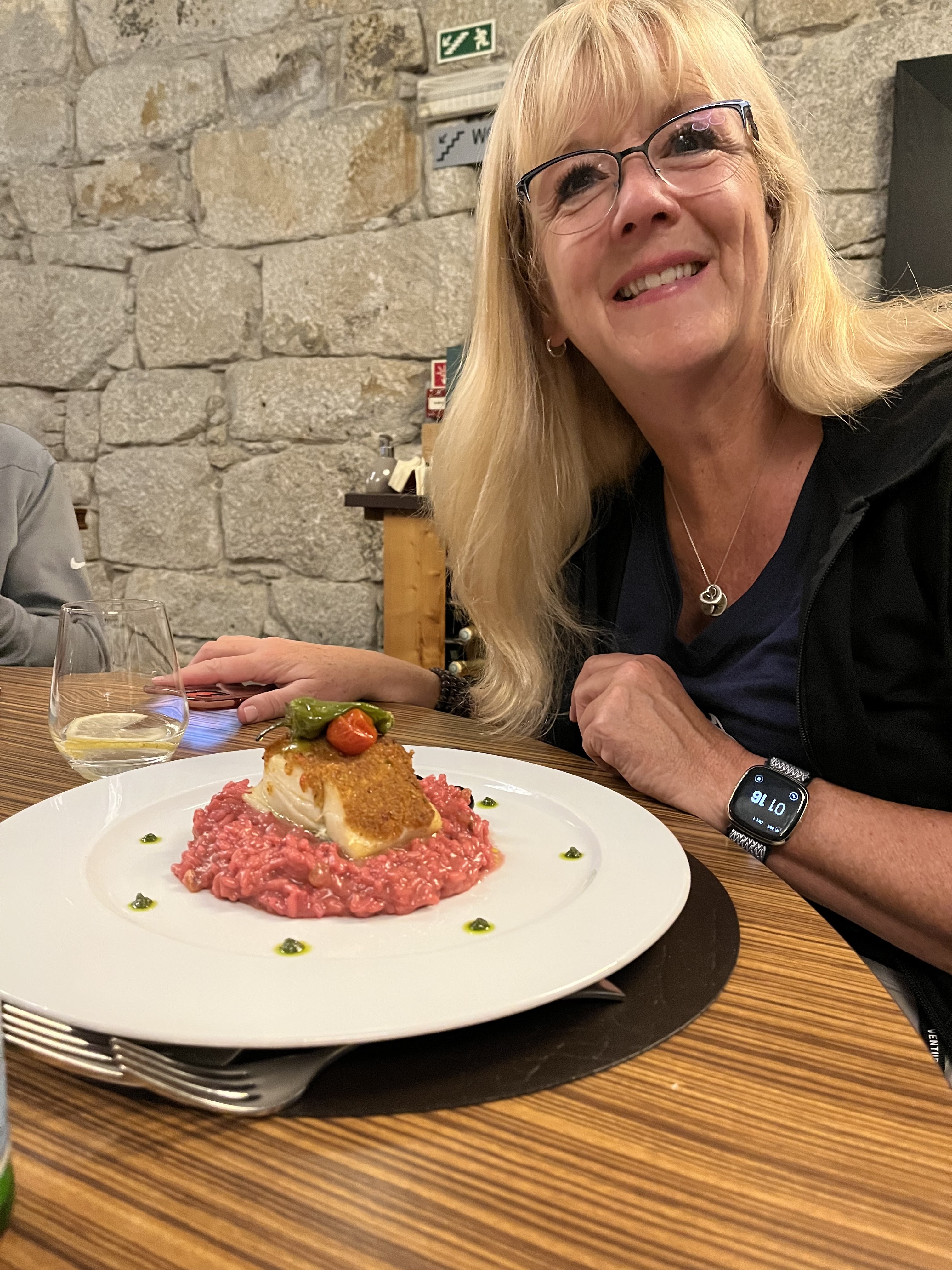
Dinner in Porto with two best friends I have never met before but will never forget. I had the Squid Pasta with shrimp and clams, and Mickey had the octopus with smashed potatoes and some veggie. Pam had the Baccalau with Risotto. We washed it all down with a bottle of Vinho Verde.
 
Then, for dessert, Mickey had a lemon-orange sorbet with a fabulous liquor. Pam and I shared a Tiramisu. OMG.

Friendships forged over such meals are destined to last forever. I love you, Porto!

Mickey had the octopus and smashed potatoes and a veggie. He looks happy, right? Mickey is a professor of psychology and religion at a Jesuit college

I had the squid ink pasta, shrimp and clams. OMG. To absolutely die for.

Pam had the Baccalau with Beet Risotto. Amazing (except, of course, for the bones; she wasn't expecting the bones).

We washed down our meal with a bottle of Vinho Verde.

Pam is a university professor of English and is active in Mothers Without Borders.


For dessert, Mickey had the lemon-orange sorbet with some kind of evil liquor they poured over it.
 

Pam and I shared a Tiramisu. How fabulous is that?


Tomorrow, we are off to the Duoro River Valley Wine Tour and then the rescheduled Fado concert and dinner. 

\

Oh, did I mention that the entire meal, soup to nuts, came to less than $30 Euro per person? 


Right.  


You know, right now, life is so damn good I can hardly stand it. This is what makes the hard times - when they come, and they always come -  a little easier to get through.

Camino: Dateline Porto, Portugal


My first view of Porto, across the bridge, at 6 PM

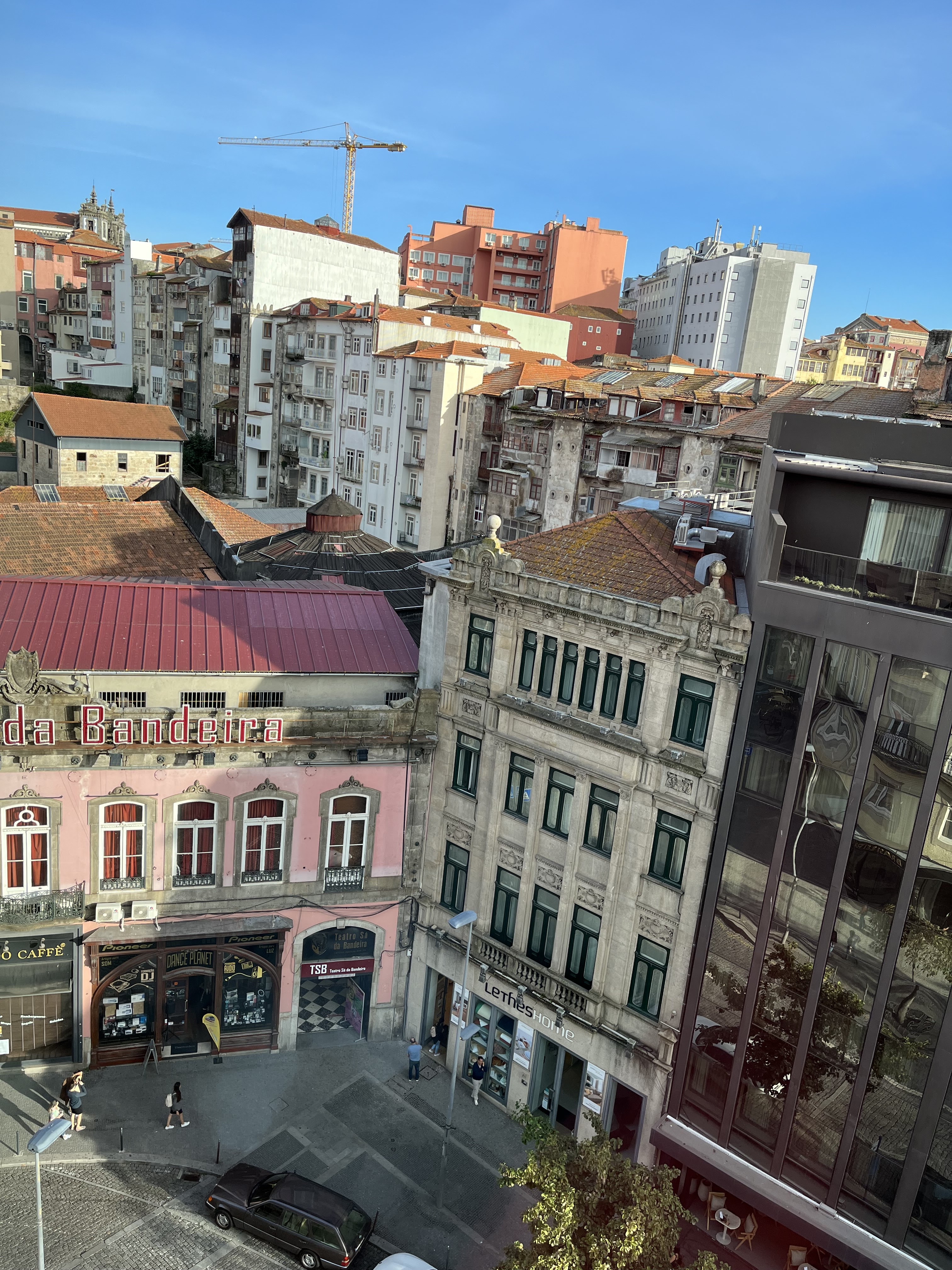
Good Saturday morning, comrades! It's the first day of October and I think the worst of jet lag is behind me. I am writing you from the beautiful city of Porto, Portugal where "a river runs through it" and the city is a very hip mixture of old European charm with modern international accommodation.

The church where I hope to attend mass early tomorrow morning is St. John's, which bills itself as "an International Church in the Anglican Tradition".

At least, I hope to attend early mass. Tomorrow morning at 9:30 AM, I am leaving with some pilgrims I just met to check out the Douro River Valley. 
 
We will be visiting two different wineries and doing some wine tasting at Quinta do Seixo - and having lunch there - and Quinta da Roeda. In between, we'll cruise the Douro River in a typical "Rabelo" boat.

I couldn't be more excited.


Today, I'm going to explore more of the city of Porto. I hope to meet up with the friend of a mutual friend for a bit of an afternoon tea.
 
Tonight, I meet up with my fellow Peregrino/a at 5:30 and we will walk to a theater not far from here to attend a wonderful (or so I hear) Fado Concert.

Fado pronounced: [ˈfaðu]; "destiny, fate") is a music genre that can be traced to the 1820s in Lisbon, Portugal, but probably has much earlier origins. Fado can be about anything but must follow a certain traditional structure. It is a form of music characterized by mournful tunes and lyrics, often about the sea or the life of the poor, and infused with a sentiment of resignation, fate and melancholy.
 
You can hear the influence of the Mores and the laments of the sea in every note.

Here's an example of my favorite Azorean singer Mariza singing one of my favorite Fados "Barco Negro"


It is the musical expression of "Saudade" that some who read this page or my blog may remember. It is a longing, symbolizing a feeling of loss (a permanent, irreparable loss and its consequent lifelong damage).

My grandmother played her guitara and sang Fado, something of which my grandfather was very proud, not only because of her beautiful voice and soulful playing but because, under the growing conservative regime that birthed the dictatorship of Salazar, and aided and abetted by the (Roman Catholic) church, at one point in time and in some towns, only men could sing Fado.


That my grandmother could sing it in this country was the manifestation of the freedom they sacrificed to attain for themselves and their children and their children's children.

But, there was always this longing for "the old country" - like the Israelites having been blessed with liberation from slavery and headed for The Promised Land but longing for the pomegranates in Egypt.

So, it's off into my day. I'm so excited to have conversations with people on the streets and in cafes. I want to learn more of why people from America seem to settle here.

I am already learning that Fr. Koumranian was right and "people is people" all over the world. My hostess at breakfast was a young woman named Rita, who talked about the Great Rush at 7:30 AM of "bus loads" of people - so many she couldn't seat them all at the same time. "So, what I'm going to do? I give them place in line. When one table finish, I fast clean, clean, clean and then another four people sit. Whew!"

I said, "Well, when you go home, you'll put your feet up and rest with a nice cup of tea."

"Oh no," said Rita. "My boy will say, "Mommy, Mommy, we go play ball. He's 5. His dad is . . . um . . . work until late today. So, I be Mommy and Daddy until tonight."


It was ever thus, eh Ladies?

Make it a great day, everyone.

Bom dia!

Barco Negro (Black (sail) boat) Translation
(The lament is "They are crazy")
 
In the morning, how I feared that you could find me ugly
I woke up trembling, laid on the beach's sand

But immediately your eyes told me the opposite
And the sun entered into my heart

Then I saw a cross stuck on a rock
And your black sailboat dancing under the light

I saw your hand waving goobye among the ready loose sails
Old women of the beach tell me that you will not come back

They are crazy... They are crazy...

I know, my love, that you, in fact, did not leave
because, everything around me tells me that you are always with me

You are in the wind, which spreads sand on the glass (of the windows)
You are in the water, that sings into the dying fire
You are in the warmth of the rest from empty seabeds
You are forever with me, into my heart/chest.

Friday, September 30, 2022

Camino: Dateline Fatima


Fatima and Faith

I saw a woman holding a baby. She was on her knees and she was praying the rosary as she held her baby. Her friend was walking alongside her, I suppose to take the infant if they started to fuss or need a nappy change.

It was only speculation but I had lots of questions about the “back story” to this obvious expression of piety.

Had she had difficulty conceiving or with her pregnancy? Had the fetus experienced some sort of health threat in utero or the neonate a physical insult at birth?

Was she there to give thanks or was she there, with her infant child in her arms, on her knees, saying the rosary, to make a special petition to the Blessed Mother who made a series of special visitations to three small children in the small, insignificant farming village in Portugal?

I was impressed that she, along with so many others, were there at Fatima not as tourists but as religious pilgrims, seekers on a path made by millions of others over the decades, to put their feet - or their knees - in the same place other pilgrims and seekers had before them.

I was surprised by two things: The vastness of the place and the sincerity of the people I saw and spoke with there, at the shrine.

I don’t know what I was thinking. I had this romantic expectation of a small grotto in the place of the apparitions. Maybe a statue of Francisco, Jacinta, Lucia, and, of course, Herself, the BVM.

But no. The grotto is a piazza- a HUGE piazza, bigger than the Vatican - with a Basilica of the Rosary on the hill at one end, and a chapel (ahem) that is able to seat 9,000 of the faithful.

In between is a place where you can buy and light candles, right next to a very small chapel which seats about 250 where the rosary is said and Eucharist is observed daily. In front of the Basilica is an outdoor chapel that seats about 150 but can be heard and observed by 10,000 in the piazza.

Very impressive.

What’s even more impressive than the vastness of the place is the sincerity of the people. These are not tourists. These are pilgrims. Straight up. Rock solid seekers.

The whole feel of the place is holy. Set apart to bring people together in prayer. Spiritual but also Religious.

There’s no one there hawking religious tchotchkes. No one trying to press rosary beads in your hand for a small price, just in case you forgot yours at home. Or urging you to buy candles or flowers to place at the base of the statues.

Oh, there are places like that. Lots of places. Just not there. You have to go up the hill and around the corner, away from the shrine and the faithful.

The people at the shrine are sincere. Let me tell you about that word that was told to me by a man named Richard, an Episcopalian and retired engineer.

When I used that word several times he told me that the origin of comes to us from the arts: sculpture, In fact.

The word sincerity comes from Latin. A statue that had no flaws and required no patching was hailed as a 'sculpture sin cera' or a 'sculpture without wax. ' The artist would sign the certificate of the piece “sine (without) cera (wax)” which meant it was genuine.

The phrase eventually came to mean anything honest or true. The English word 'sincere' reportedly evolved from the Spanish sin cera—'without wax’.

The folks I met or observed in Fatima are sincere, in the full meaning and sense of that word. They are the real deal.

No, it’s not my spirituality or theology. I do not feel the need or desire to, as Mary Oliver wrote in her poem “Wild Geese”:
You do not have to be good.
You do not have to walk on your knees
For a hundred miles through the desert repenting.
That does not mean, however, that those who do are wrong or bad or feeble-minded or have an inferior life of faith. Neither is it more excellent or pious nor does it please or displease God. The way they express their faith is different from mine but they are sincere in their expressions and I think that has worth and value in and of itself.

However, it does raise some interesting questions for me, questions that have been asked since people have been studying the great variety of religious expressions. Like:

Where does faith end and fanaticism begin? Is it okay to light candles to pray but does it then begin to cross a line when those candles are in the shape of a hand or a foot, an eye, a breast or an intestine and pray for an end to the pain or disease in that body part? (see the pictures below of the wax forms for sale)


What is inside the need to concretize belief? Was God onto some deeper, more complicated understanding of human need when the idea of the Incarnation was conceived? Is that not also what is behind religious figures and symbols in all religions, such as Ganesh and Shiva, Buddha, King David, or the Prophet Mohammad? 


What is a miracle? What constitutes a miracle? Did the three children – Francisco, Jacinta, and Lucia, ages 10, 8, and 7 – who were tending the family sheep when they saw an apparition of the Blessed Virgin Mother make up a story? 


Were they just seeking attention? Were they hallucinating? Were the government officials in Fatima justified when they jailed and threatened the children with being boiled alive in olive oil if they did not recant their story?


As a good pilgrim, my journey to Fatima raised more spiritual questions and bid me follow those questions to the answers that lie deep within my soul. I may never get an answer, but that's not necessarily the point.

The question is the point. And, following it faithfully, even if doubts are raised. As Fred Buechner once said, "Doubts are the ants in the pants of faith."

I am so glad I came here to Fatima as part of my Camino. My grandmother told me this story as far back as I can remember. It was pretty amazing to be here for that reason alone.

No, Fatima isn’t on the Camino path, but it has set my heart and my mind on The Way.

I am in Porto tonight, having had supper with four other pilgrims at The Majestic Café, one of the famous gathering places for artists here in Portugal since 1922. I’ll tell you more about that in the morning. It’s a breathtakingly beautiful city. I could honestly live here. I’m going to sleep in tomorrow and then explore more of Porto for myself.

I may not write every day but I will try to share my reflections with you. Truth is, sometimes considering and reflecting on the experiences and the questions they raise take up more time than I have to write about it.

Which, actually, is a wonderful problem to have, eh?

Buen Camino, my friends

Camino: Datline Lisbon

Bom Dia from Lisbon, Portugal. At least the sun is out and we're all eating breakfast so I'm assuming it's morning. I got about 3 hours of a fitful "cat nap" on the plane from Charlotte to London.

They don't call it "the red eye" for nothing.

I thought I might catch a few winks in the lounge at Heathrow but that just wasn't going to happen. After a long layover and a flight delay, I finally got into my hotel room a little after 1 AM. I think I finally fell asleep around 2:30 and then up at 7:30 to shower and get myself organized for breakfast and the trip to Porto.

I'm going to head out in a few minutes, after I finish my coffee, and walk around this part of the city. Then I meet up with a few members of my group before we head off to Fatima. We'll visit the shrine and attend mass then lunch and off to Porto.

I'm hoping to meet up with a friend of a friend (all Americans seem to have a friend of a friend) in Porto. I'm so looking forward to discovering a little more about that city and why so many American ex-pats live there.

I've made some time at the end of my Camino to come back to Lisbon where I'll do a little more exploring here. I want to check out the Fado Museum and go to a Fado concert. But, once again, I'm getting out ahead of my skis. It's in my DNA.

One last thing before I head out for the day: It's amazing to me to be in a place where so many people look like me. Seriously. The waitress this morning could be my cousin. It's not just her coloring or her facial features. It's the way she tilts her head when she smiles. It's the inflection in her voice - even in English. It's the commitment to hard work - to go the extra mile and consider it just part of the journey.

I think I'm home. I think I found "my people".

Sleep? Who needs sleep on Camino?

More later.

Bom dia.
 

Thursday, September 29, 2022

Camino Thoughts from Heathrow


“Hey Rev,” said the note. “I hope you get this. I lost your phone number. I wanted you to know that Mom passed on Monday. She loved you. She always said, “Rev. was the priest who loved us.” And, you did. You really loved us. So, I wanted you to know that she passed. Here’s my phone number. Please call when you get this.”

That was the message hidden in my Messenger. I usually don’t bother with Messenger- especially with those with whom I’m not friends on FB. Too much junk mail.

Something told me to check this one. I’m glad I did. What a great way to start The Camino.

I called her on my way to the airport. Lord, she sounded just the way I remember her about 30 years ago.

I had been called to the St Barnabas AIDS Resource Center. Well, +Jack Spong asked me to take the position of ED of that agency. And, he said, "You’ll also be the Vicar of St. Barnabas Church. It’s a little congregation that you’ll help have a good death, and you’ll write a grant to keep the Resource Center going."

This was Newark, NJ. It was around 1991.

AIDS had landed in Newark and it was hitting the Black community. Hard. Women and children mostly.

The wives and kids of “recreational drug users,” and/or guys “on the down low” but also some hardcore addicts. Some of the women were Ladies of the Night. They also doubled as Ladies of Afternoon Delight in the front seat of the BMW and Porches that came up from Broad Street where the “suits” – the bankers and Million Dollar Round Table men – worked before going home to their wives and families in the wealthy “bedroom communities” in the suburban towns of Summit and Morristown, Bedminster and Chatham.

I’ve got stories to tell about my work with those ladies and what they taught me but they are going to have to wait while I give props to Ms. Louise. They won’t mind. They loved her, too.

Ms. Louise was affectionately known as The Matriarch of the church. Texts in Congregational Development title that position “The Gatekeeper”. She was all that and more.

From her porch on 11th Street, she pretty much ran the church and the neighborhood. She knew who needed help and who was running a scam. She knew which husband was running around on which wife and vice versa.

It was Ms. Louise who first brought me to the Saturday morning neighborhood hair parlor - held in the living room of someone’s home - where you could get your hair straightened, colored or a “weave” while your friend got a bootlegged copy of the latest movie on VCR.

You could also get a dress or shoes that “fell off the back of the truck” along with cosmetics “brought in from NYC” which were specially made to help black skin when it got “ashy”.


But you also got “kitchen table socio-political analysis”. Let me give you an example.

I remember a conversation about Bill Clinton and how “he was actin’ the fool”. It was 1993 or ’94, I think. Example after example was given about his behavior which was met with concerned tut-tuts, groans, occasional rueful laughter, and some serious eye-rolling.

After the women had expended themselves, a hushed silence fell over the room while the women waited for one of the wise, older women to render her socio-political analysis.

“The man’s been into the hooch,” came a high, thin voice from the corner. It was Ms. Louise, whose comment was greeted with a chorus of “Uh-huh,” and “Amen,” and “You know it,” and “Tell it, sister.”

I was amazed. Now, they loved Bill Clinton. And, Hillary. But, all these rumors around him being “a lady’s man” were starting to be a distraction. I don’t know if Bill had a problem with alcohol. He sure had a problem with women.

But, those women knew. They knew the same way they knew when their husbands had been unfaithful or one of the kids had snuck out of the house after midnight or come in at 3 AM, but never said a mumblin’ word.

I have so many memories of Ms. Louise, but the one I’ll never forget is the Easter Vigil we had my first year at the church. I had convinced them that it was a beautiful liturgy and worth the effort.

When I got there in June, the year before, there were 15-20 or so people in the pew. In a little less than a year, there were between 45-50 in church every Sunday.

That Easter Vigil there were 90 people in the pew and I baptized 12. I had only planned to baptize 8 but four people I had never seen before felt moved to be baptized and presented themselves at the baptismal font.

As a fairly newly ordained priest I could hear my seminary professors and field education supervisors warning me about “proper preparation for the Two Great Sacraments of the Church,” but, you know, as Ms. Louise used to say, “When the Spirit say, do, you gotta do.”

And so, I did. It was glorious and exhilarating and it was well with my soul.

Which reminds me of sitting on Mr. Louise’s porch with her husband, Frank, on a Sunday afternoon, having had a wonderful lunch of fried chicken wings and greens and cornbread, just talking about this and that and greeting neighbors as they walked by who told the story of their day. Sometimes – well, often – as my visit would be drawing to a close, we’d sing some hymns.

Ms. Louise loved “It is well with my soul.” Frank would join in, singing the low part and sometimes the neighbors would come in with some of the sweetest harmonies that were enough to make the angels weep.

I was delighted and not at all surprised when her daughter assured me that they would be singing that hymn at her funeral. She said she sang it to her on her deathbed, which made me weep right there in the car on the way to the airport in Salisbury, Maryland.

I’m not going to be able to be there in person for the funeral, the date for which has not yet been set, but it will probably be while I'm on Camino. I will be there in spirit.

I’m writing this in the airport lounge at Heathrow. I got maybe a 3-hour catnap on the plane. I have absolutely no idea what time it is in my body, but it’s a little after noon here in London. I have a 9-hour layover so I’ll be here for a while. I wanted to get down these thoughts before I take a wee bit of a nap. Or, at least close my eyes.

Everyone who has ever done The Camino will remind you that the pilgrimage really begins when you leave your door. I think The Camino begins when you begin to think about walking The Camino. At that point, the universe begins to send you messages, loud and clear, about the stuff that is deep in your soul that is yearning to be seen and acknowledged and appreciated.

I have slowly been reaching the decision that this is my last stint as a parish priest. Oh, I will still help out here and there. I will cover for my colleagues when they are ill or on vacation. I am sooOOoo looking forward to being a member of a healthy, stable congregation where I can help when and if needed.

But, interim ministry? “Part-time pastor”? “Regular supply” or, as some call it here “Supply plus” (sounds like a box of laundry detergent, right? Grrr . . . )? No. No thank you. I’ll pass. Or, at least, the time for doing that for me is passed.

As I settle into the reality of that decision, it is well with my soul to have this reminder that a family to whom I served as pastor (Vicar) over 30 years ago, still remembers me. And, they remember me as “The priest who loved them.”

I would like to think every congregation I’ve served would remember me that way. Maybe some do. Probably some don’t.

But the truth is that I have truly loved every congregation I’ve served. Even the difficult ones. Loved ‘em with tough love.

Even the ones with sheep that attacked. Even the ones that needed their organizational infrastructure rebuilt from the ground up and had no idea what that required and were like “sheep without a shepherd”.

And yes, even the ones I had taken as far as I could and had to leave like Moses, never to see the Promised Land.

I was the priest who loved them, even if they don’t remember me in that way.

Well, one does. And, you know, that’s more than I expected.

One is enough for a lifetime.

It’s certainly the best way I know to start The Camino.

It is well with my soul.

Buen Camino!

Sunday, September 25, 2022

What does it take?


St. Paul's Episcopal Church, Georgetown, DE

Pentecost XVI - Proper 21 

September 25, 2022


Luke’s gospel presents us with some complicated and complex and often confusing parables. What are we to make about this morning’s parable of The Rich Man and Lazarus?

Lazarus – not the friend of Jesus raised from the dead in Bethany but another man named Lazarus – (that Lazarus) ends up in heaven, and the rich man in hell. We don’t know the offense committed by the rich man that landed him in hell. Scripture tells us he had nice clothes and ate well and expected the poor to wait on him. Is being wealthy and arrogant sin?


Lazarus was poor, sick, and hungry; that’s really all we know about him. Did that, alone, land him a place in heaven? Or, did he do something great, something altruistic and noble that cost him everything he owned and resulted in his poverty and ill health? We don’t really know. Jesus doesn’t mention that the rich man became rich by stealing or embezzling, or that Lazarus was a great spouse and self-sacrificing father.


Morally, how are they different? The answer is, we don’t know.


Perhaps it’s not about being a scoundrel or a saint. Perhaps this is about being human and, despite how much money you have or how nice a person you are, people are just people, and God loves us all, no matter what.


On my last Sunday with you, I want to share one of my favorite stories about the early days of my ordination. I’ve told this story many times over the years but, for me, it never gets old. 


It was 1986. I was a newly ordained priest, a Chaplain at the University of Lowell in MA. And, I admit, I was feeling, well, maybe not in control but at least on top of the word. Truth be told, after three years of seminary and having passed the rigors of the ordination process, I was pretty full of myself.


It was in my capacity as a university chaplain that I first met Fr. Koumranian, the pastor at the Armenian Orthodox Church in Lowell. For some reason unknown to me, Fr. Koumranian took a liking to me – or, maybe he was simply intrigued by a “woman priest” – and decided that I should learn the “real” liturgy of the church. So, he took me under his wing in one of the most delightful and important mentor relationship I have ever known.

He was called “Father” so I, of course, became known as “Mother”. That’s not what I wanted; it’s what he insisted. He would call me and, in his heavy Armenian accent, begin, “Mother? Dees is Father. We are having baptism at church. It would be good for you to learn Divine Liturgy. It would be good for my people to see woman priest. You come.”

Mind you, that wasn’t so much an invitation as an expectation. I was thrilled. I went. Every time. No exception.


One evening, he called. “Mother? Dees is Father. Der is funeral Wednesday. It would be good for you to learn Divine Liturgy. It would be good for my people to see woman priest. You come.”

Nothing was so important that couldn’t be rearranged so that I could be there.

There was smoke. There were bells. There was chanting. I admit that I loved it all in that beautiful mosaic tile sanctuary.


When it came time for the eulogy, I looked around the church and saw that it was filled with lots of old Armenian men and women, all dressed in black. 


I thought sure the eulogy would be spoken in Armenian and I could meditate quietly while he preached. To my surprise, Fr. Koumranian walked into the aisle, near the casket as he began the eulogy.

“Der are people in dees world,” he said, “who are always making you happy. You see dem walking on de street and your heart leaps for joy, for dey are making you so happy.”

He put his hand reverently on the casket and said solemnly, “Dees . . . is not one of dos people.”

I was, in a word, stunned. I shut my eyes tight. All I could think was, “Don’t let my face show what I’m thinking.” Which was, “What in the heck is he doing?” When I opened my eyes, I could see the front row of women, including the man’s widow.
They were all nodding their heads in agreement.

Fr. Koumranian continued, “But, isn’t God – our God – so wonderful, dat now – even now – even one such as dees is resting eternally in de arms of Jesus? Because, you know, eets true: People is people. And, God is God.” And then he said, “Ah-min,” and sat down.


Sometimes, when you least expect it – but, often, when you need it most – God brings people into our lives to help put us right into our place. Fr. Koumranian, for me, was one of those people. He died many years ago, but lives on in my heart.


Over the past 36 years, whenever I’ve felt just a little too big for my britches, I remember this important lesson from the early days of my priesthood, and I think about the lesson Jesus taught his disciples through many parables – especially The Rich Man and Lazarus.


Fr. Koumranian’s greatest lesson to me was one the Rich Man neglected to learn. It is the lesson of Servant Leadership: I am – you are – here not to be served, but to serve.  Our baptism in Christ makes that clear. Those who are ordained to the priesthood – as the reading from the Book of Hebrews (5:1-10) reminds us, “according to the order of Melchizedek” – are to lead the people of God in servant ministry.


As Jesus himself has said to his disciples, “ . . . .whoever wishes to become great among you must be your servant, and whoever wishes to be first among you must be slave of all. For the Son of Man came not to be served but to serve, and to give his life a ransom for many."


That has been my goal since my very first day with you – to model for you what it means to be a servant leader and lead you into servant ministry. I may not have always done that with grace and style – there have been times when my frustration has gotten the better of me, especially before I realized just how decimated the organizational, corporate infrastructure had become here at St. Paul’s – but I have always done it with the heart and mind of a servant leader.


I know that the leader – laity or ordained – sets the tone. I have always tried to be optimistic, energetic and enthusiastic about what I’ve seen here: The possibilities. The potential.


As I hear the parable of Lazarus and the Rich Man, I have come to understand that the moral measure of each person does not factor into the lesson Jesus is trying to teach. What if the most important thing on your early report card is not having been right? Or, experienced? Or, the one with the best attendance or the longest record or served as Warden or sat in the pew?


What if the most important thing is not being morally impeccable, but how you treat the poor? What if the worst sin is to get rich and complacent and forget about those who are suffering? To have food and shelter and be impervious to those who are hungry and homeless?


What if it’s not going to matter to God where we worship or even how we worshiped – whether the vestments were the right color for the liturgical season, or that there was a HVAC (heating or air conditioning) system throughout the church, or there was a state of the art sound system, or a fully functioning, professional choir – not HOW we worshiped but THAT we worshiped?


What if all that is really going to matter to God is that we pray, in the words of Great Thanksgiving in the Service of Morning Prayer in the BCP, “not only with our lips but in our lives.” That there is at least some shred of consistency and integrity in what we say on Sunday and what we do on all the days of the rest of the week?


At the end of the day – or, at least, at the end of this parable – it doesn’t matter to God whether you are rich, fat and arrogant or poor, sick and hungry. It doesn’t even matter what you say you believe. What matters to God is what we do with what we’ve been given. 


Today is the birthday of one of my favorite children's authors, Shel Silverstein. In his book, "Where the Sidewalk Ends," he writes:

How many slams in an old screen door?
Depends how loud you shut it.
How many slices in a bread?
Depends how thin you cut it.
How much good inside a day?
Depends how good you live 'em.
How much love inside a friend?
Depends how much you give 'em.


Or, as my dear friend, Terry Parsons, often asked, “What do you do with all you’ve been given after you say, ‘I believe’”? 


Whether you are a scoundrel or a saint, here’s the Gospel truth: God loves you more than your wildest imagination. 


And, God loves us more than any of us deserve.


Because, in the words of one of my favorite priests, ordained according to the order of Melchizedek, “People is people. And, God is God.”


Amen.