Come in! Come in!

"If you are a dreamer, come in. If you are a dreamer, a wisher, a liar, a Hope-er, a Pray-er, a Magic Bean buyer; if you're a pretender, come sit by my fire. For we have some flax-golden tales to spin. Come in! Come in!" -- Shel Silverstein

Monday, July 12, 2010

Lilies of the field.

This the new "Green Season" frontal we've recently acquired for the church.

It's part of an entire set that was created, designed and made by Colleen Hintz of Fruit of the Vine Vestments. 

Isn't it beautiful?  Wait till you see the rest!

You'll notice lamb's ear all across the bottom of the frontal. From left to right, there are three Iris, one Tulip, three Hyacinthe, two white Daffodils, two more Iris, two red Tulip and three yellow Daffodils.

What you can't see are the lady bugs, wasps, bees and dragonfly whimsically sewn in here and there.

 On your left is the hanging in front of the pulpit.

You'll see two Columbines, representing the Holy Spirit.  If you look closely, you'll see another wasp moving close to the Columbine (Don't you just love the symbolism of that?)


On your right is the hanging in front of the lectern.  There are two Iris and a three Lilies of the Valley on either side.

Both hangings have wasps buzzing around the flowers, but the one on the lectern, appropriately, has three.

Here's the frontal again with the burse and veil, which feature water lilies.  There is a tad pole (symbol of fertility, change, and renewal) sitting on the leaf of the water lily on the veil.
The chasuble and stole are simply breathtaking.

The chasuble has a frontal piece with the following flowers: three Violets (representing humility), a Columbine (representing the Holy Spirit), a few red Carnations (symbol of pure love), a few Daisies (representing innocence), an Anenome and two different Iris (two Lilies of the field).

A large monarch butterfly dances at the top of the frontal piece just to the left of the Anenome.

The stole has a Lily of the Valley on the bottom. Moving up the left side of the stole, you'll see an Iris, a Narcissis and a Turk's Cap Lily with a humming bird on the top.

Moving up the right side of the stole, you'll find an orange Tulip, two Iris, and a butterfly. There is also a large monarch butterfly at the neck of the stole. 

There is a frog on the bottom of the right side of the stole, and various lady bugs, bees, and wasps flying whimsically around the flowers.

The entire set is made of dupioni silk. Dupioni is a shimmering silk that is created by weaving silk threads of two different colors into a weave that seems to change colors as the silk is moved around in different lights.  This one is a light green with very light blue threads. It picks up the blue in the sanctuary carpet in a most amazing way.

Constructed with threads made from rough silk fibers that are harvested from double cocoons or single cocoons that are spun side by side and interlocked, dupioni silk creates a shimmering effect. The two different colors of rough silk fiber help to create a very light, crisp drape quality to the finished fabric.

It does have the disadvantage of only being able to be dry cleaned, and the minor inconvenience of never being able to be steamed. It is best pressed with a 'pressing cloth'.   

Colleen Hintz has been designing and making vestments and hangings since 1980.  She made our Creation Season (this link will take you to my blog post about it) set, our Holy Week and Rose Vestment Set as well as a "personal journey" stole for me. Sorry, I don't have a picture of that one but you can see samples on her web page. Just click on "Galleries" then "Personal Journey."

A side note too good not to include: While you're there, check out the page for Reconciliation Season - a "liturgical season," created at Church of the Redeemer, Morristown, which includes the Sundays between the Feast of Absolom Jones and Martin Luther King, Jr.

Reconciliation Season tries to raise awareness about racism.  Each of the pieces of the hangings and vestments contain a pattern from the Underground Railroad - designs that were hung on the clothes lines or otherwise outside the "Safe Houses" which gave direction and/or information to those fleeing slavery.

It's a very, very powerful collection.  The one I love most is that the design that designated a "Safe House" - a place where fugitives could find shelter and hiding - is on the altar frontal.

Check it all out at Fruit of the Vine Vestments.  (Yes, this is a shameless plug for my dear friend who really doesn't need it because her work speaks for itself. You'll also note while you're there that she's done some amazingly beautiful work for Bishops Croneberger, Beckwith and Singh.)

With a little persuasion, Colleen - who is a full time Public Health Nurse, former Senior Warden and present chair of the Search Committee at Redeemer, Morristown - will be happy to come to your church or organization to talk about the history of these quilts.  It's a wonderful, creative, educational event. 

The "Lilies of the Field" will be blessed and dedicated next Sunday, before we begin the service.

It really has to be seen "in person" to be appreciated, so, if you're ever in the area during "The Green Season," stop by.  The church is open every day for meditation and prayer.

Come and consider the Lilies of the Field from Matthew 6:25-31:
"Therefore I say to you, do not worry about your life, what you will eat or what you will drink; nor about your body, what you will put on. Is not life more than food and the body more than clothing?
Look at the birds of the air, for they neither sow nor reap nor gather into barns; yet your heavenly Father feeds them. Are you not of more value than they?
Which of you by worrying can add one cubit to his stature?
"So why do you worry about clothing? Consider the lilies of the field, how they grow: they neither toil nor spin; and yet I say to you that even Solomon in all his glory was not arrayed like one of these. Now if God so clothes the grass of the field, which today is, and tomorrow is thrown into the oven, will He not much more clothe you, O you of little faith?
"Therefore do not worry, saying, "What shall we eat?' or "What shall we drink?' or "What shall we wear?' For after all these things the Gentiles seek. For your heavenly Father knows that you need all these things. But seek first the kingdom of God and His righteousness, and all these things shall be added to you.
Therefore do not worry about tomorrow, for tomorrow will worry about its own things. Sufficient for the day is its own trouble."

Sunday, July 11, 2010

Bella Gail's Baptismal Love Letter

Image from Theology Kung Fu
A Baptismal Love Letter for Bella Gail
Pentecost VII – July 11, 2011
The Episcopal Church of St. Paul, Chatham, NJ
(the Rev’d Dr.) Elizabeth Kaeton, rector and pastor

Dear Bella Gail,

When it is at its best, the church provides a place for complete strangers to meet in a moment of importance wherein lives are changed and transformed.

You and I have never met before today and, by the time you read this, hopefully, as you prepare for Confirmation, we may never have been in each other’s company again. Such is the way of our fast-paced world.

The church is no different. Because of this moment, however, you and I and everyone here – and some who are not, along with those who are here only in spirit – will always be connected in the mystical ways of our understanding of Baptism.

This morning’s gospel story (Luke 10:25-37) gives us a little glimmer, a hint of an understanding, of how that works.

A lawyer stood up to test Jesus by asking him a question about eternal life. And, in the way of Jesus, he tested him right back, asking him, “What is written in the law?”

Of course, the lawyer knew the law: "You shall love the Lord your God with all your heart, and with all your soul, and with all your strength, and with all your mind; and your neighbor as yourself.”

But, this was to be a test for Jesus, so the lawyer pressed the issue one more time. “And who is my neighbor?” he asked. Jesus did what Jesus often does: he told a story.

This particular story is one about a man on a journey from Jerusalem to Jericho who was beaten and robbed and left on the side of the road to die. He was passed by three people: A priest, a Levite, and a Samaritan. The first two crossed the road to avoid him, but it was the Samaritan who stopped to provide assistance.

You have probably already figured out, Bella, that the world is not a fair place.

I suspect that at least several times in the past few years, you have put your hand to your hip, stomped your foot and said to your parents, “But, it’s not fair.”

And, I suspect, you may have been right – especially for the youngest child in the family. If you ask your older sister, she’ll probably say the same thing about being the oldest.

If you ask your parents . . . Well, never mind. If you’re a normal teenager, you won’t ask them anything. I have learned that you have to wait to be grandparents for kids to ask you important stuff.

Life is not fair. Nothing is fair. We can only ask ourselves, "Is it fair?" and try to be as fair as we can in the face of the gross injustices of life.

Levites were a tribe of Israel who served particular religious duties for the Israelites and had political responsibilities as well. In return, the landed tribes were expected to give tithe to the Levites, primarily because they were the only tribe to receive cities but no tribal land.

In fairness, this particular Levite may well have been on his way to Temple and, if the man on the side of the road were, in fact, dead, ritual law would require him not to function until he had undergone ritual cleansing. That could take days. Can’t miss out on Temple for a dead man. It wouldn’t be fair.

Likewise, the priests were also a class of people set apart for specific duties in the Temple. This priest may also have been on his way to Temple and while his duties were different, he was also bound by the same purity codes as the Levite.

Besides, he would be leading the services. It was simply not fair to expect him to take up his time tending to someone who might already be dead.

The Samaritan, however, was bound by no such purity codes. Samaritans, being a people from Samaria, an area of great diversity of cultures, were known to engage in intermarriage. Because of this, they were considered the ‘mongrels’ – the ‘outcast’ of ancient Israel – and so they were already considered “unclean.” It was only fair that he, of all people, should tend to the man.

Never mind that the man who lay dying was the one who suffered the greatest injustice. Never mind that it was not fair for an innocent man to have been robbed and beaten nigh unto death. There are rules to keep and scripture to be followed.

My dear friend and fellow colleague, Tobias Haller, recently wrote: “God is the foundation, who gave us Reason before he gave us Scripture, and when the written word was shown to be plainly insufficient, gave us the living Word of his son Jesus Christ."

Life is not fair, Bella. You walk down the street and suddenly, you are beaten and robbed, the value of your humanity reduced to the content of your wallet or purse. It's not fair.

If your grandmother Gail, for whom you were named, were here, she’d be one of the first to teach you that and make sure you learned it. Good people often do bad things for what they believe are all the best reasons. Bad people sometimes seem to do quite well, gaining all the outward and visible signs of success and respectability and honor.

Life is not fair. We all live busy, important lives. It's not fair to ask us to go out of our way to help a perfect stranger. Yet, even the lawyer who was trying to trick Jesus understood the importance of mercy and justice.

We can only ask, “Is it fair?” We can only try to be ‘fair’ – to act justly and fairly and with mercy – in the face of the gross injustices of life.

Indeed, when we engage life fully, when we care for those less fortunate than ourselves - even total strangers - when we take the risks of the gospel, applying our God-given intellect and reason, we can overturn the unfairness of life and make this place – this world – indeed, even the church – a place where mercy and peace and justice roll down like an ever-flowing stream.

The truth is, Bella, the world is full of scoundrels and thugs, liars and cheats. It is also filled with good people who sometimes do bad things, all with good intention.

You may find, as you journey through life, that both kinds of people can drive you right round the bend. You may move from your childhood stance of saying, “It’s not fair!” to crying out, “What’s the point?”

What's the point of relationships? What's the point of church - of sharing important moments in your life with perfect strangers?

I’m reminded of the ending of a great movie called, “Annie Hall.” It will be considered ancient by the time you read this, but I’m sure your parents can help you find it in a film library somewhere. The character, Alvy Singer, says,
“I thought of that old joke, y'know, this... this guy goes to a psychiatrist and says, "Doc, uh, my brother's crazy; he thinks he's a chicken." And, uh, the doctor says, "Well, why don't you turn him in?" The guy says, "I would, but I need the eggs." Well, I guess that's pretty much now how I feel about relationships; y'know, they're totally irrational, and crazy, and absurd, and... but, uh, I guess we keep goin' through it because, uh, most of us... need the eggs.”
Life is not fair.

The church is often not fair. It is often filled with totally irrational, and crazy and absurd people. You know. Just like most families. To be in relationship with them can be maddening.

But, that’s what you’re baptism does today.

It places you in a mystical, deeply important relationship with total strangers – some of whom are like the Levite and the priest who put their own needs before others, but many more of whom are like the Samaritan.

Either way, I’ll tell you what, Bella: more often than not, the eggs you get are totally worth it.

Welcome to the church, Bella. May you grow in awe and wonder of the mystery of life as you grow in your relationship with God in Christ. In times of trouble, know that you always have a spiritual home here.

As Robert Frost once said, “Home is where, when you have to go there, they have to take you in.”

That place is here.  Flawed. Faulted.  Not perfect. It's the church. And, after this morning, it will forever be your spiritual home.

When it is at its best, the church provides a place for complete strangers to meet in a moment of importance wherein lives are changed and transformed.

Welcome!

Amen.

Saturday, July 10, 2010

Rain

There is a gentle rain falling this morning, lowering the scorching high temperatures of the past few days, and bringing welcomed relief from the oppressive heat and humidity.

Thanks be to God.

Except, of course, it's Saturday. Some people are deeply disappointed.

There are those who work hard all week - many behind a desk, in front of a computer, in a small work cubicle - who have been catching glimpses of the sun from their office window.

They have spent most of the week half-grumbling about the oppressive heat and missing the sunshine while the other half of their psyche longs to be at the ocean or by a mountain lake, or just about any place else instead of in central air conditioning in an office in the city.

Never mind that they are in a job where there IS air conditioning. Never mind that this job may well be - or, may have once been - their "dream job" which allows them to have that home and that car and health insurance and pension, with every weekend off and take that fabulous vacation that's coming up in two weeks.

It's raining THIS weekend. Bummer.

You can please some of the people, some of the time . . .

The first time I went to visit my dear friend Rob in Hawai'i, I was thrilled to finally arrive in 'Paradise'.

It was mid-March in Honolulu. I marveled at the lush green hills which seemed to "grow" houses on the side of them. Beautiful flowers seemed to be everywhere and there were bushes - BUSHES! - of poinsettia.

And then, there was the weather. As we drove to his apartment from the airport, I was amazed to travel through several rain showers in the forty-five minute trip.

It would rain - sometimes softly, sometimes in downpours that felt like someone was dumping a bucket of water on our path - and then, a few minutes later, the sun would be out, shining brightly again.

Sometimes, the sun shone even through the soft sprinkle of rain.

As we got out of the car, I turned and looked and ahead of us was Diamond Head - an inactive volcano which was once contained a WWII Army base of operation where my father once worked. It's now a tourist museum.

Arching its way over Diamond Head was a large, beautiful, vibrantly colored rainbow.

I gasped at its beauty. "Oh, look!" I exclaimed. An amazing rainbow!"

Rob poked his head around the corner, considered the site before us, shrugged his shoulders and said, "Yeah, yeah, yeah. You'll get used to that. We get one of those four or five times a day."

You can please some of the people some of the time . . .

I understand.

I think I've probably spent half of my life longing to be someplace - anyplace - else. When I lived in the noisy, gritty City I longed for quiet beauty of the rural area. When I lived in the rural area of Maine, I longed for the activity and excitement of the Urban scene and grumbled about lack of public transportation.

If asked, I could tell you about life in the serious suburbs. Thoreau didn't write about "lives of quiet desperation" for nothing. The silence is sometimes so loud it's deafening.

Indeed, I probably spent the first third of my life wishing to be someone else.

Not Portuguese. Not immigrant working class. Not living in a tattered-and-torn-at- the-edges New England mill/factory town. Not female in a male-dominated culture and society. Not married. Well, not to THIS man. Okay, not to any man. Not queer. Not queer and female with children. Not queer and Christian.

What a complete and total waste of time to wish you weren't something God made you. Somewhere along the line (and, after spending a boatload of money in therapy), I figured it out.

If you are a banana, there is no sense wishing to be an apple.

The only thing to do is to be happy for the apple (and the orange, and the pear) but rejoice that you - YOU - are a banana!

Yes, be part of the 'fruit salad' of life, but be sure to find companionship and community with other bananas.

And, try and be the best damn banana you can possibly be - the best of the bunch, the 'top banana' as it were - so you can help other bananas (and apples, oranges and pears, along with papayas, mangoes and peaches) be all that they can be.

As Oscar Wilde reportedly said, "Be who you are. Everyone else is already taken."

Beyond the particulars of our lives, however, I think there is something in the human psyche which is never satisfied - even with the good things. The truth is that sometimes, the things which we think are burdens are actually the things that make us unique. Make us who we are. Give us the things we need to know and the paths to knowledge which we need to continue our life's journey.

Sometimes, the only time we get to think about these things and consider them carefully is on days when we have to change our plans. Slow down. Reconsider.

Because, well, it's raining.

Meanwhile, the earth and Her plants and animals are getting relief and nourishment. Meanwhile, life is going on all around us.

Meanwhile, the day is calling.

"One day tells its tale to the next," the Psalmist says. "Deep calls upon deep."

"This is the day the Lord has made. Let us rejoice and be glad in it."

This day, this rainy day, may be the most important day of your life. To do something totally unplanned. Spontaneous. Something you hadn't considered doing when you woke up this morning.

You might find yourself considering taking an action that will change what you need to change - or, at least, make a start at it.

Or, you might choose to finally, at long last, cherish and hold onto what is most dear - because you finally had the chance to consider what's really important.

Or, you simply may choose to lounge around the house in your PJs and grumble about the weather and all your lost plans.

That's alright. You may never know grateful your body is for this time, and how much you need this time to rest.

Everybody needs the luxury of being lazy every once in a while.

Meanwhile, a gentle rain is falling in soft patterns on my window. The earth is thirstily soaking in every drop. Little kids are already outside, squealing delightedly in the warm rain.

Makes no difference to them: beach, pool or front yard in the rain. It's all about water and getting wet and having fun - making fun right where you are.

Every now and again, the sun tries to shine through.

I'm thinking that we just may get to see a rainbow today.

I could get used to that.

Friday, July 09, 2010

Friendship

I had dinner last night with two old friends.

Well, one of them I've known since around 1995. The other has been his partner for about five years. I am deeply fond of them both.

In one way, our time together was nothing really special. We talked and talked, ate a wonderful meal, talked and talked some more, catching up on the various and sundry details of our lives since the last time we really had time to talk.

I suppose if our conversation had been recorded last night and played back to us this morning, we'd all be bored out of our minds and more than a little embarrassed by the banality of it all.

Spouses. Family. Grandchildren. Work. The church. Birthdays. Anniversaries. Upcoming weddings. Old friends. The various characters in the ongoing saga of "As the Anglican World Turns." A little politics. The latest scandal.

These are the simple threads of the complex patterns in life's fabric.

I love it when you can sit down with friends and suddenly realize that you have picked up the conversation where you last left it.

Sometimes, friendship is like a sweater you're knitting or a piece of needlework you've been fashioning.

You put it away for a time, take it up again, pick up the yarn or threads left dangling, remember the pattern and before you know it, you've finished yet another piece of the art and craft of friendship.

When we greet each other and someone asks, "How are you?" no one ever stiffens their back, plasters a smile across their face, extends a hand and says, "I'm doing quite well, thank you."

We throw our arms around each other and say, "I'm doin' okay." Or, "Better, now." And, if that's not the complete truth, we know that the story will unfold, eventually."

I love it most that we don't have to pretend or be "nice". We know too much about each other to get sold that bill of goods.

We've seen each other at our worst and our best and love each other all the more for the sublime humility and inherent beauty of the truth that none of us is perfect, and no one has to live up to the other's expectation.

However, if we're not living up to our own "personal best", we are unafraid to call each other to a higher standard.

We can just be honest. Human. Real. But not the kind of "keepin' it real" that's just an excuse for social vulgarity - although we are not above an occasional sojourn into vulgar humor.

Indeed, sometimes we share rather raunchy jokes with each other - or drop a few "silent obscenities," mouthing words we'd never utter in the "polite" company of some others - even in our circle of friends.

Yes, our conversation can also wander very close into gossip but we're good enough friends to know when we've slipped over the line that separates curiosity and speculation from harmful innuendo and flat-out slander.

We are quite adept at changing the conversation for each other when we get perilously close to that edge. And, we have a silent understanding that the conversation never goes any further than our dinner table.

Good friends can "take just a little taste" from each other's dinner plate without asking - or, offer a portion of food from one's plate to another's, transferring it with a questioning eyebrow and silent nod.

We are comfortable enough in each other's presence that we can lick our fingers, discretely wipe our mouths and, if necessary, noses, and unbutton the top button of our britches at the end of a good meal, letting out a deep, satisfied sigh.

We can tell a joke that only we understand.

We can laugh so hard water comes out of our nose and we laugh even harder.

Sometimes, we finish each other's sentences and, as we grow older, become each other's memory in the finer details of a great story we never grow tired of hearing or telling.

We know what subjects are "off limits" for conversation because we long ago agreed to disagree on the matter and that's just fine. Oh, it may still secretly piss us off, but what would be the point of going there? Our friendship is more important than any "issue".

We gently remind each other that perhaps another glass of wine might not be a good idea because there's that drive home.

At the end of our meal, one of my friends said to the waitress, "I'll have the ginger ice cream and they'll each have a spoon." He didn't have to ask. He just knew.

I love that. So much.

There's an old saying, "You can never have too many old friends."

I am so blessed to have old friends who know me well and love me still.

There aren't too many blessings greater than that.

Thursday, July 08, 2010

Losing One's Rag

 
Woody Allen's classic movie, 'Annie Hall', opens with these words, spoken by Alvy Singer, who looks directly into the camera and says,
There's an old joke - um... two elderly women are at a Catskill mountain resort, and one of 'em says, "Boy, the food at this place is really terrible." The other one says, "Yeah, I know; and such small portions." Well, that's essentially how I feel about life - full of loneliness, and misery, and suffering, and unhappiness, and it's all over much too quickly. The... the other important joke, for me, is one that's usually attributed to Groucho Marx; but, I think it appears originally in Freud's "Wit and Its Relation to the Unconscious," and it goes like this - I'm paraphrasing - um, "I would never want to belong to any club that would have someone like me for a member." That's the key joke of my adult life, in terms of my relationships with women.
I think Rowan Williams is Alvy Singer.

I've been following - well, sort of - all the goings on Across the Pond. The portrait of +++Himself that is emerging is one of a very intelligent man with a highly neurotic relationship with life and women.

Just like Alvy Singer.

I can't find the direct link and I don't 'tweet' (don't ask me) but Thinking Anglicans reports that Ruth Gledhill of The Times 'tweeted' that Rowan 'lost his rag' over the leak by "someone" on the Crown Nomination Commission.

The leaked information was that Dr. Jeffrey John, a self-described partnered but celibate gay man, was on the shortlist of candidates for Bishop of Southwark.

"Lost his rag" is British for "furious." Were Rowan in Parliament, he might have "flipped his wig." In America, this might be called being "royally pissed off" - which would be confusing to the Brits for whom "pissed" means "drunk" (As in, "I got quite pissed last night.").

Unless, of course, a Brit is telling someone to "piss off" which means to "leave, go away (As in, "They've pissed off and left us quite in the lurch.").

In the southern part of these United States, he would have had a "conniption fit" - which is not to be confused with having "a case of the vapors."

Rowan, apparently, "lost his rag". Never mind that a 'rag' to an American, is a vulgar slang having to do with a kind of feminine hygiene product.

Actually, who could blame him, poor lamb? First of all, the Crown Nomination Commission - like most nomination committees, but especially ones at this level and in these times - is sworn to confidentiality. Someone obviously and deliberately leaked the information.

The implications of this disclosure go even further. Once more, Dr. Jeffrey John had to endure his name, his ministry, his credentials, and the most intimate details of his life being dragged through intense media scrutiny.

And, for what? The Evangelicals will never accept a homosexual person as a child of God, much less a bishop. Listen to what Jon Snow reports that Canon Chris Sugden – Executive Secretary of something called Anglican Mainstream – said about the proposed appointment. Sugden
". . . described an active homosexual, who had now become celibate, as akin to “someone entering the Cabinet having once fiddled his expenses”. The climax to the Canon’s wrath was that his fellow Canon had “never apologised” for his journey from active homosexuality to celibacy…

Interesting, isn't it, that those who claim sole ownership of the moral high ground often behave in scandalously unethical - indeed, un-Christian - ways.

Rowan, however, consistently caves into these religious hooligans. Jeffrey John is, reportedly, a friend of Rowan Williams. Even so, John was forced to rescind ("stand down" in British-speak) from his nomination as Bishop of Reading in 2003 because of his sexual orientation.

In my kindest moments for Rowan's position (which are, admittedly, few and far between), I can only imagine that part of his fury, causing him to 'lose his rag', was the embarrassment this would cause his friend all over again, only for John to lose the nomination.

Alas, poor Rowan! Life serves you up such lousy meals, and the portions are so small.

You will find an excellent summary of the whole sordid affair at Thinking Anglicans and Episcopal Cafe.

Tune in this week, folks, for another episode of "As the Anglican World Turns". In this week's series, the Church of England meets in Synod to deliberate on women in the Episcopacy.

A very bright bloke named Justin Brett has written A Lesson concerning the Debating of Women Bishops on his Blog "The Dodgy Liberal". (Translation: "Dodgy" is British for "tricky, questionable or suspicious". The only kind of liberal I really trust.)

I'm not sure I understand it all, but it is quite good, I think.

According to Brett, the debate will most likely center around the second of eleven proposed clauses.
"Clause 2 is where things get more intricate. There are two attempts here to re-write it entirely. The first one - 512 on the Order Paper - would set up alternative traditionalist dioceses. This idea has been ruled out already as essentially legislating for schism, so it probably won't get far. The second - 513 - sets up transferred arrangements for traditionalists. No, that's not the same as the Draft Measure. Yes, it does sound the same, but there is a big difference. In the Measure as it stands, parishes have to ask the Diocesan Bishop for special arrangements, and he/she appoints someone to look after them. If this went through, the transfer would be as of right. Supporters of women bishops don't like this option because you could see it as creating 'second class bishops' by enabling traditionalists to act as if their diocesan bishop didn't actually exist. Again, these proposals have already been rejected, and they probably won't get through this time. They are not enough for the hard-line traditionalists, and a step too far for the reformers. The third major amendment is the one proposed by the two archbishops. It tries to bridge the gap between the idea of transfer and what is in the measure as it stands. Given that most of the usual suspects - sorry, I mean campaigning organisations of one sort or other - don't seem to like it, it probably won't get through. However, with both Archbishops backing it, you never know. The rest of the amendments to Clause 2 are essentially tinkering at the edges.
The dodgy-est (in the worst sense of that word) argument against women in the episcopacy in the Church of England goes to David Waller, a prominent member of Forward in Faith, which I found in The Guardian.
Forward in Faith has 7,500 members, roughly 1,000 of whom are clergy, and is the second largest membership organisation in the Church of England after the Mothers' Union. Its argument against ordaining women is, put simply, this: Jesus chose 12 male apostles and gave them authority to minister; those apostles then passed on that authority to a new generation of (male) church leaders, and so on. Women were not included in the process and so should not be now. "It seems arrogant," says Waller affably, "but it's the exact opposite: we simply do not have the right or the authority to change these things."
Cue Annie Hall's line: "La-di-da, la-di-da, la la."

The quote of the week, however, goes to the Rev'd Rose Hudson-Wilken, the Jamaican-born vicar of All Saints Haggerston, as reported in an article, "Should Women Ever Be Bishops?":
"If we are constantly at war," says Hudson-Wilkin, "we are taking our eyes off the main business, which is proclaiming good news." She bristles once more. "It wasn't the right time when we ordained women as deacons, it wasn't the right time when we ordained women as priests, and it will not be the right time when we consecrate women as bishops. It will never be the right time for those who are intrinsically opposed to women in leadership within the church."
Well, Rowan, all I can say is that it's really hard to think about membership in any organization that would accept you as a member.

Christina Rees, immediate past President of WATCH (Women and The Church) and member of General Synod, has written a detailed response to the Archbishops' Ammendments which can be found at Thinking Anglicans.
She concludes: To submit these amendments, which have not been discussed before by the Revision Committee, is to take them out of the careful process and puts the Synod in the position of voting on something that has not been subject to the same degree of scrutiny that all the other submissions have been subject to. As several people have observed, this is reminiscent of the process surrounding the passing of the Act of Synod in November 1993, when General Synod was presented with proposals it had not had time to debate before in Synod or in the dioceses. The Act of Synod was presented as a solution by the bishops and General Synod was put under immense pressure to pass it. If nothing else, we should have learned from that experience, that if something does not make theological sense, don’t do it.

Cheeky bird, that one. Imagine, a mere lay woman supposing to tell two Doctors of Theology in the church "If something does not make theological sense, don't do it."

Which brings us to the Anglican Covenant which, I understand, will also be put forth for discussion and adoption during Synod.

It's enough to make a body "lose one's rag".

Even so, I've pulled up a chair rings side and will be checking in, from time to time, to see what our sisters and brothers on the Other Side of The Pond are doing. Most of it will be rather like watching paint dry - not unlike our own General Convention - but the sound bites are apt to be worth the wait.

I'm reminded of a scene from Annie Hall where they are standing in line (or "queue" in British), waiting to purchase tickets at a movie theater.

Some guy behind them is going on and on about Fellini and Marshall Mcluhan while Alvy and Annie are engaged in yet another tense conversation about their sexual relationship. Alvy, in complete frustration, throws up his hands, moves forward and says, "What I wouldn't give for a large sack with horse manure in it."

Actually, the final scene of that movie, I think, says everything I need to say about our neurotic relationship with the World Wide Anglican Communion in general and The Church of England in particular.

Or, as Annie says to the crowd in that movie queue, "Anyone got a Valium?"

Tuesday, July 06, 2010

The Sermon

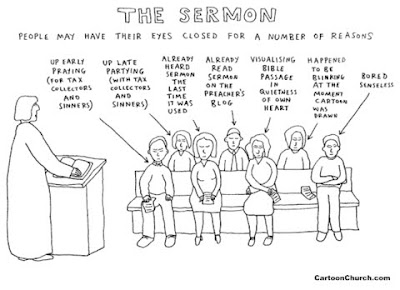
Dave Walker over at Cartoon Church has done it again. (If you can't read it clearly, click on the picture to enlarge it.)

In twenty-four years of ordained service, and of all the things I do as a priest, I have discovered that sermons are one of the most challenging - and the most naked - thing I do.

Someone asked me once how long it takes me to write a sermon. "All my life," was my answer then. It continues to be the only truthful response.

I am preaching on Sunday for the baptism of a little girl whose grandmother was very dear to me. She died two years ago, having lost her eleven year-long battle with ovarian cancer. I find myself wadding - stuck, actually, right now - in the midst of the grief of her loss.

This child will never know her grandmother which makes me very sad indeed, but that's not the point of the sermon - the "Baptismal Love Letter" some of you know I write for these occasions.

For those of you who don't know, I write a "Love Letter" to the child being baptized as if s/he were preparing for Confirmation. Yes, it is a clever little device - part of the 'performance piece' of the art and science of writing and delivering sermons.

Make no mistake: Writing and preaching a sermon is a deeply spiritual and prayerful experience. But, homeletics is both an art and a science.

It is "Playing with Fire".  (Okay, that's also a shameless plug for a book on the art of preaching by David J. Schlafer in which I was privileged to have one of my sermons used as an illustration. Never let it be said that I ever denied that a healthy ego is also important to the art of preaching.)

In the Baptismal Love Letter, I try to give the (now) adolescent an understanding of what happened during Baptism so s/he will better understand the vows they are taking for themselves.

I ask the parents to place a copy of the Baptismal Love Letter in the child's "baby book", along with the Certificate of Baptism, the Baptismal Candle and the Prayer Shawl.

I have no idea if parents actually do any of that. It's my hope and my prayer that, if they do, it might make a difference for this one child, this one soul.

I hope my affection for her grandmother will be obvious in what I have to say, but the challenge will be not to dwell on the grief of her loss but, rather, to take the spirit of the same faith which infused her grandmother's life and share that with her.

It will be to look at the gospel as a lens through which this child can meditate on the importance - the challenges and joy - of being a Christian.

And, I'll attempt to do all of that naked and without a net.

Or, at least, that's the way it always feels, Sunday after Sunday. I actually still get butterflies in my stomach before I preach. Sometimes, depending on what I have to say - or, more specifically, what God has given me to say - I actually feel nauseous.

Still. That's 25. . . 26 years later.

Everything I believe about the Gospel of Jesus Christ will be out there for all to see and know - as well as some of the things I don't believe about the Gospel of Jesus Christ.

There's no where to hide. No where to run.

Oh, wait. I lie. There are places to run and hide. I just can't go there. Not if I'm going to preach the gospel.

The dangerous part is that walking that tightrope of "Gospel Truth" can also be a fairly dangerous exercise in narcissism (see also 'shameless plug' above).

One of the younger clergy in this diocese tells the story that, when his fairly conservative rector stops by his office to check in mid-week before he's scheduled to preach, he says, "Oh, don't worry. I'm sure I'll have something important to say about the gospel. And, if I don't, I'll just talk about me."

That's the flip, jocular response, but the truth about homeletics is that, on one level, it IS all about the preacher. Even if the preacher does not use an example from her or his life to illustrate the gospel, even if the preacher merely reinterprets the text and does a quasi-bible study from the pulpit, the sermon remains the preacher's interpretation of the text.

Woe be unto the preacher who does not tell the truth about the gospel in his/her life! Woe be unto the preacher who asks the congregation to take the risk of believing or living the gospel when there is no tangible evidence that the preacher really believes and really lives the gospel s/he preaches.

The congregation will sniff out that lie in a heart beat. As Tennessee Williams wrote in his play, Cat on a Hot Tin Roof: "There ain't nothin' more powerful than the odor of mendacity . . .You can smell it. It smells like death."

Which brings me to another important point: The congregation is an essential ingredient to an effective sermon. St. Paul understood the important of audience. That's why he seems to say conflicting things in his epistles. He said some things to the people in Rome which were different than what he wrote to the people in Corinth.

To use the phrase from the theater, "It may play in New York, but it won't play in Poughkeepsie." I know I preach different sermons in Chatham than I preached when I was in Newark.  Two very, very different congregations.  Different challenges.  Different joys.

Despite all these challenges, writing and delivering sermons is one of the real joys of my priesthood. I take it as seriously as I do presiding at Eucharist. For me, one does not make sense without the other.

For me, Word and Sacrament are combined in a mysterious, almost mystical union that must come from a place of truth in me in order for it to impart the mystery of our faith.

I would much rather struggle publicly with the text and raise more questions than provide answers, if that's the truth of that gospel text in my life at the moment. I think mature Christians appreciate that no matter where they live.

I remember taking a preaching course with Katie Geneva Canon in seminary.  She stressed sermon preparation, almost to a fault.  "If you haven't got a sermon written by Friday night, you'd best call the choir and tell them to sing another hymn, cause you ain't got nothin' to say."

For the most part, I usually finish my sermon by Friday, but there have been times when I've written what I thought was a perfectly fine sermon and then something happens on Saturday - in the community or in the world - and I've had to toss it out and write something that tries to make sense of the event through the lens of the gospel.

Have I always preached a good sermon? Hell no! The funny part - the irony - is that most of the time, when I feel I have really missed the mark, someone will come up to me - sometimes right after the sermon, sometimes years later - and say, "You know, when you preached that sermon, I really felt the Holy Spirit pushing me to do something. Thank you."

On the other hand, when I've felt this - THIS - sermon was one I hit right out of the park, what I often get in the receiving line is a luke-warm smile, a limp handshake and the words that sound to my ears like fingernails on a chalkboard: "Nice message, pastor."

I've learned to smile my best smile and say - as graciously as I know how - "Thank you."  But oh, Lord, in those moments I just want to run and hide. Or, throw up.

Did I mention that preaching is also an exercise in humility?

There are two prayers I use before I begin to write a sermon that I'd like to share with you. Both were given to me years ago, after I completed the introductory course in preaching that used to be given at the College of Preachers (Now 'Cathedral College') in Washington, DC.

I had them framed and they hang in my office.

The first is from Philippians 1:20:
"I passionately hope. . .that I shall speak so boldly that. . .the greatness of Christ will shine out clearly in my person, whether through my life or through my death" (or through my preaching).
The second is a prayer attributed to St. Francis.
"The preacher must first draw from secret prayer what s/he will later pour out in holy sermons; s/he must first grow hot within before s/he speaks words that in themselves are cold."
So, off I go then, to play with some gospel fire. To struggle with the texts for Sunday and try to make sense of it for this new soul for Jesus. I hope to inspire her parents and family to assist her in her walk with Jesus.

Because, the gospel truth is that, without community around you, to support and encourage you in your journey in faith, being a Christian is much, much more difficult.

I know, as I look out over the congregation on Sunday, many will have their eyes closed, as in Dave Walker's cartoon.

I only hope to have one person in the congregation - just one - who is "visualizing Bible Passage in the quietness of own heart."

Just one soul - just one child of God - who hears the gospel in a way that inspires her/him to visualize the gospel - and, her/his life in the midst of it.

That will be enough for me.

For these are the 'crumbs' from which I gather up and bring to the Table of the Lord that we all may have a foretaste of the Heavenly Banquet.

Monday, July 05, 2010

Makes me wanna holler


My friends in 12-Step Recovery Programs tell me that 'Coincidence' is the name God uses when S/he wants to remain anonymous.

Within the space of twenty four hours, I received three articles/emails which have inspired me to walk around the house singing in my very best Ethel Merman, "There's no business like church business like no business I know."

That's on a good day.

The first was this blog post, "Ten Highly Effective Strategies for Crushing your Pastor's Morale," by retired UCC Pastor, Richard Floyd.

These hit a nerve:
7.Whenever your pastor goes away and returns from denominational meetings or continuing education events never miss an opportunity to ask, “How was your vacation?”

8. Make sure the pastor is made aware of the two biggest complaints, namely, that he is never in the office, and he doesn’t make enough home visits. That the two cannot both be true will not diminish their use as morale crushers.

9. Tell the pastor that there are anonymous complaints that a. your sermons are too long; b. your voice is too soft to be heard (especially by the deaf); c. your spouse is not involved enough (or too involved) in the life of the congregation; d. your child shouldn’t have been given the lead in the Christmas pageant; e. your lawn needs mowing; and f. you were seen in shorts at the supermarket. This is just a sample list. Use your imagination.

10. Constantly compare your pastor to his long-tenured saintly predecessor, with special attention made to his never asking for a raise for himself or his staff.
Cue the choir: "And they'll know we are Christians by our love."

When I was in Provincetown last week, the Provincetown Banner had a story on page three which ran the headline "Hyder to take her leave from meeting house congregation".

I couldn't find a link for it, so you'll have to trust me on this (If anyone does find it, please let me know).

The story is about 52 year old Alison Hyde, Provincetown's UU Meeting House minister, who is leaving the church after 11 years.

The first paragraph reads:
"Resigning ahead of what she believes to be a pending request for her to leave by the church board of directors, Alison Hyder has given notice to the Unitarian Universalist Meeting House here after 11 years as is minister, the longest term served by a full-time pastor in the 181 year old church's history."
Why? You ask.
"I came across as too jocular. I'm not formal enough. I go to piano bars.They want the image of the meeting house to be more uniformly grand," she said.
There were also complaints that she "focused more on serving the Provincetown community than the UU members," even though board of Director's Chair, Barbara Loren-Murphy is quoted as saying that the UU Meeting House has been searching for a more community-oriented identity for more than a decade. The article continues,
"The church has a long history of community involvement. During the influenza epidemic of 1918, it turned its first floor into a hospital. Eighteen years ago it started the Soup Kitchen in Provincetown, which today serves lunch to about 80 people in need a day throughout the off season. And the church was deeply involved in the AIDS crisis in Provincetown, helping the community learn how to support the infected men who came here to die. But post-AIDS, the church has had difficulty finding a new mission, Loren-Murphey said.

"We as a congregation lost our outward focus. We didn't have any committees. We've had some issues," she said. "There were some, not nearly a majority, that really felt Alison wasn't ministerial enough. Their sense of ministerial was she was not formal enough. I personally did not agree. I thought she was wonderful for both the congregation and the community."

"Instead of a small family, which we've been, we want to be a moral beacon to the community. You need a leader (to do that), said Kujawa (another member of the board). "There are people with no place to live. People with no jobs. We would like to be more than just a very pleasant coffee hour."
Which, apparently, Ms. Hyder was trying to do. Except, apparently she wasn't doing it 'formally' enough - and, doing it while not taking care of some members of the community and the board. At least, not to their liking.

See also #8 in Reverend Floyd's 'morale crushers'.

The third came from a clergy colleague - very intelligent and very wise - who wrote in response to Reverend Floyd's article:
"Interestingly, I think all these issues are addressed in stories in Exodus and Numbers about various challenges to Moses' authority. Two stand out. The Golden Calf (let's take a vote and redesign our liturgy to make it more celebratory and give the congregation what makes sense and do what all the growing congregations are doing) and Korah's Rebellion (Why should any one person in the community have a special status. Are not all the people equal before God and cannot we all come before God on our own?)"
His particular take is that clergy have not been allowed - or have abdicated - our leadership role given to us at ordination. He continues:
"I wish we could have a forum for a further conversation about what it means in practical terms to say that we believe in "one, holy, catholic, and apostolic church" and to reflect on what we think actually happens at (and in) ordination. If clergy are given the Spirit, then clergy are different from people who have not undergone that same process and experience; if clergy are not given the Spirit, what do we think we are doing when we lay hands on someone and ask that God give God's Spirit to them?"

"Our theology of the Trinity becomes active here--if the Spirit is an equal partner with the Father and the Son, someone in whom the Spirit dwells in an extraordinary fashion is significantly different from someone without that gift. If the Spirit is just a metaphor for some vague feeling of well being, then special possession of it does not matter so much. Every time we fudge the Trinitarian formula with various functional descriptors instead of names, we undermine the authority of ordained people."
I'm sure he's right and his point is a good one, and, in fairness, he was responding to Reverend Floyd's blog post, but I don't think authority is the entire problem.

We do seem to have lost our moral compass as a people, and clergy do not seem to be able to step up to the plate and provide direction. We've all caved in, it seems to me, to a "consumer model" of religion.

If "The customer is always right," then the business of church seems to be less about being "the church militant here on earth," leading us "nearer my God to thee" and more to a fast spiritual food franchise where "The King" let's us "have it your way."

In the midst of all of this, I came across an article by Methodist Minister Dan R. Dick in this month's Progressive Christian, "Measuring Faith: Metrics are no way to assess spiritual vitality."

He writes from his own denominational experience, but what he has to say is applicable to the experience of many, many institutional religions. He writes:
"Mainline denominations are in a panic. They’re losing members and resources, and they’re responding to the crisis with the best models that business schools can buy. The trouble is, the church of Jesus Christ isn’t a business, and to run it like a business may be one of major reasons that Protestant churches are in trouble numerically, and have so little moral influence on society today."
He makes the point that we confuse "indicators of vitality" with "activity" and they are not the same. Let me give you an example from the article. The first "indicator of vitality" in the Methodist Church is "Average worship attendance as a percentage of membership":
"This will not tell you anything more than how many people attend worship. True measures of spiritual growth and development must measure how a person is progressing in his or her relationship with God and Jesus Christ. This requires a set of standards, of which, worship attendance should certainly be one. But this should also include some measurement of prayer, study of scripture, service to others, relationship to the covenant community, etc.

“Membership,” as it stands in the current United Methodist Church must be evaluated in relationship to the clear promises we ask people to make. Until we are monitoring, assessing and evaluating how well people are growing in their commitments to “prayer, presence, gifts, service and witness” (the United Methodist membership vows), we have not measured anything truly valid or valuable. Survey after survey shows that people attend worship that they “like,” but very few evaluate the impact of worship on the gathered body. The much more compelling “percentage” measurement in vital churches is the percentage of active participants (members and regular “friends”) engaged in some form of ministry each week. The most vital churches I visit no longer count only Sunday morning worship attendance, but participation in Sunday school, Bible studies, church ministries, events, training, etc."
Reverend Dick ends with this important thought:
"Vitality is all around us, but we are going to continue to miss it if we continue counting what we have been counting through the past four decades of decline. Doing more of what we have already been doing that hasn’t been working seems like poor stewardship to me. We know what we should be measuring, but we don’t do it because it is more difficult. But until we suck it up and do the difficult work, nothing much is going to change. We have got to start looking at ourselves in a new light. What actually is changing in the church due to our best efforts? How much more “open” are we after a decade of “open hearts, open minds, open doors,” to quote the United Methodist Church’s 10-year-old tagline. How much church has been “rethought” to date and what difference did it make?

What we should be measuring is how well people have been equipped to live their faith in the world, and how our world is being transformed."
Reverend Dick makes a good point. It's much easier to count than analyze. It's much tougher to measure the impact we've made on the transformation of people's lives in bringing us closer to the Realm of God.

But, isn't that what we're supposed to be doing?

And, if we're not, perhaps we invite the very morale crushing behavior that knows no limits of denomination or creedal statement or liturgical expression.

Time for some 'tough love', I'm thinking. Jesus was always dishing it out to his disciples as well as those who sought him out for healing and pastoral care.

When his disciples complained to him that a large crowd - a few thousand people - had gathered to hear him as the hour grew late and there was nothing to feed them.

"Send them home," one report claims a disciple said. "Shall we go to town and buy food? Where will we get the money?" asked another. Yet another whined and said, "There's a little boy here with two fish and five loaves, but that's hardly enough."

You can almost hear Jesus sigh and say, "What do you have? Go and see."

That Jesus! Always empowering people. Always inspiring them to bring what they have to him - even the smallest amount - to be transformed.

"I obey all the laws. I'm a good, generous person." said the rich man, "what must I do to inherit eternal life?"

Jesus said, "Sell everything you have, give it to the poor, and follow me."

I can't imagine saying that to a parishioner. Can you?

No wonder they wanted to kill him. He was lucky the rich man just walked away.

Then again, I don't recall Jesus having "office hours" much less an office. No pension plan or 401K. No car allowance or housing equity plan. Didn't even have a Temple. Just went to where people were.

Perhaps it is time to "suck it up" as Reverend Dick says. Unless we "do the difficult work," of going behind the numbers and evaluating ourselves and our churches "nothing is going to change."

There's another wise aphorism from the 12 Step Program: "Insanity is doing the same thing over and over and expecting something to change."

Vitality is all around us.

I'm haunted by the story of the feeding of the five thousand and these words of Jesus "What do you have? Go and see."

That's when I'm not doing the same thing over and over while singing my best Ethel Merman like a crazy person.

Sunday, July 04, 2010

A July Fourth Message from Her Majesty

The following chestnut has been around for a while but it's too good not to post it as a humorous reminder of why we celebrate The Fourth of July. (And, to celebrate why we are The Episcopal Church and not Church of England.)

To the citizens of the United States of America from Her Sovereign Majesty Queen Elizabeth II

In light of your failure in recent years to nominate competent candidates for President of the USA and thus to govern yourselves, we hereby give notice of the revocation of your independence, effective immediately.

Her Sovereign Majesty Queen Elizabeth II will resume monarchical duties over all states, commonwealths, and territories (except Kansas, which she does not fancy).

Your new Prime Minister, David Cameron, will appoint a Governor for America without the need for further elections. Congress and the Senate will be disbanded.

A questionnaire may be circulated next year to determine whether any of you noticed.

To aid in the transition to a British Crown dependency, the following rules are introduced with immediate effect:

(You should look up 'revocation' in the Oxford English Dictionary.)

1. Look up aluminium, and check the pronunciation guide. You will be amazed at just how wrongly you have been pronouncing it.

2. The letter 'U' will be reinstated in words such as 'colour', 'favour', 'labour' and 'neighbour.' Likewise, you will learn to spell 'doughnut' without skipping half the letters, and the suffix '-ize' will be replaced by the suffix '-ise'. Generally, you will be expected to raise your vocabulary to acceptable levels. (look up 'vocabulary').

3. Using the same twenty-seven words interspersed with filler noises such as 'like' and 'you know' is an unacceptable and inefficient form of communication. There is no such thing as US English. We will let Microsoft know on your behalf. The Microsoft spell-checker will be adjusted to take into account the reinstated letter 'u' and the elimination of -ize.

4. July 4th will no longer be celebrated as a holiday.

5. You will learn to resolve personal issues without using guns, lawyers, or therapists. The fact that you need so many lawyers and therapists shows that you're not quite ready to be independent. Guns should only be used for shooting grouse. If you can't sort things out without suing someone or speaking to a therapist then you're not ready to shoot grouse.

6. Therefore, you will no longer be allowed to own or carry anything more dangerous than a vegetable peeler. Although a permit will be required if you wish to carry a vegetable peeler in public.

7. All intersections will be replaced with roundabouts, and you will start driving on the left side with immediate effect. At the same time, you will go metric with immediate effect and without the benefit of conversion tables. Both roundabouts and metrication will help you understand the British sense of humour.

8. The former USA will adopt UK prices on petrol (which you have been calling gasoline) of roughly $10/US gallon. Get used to it.

9. You will learn to make real chips. Those things you call French fries are not real chips, and those things you insist on calling potato chips are properly called crisps. Real chips are thick cut, fried in animal fat, and dressed not with catsup but with vinegar.

10. The cold tasteless stuff you insist on calling beer is not actually beer at all. Henceforth, only proper British Bitter will be referred to as beer, and European brews of known and accepted provenance will be referred to as Lager. South African beer is also acceptable as they are pound for pound the greatest sporting nation on earth and it can only be due to the beer. They are also part of the British Commonwealth - see what it did for them. American brands will be referred to as Near-Frozen Gnat's Urine, so that all can be sold without risk of further confusion.

11. Hollywood will be required occasionally to cast English actors as good guys. Hollywood will also be required to cast English actors to play English characters. Watching Andie MacDowell attempt English dialogue in 'Four Weddings and a Funeral' was an experience akin to having one's ears removed with a cheese grater.

12. You will cease playing American football. There is only one kind of proper football; you call it soccer. Those of you brave enough will, in time, be allowed to play rugby (which has some similarities to American football, but does not involve stopping for a rest every twenty seconds or wearing full Kevlar body armour like a bunch of nancies). Don't try rugby - the South Africans and Kiwis will thrash you, like they regularly thrash us.

13. Further, you will stop playing baseball. It is not reasonable to host an event called the World Series for a game which is not played outside of America. Since only 2.1% of you are aware there is a world beyond your borders, your error is understandable. You will learn cricket, and we will let you face the South Africans first to take the sting out of their deliveries.

14. You must tell us who killed JFK. It's been driving us mad.

15. An internal revenue agent (i.e. tax collector) from Her Majesty's Government will be with you shortly to ensure the acquisition of all monies due (backdated to 1776).

16. Daily Tea Time begins promptly at 4 pm with proper cups, with saucers, and never mugs, with high quality biscuits (cookies) and cakes; plus strawberries (with cream) when in season.

God Save the Queen!

Saturday, July 03, 2010

John Adams meets the King


Important protocol to remember in terms of our relationship with England.

Especially important as former "subjects of The Empire" - and in the midst of the present "troubles" in the Anglican Communion.

King George III: "I pray, Mr. Adams, that the United States will not suffer unduly from its want of a monarchy."

John Adams: "Yes, we will strive to answer those prayers, your Majesty."

I believe we have done well, Mitregate not withstanding.

Farewell, Fairbanks Inn

These are my old (well, but young at heart), dear friends, Alicia and Kathleen - two very angels who rescued me from myself and helped me to heal.

They are the owners, the "Inn Keepers" of the Fairbanks Inn in Provincetown, MA.

Two more generous, loving, kind people you would be hard pressed to find on Planet Earth - or, in fact, any planet in the galaxy.

They took me in, gave me space, loved me, and treated me like visiting royalty.

I owe them a piece of my soul. I will be forever a grateful debtor. (And at least five pounds heavier.)

This is also a shameless plug for their Inn. When you come to Provincetown - especially in the "off season" (they are crazy busy otherwise, thanks be to God, so book early) - please consider staying with them.

You will love their hospitality - fresh homemade muffins, Alicia's own granola mix, yogurt, great coffee and fresh juice - and, if you're lucky, they will tell you stories of their Great Inn Keeping Adventures.

You will not be bored. Hand to Jesus.
Oh, but before I go on, let me introduce you to the incomparable Randy Roberts, who does Bette, Celine, Cher and, of course, Lady Gaga.

She works hard for the money.

We met her on our nightly walk through Commercial Street. She's playing at the Art House this season. Don't miss her.

Okay, let me continue.  What you don't know about Kathleen is that she is an attorney. A very good attorney. Used to work for a major corporation in New York.

What you don't know about Alica is that she is a professional musician. Violin and Viola. She is phenomenal.
Through the movement of the Holy Spirit or Serendipity, or whatever whimsical, inspirational spirit was aligning in the cosmos yesterday, Peter Donnelly, a local artist and musician, called Alicia to see if she wanted to play.  You know.  Jam.  Improv. No music.

What you don't know about Alicia is that "PPT" (pre-Provincetown), she would rather have chewed ground glass than say yes to such an invitation.

Alicia is a professional. Put any sheet of music in front of her and she can play it.  Give her some time to practice and rehearse and her playing will make you weep.

So, Alicia?  Just "jam"? Inconceivable!  Except, she does.  She's amazing.

Of course, her internal self-critic kicks into overdrive and she'll tell you she was awful, just awful, but I have to tell you that, for as long as I've known Alicia - and, it's gotta be at least a dozen or so years - I've never seen her beam like that when she plays.

It was almost as beautiful as watching the light play on the ocean.

Another "This!" moment - right there in front of Provincetown Hall.

I posted a few video clips on my FaceBook page last night. I don't know how it works on Blogger but I'm going to try and post a very short clip below.  If it doesn't work and you're on FB, go visit my page and check it out.


I'm leaving this morning to head back to New Jersey.   Got church on Sunday.  I'm sure I don't get compensated nearly as much as Ms. Randy Roberts, but this girl works hard for the money, too.

I am so grateful for this time here at the "end of the earth," but mostly, I'm grateful for old and dear friends.  A wise person once wrote, "You can't have too many old friends."  I think that's right.

I'm just grateful today for these two.

My other favorite saying is, "If you're lucky enough to live by the water, you're lucky enough."

If you've got old friends who live by the ocean, you are blessed.

You are most blessed, indeed.

Hand to Jesus!

Friday, July 02, 2010

I Made Kate Clinton Laugh

Comedy is serious business.

That's on a good day.

In order to be a comedian in P-Town - a place that has been described as 'the world's largest open air asylum' - one must be, well, at least a little insane.

Case in point: Meet Dina Martina:

This is not exactly what one would call a "female impersonator" - a term usually reserved for those men who dress and look and sound like women performers such as Liza, Cher, Judy, etc.

I suppose this qualifies as drag - but minus the 'queen'.

Dina Martina could be described, I guess, as a "Drag Comedian." S/he dresses like a rather dowdy old woman whose sense of style is only made worse by her application of makeup (Check out the lipstick. Sheesh!).

I confess that I have a wee bit of a problem with Drag Queens anyway. I don't want to get into a big political thing here, and it's hard for me to explain, but I suppose it can be summed up succinctly by saying: "Male privilege by day, getting rich by impersonating/making fun of women by night."

Sorta rubs my 'inner feminist genie' the wrong way. She pops out of her bottle and makes three wishes for greater expressions of equality in entertainment.

Don't get me wrong, Drag Queens are some of the hardest working people in our community and I respect that. I have no doubt that they, as as group, have probably raised more money for People With AIDS than any other group and I'm grateful for that.

I wish they would also consider raising some money for women who have limited access to quality health care, and are more likely to work marginal jobs and be homeless than men, but I understand. It's not a perfect world.

Drag Queens / Comedians are the clowns of our community who make us laugh at our cultural assumptions about women and, in so doing, challenge our thinking about the role of men.

Sometimes, I'm just not in the mood to be challenged while I'm being entertained.

ANYWAY, I digress.

It was a lovely evening for walking on Commercial Street last night.

Well, I use the word "walking" as a euphemism of sorts.

We were somewhere between a 'stroll' and a 'stall'.

We began the evening, of course, with dinner. I had the BEST Portuguese soup I've ever eaten in a restaurant at a place called "Napi's". Hand to Jesus, it was spectacular.

We continued our evening, talking and laughing as we strolled past shops and ice cream parlors, restaurants and cafes.

Commercial Street does have a carnival-like atmosphere. Still, I was a bit taken aback by the 'barkers' in front of some restaurants and clubs.

A 'barker' is someone who tries to entice passersby to come into the establishment. "Come in! Meet Lydia the Bearded Lady! See the Tallest Man in the World."

These P-Town Barkers were calling out, "Tonight's seafood is fresh Atlantic salmon, pan seared, served with a fresh wasabi and ginger sauce, wild rice and asparagus sauteed in a wine and butter reduction sauce."

The Drag Queens were also out, giving passersby a 'quick peek' of the glamorous entertainment that awaited them indoors, while the barker stood out in front, handing cards with information about the performance schedule.

A few, like Dina Martina, were their own barkers. I'm thinking that, for most tourists - first time visit to P-town from Arkansas or Wisconsin and completely blown away by the open air LGBT marketplace - barkers could be pretty effective.

It was in the midst of such heady thoughts as these that we came upon Kate Clinton and her partner as we were crossing the street.

Okay, okay, it annoys me that some of you are asking, "Who's Kate Clinton?" It's annoying because you are probably too young to remember her. Which means I get another subtle reminder of my own age. Which, whether you intend it or not, is annoying.  And, rude.

More importantly, if you don't know Kate Clinton, you have no idea how significant it was to have had a "Lesbian Comedian" make the scene.

First of all, "back in the day" (late 70s to mid 80s) feminists were widely stereotyped as being so highly focused on politics that we had no sense of humor.  That continues today and rears its ugly little head in powerful women like Hillary and Madeline.

Back then, however, it was one thing for a woman to be a feminist and be a comedian, but it was a whole 'nother smoke to be a Lesbian Comedian - being out and open and honest AND laughing about it.

Indeed, laughing about it all the way to the bank.

I've seen Kate Clinton many, many times over these many, many years. The Michigan Women's Festival. The New England Women's Festival. On HBO.

She's brilliant. Sharp. Intelligent. Irreverent. Wise. And, very, very funny.

I owe her lots of laughs during times when it was hard to see the light at the end of the tunnel and not fear that it was another train.

So, it was really good to be able to return the favor.

It happened rather without warning.

She was curious about the fact that my friends introduced me as the Episcopal Priest who married them ten years ago.

I thanked her for giving me some great lines for some of the sermons I have preached to LGBT congregations when I was at The Oasis.

"Really?" she wanted to know. "What lines would those be?"

"Hmm . . . the one I remember best is how the Roman Catholic Church gives you skills for being a lesbian . . . like how to get the host off the roof of your mouth without chewing . . ."

I wasn't able to finish the sentence when she doubled over with laughter. When she came up again, she was actually blushing.

She may have had the laugh, but I came home later that night to discover something in my soul had healed. Something in someplace, deep in a crevice I didn't even know was wounded.

I sense it is not a new wound. Ancient, I'm thinking. A place where life is bound to wound you, if you are lucky enough to be fully alive and love others.

The healing, I think, is something about being able to return the gift of laughter to one who has healed so many with laughter. It's about the ancient medicinal power of humor in community.

In a walk earlier in the day, I found this graffiti on a sea wall at the Provincetown Wharf.
If you can read this and nod your head in agreement, you understand what I've been saying about humor and laughter.

If you can read this and are confused and don't understand, you should probably check your pulse. I'm not sure you should be reading this blog. It could prove to be hazardous to your health.

You should know and be warned: I once made Kate Clinton laugh.

Be afraid. Be very afraid.

Thursday, July 01, 2010

This!

I'm in Provincetown, MA, visiting with some very dear friends who invited me here to rest and recharge my batteries and heal.

This is the view from Provincetown facing, I believe, Truro, the next town over.

I had forgotten how beautiful it is here, the way "end of the earth" communities have their own unique beauty.

I am quickly remembering the way places like this have a way of attracting artists - along with flocks of zanies and loonies and herds of misfits and the various rebels and castaways of society.

It also attracts the young - and young at heart - who are trying to figure out who they are or what they will become. Or not.

Interestingly enough, these very people are also part of the reason tourists come here - to look and gawk and snap pictures to take back home so they can titter and shake their heads in disbelief or shock or horror with all their friends back home in "Normal, USA."

But, mostly people come here, I think, for the very reason I am here. Because the beauty here is so insanely beautiful it helps you back on the path of sanity.

There is something spiritually medicinal about the way the salt water finds its way into your soul. The way each ocean wave whispers words of comfort and challenge - whether you need to hear it or not. The way every zanie and looney you pass reminds you that it's okay to be you.

And, if it's not okay to be you - who you are where you are - be who you are right now anyway because, as Oscar Wilde used to say, "Everyone else is already taken."

At dinner last night, my dear friends were venting a bit about the challenges and joys of being Inn Keepers in P-town. At one point, one of my friends stopped mid-sentence, looked out the window onto the Bay, pointed and said, "This!"

I looked over to see the still-blazing sun casting pink strips of light on the deep blue ocean while causing the boats to shimmer and shine in mesmerizing display.

After a few moments of this momentary bliss, she commented that when she and her partner first came to P-Town, people who had been here for a long time would stop mid-sentence, look over at the way the light was playing with the ocean and say, "This is why we stay here."

Over the years, that has been shortened to simply, "This!"

I think we all need places in our lives where we can do that. It may be the ocean for you. Perhaps it is a lake or a forest or a mountain. Maybe it's in a museum or an art gallery or under a back alley, inner city street lamp. It might be in the face of a young child or an elderly person or a drag queen or punk kid with purple and orange hair.

Wherever it is for you - whoever it is for you - it is important not only to know that but to acknowledge and appreciate it, at least occasionally.

And not just to stay where you are - where you live - but to stay. Here. In the midst of life with all of its challenges and joys. Keepin' on keepin' on. Fighting the good fight. Living the good life - however that is defined for you.

Stability was one of the Rules of St. Benedict - along with fidelity to the monastic way of life and obedience to leaders in community that flows out of a relationship in Christ.

Stability, wrote Benedict, is the path to contentment and fulfillment which can not be found in constant change.

However, the wisdom of Benedict's Rule lies in its flexibility, its tolerance for individual differences, and its openness to change.

From time to time we need to allow the beauty in the world to break our hearts open to see that even chaos has its own order, its own beauty.

Beauty is all around us, often hiding in plain sight. It's often found in the unexpected, far off the beaten path that leads to "normal".

Sometimes, it takes going somewhere else to open our eyes and our hearts to simply say, "This!"