Come in! Come in!

"If you are a dreamer, come in. If you are a dreamer, a wisher, a liar, a Hope-er, a Pray-er, a Magic Bean buyer; if you're a pretender, come sit by my fire. For we have some flax-golden tales to spin. Come in! Come in!" -- Shel Silverstein

Sunday, September 27, 2009

Indiscriminate inclusivity or Discriminating exclusivity?


Note: Jon Richardson preached a great sermon today. I was daunted by the texts and probably would have preached on the Perils of Whining. He went into a completely different direction - one that pointed to the heart of the Gospel.

G'won. Read it for yourselves. You just may discover that the heart of the Gospel is the most ancient form of Social Networking. FB and Twitter ain't got nothin' on Jesus.


A sermon for XVII Pentecost
(the Rev'd) Jon Mark Richardson
Interim Missioner for Youth and Young Families
The Episcopal Church of St. Paul, Chatham, NJ

In the name of God: One, Holy, and Living. Amen.

It’s been fascinating to me to discover just how many of my sermons here lately have a beginning – whether spoken or unspoken – that is somehow related to the social networking tool, Facebook.

This sermon began as a “status update” that I began seeing on a few friends’ pages. The status update is a little box where you can type what you’re doing, or some quote that strikes you or expresses you, or some kind of conversation starter.

My status update yesterday was, “Whew!! Finally found the [LSU] Tigers on TV! It’s sometimes tough to be in exile!” It was a way for me to claim my heritage in a strange land, and a way to reach out to my people back home over a shared experience. So a status update can really be anything.

Lately, I’ve been seeing a debate emerging on a few of my friends’ status updates. It’s an update of the “conversation starter” variety. It says, simply, “Indiscriminate inclusivity or Discriminating exclusivity, which do you prefer?”

Think about it. If you only had the two choices, which would be more desirable? Would you want to be inclusive if it meant that you had to include absolutely everybody? Might it be easier if you could pick and choose just a little?!

We certainly tend to value our inclusiveness. In this parish in particular, we are proud of the fact that we welcome everyone. If you go to our parish website, one of the first things you will see is a welcome.

You don’t have to click anywhere. It’s right there, below the “Come, Grow, Celebrate” banner. “Absolutely everyone is welcome in this place!” That’s a quote. There’s even an exclamation point on the end! We’re trying to say that we really mean it!

But it’s not just a Christian value – this valuing of inclusiveness. We, as a nation, declare ourselves to be inclusive. We’re proud of our inclusiveness. In her poem, “The New Colossus”, Emma Lazarus describes the Statue of Liberty – that most powerful symbol of welcome – as the “Mother of Exiles”. On her tablet, Lazarus’ words are inscribed: “Give me your tired, your poor, /Your huddled masses yearning to breathe free, /The wretched refuse of your teeming shore. /Send these, the homeless, tempest-tost to me,…”.

They were Lazarus’ words. They became the words of that “Mother of Exiles”. And each of us, in our schools or in our families, was taught to make them our own. We were taught to take pride in the fact that we are a part of a country such as that – a land where all are welcome.

So the Facebook debate seems pretty simple, right? “Indiscriminate inclusivity or Discriminating exclusivity?” We’re Christian. We’re American. We value inclusiveness, so we should be inclusive. Moreover, we should demand it of others. It’s that simple.

The problem is, it’s not that simple.

As Americans, we’re not exactly as inclusive as Emma Lazarus had dreamed we might be. A wall is being built along our border with Mexico, because we seem to think we have enough of them. And though it’s looking like the policy may soon be changing, people who are HIV-positive have, for years, been denied the possibility of immigrating to, or even traveling to, the United States. We’re afraid that they might create a health crisis! (As if we didn’t already have one.)

Even students from other countries who hope to come to the United States to further their educations must demonstrate financial viability by proving that they hold very large sums of money. We certainly wouldn’t want poor people getting stuck here. They might be a burden to us.

“Give me your tired, your poor, your huddled masses yearning to breathe free”? Well… Sure. So long as they’re not tired, or poor, or parts of huddled masses. We don’t want them!

Wherever there is a “we” or a “them” the ideal of inclusiveness wasn’t reached.

Christians also have a long history of struggling to adhere to our value of inclusiveness.

I remember one of the much talked about scandals of the Lambeth Conference last year: in the opening worship service in Canterbury Cathedral, many people were offended that the Bishops of the church were asked to sing that great hymn, “All Are Welcome”. The scandal there was two-fold. First, it was a ticketed Eucharist. Only those closest to the center of the Conference activities were allowed to attend. Those of us “on the fringes” of the event were politely uninvited. We most certainly were not welcome – despite whatever hymns might have been sung.

But, perhaps more seriously, was the fact that Bishop Robinson, the Bishop of New Hampshire, had been politely uninvited from the Conference altogether. The pain of his exclusion was still raw for many of our Bishops, and fortunately, the irony of them being asked to sing that song at that time and place was not lost. The church could not sing of its inclusiveness in the midst of an act of exclusion without someone noticing.

In the Gospel lesson that we’ve heard this morning, we hear this same Facebook debate roiling among the disciples and Jesus – are we to be indiscriminately inclusive, or discriminating and exclusive? Like a 7-10 split, Jesus instructs us to aim for both of these contrasting ideals. He calls us to be discriminating and inclusive.

With regard to those outside the fold, the exchange is telling: “John said to Jesus, ‘Teacher, we saw someone casting out demons in your name, and we tried to stop him, because he was not following us.’ But Jesus said, ‘Do not stop him; for no one who does a deed of power in my name will be able soon afterward to speak evil of me. Whoever is not against us is for us.”

So long as they’re not causing us harm, they are welcome. Even if they’re not following us, they’re helping us in their own way. We don’t need a monopoly. “All are welcome!”

The real discriminating, however, should happen within ourselves. Jesus instructs us to be always mindful of the ways that our own deeds can be a hindrance to the work of God. Though we are on the inside, it would be easy for us to cause either ourselves or others fall away from the fold.

It’s counterintuitive. Everything in the world tells us to “look out for number one”. We want to find ways to get ourselves included, but we are naturally given to being discriminating about who we’ll let in – either into ourselves or into our circles of influence. Jesus turns all that on its head.

The disciples were worried that their power would be diminished if it were indiscriminately shared. But Jesus knew the paradox – in sharing himself and his power, it could only grow. And so the same was true for the disciples just as it is true for each of us.

I’m reminded of one of my favorite quotes – I’ve probably used it here before, but it’s worth hearing again. Mother Theresa once said,
“I have uncovered the paradox that if I love until it hurts, then there is no hurt – only more love.”
That’s the message of the Gospel. That’s the answer to the Facebook debate. That’s the discriminating inclusivity to which Christ calls us. Because it’s precisely in that openness to others that we find the living Christ. Amen.

Saturday, September 26, 2009

Take 30 - and a few locust

After Anaheim - Integrity Leadership Conference

That would be 30 minutes of your time to watch this extraordinary summary of the journey - the struggle - that we have been on this last decade.

Susan Russell, outgoing President and soon to be Canon of the Cathedral in the Diocese of Los Angeles, gave this summary at last month's Leadership Conference of IntegrityUSA.

Of course, the journey started long before that - even before Blessed Louie Crew launched the organization we've come to know and love called Integrity.

As I listened to Susan, I was reminded of a story of God as told by Olive Schreiner of South Africa.
A woman on a journey asks, "Why do I go to this far land where no one else has gone before? I am alone, utterly alone. My efforts seem so futile. Who am I to change anything, to make any kind of difference?"

A wise old one, who stood close by, bid her to be silent and to listen to what she heard. She listened intently and finally said, "I hear the sound of feet, of a thousand times ten thousand feet that beat their way."

The wise one said "They are the feet of those who shall follow you. Lead on. Go into the new land. Go directly to the water's edge. Where you stand now the ground will be beaten flat by thousands upon thousands feet."

She said, "How will I cross the stream?"

The wise one said, "Have you seen the locust how they cross the stream? First one comes down to the water's edge and it is swept away, an then another comes and another. At last with their bodies piled up, one on the other, a bridge is built that the rest pass over."

She said, "But, of those that came first, some are swept away and are heard of no more; their bodies do not even build a bridge."

“Yes,” the wise one responded, "Yes, and are swept away and are heard of no more. And, what of that?"

"And, what of that?" she echoed in amazement.

"They make a path to the water's edge." the wise one answered.

"And, over the bridge which shall be built of our bodies who will pass?", she asked.

The response of the wise one was: "The entire human race!"

And, the woman grasped her staff and turned down the path toward the water.

This is a story of God.
G'won. Click on the video of Susan's presentation. It may well be the best 30 minutes you spend today.

Who knows. You just may begin to understand yourself as one of those locust.

Because whether you know it or not, you, too, are part of the story of God.

Give (the) PEACE a Chance


British cartoonist Dave Walker always makes me laugh. Well, nearly always. He has a real eye for the Real Life of Anglican congregations - even the Episcopal varieties Across the Pond.

I have some of these folk in my congregation. I'll bet you do, too.

Indeed, the Passing of the Peace in many churches, including mine, has become less a liturgical device and more of a "Half Time Event".

In fact, during Lent, I move the Passing of the Peace to what I understand was its historic place in the Liturgy - right after the Eucharistic prayers and just before the Lord's Prayer.

Except, I understand that the Lord's Prayer always ended the Prayers of the People.

I'm reminded of that old saying: 'all liturgy is innovation'.

And, of course, "the only thing worse than negotiating with a terrorist is negotiating with a liturgist." Except, at least with a terrorist, you have a chance of having a reasonably sane conversation with a positive outcome.

I have found that it does help a bit to put the focus more on the liturgy and less on a "mini Coffee Hour" experience. This is especially appropriate during Lent.

The H1N1 virus or "Swine Flu" pandemic is changing all of that. To wit - this latest cartoon from the inner recesses of the brilliant mind of Our Dave.

I'm sort of partial to the "Text Message of Peace" myself. I wonder how long it will take to develop the "Twitter of Peace". Wait! That's already happening from certain NYC churches where parts of the service - especially the sermon - are being 'tweeted'.

Or, perhaps, the "FaceBook of Peace" - with a special "I'm a Fan of Passing the Peace" group page.

I've been wondering - if the pandemic manifests itself in as a local epidemic, will we have to resort to Eucharists on iChat with our laptop cameras?

It's just a natural extension of technology - well, as natural as technology has already become in our lives.

If we did that, however, we'd miss out on this processional innovation.

Like I said, Dave Walker always makes me laugh. Not exactly the worst preventative medicine.

As the drum beat of anxiety about the Influenza Epidemic steadily increases amidst the cacophony of concerns like rising unemployment, economic instability, health care reform and the higher volume of whispers of impending schism, The 'Church of God's Frozen Chosen' could certainly use a few prophylactic doses.

Friday, September 25, 2009

Wonder and Ironies Abound


It's really a wonder and an amazement just how 'high tech' St. Paul's has become in the last few years. We communicate less and less on paper and more and more in cyberspace.

We've stopped printing and mailing the monthly newsletter, which, due to the uneven delivery rate of 'bulk mail' (for those of you who've never heard of this, think: 'blast email'), sometimes didn't arrive in a person's mail box until AFTER the event has already taken place.

We do send out a weekly newsletter via email, every Thursday late morning, which captures all but about 30 of our parishioners who either don't have an email account or we simply don't have it on file.

And, we have a weekly USPS mail list of a little over 30 - mostly fragile elderly or those whose health status is unpredictable or who have moved into a nursing home or extended care facility. They also get a copy of the past Sunday's sermon and a little, personal note from the Pastoral Care Coordinator.

We still use the U.S. Postal Service for personal notes and cards - especially condolence cards. There are just some things that can only be communicated in a personal, handwritten note. I'm not exactly 'old fashioned' or necessarily 'conservative' but my Momma did teach me good manners.

Oh, there was some grumbling about all the changes at first, but for the most part, people are really happy to have the information in a timely manner.

We figure there are seven different vehicles of communication we have at our disposal: 'snail mail', email, web page, Sunday parish bulletin, Parish bulletin board, Community Bulletin Boards and Telephone Tree.

The Telephone Tree is something we've saved for Very Important Things - like Stewardship Reminder Calls or to communicate the funeral arrangements of a long-time member of the church. The Vestry did the calling - about 25 calls apiece generally covered the entire parish membership list.

Technology marches on. We now have an Automated Telephone Tree Service - much like the local school system uses to communicate delays in school openings or cancellations due to snow storms.

It's surprisingly inexpensive (the competition looks keen), very efficient and highly effective. The hardest part was getting very clear about when and how often we'd use it and for what purposes and whether or not we wanted to create sub lists for, say, acolytes, Youth Group, etc. We also had to decide when NOT to use it.

The deal is that you have one full minute, but the reality is that you try to get your message in under 30 seconds. Well under 30 seconds. More like 15. People will just hang up if you go on too long. Television and radio announcements have conditioned and trained us well.

You also have to be concerned about consistency of messenger as well as the tone of the message, but once you decide that, you simply call an 800 number, follow the prompts, record your message and then send it off. I did it Wednesday night from my very own home phone.

The Vestry members who used to do the Phone Tree are Very Happy.

We've used it twice since the beginning of the year - one for "Welcome Back Sunday" and just this past Wednesday for a Covered Dish Supper and entertainment featuring the DECCOS - a local band that plays original music and includes two members of our congregation on bass and keyboard.

We didn't know the DECCOS would be available and, since we had a Very Short Window of Time to communicate that information, we decided to use the Telephone Tree.

So far, the response has been Very Positive. Enthusiastic, even.

However, we have had two complaints. The first time was after the first call to "Welcome Back" everyone to the new Program Year. When I asked the congregation for their assessment of the phone call, one young man raised his hand.

He said it was "too impersonal" and wanted a "real voice" on the other end of the phone. Actually, he later told one of the Vestry members, it would be great if the rector - not a Vestry member - could make the personal calls.

That would be ALL the personal calls on the "Parish Phone Tree".

Oh, did I mention that he's an IT / computer geek guy?

The other complaint came yesterday in response to the Covered Dish Supper tonight and the performance by the DECCOS.

He's an elderly gentleman - a faithful usher at the 10 AM Service and a most charming man. He called to say that he wanted to be taken off the Phone Tree List for these sorts of announcements. Found them too impersonal.

Oh, did I mention that he left this recorded message in our voice mailbox?

I have had other, funny stories about people who check their Caller ID, see that it's the church calling at 8:45 in the evening, and immediately think "Trouble" so they fall all over themselves to pick up the phone, only to discover my chirpy little voice beckoning them to come to church.

Other people have said that my recorded message sounds so much like me that, at first, they start talking back to me and then dissolve into laughter when they figure out that it's just a recording.

I'm thinking I should send out one recorded message sometime that says, "Hi, this is Elizabeth . . . How are you?. . . . . Oh, really? Tell me more about that . . . . . . Uh-huh . . . . Mmmm-hmmmm . . . . How did that make you feel? . . . . "

We'll call it something like "The Pastoral Phone Tree Check-in."

Or, maybe we could establish a service called "Dial-A-Priest" - where I would have the recorded message with pauses and appropriate Rogerian reflective questions. During those pauses, the caller could record their problem.

Kidding. Only kidding.

But, you know, there are some days . . . . .

Thursday, September 24, 2009

Fall Clergy Day


Every year at this time, clergy (at least in The Episcopal Church) are gathering for one of two times in the program year for some time with each other and our bishop.

There will be some presentations, some information gathering and sharing, but mostly, it will be a 'Clergy Rally Day' of sorts. Pep talks about the newly-Christened Diocesan Mission Statement. Encouragement to have our work at the local level reflect the mission of the diocese.

I don't know too many clergy who have time for this sort of all-day gathering. I know even fewer who woke up this morning, bounded out of bed and said, "Oh Wow! It's Fall Clergy Day!"

Oh, I'll very much enjoy seeing some of my colleagues and catching up but by the time 3 PM rolls around, we'll all be very much ready not to see each other again until Clergy Retreat next month. And, for some of us, even that will come too soon.

Oh, you came here for some reflective thought on some Important Issue of The Day. Try here. Or this one on Mike Huckabee in the Holy Land.

I loved this article "Gays Losing Value to Value Voters" by Candace Chellew-Hodge. Candace. My girl.

Off I go, anyway. It's a one hour drive, so I'm packing some strong coffee and a snack.

I've also packed my sense of humor and positive attitude, so if you're looking for it here, it's not as obvious only because it's already in my briefcase.

Then again, don't you just love those habits the girls are wearing in the picture above? Ah, the good-old Days of Bad Religion, where clergy men wore black suits and women knew their place.

Wait. I think they may still be with us.

Film at 11.

Wednesday, September 23, 2009

The Gospel According to Yoda


I'm still stuck on the Epistle of St. James (3:13 - 4:3, 7,8a) from last Sunday's lectionary lessons.

You'll excuse me for sounding impertinent but some of it sounds a bit like Yoda might have written it, doesn't it?
You do not have because you do not ask.

You ask and you do not receive because you ask wrongly.
Annoying, this is.

Or, as Yoda would say, "Do or do not. There is no try."

I like Yoda. Sadly enough, he has become, for an entire generation, the closest thing to a resource for understanding spirituality and prayer.

I suspect every generation has one. I seem to remember the popularity of Master Po in the Kung Fu Series. As I recall, instead of an apprentice named Luke Skywalker, there was someone Master Po called "Grasshopper."

And, let us not forget Professor Dumbledore to Harry Potter. I suppose in my generation, it was Jiminy Cricket to Pinocchio.

Yoda says things like,
"Fear is the path to the dark side. Fear leads to anger. Anger leads to hate. Hate leads to suffering."
Somebody give the weird little creature an, "Amen."

Here's the thing for me about the message from St. James' Epistle: Prayer is a mystery. I think that's true because prayer is, essentially about relationship. And relationships, especially between God and ourselves and others, are an even deeper mystery than prayer.

In order for prayer to work, one must believe in mystery.

As Luke Skywalker once said to Yoda, "I can't believe it."
And, Yoda said, "That is why you fail."

'Belief in mystery' sounds like a mystery itself. That's because it is.

The other true thing I know about prayer is that even when we don't believe in mystery, prayer can still work.

That's the mystery of prayer.

Or, as Yoda would say, "A mystery is prayer."

It means letting go of what the world values, and embracing the values of the Realm of God where the values of the world have no meaning or currency.

Or, as Jesus said,
"Whoever wants to be first must be last of all and servant of all."
To which Yoda might say, "True, that is."

Amen.

Tuesday, September 22, 2009

Paranoia Strikes Deep

The cover story of this week's TIME magazine has a picture of Glenn Beck on the cover.

He's sticking out his tongue and the cover reads: "Mad Man: Glenn Beck and the angry style of American politics."

Calling him, "The Agitator," author David Von Drehle introduces his piece with this:
"Glenn Beck is channeling the fears and anger of Americans who feel left out - but is he also stirring that anger and heightening those fears?"
You can read the article at the link above and answer the question for yourself.

What I found fascinating was the insert of a time line of "Them vs. Us" - which is, I discovered, a timeless theme in American politics.

I think this time line helps to put the insanity of paranoid politics into perspective. These guys come and these guys go.

They are not to be ignored, but, given the historical context, I suppose they are to be expected - and watched carefully.

1798 Illminari Scare

Prominent New England ministers warn of a plot by Illuminists - a secret society of European intellectuals to destroy Christianity and overthrow all governments.

1820's Anti-Masonic Movement

Freemasons are condemned for participating in secret societies; the Anti-Masonic Party is formed in opposition.

1850's Know-Nothing Party

Also known as the American Party, the anti-Catholic, anti-immigrant Know-Knothings fear that American Catholics are more loyal to the Pope than to the U.S.

1930's Father Charles Coughlin

Sermons of the "Radio Priest" attack capitalists and communists alike, rail against Jews and accuse FDR of being a tool of wealthy bankers. At their peak, his radio broadcasts reach some 40 million.

1951 McCarthyism

Senator Joseph McCarthy says, "Men high in this government are concerting to deliver us to disaster," and launches a probe into communist subversion in the U.S. - one that ultimately ends in his disgrace.

1958 John Birch Society

According to society founder Robert Welch, "both the U.S. and Soviet governments are controlled by the same furtive conspiratorial cabal of internationalists, greedy bankers and corrupt politicians." By late 1961, the society gains up to 100,000 members.

1963 JFK Assassination

The Warren Commission points to a single gun-man, but conspiracists spin cover-up theories that persist to this day.

1972 Watergate

The break-in at the Democratic National Committee headquarters exposes a pattern of paranoid behavior by the Nixon White House - and fuels Americans' mistrust of government.

1993 Siege at Waco, Texas

A 51-day standoff between Branch Davidians and federal agends ends with a fire that kills nearly 80 people. The government blames the cult's leader, David Koresh, for setting the blaze, but skeptics cite "evidence" that the feds are responsible.

1995 Oklahoma City Bombing

Timothy McVeigh and Terry Nichols orchestrate an explosion at the Alfred P. Murray Federal Building, partly in retaliation for the siege at Waco.

2001 World Trade Center Attacks

After terrorists kill nearly 3,000 in attacks in New York City and Washington, conspiracy theories surface on the Internet. Leftists "truthers" suggest that the Bush Administration was behind the attacks as a pretext to invade Iraq.

2009 "Birther" Movement

Fringe right-wing groups contend that Barack Obama was not born on American soil and therefore cannot legally be President.

The article quotes Glenn Beck as saying, "I'm afraid. You should be afraid, too." It's okay to be afraid, I suppose. As the old saying goes, "Just because you're paranoid doesn't mean someone isn't out to get you."

There's nothing illegal about what Beck is doing - although, didn't it used to be against the law to "incite to riot"? It's simply a crime, however, what he is doing to the First Amendment Right to free speech.

Here's the thing I'd like to point out to Mr. Beck, just in case he stops by:

69 million people voted for Barack Obama as President.

When LGBT people marched on Washington in 1993, we were 800,000 strong.

In 2004, over 1 million Pro-Choice people marched on Washington.

And, in February 2009, over 1 million people celebrated Obama's Inauguration.

Mr. Beck inspired less than 100 thousand Tea Baggers and Birthers to march on Washington a few weeks ago.

Among other things, this man, like Rush Limbaugh and Ann Coulter, is clearly a legend in his own mind.

And, he - along with Limbaugh and Coulter and their disciples - should be very carefully watched.

Because these are desperate people. These are desperate times. And desperate people in desperte times do desperate things.

Monday, September 21, 2009

What's left of The Left


I'm here at the fall gathering of The Consultation - which is a coalition of thirteen independent organization in the Episcopal Church committed to peace with justice.

You can read our Platform for General Convention 2009 with post-convention report here.

You may not have heard about us, because we are mostly an intentionally 'under the radar' kinda group. Except when things gotta get done, and then we use our fairly wide network of relationships to advocate. Things happen more in quiet, if not private, 'conversations of influence' to provide solidarity, if not direct action in issues of peace with justice that are a concern to our constituent members.

We have been known, however, to take public stands and public actions when necessary and appropriate. We are formulating a few of those stands and actions here, in fact. You may well be hearing about some of them in the days and weeks ahead.

I'm a big fan of Veggie Tales. I adore Bob the Tomato and Larry the Cucumber. This is one of my favorite clips from VeggieTales. It's called "Pirates Who Don't Do Anything." It's silly and fun and, I think, sums up my experience of being on the Steering Committee of The Consultation these past 12 years.

Yup. We're "what's left of the Left" as Lily Tomlin once said (or, was it her Beloved, Jane?), but we're also "Pirates who don't do anything" - at least, it may look that way on the outside. And, that's just the way we like it, thank you very much.

But, we're Pirates, nonetheless - ones who work for justice with peace in The Episcopal Church.

Please keep our work in your prayers.

Sunday, September 20, 2009

The predictable and the possible.


“But they did not understand what he was saying
and were afraid to ask him.”
Mark 9:30-37 – XVI Pentecost
September 20, 2009
(the Rev’d Dr.) Elizabeth Kaeton
The Episcopal Church of St. Paul, Chatham

Have you ever looked at a situation and known exactly how it was going to end? You don’t need to be clairvoyant. There are just some things – some situations, some human behaviors, some human relationships – that are as predictable as rain.

It’s easy when you know how the story is going to end.

This morning’s gospel is a bit like that. Jesus is passing through Galilee, making a ‘stealth visit’ and trying to remain under the radar so no one from his old stomping ground will know he’s in the area and he can teach his disciples.

He begins to teach them, saying, "The Son of Man is to be betrayed into human hands, and they will kill him, and three days after being killed, he will rise again. But they did not understand what he was saying and were afraid to ask him."

We know what Jesus is saying is absolutely right. We know the story. That IS exactly what is going to happen. Furthermore, we know how the story ends. We know that yes, Jesus will be betrayed and he will die on the cross and then there will be the resurrection.

But, the disciples did not know that. Couldn’t get their heads wrapped around such thoughts. So, they started playing the Mohammad Ali game among themselves, and argued about ‘Who was the greatest.” I suppose that was predictable.

We shouldn’t be surprised. Amused, perhaps, but not surprised. Some things about human nature are, if not predictable, then certainly not an unexpected surprise.

Let me exaggerate to make a point. Jesus does this all the time – takes stuff from the culture of his day and time and exaggerates just a bit to catch our attention.

I don’t think you have to be too old to remember either Barry Manilow or some of his songs. So there was this one song which told a story that is as old as ‘David and Bathsheba’, but this one is set at a night club.

It’s the Copa. You may know it as the Copacabana. Why, it’s just the hottest spot north of Havana.

There was a woman who worked there. Her name was Lola / she was a showgirl/ With yellow feathers in her hair and a dress cut down to there. . . .And while she tried to be a star, (her boyfriend) Tony always tended bar / Across a crowded floor / they worked from 8 till 4/ They were young and they had each other / Who could ask for more?

Well, when you are in a place where “music and passion are always in fashion,” are we really surprised by what happens next?

As my sainted grandmother advised, “Nothing good ever happens after midnight."

His name was Rico, he wore a diamond / He was escorted to his chair, he saw Lola dancin' there /And when she finished, he called her over /But Rico went a bit too far, Tony sailed across the bar /And then the punches flew and chairs were smashed in two /There was blood and a single gun shot / But just who shot who?

Right. Even if you’ve never heard the song, you could finish this song, couldn’t you? In fact, you could write the songs that make the whole world sing . . . .

Um. . . Er. . . Sorry, but you get my point, right? Part of the ‘fun’ of the song is that it is so predictable. A few variations here and there, but we know how the story is going to end. Human behavior in certain situations is often so very predictable.

Which is why, I think, Jesus is always so full of surprises. Scripture tells us that he asked the disciples, “What were you all talking about on the way? But they were silent, for on the way they had argued with one another who was the greatest.”


So, Jesus “sat down, called the twelve, and said to them, "Whoever wants to be first must be last of all and servant of all. Then he took a little child and put it among them; and taking it in his arms, he said to them, 'Whoever welcomes one such child in my name welcomes me, and whoever welcomes me welcomes not me but the one who sent me.'"

Human behavior in some circumstances may be highly predictable, but God as revealed in Jesus is full of surprises. In the Realm of God, it’s not about being the greatest of all, but the least of all and the servant of all.

Furthermore, when you do an act of kindness to “the least of these” – in this case, Jesus took a little child, certainly one considered of no real value in that ancient culture – and picked her up into his arms and said, "Whoever welcomes one such child in my name welcomes me, and whoever welcomes me welcomes not me but the one who sent me."

I suspect you could have blown them all over with a feather. Suffice it to say, the disciples were certainly not expecting either that behavior or that response.

Let me give you another example – one that is not an exaggeration and certainly one that would never make it into a song, much less the Top 40 Countdown of Greatest Hits – but it is one that is just being written.

No one will be surprised to hear me say that these are tough economic times. We should all be hunkering down and preparing for the worst, right? Because as bad as things are, they are probably going to get worse before they get better.

Right? Right.

Wrong!

The Wardens and Vestry and I have been cooking up a little scheme. We’ve been wanting to have a series of dinners at the Rectory – small gatherings once a month for fun, food and fellowship.

The problem was that entertaining like that is expensive and we just couldn’t get the budget numbers to crunch. The end of the story might be predictable. We’d just wring our hands, say, “Oh woe,” and write this off to the place where all good intentions eventually lead.

Except . . . . we’ve decided to do it anyway. But, we’ll be having a ‘covered dish supper’. Each month, a Vestry person will take responsibility for coordinating the meal and someone will provide the Main Dish, and others will be asked to bring the Appetizer, Wine or Dessert. You’ll be hearing more about this during the Announcements.

In the Realm of God, all things are possible, especially when we share what we have.

Let me say that again because it's very important: In the Realm of God, all things are possible, especially when we share what we have.

You simply have to think like a child and we all know that children think all things are possible – even when the adults think they are not.

If we are going to get through these difficult times, we need to stop thinking of the predictable and thinking more of the possible. That is the basis of the economy in the Realm of God. Not predictable. Possible.

We need to have hearts and minds as wide open as little children. God chose Jeremiah, who was just a young lad, to be a prophet. St. James reminds us that “You do not have because you do not ask.”

We know the story. The story of God’s relationship with humankind begins in the Garden and ends in The Garden. We’re all going to get to heaven. That’s the promise of the Gospel.

That’s God’s love song to us, which is still being composed.

Our work, our mission, our ministry, is to do the very best we can with what we’ve been given. And the truth of the matter is that we’ve all been given a great deal.

I know this much to be true: Mission and Ministry happen when you say ‘yes’ unless there’s a good reason to say ‘no.’

Even though we know how the story ends, the truth is that it has not ended. God’s relationship with us is still being revealed, still being written.

We would do well to remember the words of St. James, “Draw near to God and God will draw near to you.”

And then, expect the unexpected.

Amen.

Saturday, September 19, 2009

Let's talk about 'the sacredness of marriage', shall we?


So, I've had a full day - a few counseling sessions in the morning, followed by an afternoon of building my own shelving unit for the garage and then, in a veritable whirl of self-righteous activity, cleaned out the garage.

It's magnificent, if I do say so myself. Well, for a garage. And, the metal shelving is a bit, well, one-sided. Ms. Conroy and I about fell over laughing when it was done. Indeed, we'll probably giggle every time we look at it.

But, the garage is clean and orderly and all the junk will be picked up and taken to the dump on Monday. Well done, thou good and faithful servants.

I finished around six-thirty, came in, showered, fixed supper, put some spit and polish on tomorrow's sermon and then sat down to read this week's Time Magazine. The one with the picture of Glenn Beck on the cover. Sticking his tongue out.

I'm sure you'll be hearing about that in a few days.

A quote in the VERBATIM section caught my eye.

'The only thing that happens
is a check mark in a box in a courthouse.'


This is a verbatim quote, we are told, from one "Mary McCurnin, a Rancho Cordova, Calif., woman, on her decision to file for a divorce in order to reap financial benefits. By getting the divorce, McCurnin, who is happily married to husband Ron Bednar, becomes eligible to receive the Social Security payments owed to her deceased first husband."

As I'm preparing to do my nightly ablutions and before I say my prayers and turn off the light and go to bed to sleep, perchance to dream of the day when Ms. Conroy and I might be able to be married, I'm thinking to myself, "What the what?"

So, let me get this straight (as it were), the woman CAN get married, in fact, WAS married - 'happily' so - but if she stays married, as 'a woman of a certain age', she loses out on the death benefits of her deceased first husband.

So, the only way she could probably make ends meet in these tough economic times, was to divorce her second husband so she could collect the no doubt more substantial Social Security of her first, deceased husband.

Sounds like a smart economic move.

It's just a 'check mark in a box in a courthouse'.

So, tell me again about the 'sacredness of marriage'? And, why is it that LGBT people, who are fighting for the right to be married are a threat to the 'sacredness' of this great institution?

Indeed, I'm starting to wonder if Ms. Conroy and I, being 'women who are rapidly approaching being of a certain age' should NOT consider marriage. I mean, except for the 'sacredness' of it, I have to wonder if it would rapidly, ironically, become a Very Poor financial decision?

Why am I getting the sense that, instead of a dream, I'm going to have nightmares tonight?

Friday, September 18, 2009

The Politics and Spirituality of Apology


Apologies. They're all in the news. As well as the people who apologized.

Or refused to.

Kanye West and Serena Williams did.

Joe Wilson did and then didn't.

He apologized to the President of the United States, but refused to apologize to his colleagues for his behavior. He was officially rebuked by the House.

A lot could be said for all three apologies, which weren't exactly apologies.

West said he rudely interrupted Taylor Swift's acceptance speech at the MTV awards, saying that it should have gone to Beyonce, because he's still upset about the death of his mother.

Williams issued a "Zen apology" for her X-rated outburst at Match Point. She was, she said, "in the moment".

And Wilson? Well, he was close to Zen saying that "I let my emotions get the best of me." But, he refused to apologize to the House, saying, “The challenges our nation faces are far bigger than any one member of this House. It is time that we move forward and get to work for the American people.”

Seven Republicans joined 233 Democrats in approving the resolution; 12 Democrats joined Mr. Wilson and 166 other Republicans in opposing it.

The spin doctors on the Left and Right have made us all dizzy with the rhetoric of victory, snatching a word here and a phrase there and weaving it into a crown.

I'm more concerned about apologies - or lack or refusal thereof - as a further evidence of the demise of civility in our culture. I think it has a great deal to tell us about the nature of fear and the central message of the prophets and the gospel of Jesus Christ.

My memories of my childhood apologies were much like that of Williams, West and Wilson. I either offered excuses ("I'm sorry but s/he hit me first") or forced by my mother, (Mother: "Apologize to your brother RIGHT NOW!" Me: (Hand on hip, teeth grit) "Okay! I'm sorry."). Neither was either adequate or sincere.

I understand being "in the moment". When I was outraged that I had gotten into trouble with the authority figure of my young life for defending myself, I could hardly be expected to offer a sincere or adequate apology, even though I understood, on some level, that my actions hardly helped the situation.

I also understand offering excuses. It's important, when you've embarrassed yourself, to try to explain the context of the situation. Equally important is to understand is that when someone asks, even earnestly, why you did what you did, that the trap is that your explanation will always sound like an excuse.

I've learned this lesson the hard way. It's always better to stick with a sincere but simple, "I'm sorry." When I hear myself say the word "embarrass" I know that this is a clue that, if I say any more, I'm only going to dig the hole deeper into the Hole of Embarrassment.

Being required to apologize - especially a public apology - rarely produces a sincere or adequate apology, so I understand the resistance to it. However, there are times when standards of discourse and civility absolutely demand it. The best thing is to find the higher ground, even if you feel you were - still are - right, and apologize for the result of your behavior or words.

This is precisely what happened when the Primates of the Anglican Communion demanded a public apology from the House of Bishops in The Episcopal Church for the election and consecration of Gene Robinson.

What the House of Bishops said was that "we regret" the impact of our actions on the certain parts of the Anglican Communion. That was, at least, truthful. To have apologized would have been to admit we/they were wrong, which they/we were decidedly not. They took the higher ground and told the truth about the state of our souls and psyches.

They did the honorable thing in a difficult situation.

That is usually enough for most reasonable people. It wasn't for many of the Primates and many of their flock, who now seek to find retaliation and retribution for what they consider a dastardly deed.

This is not an honorable thing in a difficult situation. Indeed, they have now created a situation in which they have compounded the difficulty and done more harm than the original event.

Which begs the question: What is to be done when one feels that an apology is not enough?

Take, for example, the issue of apology for a heinous crime or murder - especially one showing 'depraved indifference to human life'. Saying, "I'm sorry" doesn't go far enough. There must be consequences for actions and behaviors. That is the basis for our penal system - as well as capitol punishment.

The issue of apology for the Holocaust or Slavery brings up intense emotion on both sides - especially when the subject turns to that of reparations.

Some see Reparation as retribution for things they did not do. The cry goes up, "Why should we pay for something we didn't do - would never have done?" The complexity of how it is we have all benefited from systems of cruel oppression escapes us when our wallets are threatened.

This has lead one of my African American friends to lament that he wishes we would talk about "Reparation" vs "Reparations".

"Put that 's' on the end," he says, "and people see it as a dollar sign."

We've become a litigious society which has been carefully taught by the Litigators Among Us that an apology implies guilt and guilt implies responsibility and responsibility means, bottom line (and, we've all become obsessed with the bottom line), you are going to have to pay something - usually lots of money - to someone.

Hugh Settlements of Big Bucks has made some of us reticent and others of us cowards.

It takes enormous fortitude to put aside political and legal concerns to find our own moral compass to say the right words that convey our sincere regret and satisfy our social obligations to one another.

I've been thinking a great deal, these past few days, of Bishop Barry Valentine. Bishop Valentine is a retired bishop - of Manitoba (Canada) and the retired assistant bishop of the Episcopal Diocese of Maryland in 1989.

When the history of this time in our common lives of faith is written, I suspect that the "shot heard 'round the Anglican Communion" will be identified as the Baltimore Declaration.

The Baltimore Declaration was a piece written by six Episcopal priests in the Diocese of Maryland in 1991 regarding affirmation of orthodox Christianity. It is sometimes used as a manifesto by Episcopalian factions which wish to reaffirm orthodox Christian principles within the Episcopal Church

The signers were (see if you recognize any of these names): The Rev. Ronald S. Fisher, The Rev. Alvin F. Kimel, Jr., The Rev. R. Gary Matthewes-Green, The Rev. William N. McKeachie, The Rev. Frederick J. Ramsay, The Rev. Philip Burwell Roulette.

You can read a brief summary of it here. For some reason, I was unable to find the entire document - even 'blocked' at one site. Hmm . . . Strange. But, I digress.

UPDATE: Thanks to "Kevin," you can find a full copy of the document here.

The Bishop Diocesan, Ted Eastman, made what he thought was a very strategic move in asking Bishop Valentine to be his Assistant rather than calling for a Bishop Suffragan.

Bishop Valentine's credentials as a conservative Anglican were absolutely sterling. There was a growing unrest in the diocese, stirred up by the aforementioned clergy, who called for a return to "biblical orthodoxy". Bishop Valentine could speak to them, using their language, and be their pastor.

Something happened. I don't remember the details, if I ever knew them. Bishop Valentine said or did something that eroded the trust between he and Bishop Eastman. It was clear that the two men could no longer work together.

Bishop Valentine retired his position.

Oh. My. God.

While I might not remember the details of the disagreement, I do remember the fall out. The press was all over the story like Old Bay on steamed Maryland Crabs.

I also remember the public statement by Bishop Valentine. I don't remember the exact words, but it went something like this, "I deeply regret what has happened. Anything more I could say would be less than helpful at this time."

And then, he quietly returned to Manitoba.

Now, that takes class. Oh, yes, and spiritual depth and maturity.

Which leads me to my point.

Scholar and modern prophet Walter Brueggemann argues that “fear not” is the primary message of the Gospel. I think he's right. The problem is that I hear the words "fear not" as a challenge to find that little switch in my psyche that can instantly turn off my fear.

It ain't that easy. Not in my experience, anyway. Not when I have to sort through what it is, exactly, that I fear. Especially when I'm expected to apologize and make it both appropriate and sincere.

I have discovered that saying, "I'm sorry," are two of the most powerful words in the English language. They are only powerful, however, when they speak the truth. And, to find the truth, I have to sort through my fear: embarrassment, being wrong, changing my mind or position . . . fill in your own blank.

There is a woman who is teaching me how to do this. It's a "negative lesson" but it is both effective and powerful.

She is a most unhappy person, mostly with herself. To 'outsiders' she is successful - lives in a beautiful home. Has a loving and devoted husband. Two wonderful children. One can only imagine the inner turmoil that brews inside her - or the 'internal scripts' she learned and memorized as a child - that lead her to be so hypercritical.

I can never do anything right in her eyes. And, when I do - when, on those rare occasions I do something right - and she offers a compliment, it doesn't take 15 minutes for her to balance that with a criticism.

It's taken me a while, but when she 'rebukes' me - always publicly - I have learned to step back psychically, take a deep breath into my soul and blow through my fears, find a place of truth in me and say, "I'm sorry to have disappointed you again."

It hasn't stopped her from being hypercritical, but it does stop her dead in her tracks. Every time.

It doesn't cost me much, really. I know I'll never change her. Her patterns of behavior are so set at this point that she's not even aware of her behavior.

Don't get me wrong. I'm far from perfect. My sins are ever before me and I know them well. I don't - can't, yet - do this with everyone, every time. But, I'm learning that relationships in community are worth the sacrifice it takes to find an expression of apology or regret.

And, that's the point. It's not so much about the situation or the regress - who's right and who's wrong. What political point is important to make. And, there are times and situations when it is important to speak the truth to power.

It is always important, however, to speak the truth, insofar as it is possible, in love. Sometimes, it is important to pull a punch and other times it is important to come out swinging.

The wisdom to know the difference, I am learning, arises from a place from whence self-knowledge arises. Part of that self-knowledge is to understand God's unconditional love for us and forgiveness of our sins the moment we express regret.

Knowing that we are loved and forgiven by God makes it easier to love and forgive others - or, at least express apology and regret before we're fully able to do that with sincerity and truth.

"Be not afraid," is a daunting challenge. It is easier to accept that challenge when we hear, before and after that statement, that God loves us, as Gene Robinson reminds us, beyond our wildest imaginings.

Thursday, September 17, 2009

I want my America back!


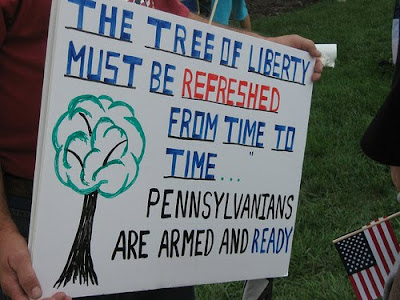
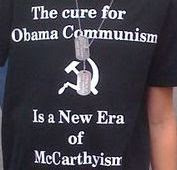
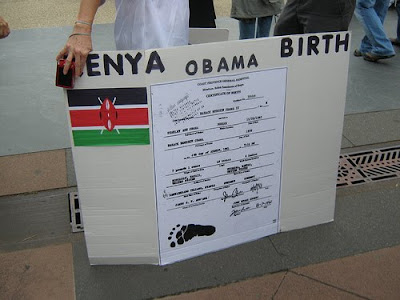
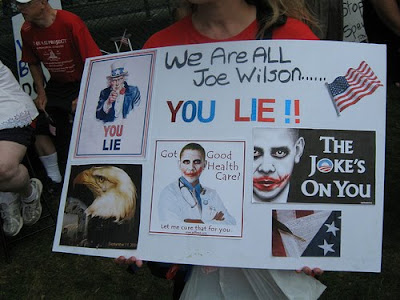
The pictures of these posters were taken by "People for the American Way" during the demonstration in Washington, DC last weekend by right-wing radicals.

The mission statement of PfAW begins with these words:
"People For the American Way is dedicated to making the promise of America real for every American: Equality. Freedom of speech. Freedom of religion. The right to seek justice in a court of law. The right to cast a vote that counts. The American Way."
PfAW distributed these pictures with this note:
"Over the weekend, tens of thousands (note: estimated 60,000)of right-wing activists rallied in Washington, DC with signs that challenged President Obama's citizenship, accused him and Democratic congressional leaders of everything from Nazism to communism, promoted paranoia about "death panels" and euthanasia, and declared support for figures like Sarah Palin and Rep. Joe Wilson."
While this paragraph is clearly descriptive of what happened last weekend, these deeply disturbing pictures tell the story without blunting the truth they represent, which is this:

The level of violent rhetoric and hate-speech in this country has reached dangerous proportions. This is not 'street theater'. These signs represent deeply disturbed minds - some of which are fully prepared to do murder.

Don't believe me? See the poster above and this one below.

These yahoos ain't playin'.

If you're not yet convinced, take a look at some of the other posters. If you've got the stomach, you can look at an entire gallery of them here.

The following will give you more than a good sense of what I'm talking about:


You know, I believe in the rights guaranteed under the Constitution of the United States of America.

I believe in the right to assembly and the freedom of speech. Hell, I even believe in the right to bear arms - but I also believe in gun control.

I think, however, someone needs to take some responsibility for reigning this one in. This is getting dangerous.

We need to hold to some standard of accountability folks like Glenn Beck and Rush Limbaugh, Janet Porter and Michele Malkin - who pollute the airways with their toxic waste day after day - and charge them with inciting to riot.

Or, at least, and EPA violation.

A PfAW staffer who showed up to check out the scene talked to many participants, and when she asked why they showed up, an overwhelming number gave the same answer: "Glenn Beck sent me."

We need to take that statement very seriously. Even more importantly, we need to find a way to hold these yahoos accountable for the abuse of the rights and freedoms promised to us in the Constitution.

I don't know what that might look like, exactly. I only know without these right wing nuts blighting the landscape with their hatred, this country just may start to look again like the America I know and love.

Tuesday, September 15, 2009

The Sacramental Nature of Community


There was a funeral for a long-time member of St. Paul’s yesterday.

John. His name was John. He was 86 years old. Had been married for 58 years.

How do you sum up and celebrate 86 years of a life well lived?

That is a daunting question and an even more daunting liturgical task.

I think the answer is this: community.

This man’s funeral – as so many of the liturgies, big and small, but especially the important events in the life cycle of a community – was an absolute marvel of community at work.

The Altar Guild polished the sliver to a fair-thee-well. They made certain that there was enough bread and wine – with back up of consecrated hosts, just in case.

The Flower Guild absolutely outdid themselves with a gorgeous arrangement at the altar and two tastefully done arrangements in front of the lecturn and the pulpit.

The Sexton made certain that the carpets were clean, the Parish Hall was set up to the caterer’s specification, the front outside steps and walkways were swept, the furniture was polished and all the windows and glass areas were sparkling.

One of the Vestry members lurked about in the Parish Hall, coordinating with the caterer and helping friends and relatives to feel welcome and comfortable.

The soloist, a former member of the choir who has had to take an LOA to work on a project, sang the Ave Maria and the Gospel Alleluia’s like a very angel.

Our new organist is an excellent performer, but even more than that, he understands liturgy – and his role in it. And, he’s not even Episcopalian (hmmm . . . perhaps that’s why?)

The Parish Administrator did a fantastic, professional job with the bulletin – not one typo and all the pages were centered – and ran off the front cover with a color picture of John from the office printer. By hand. Ten copies at a time.

The (transitional) deacon was fully present, lurking tastefully about, tending quietly and unassumingly, and was absolutely indispensable to catching the details. He also read the gospel with clarity and meaning and tended to the Table with competence.

The altar party – Crucifer, two Torch Bearers and three of the visiting clergy, all former rectors or assistants – performed as if they had worked together for years.

The man who functions as my unofficial verger was indispensable. He came in early to polish the candles sticks and candelabras, made certain that the 'family pews' had water and tissues, and helped to coordinate the altar party.

The four ushers were dressed to the nines, greeting people, handing out service booklets, helping people to find a seat, and “directing traffic” to the altar at communion.

The two Eulogists were simply magnificent. Appropriately humorous. Heartfelt. Sincere. Clear and Concise. They summed up two very different aspects of the man’s life in ways I could never have done.

Two members of the family did “parking lot duty” – they were out in the parking lot, greeting people as they came in and helping late arrivers find alternative parking when our lot became full.

I have discovered that the more I give away, the more I receive. The more I learn to coordinate and not “do,” the better the quality of the service.

Liturgy is the work of the people and liturgy is at its best when the people do the work they do best.

There is a sacramental nature to community - it is an outward and visible sign of the inward and spiritual grace of God. It is a deep mystery to me, revealing something about the nature of God as revealed in the work of the people.

At the end of the day, and the beginning of another, I know this much to be true: The life of our dear friend John was honored and God was glorified.

You know, it just doesn’t get much better than that.

Monday, September 14, 2009

Boycott Slave Trade Goods


It's going to be a long, busy day, so not a great deal of blogging today. I did want to point out this article about human-trafficking from Change.org that finally gives us an opportunity to make an impact on goods made by the slave trade industry.

There's a long, detailed list that's a little blandly formatted, but it indicates whether goods in a certain country are made with child labor, forced labor, or both.

It's important to keep in mind this doesn't mean all goods from that sector in that country were produced with exploitation. Here are some of the worst offenders for forced labor or slavery specifically:

* Bolivia: nuts, cattle, corn, and sugar

* Burma: bamboo, beans, bricks, jade, nuts, rice rubber, rubies, sesame, shrimp, sugarcane, sunflowers, and teak

* China: artificial flowers, bricks, Christmas decorations, coal, cotton, electronics, garments, footwear, fireworks, nails, and toys

* India: bricks, carpets, cottonseed, textiles, and garments

* Nepal: bricks, carpets, textiles, and stones

* North Korea: bricks, cement, coal, gold, iron, and textiles

* Pakistan: bricks, carpet, coal, cotton, sugar, and wheat

You can read the entire 194 page list at Change.org.

Those of us who are horrified and angry about this human rights issue can now put that energy to good use to have a direct impact to end the abuse.

Please read the labels of your purchases and take five minutes to talk with the store managers about your boycott.

Today, we as consumers are more powerful to end slavery than ever before.

We can make this happen. "Just say no" to slave-trade goods and let your voices be heard.

Thank you.

Sunday, September 13, 2009

"Deny yourself, it's later than you think"


“And Peter took him aside and began to rebuke him.”
Mark 8:27-38
Pentecost XV – September 13, 2009
The Episcopal Church of St. Paul
(the Rev’d Dr.) Elizabeth Kaeton, rector and pastor

Welcome back. Welcome home. It’s good to see so many of you here!

There are probably as many ways to read this morning’s scripture as there are those of you who are here. Some preachers will read this text and see in it more of Mark’s “Messianic Secret.”

Others will focus in on the high, noble calling of these famous words of Jesus: "If any want to become my followers, let them deny themselves and take up their cross and follow me.”

Other fiery preachers will focus in on not being ashamed of the Gospel.

I am fascinated by how the words of the Epistle of James – which we don’t often hear in church – bring into focus the action of the Gospel. If you look beyond the words on the page, you will notice that Peter rebukes Jesus and then Jesus rebukes Peter right back in front of the other disciples.

The topic under discussion was the central identity of Jesus – was he or was he not the Messiah? And, what did that mean?

Jesus was very clear about his understanding of the suffering he would have to endure as the Messiah, which made Peter very uncomfortable. A disagreement broke out between the two men about this.

Please note, however, that the rebuking done by Peter and Jesus was done in private. It was done between the two of them and then, among the disciples. It was not done in public.

Which leads me to talk about ‘civility’. I suppose the words from the Epistle led me to see that theme in the Gospel, but I suspect it was not a difficult stretch, given what has been happening of late in our lives together in this post 9/11, post-modern culture.

I don’t know that I can say that civility is dead in this country, but if it isn’t, all life-support has been suspended, the DNR order has been signed and it is on Hospice Care.

Yes, in part, I’m talking about the shameful outburst by the Representative from the Great State of South Carolina who called the President of the United States a liar on national television during an historic Joint Session of Congress on the topic of Health Care Reform.

Yes, it has to do with that, but it has to do with much, much more.

No, I’m not talking about politics, and I’m not talking about Health Care Reform. I think we all agree, no matter our political persuasion, that our Health Care System needs to be reformed.

There are stories in this church from parishioners that would raise the hair on the back of your neck and lead you to be as outraged as I am.

What we may differ on is the (ahem) . . .“significant details”. . . of that reform, but there is not doubt, at least in the minds of those I know and respect, that our Health Care System in general and the Health Insurance and Pharmaceutical Industries in particular are in need of reform.

Yes, yes. The devil is in the details. Of that, there is no doubt. But, this is not a sermon on Health Care Reform, which, as Christians, is an issue about which we should all be concerned.

Bishop Beckwith leaves tomorrow to spend a week in Washington, DC with a group of other Episcopal Bishops known as “Bishops Working For a Just World” where they will lobby Congress about Health Care Reform.

I’m very proud of our bishop and hope that you keep him and this very important work in your prayers.

I’m not talking about politics and I’m not talking about particular political issues. I am talking about civility, which we seem to have lost in our public as well as our private discourse.

It’s not just about language, although I’m sure I’m sure you’ve noticed that it’s now de rigueur to drop the “F-bomb” just about anywhere, any time, to anyone you wish.

Yes, in part, I’m talking about ‘shock-jocks’ and news commentators – in print, electronic and cyberspace – who make outrageous statements of opinion which masquerade as fact, and then encourage people to call in or write and comment as if their opinions were even worthy of discussion or comment.

I know the writers of the Epistle of James, at the time they were writing, could never have known about modern technology, but let me read that passage to you again:
So also the tongue is a small member, yet it boasts of great exploits. How great a forest is set ablaze by a small fire! And the tongue is a fire. The tongue is placed among our members as a world of iniquity; it stains the whole body, sets on fire the cycle of nature, and is itself set on fire by hell. For every species of beast and bird, of reptile and sea creature, can be tamed and has been tamed by the human species, but no one can tame the tongue--a restless evil, full of deadly poison.”
Tell me if that doesn’t apply to some of the more notorious of the so-called “commentators” who fill the airways and clog cyberspace.

That’s an issue for another time. Mostly, I’m talking about you and me, the ‘little people’, and how we live our lives with at least a modicum of civility, and how it is we teach our children to behave in a civil manner.

There will always be conflict in community - as there is in every part of normal family. But, Jesus teaches us how it is we are to handle that conflict in community. In the 18th Chapter of Matthew’s Gospel, Jesus gives us a guideline of how we are to do that:
“If your brother sins against you, go and tell him his fault, between you and him alone. If he listens to you, you have gained your brother. But if he does not listen, take one or two others along with you, that every word may be confirmed by the evidence of two or three witnesses. If he refuses to listen to them, tell it to the church; and if he refuses to listen even to the church, let him be to you as a Gentile and a tax collector.”
That, I think, is the very definition of civility. It’s what we see Jesus do with Peter in Mark’s gospel. It is the way Christians are to behave. It is the way we ought to behave as adults and, as responsible adults, the way we ought to teach our children to behave.

Why am I so concerned about this?

I am concerned because of what St. James warns us: How great a forest is set ablaze by a small fire! And the tongue is a fire.

I am deeply concerned because the Southern Poverty Law Project has been warning us for months that the level of violent rhetoric is growing at an alarming rate. Not coincidentally, the build up of private arsenals by individuals known to be part of Hate Groups is also growing exponentially.

On a personal level, we know from studies in domestic violence that violent language always leads to acts of violence. Children will listen. Our children and grandchildren are listening.

They hear. They see. They know. And, they look to you. They look to their schools. They look to the church. They watch and listen very carefully to see if the words you say with your lips are reflected in the way you live your lives.

The White House understands this about children, which is why Presidents and First Ladies make a point about going to visit school children – reading to them, talking with them.

Except, of course, when the current Administration tries to talk to as many school children as possible, to give them a word of encouragement in these difficult times.

The resulting, appalling lack of civility by some parents taught our children an unintended but very strong lesson – one they are almost certain to rebel against in later years.

Children will listen.

"You have to be carefully taught."

When Peter disagreed with Jesus, he took him aside before he rebuked him. And Jesus, being a good Rabbi, took Peter aside with the disciples and rebuked him right back, BEFORE he turned to the crowd and said,
"If any want to become my followers, let them deny themselves and take up their cross and follow me. For those who want to save their life will lose it, and those who lose their life for my sake, and for the sake of the gospel, will save it. For what will it profit them to gain the whole world and forfeit their life? Indeed, what can they give in return for their life?”
Civility in public discourse is a cross to bear. It requires discipline and, in many ways, involves a sacrifice of self for the greater good. For, if we do not hold civility as a value in our public life, what is to be gained if we score political points, but lose the soul of our community?

As we begin this new program year in the midst of increasing financial uncertainty, soaring unemployment rates, and public debate about Health Care Reform, and anxiety threatens to set our tongues ablaze, let us keep in mind the words of the Epistle of James and the model of Jesus with his disciples.

A little more self-denial and cross bearing might well lead us to the path of greater civility and, in the process, we just might become better Christians – better followers of Christ – as well as citizens of the universe.

From one generation to the next.

Amen.