Come in! Come in!

"If you are a dreamer, come in. If you are a dreamer, a wisher, a liar, a Hope-er, a Pray-er, a Magic Bean buyer; if you're a pretender, come sit by my fire. For we have some flax-golden tales to spin. Come in! Come in!" -- Shel Silverstein

Showing posts sorted by relevance for query Ruth the Moab. Sort by date Show all posts

Sunday, December 17, 2017

The Prophets of Advent III: Ruth of Moab

Ruth is the third woman named in the lineage of Jesus recorded in the first chapter of Matthew. Her story, told in the Hebrew Scripture of the Book of Ruth is familiar to many of us.  Well, at least the part where she refuses to leave her mother in law Naomi.

The fuller story of Ruth’s courage and faithfulness and tenacity to the family she married into leads her to begin an entirely new family, one which also leads to a religious conversion and will place her in the lineage of the House of David and elevates her lowly estate to an ancestor of the Messiah.

The story begins when a family of four, Naomi with her husband and two sons, leave Bethlehem to travel to Moab to escape the famine which has brought hardship and tragedy to the land and its people. It’s important to note that the nation of Moab was descended from Lot’s son of the same name. These families had been separated for many generations. Moab had a long history of conflict with Israel and intermarriage between the two countries was frowned upon.

Even so, Naomi’s sons marry Moabite women – Ruth and Orpah – but tragedy strikes and all three men die, leaving the women destitute in that ancient culture. With absolutely no hope for the future, the three women leave Moab and head back to Bethlehem where Naomi at least has family.

Along the way Naomi has a change of heart, and urges Orpah and Ruth to return to their families (releasing them from their marital obligations). Orpah turns around but Ruth stays, pledging the words which have become a familiar if not romantic part of wedding ceremonies “Wherever you go, I will go…your people shall be my people, and your God, my God” (1:16).

Unfortunately, no one in Bethlehem is able to help the three women so Ruth comes up with a plan to work gleaning in the fields which are owned by Boaz, a wealthy relative of Naomi’s late husband. 

Ruth’s hard work catches the attention of Boaz, who begins to take an interest in her welfare and offers her protection and extends her some privileges.

Ruth works there until the end of the barley and wheat harvest, which is about two months. Still, no one comes to help them. 

Naomi develops a plan to help Ruth secure a marriage proposal from Boaz and instructs her to go to him privately in the dead of the night. But Ruth appeals to Boaz, asking him to assume the ancient tradition of taking on responsibility for destitute relatives. Boaz is rightly impressed by Ruth’s character and loyalty to Naomi and agrees to her proposal.

Arrangements are made – with great delicacy and finesse since there is a closer relative who must be dealt with first and money, of course, is involved – but Ruth converts to Judaism and marries Boaz and they have a son, Obed. This makes Ruth an ancestor of David, Israel’s most illustrious king.

On this third Sunday in Advent, Ruth’s story also sets our eyes, like the shepherds and wise men from the East before us, toward Bethlehem.
  • It was in Bethlehem that Judah’s tribe settled (See Advent I: Tamar.)
  • It was to Bethlehem that Naomi returned with her daughter-in-law, Ruth, the Moabite, bringing reconciliation to two families separated for generations.
  • It was in Bethlehem that Ruth and Boaz (a descendant of Rahab - see Advent II) married and had a son, Obed.
  • It was in Bethlehem that Obed raised a family, even a grandson who would be king (and who would marry Bathsheba whom we will meet next week.)
  • It was to Bethlehem that Joseph traveled with his very pregnant wife, Mary.
  • It was in Bethlehem that Jesus, the Prince of Peace, was born
  • It was in the fields of Bethlehem that angels appeared to announce Jesus’ birth to the shepherds.
So, when you light the third – pink! – candle of your Advent wreath this evening, remember the story of one of the women in the genealogy of Jesus.

Remember Sister Ruth and her courage and strength, her valor and faithfulness to “the tie that binds” all human hearts in love over the ancient hurts that separate us. And, say a prayer for Sister Naomi whose generous heart took in her daughter-in-law even though she had many reasons that mitigated against that act of sacrificial love.

Remember and tell the story to your children that your children's children from generation to generation may know that the glory of God is the human person fully alive.

Holy God, as we begin to turn our eyes toward Bethlehem, help us to turn away from ancient fears and follow the light of Love which leads to hope and reconciliation. Give us the faithfulness and strength of Ruth to take the risks of love that we may become Children of Light and Hope and Love. 

Amen.

Sunday, December 23, 2018

Holiness Happens

A Sermon Preached for Advent IV - December 23, 2018

Christ Episcopal Church, Milford, DE


Well, here we are, the fourth Sunday in Advent and two days from Christmas. 

This will be my last Sunday with you – well, I suspect we may see each other again – but I think we can all agree that it will be wonderful for you to have an Interim or Priest in Charge which will place you back on the road to stability in leadership, besides your amazing Jr. and Sr. Wardens and hard-working Vestry. 

In three weeks with you I know this much: You are a wonderful community of faith.

If you’ve learned anything about me in the past three weeks, it’s that I’m a storyteller. I love the Gospel stories and I love the stories of our lives that reflect the ancient stories of Good News – and the way the people of today reflect the ancient characters in the Gospel stories.

I especially love Luke’s story of The Visitation which gives us the beautiful song of Mary we know as “The Magnificat”. Scholars tell us that this song affords Mary the most words said by any woman in any piece of scripture anywhere.

What I love about the story of the Visitation and the Magnificat is that there are so many stories within that story. The story looks to me the word equivalent of one of those Russian Nesting Dolls – like this one here – where one doll fits into another and then another until you get to the baby.

Now, I'm really excited to get to all the stories in the stories, but before I begin, let me address something that always dances in the mind of at least one or two people in a congregation like this. Someone always wants to dismiss this story because of The Virgin Birth – which they consider so much hocus-pocus or poppycock. 

I love what author and Presbyterian minister, Frederick Buechner says about that:
“ . . . .many Christians have made it an article of faith that it was the Holy Spirit rather than Joseph who got Mary pregnant. If you believe God was somehow in Christ, it shouldn't make much difference to you how he got there. If you don't believe, it should make less difference still. In either case, life is complicated enough without confusing theology and gynecology.

In one sense anyway, the doctrine of the virgin birth is demonstrably true. Whereas the villains of history can always be seen as the products of heredity and environment, the saints always seem to arrive under their own steam. Evil evolves. Holiness happens.”
Evil evolves. Holiness happens.

The story of the Visitation of Mary and Elizabeth and the Magnificat that Mary sings is one of those moments when “holiness happens”. 

It has a great deal to do with the word “blessed” – which is the word Elizabeth uses to greet Mary: “Blessed are you among women.” 
 
Hold that thought because I’m going to come back to it in just a minute.  Or, two. 

I say that this is one of those moments when ‘holiness happens’ because on the surface of the story it may look like only Mary and only Elizabeth are present in this story. 

But, if you open the Nesting Doll of this story, you’ll find other women present, as well, all having to do with Mary having been greeted by Elizabeth as “Blessed”.

The first is the story of Hannah, which Mary must have known. Indeed, she may have even learned it from her mother who may have sung the song around the house as she went about her work. 

Found in the second book of Samuel (2:1-10), Hannah gives thanks to God for the birth of her son Samuel. It is very similar to Psalm 113. In Judaism, the song of Hannah is regarded as the prime role model for how to pray and is read on the first day of Rosh Hashanah. It begins: 
 “My heart rejoices in the Lord; my strength is exalted in the Lord. I smile at my enemies, because I rejoice in your salvation.”
But, there is yet another story in this story – the song of Deborah which we find in the fourth book of Judges (4:4-5) – her song is in Judges 5. 

Deborah is described as a prophet, a judge and a warrior – a mother of Israel. Her story comes at a turning point in the history of Israel as the people cross over to reclaim Canaan. It is a time of violence and war when men and women are called to battle to save the nation of Israel.

Deborah’s song recalls the heroine Yael who kills Sisera, a general hellbent on destroying Israel. Yael offered him milk and kindness and hospitality and then, when he becomes drowsy with satisfaction, drives a peg through his skull and kills him. For this, Deborah sings the praises of Yael and says she is “blessed among women.”

But wait! There’s more. 

There’s another nesting doll to be uncovered. Yael is not the only woman thus invited into this holy moment. 

Perhaps you may have heard the story of Judith, another strong woman in the stories of our faith during the time of the Assyrian attempted take over of Israel. In the 13th chapter of the Apocryphal Book of Judith, Judith is praised in similar language for killing Holofernes:  
"O daughter, you are blessed by the Most High God above all other women on earth; and blessed be the Lord God, who created the heavens and the earth, who has guided you to cut off the head of the leader of our enemies."
So, we have Mary and Elizabeth, Deborah and Yael and Judith. 

Oh, but wait! There’s more. 

You may already know this but there are only two of the four Gospels which give us any sense of The Nativity. John and Mark are silent on the details of the birth of Jesus. Luke’s story contains the most specifics and is what the kids will act out in their Christmas pageant on Christmas Eve. 

Matthew gives the genealogy of Jesus, to prove his human lineage. In that genealogy, four women are named: Tamar of Judah, Rahab, the Canaanite of Jericho, Ruth of Moab, and Bathsheba, the Righteous. 

Tamar, Rahab and Bathsheba are each described as women whose morals are at least questionable if not scandalous but a closer look at their stories reveals the story of women who were smart and brave. 

Even Ruth is encouraged by her mother-in-law, Orpah to seduce the owner of the fields where she works – but only in order to save them from starvation and death. 

All of these women are in the room with Elizabeth and Mary. All of them are “blessed among women” because Mary carries within her womb the embodiment and the redemption of all of their stories. 

No wonder John the Baptist leaps in utero when Elizabeth greets Mary.

To understand this, to understand how ‘holiness happens’, you have to know something about the word “blessed”. That story is the final nesting doll in the nesting egg of stories about the Magnificat.

Several years ago, I was curious about the word “blessed” so I looked it up in the Old Oxford English Dictionary. I grew even more curious as I discovered that the root of the word ‘bless’ is ‘blood’. 

I mentioned this to my spiritual director at the time, Martin Smith, who was, at that time, a brother in the Anglican Order of the Society of St. John the Evangelist in Cambridge, MA where I attended seminary. You may know them as “The Cowley Fathers”. 

Martin explained to me that most of our words in the English language came to us from St. Gregory who founded a monastery where the monks wrote down most of his sermons.  Prior to that, not many sermons were written down. Gregory’s favorite preaching topic was the stories of Jacob. He especially loved preaching on the story of Jacob’s wrestling with an angel.

Gregory said that, when Jacob and the angel began to wrestle, in that moment, time stood still. It’s a holy moment, Gregory said, when the past and the future fold into the present and become one.  

In that moment, Gregory preached that the blood of the cross splashed on Jacob and he was “blooded”. 

Jacob was ‘blooded’. 

When the monks wrote down the sermon, they wrote in the script of their day, of course. To eyes that came to read that sermon later in time, their letter ‘d’ looked like an ‘s’. 

Thus, ‘blooded’ become ‘blessed’. 

Jacob was blessed.

When you open the nesting egg of the story of the Magnificat and begin to hear the echoes of all the other women who are singing with Mary in that holy moment – all those warrior women who fought for the freedom of their country which did not fully grant it to them – you begin to understand the blessedness of Mary, and why Elizabeth greets her as “Blessed among women.”

You begin to understand that in the holy moment when Mary wrestled with the words of an angel and had to suspend logic and reason, the past and the future folded into the present and the blood that had been shed in the past and the blood that will be shed on the cross has splattered on Mary. 

St. Gregory would have said that Mary is blooded.
 
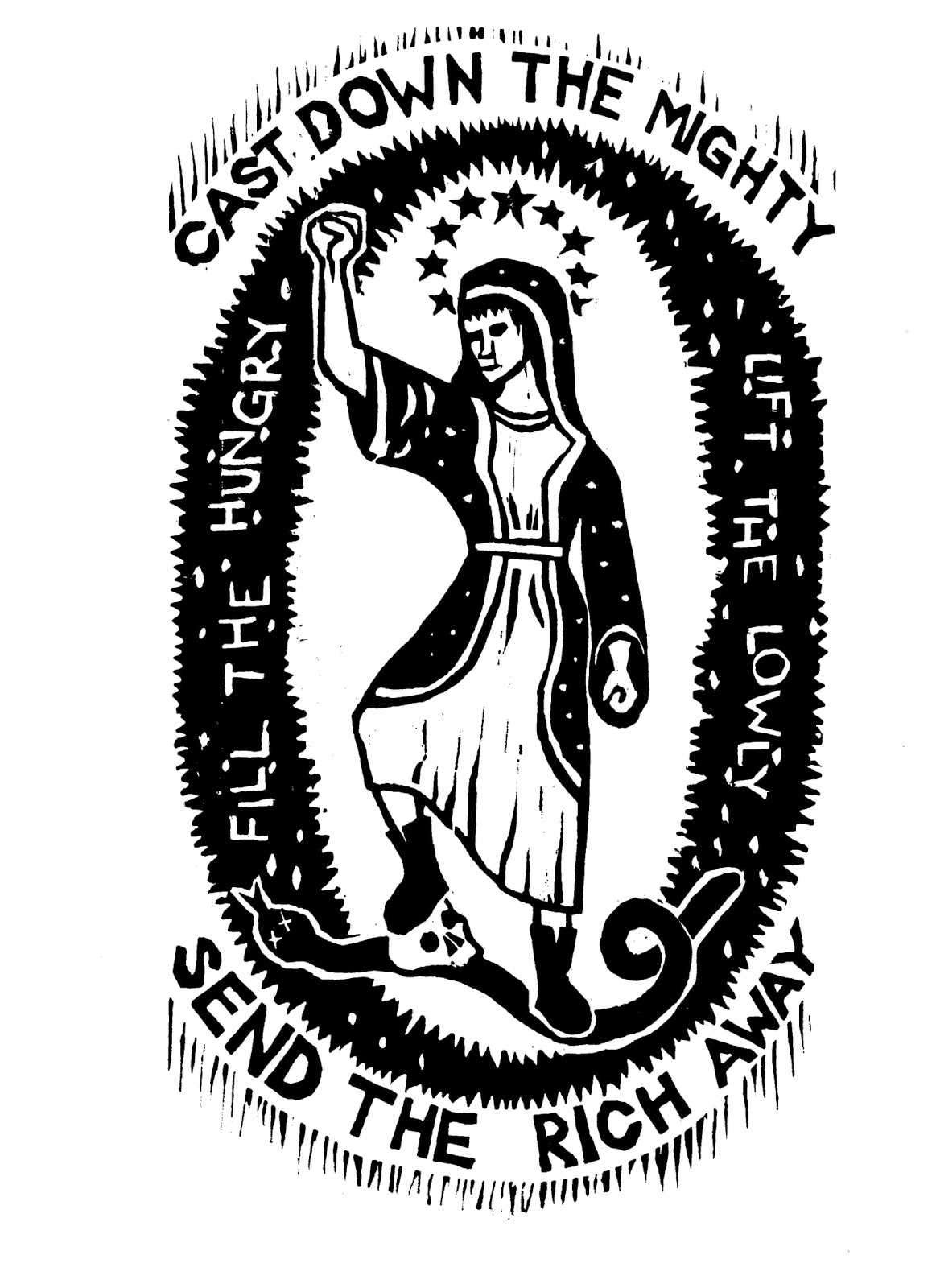
You also begin to understand why Mary spoke about the “strong arm of God” and “casting the down the mighty” and “lifting up the lowly”. Perhaps you can understand why she sang about “filling the hungry with good things” and sending “the rich away empty”. 

And, you begin to understand just how much of an influence Mary had upon her son, Jesus as well as his cousin John who leapt in her womb when he heard Elizabeth say to Mary, “Blessed are you among women!”

In two days, we will be celebrating the Nativity of Jesus. We will be asked to participate in a story that defies logic and strains reason. 

And for one night, one Holy night, we will be asked to suspend logic and reason and belief and participate in a story that requires an act of faith.   
We will be asked not just to receive Jesus, but also to conceive Jesus in our hearts and souls and minds.

We will be asked to participate in a miracle.

Like Mary, we will be asked to say YES to God, even though people may judge us unkindly. 

Fear not! We will not be alone. 

We will be surrounded by Mary and Elizabeth, Hannah and Deborah, Judith and Yael, as well as Tamar and Rahab, Ruth and Bathsheba and a whole host of holy women and men, the saints of old, who arrived into a holy moment on their own steam.

At Christmas, we will enter that time and space when time stands still and holiness happens.

And when we do, we, too, will be blessed among women and men. 

Amen.

-->

Sunday, November 29, 2020

Celtic Advent - Day XV - November 29


Celtic Advent - Day XV - November 29

Today is the first day of Advent on the Church's liturgical calendar. At tables in many homes - Christian and not - the first candle of the Advent wreath will be lit at sunset or at the beginning of the evening meal. Perhaps some prayers will be said which includes something about the significance of that particular candle.

Someone somewhere decided sometime ago that each of the four candles stood for something: hope, love, joy and peace and the fifth one in the middle is the Christ candle. 

When I was a child, my grandmother said that each candle stood for those who prepared us for the Messiah: The Patriarchs, the Prophets, The Virgin Mary, John the Baptist and, of course, the Christ candle.

A few years ago, I started an Advent Wreath to remember the women identified in the genealogy of Matthew's gospel:  Tamar of Judah, Rahab the Canaanite of Jericho, Ruth of Moab, Bathsheba the Righteous, and, of course, the candle for the Theotokos, Mary. (Yes, if you click on each of those links, it will take you to the meditation for each of those women.)

The real controversy - and, of course, there would be a controversy about an Advent wreath as there is about everything else liturgical in the church - is which color candle to use. 

Tradition has it that there are three purple, one pink and one white. But, since the church has been more recently celebrating Advent as a season with its own intent and merits, the penitent purple has been switched for sarum blue. 

The important thing is to have a special "Mary" candle on the third Sunday in Advent. The color of that candle is traditionally pink. +Catherine Waynick was one of the first women to be bishop diocesan in The Episcopal Church. 

I remember clearly her first Advent letter to the diocese in which she added a PS: "People ask me why the third candle of the Advent Wreath is pink. And now, I will tell you: The third candle of the Advent Wreath is pink because Mary really, really, really wanted a girl."

The problem, of course, is finding purple or blue candles. Many supermarkets have a whole section of candles but the color selection for dinner table candles is usually limited to white or red and sometimes green but rarely purple or blue. 

Necessity being the mother of invention - and people being creatures of forgetfulness until it's too late to order them online - you will find some Advent wreathes with four red, one green and one white candle. Or, depending on the stock in the store, four green, one red and one white. 

Or, sometimes, especially for those who really don't know anything about the Advent wreath except it's a Christmas "decoration" and it looks lovely, all five candles will be white. Or, blue. Or, purple. 

And, sometimes there will be four candles and no fifth for Jesus (pun quite intended). 

This - especially this last one of no Jesus Candle - the drives the purists absolutely right 'round the bend and back again.  I have seen some people loose their stuff in a guest's home about their Advent wreath. Which, I think, makes Mary and Joseph and the Baby Jesus and all the shepherds and angel howl with distress. 

Perfection is absolutely the least thing important about Advent, much less the candles on the Advent wreath.  

In the first place, perfection is not the reason Jesus came into the world. Had we all been perfect, there would have been no need for the incarnation and even less need for redemption. 

It's also absolutely contrary to the significance of the four candles - hope, love, joy and peace. 

So, no arguing over the candles, please.  Let's look, instead, at the intent and celebrate that.

I don't know what is done for Celtic Advent. When I google Celtic Advent Candles or Wreaths, I usually get lovely ceramic or metal wreaths with Celtic triquetra designs and, you guessed it, four candles. 

Which, I suppose, is just fine. I've supplemented mine with tea candles. Just don't send the Celtic Liturgy Police to my home and no one will get hurt.

In two days - December 1st - the commercial Advent calendar begins. The tradition in lots of countries is to create a calendar for the kiddos - usually of a material like felt - with 25 small pockets, each numbered for the 25 days of Christmas in December. 

A small, sweet treat is placed into each pocket and, every day, the children are rewarded for their patient waiting by being allowed a treat at the end of the day. 

In homes not so lucky, the Advent Calendar will be made of paper and the "window" on each number will be opened to reveal a character in the Nativity Story and one of the parents will tell that character's story. 

In very lucky adult homes, the Advent Calendar will come from Aldi and you will have your choice of 24 amazing different cheeses and/or 24 small bottles of wine or beer. I kid you not. 

If you have never been generously gifted with an Aldi calendar or bought one for yourself, 2020 may just be the perfect year to indulge. Run right out tomorrow and get one while there's still time. (They also have bath soap and moisturizers for those who do not imbibe.) It may be one way to cope with the last few remaining weeks of this annus horribillis. 

Advent wreaths are - or, at least, can be - a little daily meditation on the journey toward the Incarnation. It is a journey which begins, of necessity, in the dark as an embryo deep in the womb, but it moves and grows always, to the Light. 

As we light each candle, the amount of light increases, which is wonderfully symbolic of Jesus, the light of the world, coming into our dark and broken world to illuminate the path to healing and wholeness, redemption and salvation, and hope, love, joy and peace. 

Whether you observe a Celtic or Traditional or Cultural Advent, take some time to consider those times when hope, love, peace and joy came into your life. Did it come as a gift or a surprise or was it something you intentionally sought? 

Perhaps you'll want to spend some time thinking about the virtue of patience and whether or not it is in your possession; and, if not whether it might be a good spiritual discipline to cultivate through a spiritual exercise this Advent.

I will leave you with this Blessing for Advent I by Jan Richardson

A Blessing for Traveling in the Dark

Go slow
if you can.
Slower.
More slowly still.
Friendly dark
or fearsome,
this is no place
to break your neck
by rushing,
by running,
by crashing into
what you cannot see.

Then again,
it is true:
different darks
have different tasks,
and if you
have arrived here unawares,
if you have come
in peril
or in pain,
this might be no place
you should dawdle.

I do not know
what these shadows
ask of you,
what they might hold
that means you good
or ill.
It is not for me
to reckon
whether you should linger
or you should leave.

But this is what
I can ask for you:

That in the darkness
there be a blessing.
That in the shadows
there be a welcome.
That in the night
you be encompassed
by the Love that knows
your name.

Saturday, June 12, 2010

Hospitality and Unholy Women


I've been thinking a great deal about the lessons from the Revised Common Lectionary for tomorrow.

I'm not preaching tomorrow (thanks be to Jesus) and this isn't a sermon, but it is simply irresistible for me not to say something when so many women fill so many lessons - with the words of St. Paul (Galatians 2:15-21) sandwiched in among them as, I suppose, a justification of sorts.

The choice of lessons from Hebrew Scripture is either the story of Jezebel and her sulking husband Ahab (1 Kings 21:1-10, (11-14), 15-21a) or Bathsheba and that scoundrel David (2 Samuel 11:26-12:10,13-15).

The gospel lesson is from Luke 7:36-8:3 - wherein "a woman in the city, a sinner" washes the feet of Jesus to the outrage of the assembled dinner guests.  It ends with this note:

Mary, called Magdalene, from whom seven demons had gone out, and Joanna, the wife of Herod's steward Chuza, and Susanna, and many others, who provided for them out of their resources.

Reading the scripture lessons for tomorrow is a little like watching the "Disney Women":


Cruella de Vil (say it fast: d'evil) whose obsession with fur leads her to do anything to take her nephew's Dalmatian puppies (“Poison them drown them, bash them on the head!”).

Doesn't get much more charming than that, eh?


Then, there's the Evil Ursala, the lip-pouting, manipulative octopus, who collects souls so they can live out the rest of their lives in misery. First she steals the Mermaid Princess Ariel's voice so she might have her handsome prince (don't get me started on THAT one).  Then, she successfully tricks Ariel and steals her soul so she may inherit her father's kingdom.


Once "the fairest of them all" begins to age and lose her beauty, The Queen plots to kill her beautiful step daughter, Snow White, and demands that she have her heart to feed on. (Nice, right?)

When the man she sends to do the deed is too kind to kill Snow White, she flies into a rage and uses her special magical powers to transform herself into an old hag to bring Snow White a poison apple.


My personal favorite is Maleficent who has so much evil in her,  she was even named for it.  (In case you missed the point, look: her hat has evil-like horns.) All of her insidious plans are devised out of spite.  She casts a spell on Aurora ("Sleeping Beauty") to ensure that "Before the sun sets on her sixteenth birthday, she shall prick her finger on the spindle of a spinning wheel and die."


And you thought Jezebel was evil.  Ha!  She ain't got nothin' on old Maleficent.


Last but not least is Cinderella's psychologically abusive "wicked stepmother," Lady Tremaine.    She ruthlessly toys with the poor girl’s hopes and dreams, treating  Cinderella as a slave rather than an equal.

In an attempt to prevent  Cinderella from attending the grand ball, she locks her away with no  chance of meeting her prince. Lady Tremaine  successfully manages to inflict extreme suffering on Cinderella without  laying a finger on her.

Evil women plotting against innocent women.  Men who are easily manipulated or "just can't help themselves" because they have been so smitten by the beauty of women.

Hmm . . . wonder where "Uncle Walt" Disney got his ideas about women?

I know, I know.  Many very fine essays have been written and college courses taught on the subject of the sexism and misogyny of Walt Disney. I'm not going to go into any great depth here.  This is not a sermon and it's not a definitive essay on the subject of Disney women.

Or, the controversy surrounding the accusations of sexism combined with the racism inherent in Disney films like Pocahantas and Mulan.

Oh, BTW and PS - Y'all know the story about the supposed 'gay purge' during the writing of "The Little Mermaid", right? 

And, how the LGBT community got their last laugh?

Look over there to the right and you tell me if it's not true that "Hell hath no fury like a scorned Quean."

I understand this was on the cover of the VCR release. It has since, apparently, been . .  ahem . . . "cleaned up."
 
The folks at Disney finally did sort of woke up to their own misogyny - or, perhaps, heard the howls of protest from women and liberated men - and started giving us characters like "Belle" from "Beauty and the Beast", who would rather read a good book than be wooed into marriage by the most handsome, available bachelor in the village.

Generations of young girls and boys, however, have gotten the message. And, are getting it, still. DVDs preserve these stories for generations to come.

And then, of course, there's scripture.

Holy Scripture about unholy women.

Yes, of course, there are exceptions.


Esther, wife of King Xerxes of Persia and the Queen of her people, who saved them from certain death because she, of all women, knew that "the way to a man's heart is through his stomach."

I'm talking, the whole Magilla here, if you know what I mean.

I always try to get myself invited to someone's Purim party.  They are the BEST.


The courage and tenacity of Ruth and Naomi have inspired generations of women and men.  Their journey from Bethlehem to Moab and back could only be accomplished by the mutual reliance that comes from a relationship based on a love that knows know boundaries of country or kin.

No wonder it is often read at weddings.


There are many others, but my personal favorite is Judith.  I love the moral complexity of the story - the ethical dilemma it presents in the ever-unfolding story of God's actions in the world.  It is often seen as a parable or, as Wiki notes, "perhaps one of the first historical novels".

You know the story, right? Judith is the beautiful young widow of Manasseh who had died of sunstroke during the barley harvest while the armies of Holofernes were advancing on the nation of Israel.

Chapters nine and ten of the Book of Judith contain some of the most beautiful, complex passages written about women in all of scripture (indeed, I had parts of it read at my priestly ordination).

Judith prays fervently to God for direction and guidance. She mourns her husband, Manasseh and then arises from her sack cloth and ashes, bathes herself in her best perfume, dresses in her finest clothing, puts on all of her jewelry, and gets the maids of her household to help her pack up her things so she can get Holofernes good and drunk and seduce him before she kills him.

In the beheading of Holofernes, the Assyrians have lost their leader and the nation of Israel is saved.

You know, it just doesn't get better - or, more morally complex - than that. 

So, of course, a woman is involved.

I'm quite certain that tomorrow, the safe bet is on hearing a sermon on hospitality. Indeed, there will probably be no end to the number of safe sermons preached tomorrow about hospitality.

I, on the other hand, would probably be preaching about the holiness of women who are considered "unholy" and "possessed of demons".

I'd no doubt be talking about how women have always provided for the Body of Christ out of the meagerness of their resources.

I would absolutely be talking about Jezebel, Bathsheba, Mary of Magdala, Joanna, and Susanna as morally complex icons of the radical hospitality of women.

Oh, and I probably could not resist talking about Disney women.

It would be quite a sermon - if I would write it and preach it.

I'm thinking some place, somewhere in Western Christendom, someone is breathing a deep sigh of relief.

Then again, didn't St. Paul say,
"For through the law I died to the law, so that I might live to God. I have been crucified with Christ; and it is no longer I who live, but it is Christ who lives in me. And the life I now live in the flesh I live by faith in the Son of God, who loved me and gave himself for me. I do not nullify the grace of God; for if justification comes through the law, then Christ died for nothing."
Somebody in the church - somewhere - give the man an "Amen."

(Oh, and give a listen to the Presiding Bishops talk about Mission or "Incarnate Engagement" here.) She is clearly speaking in the tradition of that 'unnamed woman' who washes the feet of Jesus.