Come in! Come in!

"If you are a dreamer, come in. If you are a dreamer, a wisher, a liar, a Hope-er, a Pray-er, a Magic Bean buyer; if you're a pretender, come sit by my fire. For we have some flax-golden tales to spin. Come in! Come in!" -- Shel Silverstein

Friday, October 12, 2012

Democracy vs. Ideology

If political debates have become the new "must-see-TV", last night's Vice Presidential debate delivered something between what David Brooks called "'The Honeymooners' versus 'Family Ties'; Ed Norton versus Alex Keating."

To my mind, it was neither of these. It was less a debate and more a "Family Feud" with Martha Raddatz of ABC News functioning as half professional moderator and half Richard Dawson (he was my favorite) as host.

The Honeymooners
Joe did Delaware proud - and helped Obama more than anyone might have imagined. He never let young "Lyin' Ryan" get away with factual errors, frequently pointing out that "I was in the room with the President" when certain decisions were made.  He called him out on his lack of substance, saying at one point, “Stop talking about how you care about people,” he said. “Show me something.”

Mr. Ryan’s predictable response: You said the stimulus would fix the entire economy and it didn’t. But he had no responsible answer for increasing growth.

Ryan, for his part, demonstrated a surprising knowledge of foreign policy although it was disingenuous and bumbling. Again, he lacked substantive responses to the specifics of any Republican - much less the Romney-Ryan - plan for Iran's nuclear stockpiling, and agreed with the administration’s planned 2014 pullout from Afghanistan but still thought it was a bad idea, although he didn't really say why.

Ryan offered little in the way of economic proposals beyond the tried and untrue Republican solution of cutting taxes and spending and ridiculing the Obama administration’s stimulus program. The Vice President, who was in charge of that program, showed Mr. Ryan’s hypocrisy on the subject by pointing out that the congressman had asked for stimulus money for his state of Wisconsin, just as other Republicans did even as they vilified the program.

It's amazing to me that Romney-Ryan team continue to give us Republican policy "solutions" to the economy which mirror the very same Bush policies which got us into this mess in the first place. 

I had to give Ryan points, in defending Romney's hateful "47%" remark, when he pointedly said, “I think the vice president very well knows that sometimes the words don’t come out of your mouth the right way.” But Biden retorted sharply: “But I always say what I mean. And so does Romney.” 

Beyond the wearisome posturing and "war of words" that so many find so "entertaining", what I saw last night on the stage of Newlin Hall on the campus of Centre College in Danville, KY was an almost classic confrontation between Democracy and Ideology. 

Family Ties
Never was it more clear than when the conversation came 'round to the matter of abortion.  Despite Ryan's seemingly softer stance that, in a Romney-Ryan administration, abortion would be allowed in cases of rape, incest and the endangerment of the life of the woman, a dangerous truth was inadvertently told. You might have missed it if reproductive rights is not on your particular radar screen. 

Ryan made a predictable assertion that the issue was more an issue of "State's Rights". It was a clear admission - he admitted in a rare moment of truth-telling - that his position is shaped and formed by his Roman Catholicism. 

Biden, also a Roman Catholic, quickly pointed out that the next President will likely appoint the next two Supreme Court Judges - something Romney, a former Mormon bishop, has also mentioned as being important to his reelection, while saying that he does not see one law that he would change. 

Right. Get it? It's the old political "one-two" punch.

Ryan talks about how abortion should be determined in the individual state legislatures while Romney knows that, if he's President, he can appoint conservative judges to the Supreme Court and let them do all the heavy Tea Party lifting and reverse Roe v. Wade. 

Biden saw though all that and called it for what it is: "Malarkey". He said that his RC faith makes him who he is but he would never impose his religious beliefs on others, including the right of a woman to make her own decisions regarding what happens in and to her own body. 

The Romney-Ryan Republican administration would remove that right "by any means necessary" - attacking it on the state and federal level. Religious ideology and "state's rights" trump a woman's right to self-determination.

I know that, to many people, reproductive rights is a "social issue" that has little or nothing to do with the "more important" issues of the economy and unemployment, the debt and foreign policy. 

I want to suggest to you that reproductive rights is a bellwether issue which exposes what is at the heart of this political campaign. 

It is nothing less than Democracy vs. Ideology. 

That's why Romney-Ryan have got bupkus - zero, zip, nada, nothing - of any real substance to offer except their religious beliefs about what is right and who is good - no matter whose rights have to be compromised. Meanwhile, the entire Constitution - which they seemingly cherish - is trashed on the single constitutional issue of Religious Freedom.

They seem oblivious to the fact that Religious Freedom not only guarantees freedom OF religion but freedom FROM religion.  I'm not talking atheists here. I'm talking about the constitutional guarantee that no one will be forced to live under the religious ideologies of others. They also seem to have no clue that the "terrorists" they fear are religious ideologues whose perspective on women (and, wealth, poverty, human sexuality and religious freedom) is dangerously close to their own.

You hear it in the rhetoric of "takers" vs. "makers" and in Romney's despicable "47%" and Ryan's hateful "30%". You hear it in everything from the Republican tax plan, to their firm line on immigration to their aggressiveness on foreign policy - even suggesting that a war might be in the offing with Russia. 

It's not Democracy. It's religious ideology. 

Family Feud
Or, in Joe's words, it's "Malarkey!" - which is what you say because you can't say "Bull***t" on live, national network television.

How will this all play out with the people?

Well, we have two more Presidential debates - the next one coming up on Tuesday. The President will have an opportunity to redeem his last, lack-luster debate performance. I expect him to work Romney over, demanding specifics and exposing his flip-flops and lies.

Have you noticed that the President lost points for being a "gentleman" and keeping his cool while Romney rudely interrupted and talked over both the President and the Moderator, but some people are lambasting Biden for being "rude" and "aggressive" while Ryan seemed to keep his cool for most of the evening - except, of course, when he sat there, looking at Biden as he exposed his duplicity, giving him his distinctive Eddie Munster smirks?

Makes me laugh when it doesn't drive me to tears of frustration.

It won't make any difference to those who are solidly Republican or Democrat, but it will make a huge difference in (1) continuing to energize the Democratic base, (2) hardening the resolve of the Republicans to get the Black man out of the White House and (3) swaying those "independent" or "undecided" voters, some of whom will be persuaded by style and others by substance. 

On The Family Feud, it never really mattered how good your answer was or how charming you or your family appeared. As Richard Dawson used to say, "And, the survey says........".

I'm a Democrat but I'm also enough of an American to put solid money on the fact that democracy is higher on the list than ideology.

Thursday, October 11, 2012

Micah 6:8 and the Missional Church

I was raised as a Roman Catholic. I'd like to think I took all the best of what I was taught with me in my journey as an Anglo Catholic, leaving the rest behind.

I think that's mostly true, although I do have my moments and Anglo Catholicism is not without its own faults and flaws.

When I left the Roman Church, it was the liturgy and music of The Episcopal Church which initially "hooked" me. The centrality of the Eucharist in the life of the worshiping community was important to me. The first community of faith in which I became a member not only offered the comfort and solace of familiarity with the liturgy, there was also a theological consistency about the application of liturgy in my daily life and work.

I carefully read the Catechism ("An Outline of the Faith" - or, as some of my friends call it, the "FAQ" = Frequently Asked Questions" about our church) on p 845 in the Book of Common Prayer. Much of it sounded like a very strong echo of the Baltimore Catechism I had learned as a child.

I was especially taken by this description of the church (BCP 854):
Q. Why is the Church described as catholic?
A. The Church is catholic, because it proclaims the whole Faith to all the people, to the end of time.

Q. What is the mission of the Church?
A. The mission of the Church is to restore all people to unity with God and each other in Christ.

Q. How does the Church pursue its mission?
A. The Church pursues its mission as it prays and worships, proclaims the Gospel, and promotes justice, peace and love. 
I was immediately relieved by two things. First, the church considered itself "catholic" not because it was "absolutely and always correct all of the time about all things to all people" but that it "proclaims the whole Faith to all the people, to the end of time."

"The Whole Faith". Not "The Truth, the whole Truth and nothing but the Truth". The Whole Faith - the good, the bad and the ugly truth - about the Faith of the Church.

Has a nice ring to it, still, after all these many years.

The second thing that both relieved and inspired me was that the mission of the church was about restoration and reconciliation of relationships through prayer, worship, the proclamation of the Gospel, and the promotion of justice, peace and love.

This cinched the deal:
Q. Through whom does the Church carry out its mission?
A. The Church carries out its mission through the ministry of all its members.
It's "The Priesthood of All Believers" writ large.

Well, that's the goal, anyway, if not always consistently in 'catholic' practice.

When I was a RC kid in Catechism Class, we were taught about The Two Feet of Christian Service. Justice and Mercy must walk together, we were told, in order to follow in the footsteps of Jesus.

Acts of Mercy (Charity) included helping people through immediate life crisis, like disaster relief after a flood or tornado, visiting those in hospital or prison, providing food and clothing and shelter for the poor, and looking for immediate solutions with temporary results.

Acts of Justice, however, included working with people for long-term solutions so the poor could help themselves back on the path to dignity and liberation: job training, educational opportunities, and low interest loans. This also included working with organizations and governments to advocate for fair wages, participating in legislative networks that focus on the rights of the poor, organizing neighborhood community groups and being concerned with the underlying causes of injustice.

I often heard the old aphorism - which the nuns of my youth credited to an Ancient Chinese Proverb - "Give me a fish and I'll eat for a day. Teach me to fish and I'll eat for a lifetime."

For many years, I was very good about the first part, not so good about the second. I was all about mercy which I thought was justice. It is, but it is incomplete. Mercy without justice is like the old story of the people in The Village by the Beautiful River. I'm sure you've heard it before.

There was once a village of people who lived by a beautiful river. They drew from the river fish to eat and water to drink and everyone was healthy and happy.

One day, the village woke to find all matter of trash and garbage in their beautiful river. Everyone got together and cleaned it all up and life went back to normal. One month later, they awoke to find the same thing: their beautiful river clogged and jammed with trash and garbage. Again, everyone from the village got together and cleaned it out and restored the river to its natural beauty.

This went on for some months. Once a month the river would be polluted. Once a month, the villagers cleaned up the mess. Finally, one day, someone announced, "I'm going to go up the river to see what is causing this." They found another village of people who, once a month, were dumping their trash and garbage into the river. They did not mean any harm. They were just thoughtless. They just simply had never considered that there might be anyone else downstream.  They thought the river magically carried everything away.

The people from both villages sat down together and worked out a plan to deal with the trash and garbage and the beautiful river became beautiful once again, and everyone had enough water and fish to be happy and healthy again.

The moral of the story, the nuns carefully taught us, is that we can continue to do corporal acts of mercy, but if we do not engage in the process of justice, there will always be corruption and poverty and misery in our world.

We need both: mercy and justice. We learn both from walking humbly (some translations say 'attentively') with God (Micah 6:8).

I think many churches are limping. We "do mercy" in a big way, and although we "love justice", well, we don't do it so much. I think Louie Crew may have discovered the reason for this. As he notes at the top of his "Unofficial Anglican Pages":
Geoff Curtiss and Marge Christie, both colleagues on the Newark deputation, have pointed out to me a dangerous mistake on page 847 of the Book of Common Prayer.
Q. What response did God require from the chosen people?
A. God required the chosen people to be faithful; to love justice, to do mercy and to walk humbly with their God." 
That is not what Scripture says: "God has told you, O mortal, what is good; and what does the Lord require of you but to do justice, and to love mercy and to walk humbly with your God?" (Micah 6:8)

God is calling us to do justice and love mercy. It is easier to love justice than to do it; it is easier to be merciful than to love mercy. Lutibelle/Louie.  
Many people in many dioceses are having conversations about what it means to be a "missional church".  Lest we fall into another "trend du jour" and travel off into yet another journey down a rabbit hole of good intentions, it's important, I think, to first, get our bearings.

Let's start by looking at our own two feet. Let's first determine how to walk 'attentively' with God and spend some time listening - really listening - to what the Spirit is saying to the Church about who we are and how we are to be the Church, the Community of the New Covenant, the New Jerusalem, the Body of Christ.

How is it that we "proclaim the whole Faith to all people to the end of time"?  How, exactly, do we "restore all people to unity with God and each other in Christ"? What does that look like?

Do we, as a church, "pray and worship, proclaim the Gospel, and promote justice, peace and love"? If not, why not? If so, then how?

Finally, how is it, exactly, that we equip and empower the Priesthood of All Believers to "carry out" the mission of the church?

I suspect, in attempting to answer these questions, we may discover that we need to begin where Jesus began with his disciples: By washing each other's feet. 

We may need that foot washing not only to remind us that we are baptized to be humble, attentive Servant Ministers and Servant Leaders of Christ Jesus, but also to see more clearly that we are to walk humbly and attentively with God on the two feet of Christian Service: Mercy and Justice.

As we move forward into becoming a "missional church" - whatever that means and however you choose to define it for you and your church in your diocese - let's take the best of what once was and leave all the rest behind.

I suspect, as we walk along - learning and discovering as we go about what it means to 'love mercy and do justice', finding our balance on the Two Feet of Christian Service - we may just find ourselves waking up one fine day to realize that we've been doing God's mission without even realizing it.

Monday, October 08, 2012

Friends and food

I'm so excited.

Some dear friends are arriving later this afternoon from Baltimore and staying until Wednesday.

I've been pouring over my recipe books.  I have some wonderful chicken and lamb recipes but, you know, if you come to the Eastern Shore, you expect seafood. Besides, I checked my local seafood market yesterday and there are some really good deals - especially on shrimp and chick lobsters.

So, tonight, it will be Spicy Shrimp and Creamy Grits (from a wonderful recipe I got years ago from my friends in the Low Country of South Carolina) with some Portuguese Rice Pudding for dessert.

Tomorrow, we have another couple joining us for dinner so I'll make a Portuguese Paella (made with saffron rice, shrimp, scallops, crab, mussels, crab and a chick lobster along with some chicken and spicy Portuguese sausage) and a Pavlova for dessert. 

Portuguese Paella and Pavlova. I seem to be stuck on the P section of the cookbook for some reason.

I've tidied up the guest room and freshened up the guest bathroom. I've done the marketing for the next few days - dear God, saffron threads have gotten even more expensive, more so than the scallops or lobster! - and, within the next hour or so, will start being my own sous chef. I want to have as much prepared as I can so I am able to enjoy my friend's company.

If the weather behaves, we'll spend some time on Tuesday walking the boardwalk in Rehoboth Beach and doing wonderful "touristy" things like eating a big container of Boardwalk Fries sprinkled with salt and malt vinegar all in one go and then munch on a box of Salt Water Taffy for dessert.

So healthy, right? We're walking. We're talking. We're laughing. We're eating. It all evens out.

We'll talk and talk and laugh and laugh as the ocean roars and the sea gulls cry. And, of course, we'll talk politics and tsk-tsk and tut-tut about the election process while making our various predictions about key elections, and, of course, we'd be able to solve all the problems of the world if our national and international leaders were able to listen in on our conversation.

Talking about the church will be unavoidable. On Tuesday night, there will be three priests and one Abbess in the room. I mean, what else do you expect? Given these three priests, however, it won't last long. It's not that we're not interested or that it's not important. It's just that there are other more important things to talk about.

We'll have all these conversations while munching on some freshly made guacamole and salsa one night and, the next evening, we'll enjoy some absolutely marvelous Stilton Cheese with Mango, smeared on some amazing French bread I made earlier this morning.

My friends will bring the libations with which we'll wash it all down.

Good food and friends just seem to go together, don't they?

Nothing delights me more than preparing a good meal for good friends. It's really not work when you're doing something you love for the people you love. Besides, the house smells wonderful for days.  All that garlic and onion and herbs and spices seem to make a house smell like home.

Good friends, good food, good conversation.

Can heaven be far from sight?

Sunday, October 07, 2012

"Like a little child"

Agnus Day

 
“Like a little child” Mark 10:2-16

Pentecost 19, Proper 22B, RCL – October 7, 2012

All Saints, Rehoboth Beach – (the Rev’d Dr.) Elizabeth Kaeton

This is a sermon about mature faith.

You might not have guessed that from the lessons we just heard this morning.

The first thing I need to make certain that you know about the first reading from Job is that it’s not history. I mean, there actually wasn’t anyone named Job and all the horrible things that are described in the story did not really happen.

The book of Job is an ancient folklore that explores the depths of faith in the midst of suffering. It attempts to deal with the question that is timeless – as modern as it is ancient – for it is central to the enterprise of being human: “Why do bad things happen to good people?”

Job as portrayed by Bonnat
In the story of Job, we are told, all the sufferings he endured were due to a little deal Satan struck up with God to test Job’s integrity. Satan wants to know: Does Job serve God because it is profitable, because God has been good – and will continue to be good – to him? Or, does Job serve God because he loves God – no matter what might befall him? Because he is righteous and upright and blameless.

It’s just a game – a cruel game – which sets Job up for us as a model of redemptive suffering. Some of us – children and adults – have been carefully taught to emulate Job. When chided and challenged by his wife, Job said, “You speak as any foolish woman would speak. Shall we receive the good at the hand of God, and not receive the bad?"

On the surface, it all seems very childlike – from the cruel game between God and Satan to the childlike faith of Job. This childlike faith is something Jesus himself seems to advocate when we hear him say to his disciples, “Truly I tell you, whoever does not receive the kingdom of God as a little child will never enter it."

What are we to make of this, especially when Jesus is heard earlier talking about a very grown up thing like divorce? What kind of God would allow Evil to inflict suffering on an innocent, good person just to ‘test’ someone – or as a ‘sport’ of sorts with Evil? Did God bestow us with intellect and an ability to reason and not expect us to use these gifts? Are we to follow blindly, without question, as little children might? Is this life only about endurance of suffering and blind obedience so that our reward will be Life Eternal in heaven?

Is that what it’s all about, Alfie? 

I don’t know about you, but I believe things differently now than, say, when I was in the fifth grade. When I was in the fifth grade, everything was pretty simple and straightforward. There were rules to follow: Obey your elders. Eat your vegetables. Eat the old fruit before the new fruit. Look both ways before crossing the street and it’s better to hold hands with someone when you do. Brush your teeth, comb your hair and put on clean underwear before you leave the house. Be home when the streetlights go on. Bring a sweater and put a quarter in your shoe for the payphone. If you are lost or in trouble, find a policeman or go to the church and find a priest and he (yes, he) will help you. Say ‘Yes, please’ and ‘No thank you.’ 'Sir' and 'Ma'am'.

And then, I grew up and everything seemed different. Rules changed – or got more complicated. Parents didn’t know everything. A sweater on your shoulders, clean underwear on your backside and a quarter in your shoe didn’t protect you from the sudden chill or the challenges a night can bring. Some policemen and even some priests did bad things. Common courtesy seemed passé.

I soon discovered that a fifth grade perspective on the world is fine – if you’re in the fifth grade. Before too long, I discovered that my fifth grade theology – my understanding of God and what it means to be faithful – was also a few sizes too small.  I had a size 7 foot I kept trying to fit into a size 3 shoe and wondered why I was limping in pain through my faith.

I want to suggest to you this morning – because I think these passages from scripture require me to – that a mature faith is one that employs our God-given gifts of intellect and reason. Indeed, I think intellect and reason are the pathways that lead to a painful awareness that our human understanding is limited and flawed; that there is a power and an intellect in the universe that is greater than our own – one that eventually leads us to our knees, gaping in a childlike sense of awe and wonder at the mystery and majesty of God.

So, let’s get to the heart of the matter. What are we to make of the things Jesus said about divorce?  I’m willing to bet a cup of Starbuck’s coffee that perhaps as much as half the members of this congregation are divorced and remarried. That’s not exactly a wild guess. I have statistics on my side. I’m thinking this is a question many of you have struggled with and wondered why the church seems silent on the matter.

This is a sermon about mature faith and I’d like to think we’re all grown up enough to at least be able to talk about divorce in church. In front of each other and God.  So, let’s do that, shall we?

Well, so, this is a sermon and not an adult education class on marriage and divorce, but I think it’s important for you to at least know that, since 1946, The Episcopal Church has allowed for divorce and remarriage. And yes, your intuition is correct: This was undoubtedly influenced by King Edward VIII and his abdication to marry the once divorced, in the process of a second divorced, Mrs. Wallace Simpson in 1936. Prior to that, the church frowned on remarriage after divorce if their former spouses were still alive.

Oh, there was, at the time, a “Divorce Court” of sorts – which was a little like the Roman Catholic Marriage Tribunal that exists today – where one had to plead one’s case before a board of prelates who determined whether or not there were grounds to declare the previous marriage null and void and allow the person to remarry in the church.

It’s a bit easier now, but there are canons in the church – initially in 1973 and finally in 1976 – which require a priest to investigate the divorce, making certain that things like alimony for the divorced spouse and child support are maintained, and that all the required paperwork is in order before requesting formal permission from the bishop to allow a divorced person to remarry in the church.

How is it that we can do that, given what we just heard Jesus say about divorce? Why isn’t remarriage after divorce considered adultery, as Jesus says? Ah, you see, that’s where the intellect and reason which shape and form a mature faith come into play.

You may remember that the Pharisees asked the question of Jesus about divorce in order to “test him” on what Scripture said about the matter. Jesus not only knew what Scripture says – specifically Deuteronomy 24:1-4 which permits a man to divorce his wife if he "finds something objectionable about her." – but then Jesus proceeded to separate the law of man from the intentions of God. His strongest words are against those who initiate divorce as a means to get something else, sacrificing a spouse to satisfy one's desires or ambitions.

Indeed, Jesus knew that a woman of his culture and time was particularly vulnerable after divorce. Without a man in her life, an ancient Hebrew woman was doomed to a life of poverty and despair. Some scholars point to the fact that, later in this passage of Mark’s gospel, we see Jesus elevating the status of children – also considered as vulnerable and as worthless in their day as women – in order to underscore the point.

Actually, if you look closely, Jesus isn’t so much speaking against divorce as he is speaking about the sanctity of marriage – specifically as a covenant made between two people before God and witnesses. Covenants are not just contracts. They are sacred, holy oaths. While covenants, like contracts, can be broken by humans – because humans are flawed and faulted – God never breaks a covenant with humankind.  Jesus is saying that we should consider divorce with the same respect – not ‘lightly and inadvisedly’ – as that which we consider marriage.

It takes a mature faith to “get” that point – to move beyond the one-dimensional words on the page and into exploring the context of this passage from scripture, delving deep into the history of this ancient culture while considering the audience to whom the words were address.

Jesus is always calling us beyond the obvious of our reality and into the mystery of faith.  It’s uncomfortable there, in the mysteries. It’s ever so much more safe to carve 10 Rules on a Tablet, obey them, and think you’ll be able to live “happily ever after”.

Well, as some of us who have been divorced and remarried – and even those of us who are married and never divorced – have discovered, ‘happily ever after’ is a lovely fairy tale that has no basis in reality.

Life happens. Troubles come. Money isn’t enough (it never is). Love is tested. We make it through. Or, we don’t. Life goes on. We go on. We learn that you find ‘happily ever after’ by learning to be happy one day at a time.

Here’s the thing I’ve learned about a mature faith: It’s not age-dependent. I’ve known some very spiritually mature children and some adults whose spiritual maturity level is a little higher than that of a fern. Mature faith flows like sweet honey from the rocks of intellect and reason, experience and humility.

Mature faith doesn’t come from taking a lovely stroll down the garden path with Sweet Baby Jesus, Meek and Mild. It comes more from something like getting into a locked cage with a ferocious lion and wrestling until you think you can’t go on any more and find that you do. 

When you get to that place, when you’re weary and weak and still find the strength to get up in the morning and care for the children or those who are dependent upon you – whether you know it or not – you have come to mature faith.

Sometimes, this is after something happens like divorce – Or: a long, slow, painful death, or a sudden accident or an unexpected diagnosis of a disease with terminal implications.

We are, in that sense, tested – not by a god who is a maniacal, maleficent puppeteer, pulling the strings that animate our lives. 

Rather, we are tested by the randomness of life, which can carry us – without out our permission and against our will – to what Martin Smith calls “the crucifyingly obscure boundaries of faith”.

There, at those crucifyingly obscure boundaries, we find ourselves lost and then found – by amazing grace – with a deeper understanding that we are part of the mysteries at the center of life. Indeed, we discover that we, in fact, belong to the mysteries. 

It is in that sense of belonging – of knowing and being known and loved unconditionally by God – that we are changed and transformed and will never again be the same.  We discover, in the words of scientist and novelist, Diane Ackerman, “It began in mystery, and it will end in mystery, but what a savage and beautiful country lies in between.”

We grow up. We betray and hurt the ones we love. The ones we love betray and hurt us. We can hide behind the words of scripture, clinging like frightened children to every word and judge others in the hopes that others will be less apt to judge us. Or, we throw ourselves into the Incarnate Word and learn to judge not lest we be judged. We mature. And, so does our faith.

Bad things will still happen to good people and good people will still, sometimes, do bad things, but being part of and belonging to the mysteries of God leads us to stand in awe and wonder of the realization that God has made us, for a little while, a little lower than the angels.

And, in that moment – with the understanding of being fully human and with the intuition of a child – we know we belong to God and the Realm of God belongs to ones such as us.

Amen.

Friday, October 05, 2012

Sukkot

We are mid-way into the Jewish Festival of Sukkot. Sukkot means huts or tabernacles.  Some people prefer to call them "booths".

Every fall season, depending on where you live, faithful Jews build a sukkah (singular form of sukkot), a temporary shelter where all their meals are taken and sometimes, it's where people sleep.

Sukkot is really three celebrations in one. First, it celebrates the harvest and offers thanks to G-d for the abundant bounty of the earth. I don't know if you have friends who observe Sukkot but if you happen to drop by, you'll find that there is always lots of food in a sukkah. Lots and lots and lots. No one ever goes hungry during this festival. ("Have a sandwich. Maybe a piece of fruit?")

I'm told by some of my Rabbi friends that this aspect of the festival derives from earlier pagan traditions and at times has included some rather bizarre rituals such as throwing lemons at, or pouring water on the king (more on this in a bit).

The lemon-throwing is still practiced in a more subdued manner in the shaking of the etrog (a lemon-like fruit) and lulav (a palm frond and willow and myrtle branches tied together).

The shaking of the lulav and etrog in the six directions is reminiscent of the Native American tradition, as is the customary use (in this country at least) of squash, maize and cornstalks to decorate the sukkah.

The second aspect of Sukkot commemorates the time when the Israelites came out of captivity in Egypt and entered Canaan - The Promised Land - and lived a nomadic existence in the desert. The sukkah was not meant to be permanent but merely protected them mainly from the harsh sun. Strict Jewish law still requires that the roof of the sukkah be at least one-third open to the sky.

Finally, there is a deep, spiritual aspect of the sukkah which I think Christians would do well to remember. The sukkah is a reminder that we are vulnerable and finite creatures. The sukkah alone can not protect us from the forces of nature. Its structural fragility is a powerful reminder of our dependence on G-d, keeping our human egos in check while reminding us that even the most powerful king is still a human being. Above all, the sukkah demands that we have faith in a power greater than ourselves.

Actually, our Eucharistic is reminiscent of Sukkot, the Festival of the Tabernacles, in many ways. We celebrate and honor our Abundant God by gathering up the stories of God's presence in our history as well as our daily lives, collecting our treasures to share with others, and sharing a sacred meal of remembrance where everyone is given a foretaste of the Heavenly Banquet to which everyone is invited and all are fed.

Except.......we do not gather in temporary structures. Indeed, many of our churches are magnificent structures of stone or brick or wood - some with elaborate stained glass windows - that were designed to hold many, many people for many, many years.  They were intended to give glory to God and inspire worship and awe, but, more often than not, they are a source of pride to the congregations who attend and the clergy who lead services there.

Yes, of course, Jews have there magnificent Temples, as well. However, there is something about a sukkah that reminds us of the fleeting fragility and impermanence of life that provides, I think, a wonderful antidote to the pride we hold in our places of worship.

St. Peter's Cathedral, Wilmington, DE
In fact, I think the pride we have in our churches is killing us. Whenever I served as Vicar or Rector of a church, it used to amaze - as well as pain - me every time I realized how much money were were spending on buildings and grounds. Invariably, it was at least three times more than the money we contributed to alleviate poverty or provide shelter for the homeless or food for the hungry.

I think it's a sin.

I do not think it is pleasing unto God.

I was talking with a friend earlier today who, among other things, brought me the news that yet another church in this diocese is closing. We closed the cathedral in June. Last weekend, we closed a little church that had been recently "planted" but its roots did not take and it "died on the vine".  Now, another church will close sometime in June of 2013.

When I arrived here two years ago, there were 32 or 34 churches in this diocese - depending on how you count them. There are now 29 or 31. Rumors are swirling that there will be two more churches closed by years end, bringing the total number down to 27 or 29.

While I grieve for the people who have lost their sense of what it means to be church, I am more hopeful that God is up to something and the Spirit is moving. 

No, I'm not bothered by the dwindling numbers. Indeed, I hear it as a call to a deeper sense of vocation and ministry and mission. I privately delight to wonder where this may all be leading and what new sense of being church will mean to us.

Perhaps we are learning - finally! - that the building is not the church. So many of us are 'marching in place', struggling to hold onto a building that has not served the needs of the congregations or the community that surrounds it for many, many years. And yet, we hold on for dear life, which is a painful irony since life has long since left the building.

The church building, sturdy as it may seem, can not protect us from the forces of nature - be they sun, wind, rain or fire. Neither does attending church guarantee us happy, carefree lives undarkened by heartache or illness, grief or suffering.

Perhaps we all need a little Festival of Sukkot every year - just eight days in the autumn where we build a temporary structure where we eat and sleep and live and invite our friends of whatever religious persuasion (or, none) to celebrate and share in God's abundance.

I want to suggest that we need these reminders of our impermanence and vulnerability as well as our dependency on a power greater than ourselves as an antidote to the sins of pride and avarice.

This is especially so if we want to become a more "missional church" - the new theological buzz phrase that seems to be sweeping through some dioceses.

If we go "back to the future" of the church, we may remember that we are a pilgrim people, and, in the words of that wonderful Ruth Duck hymn, rediscover that "the journey is our home".

Many years ago, a Rabbi friend gave me this Sukkot Prayer which I think speaks powerfully to those of us who have, perhaps, "lost" their church building and are searching for a "church home".  It also reminds those of us who worship in church structures that are modest or magnificent about the real meaning of "home".
The Way Home
G-d of Old
The One who led our ancestors to a land of promise,
A vision of abundance,
Milk and honey from holy soil,
Grant me the strength to follow that sacred path,
Trials in the desert,
Trials of heart,
The journey home.
Ancient One,
Your Voice resounds in the hills,
Your Call echoes in the valleys,
Your Mysteries waiting
In the desert and by the seas.
Home is in my breath,
In my eyes,
In my heart.
Home is in the joy and the laughter,
In the work and the struggle,
In the toil and in the rest.
Blessed are You, G-d of our Ancestors,
You are the way home.
Chag Sameach (KHAHG sah-MEHY-ahkh) - literally "A Joyous Festival" - to all my Jewish friends.

Never doubt that the blessings you receive make you a blessing to others. 

Thursday, October 04, 2012

And, the winner is......

.....style over substance, hands down.

I was on the debating team in High School. I loved it. That's probably because, growing up in a first generation Portuguese immigrant family which was heavily involved in the labor union movement, we didn't debate. We argued. Passionately.

You mostly made your points through zingers and other ad hominem attacks. When that didn't work, you yelled. The unwritten rule seemed to be that the louder you yelled, the more you drowned out your opponent, the more likely you were to win. Pounding your fist on the table or into your hand earned you extra points.

It was all about posturing and deflection, intimidation and flourish.

Debate Class, on the other hand, was all about point and counterpoint. Manner and method were carefully taught. It was about skill and strategy and knowing yourself and your opponent. Yes, style was important - right down to what style and color of clothes - you were going to wear. Blue was a favorite. "Blue is believability" we were taught.

If you were nervous, that was okay. It was important not to look nervous.  Volume, pitch and body language were carefully covered. We practiced elocution.

No cue cards were allowed. We were taught to look your opponent in the eye when addressing him or her. Look at the audience more than you look at your opponent. Connect with them. Convince them.

Did I mention that I loved it? Mind you, I wasn't very good at it, but I loved the art and science of it. I loved watching the clips of the Nixon-Kennedy debate - analyzing them, studying their every move and following every vocal inflection.

It never really worked in my family which considered it a verbal blood-sport. It was sort of like boxing with your gloves off, only with words.

They wanted to argue. I wanted to debate. It didn't work. I lost every time.

If I introduced "facts" into the argument, I would get laughed out of the room. Facts, in and of themselves, do not win or lose a debate. I learned that facts are like bricks in a wall. If you remove one of them, you will weaken your opponent's case, but you really need to attack the main argument in order to bring the whole wall crashing down.

One last thing: You never actually "won" a debate. No, you "bested" your opponent. Very civilized, right? Sort of like "love" in a tennis match. Except, in tennis, "love" means no score - and, anything is possible on the next serve.

So, I was not merely an interested, invested voter watching the first of three Presidential Debates in a very hotly contested election where the ideological choices have never been more clear and the stakes have never been higher. I watched it as someone who actually remembers what she learned way back when in high school, curious about the way the 'pros' would handle themselves.

Apparently, a large percentage of the American viewing audience - especially the political pundits - have decided that Romney "won" last night's debate.

That may well be so, but, based on what I know about debating, I'm of the opinion that Obama "bested" Romney.

What "won" was style over substance. Which, when you're going for 'likeability' may actually win you a few shallow points. Me? I want a President, not a man who really, really, really wants to be President of the United States, someone who represents a political party that simply wants to unseat the incumbent and then run ripshod over poor people and women and people of color and.... well, anyone who isn't affluent and "successful".

There is no doubt in my mind that Romney put on the better show. He was aggressive and energized, well-rehearsed and eager to score points.  He did "squint" at Obama during the counterpoint - which I found annoying - but never looked him in the eye. He never looked at the audience, either. He was rude to the moderator, who allowed both men - but mostly Romney - to run right over him.

Romney had lots of "facts". Unfortunately, most of those "facts" were inaccurate. He was, once again, sorely lacking in the details of his plan, and when he did give details, they reversed everything he's been saying for the past 18 months. It was the old "empty suit" at the podium again.

Indeed, I'm thinking he's in trouble with many factions of the Republican Party this morning. Unless, of course, they are less concerned with the substance of what Romney said and more focused on their stated goal of making Obama "a one term President".  I've got enough money for a cup of Starbucks coffee to bet that the later rather than the former is closer to the truth.

At first, Obama disappointed me. Indeed, as the debate ended, I was feeling deflated and sad. It didn't help to hear Chris Matthews in full meltdown mode, yelling, "Where was Obama tonight?". The President didn't seem to fight back. Where he normally appears cool and calm, he seemed more tired and weary - like the last thing he wanted to do on the 20th Anniversary of his marriage to Michele was to be on the same stage as Romney. And, who could blame him, really?

But, he was. On the stage. In the first of three Presidential debates. In a very close race. Where the stakes are inordinately high.

He never looked Romney in the eye. He did look at the audience, playing to his strong suit of connecting with the people. He effectively communicated that he is the Commander in Chief but, combined with what appeared to be weariness, that seemed to work against him.

He's in a tough spot - especially with the Right's much-hyped re-release yesterday of a 2007 tape of Obama talking to a room full of Black pastors and giving a "shout out" to his then-pastor, Jeremiah Wright. Tucker Carlson kept underscoring the image of an "angry Black man" - which was a stretch even on a good day.

That tape was released (or, actually, re-released) the day before the debates. That was no accident. The message had been sent to the American viewing audience which Obama heard. If he raised his voice - even a notch - the idiots on the Right would start screaming, "See? Angry. Black. Man."

As if that's a bad thing. As if Romney isn't an angry white man. As if the entire Right isn't so white-hot pissed off that there's a Black man in the White House that they will do whatever they need to do - say whatever they need to say - to get him ousted.

The bottom line for me is that Romney may have removed a few bricks from Obama's wall, but he didn't touch the main argument and never presented his own case. Obama spent less time trying to remove bricks and more time laying out his vision for the country. 

Romney may have "won" in style but Obama "bested" him in substance.

Here's my take away from last night's debate:

Mitt Romney really, really, really wants to be President of the United States.

Barack Obama wants to lead the country and serve the people.

The American viewing public seems to think style is to be preferred over substance. Small wonder. We've been fed a steady diet of fast food and raised on sitcoms where life comes with a sound track and every major family problem or societal crime can be solved in thirty to sixty minutes.

I keep hearing Mandy Patinkin sing "Coffee in a Cardboard Cup". ("It's Ready Whip and instant tea and Minute Rice and my-oh-me....")

All I can say is wait. Remember the fable of the Tortoise and the Hare? Remember who won?

Slow and steady wins the race.  Slow and steady is the name of the game, baby.

There's a Vice Presidential debate and two more Presidential debates ahead of us.  The VP debate promises to be very lively if not entertaining, watching Old Joe punch a few holes in Lyin' Ryan's wall.  It won't be a great debate but it will probably score high on the "Must-see-TV" rating card.

I'll watch that debate, simply because.....well.... Hi, my name is Elizabeth and I'm a political junkie.

This race is far from over. Perhaps Mr. Obama should spend some time thinking about these words from Mr. William Shakespeare:
Once more unto the breach, dear friends, once more;
Or close the wall up with our English dead.
In peace there's nothing so becomes a man
As modest stillness and humility:
But when the blast of war blows in our ears,
You know your places: God be with you all!
           Henry V, Act III, Scene i.
So, if you woke up this morning feeling badly because you watched the debate - or you didn't and you're feeling down about what you're hearing from the political pundits - just chill out. Barry is on it.

I love it when I wake up in the morning and Barack Obama is the President. 

In the end, substance usually wins out over style. 

When it doesn't, God help us.

And, God always does.

Wednesday, October 03, 2012

Debate Party BINGO!


Bob Keithan, director of Public Policy, along with some of the staff at RCRC (Religious Coalition for Reproductive Choice) have developed a wickedly ingenious game to help get you through tonight's debates. 

As Rob writes,

If you’re like us, you’ve probably been keeping up with the guessing game of what President Obama and Gov. Romney will say, how they’ll distill themes into bullet points, and especially what the catchphrases of the debate will be the next morning.
 
As we were talking in the office about those themes and catchphrases, someone suggested making it a real game… and what better game to play than bingo?! And the RCRC 2012 Presidential Debates Bingo was born.
 
Print out the attached cards, invite some friends over, and let the fun begin! Which candidate will be the first to use the words “values,” a form of “reproduction” or “faith”? Which candidate will be the first to say “… that’s what’s great about America”? You can play along after you’ve downloaded one of the two files: one with just two cards and one with ten cards so you can use them with a group of friends. The RCRC Pro-Faith, Pro-Family, Pro-Choice logo is your free space!
 
And because we want to share in the fun, we’ll be live tweeting at @rcrchoice and making regular Facebook updates to our page throughout the evening!
Print out your Bingo card (or, make one up of your own with your own favorite words or phrases, call up a few of your friends, make some snacks or desserts, chill the wine (and, if you must) beer, and have yourself a "Debate Party".

To spice it up even more, you can use quarters for the markers on your BINGO cards and donate the money to the political campaign of your choice (and, the choice is Very Clear).

Off you go, then. Have fun!

Thanks, Rob and the staff at RCRC.

Tuesday, October 02, 2012

Barking Dogs and Debates

I have three dogs. They are wonderful companions. The provide absolute, unconditional love. Even though I feed them the same stuff, day in and day out, with an occasional variation of "safe" table food, or let them lick the bowl after I've finished my ice cream (just not chocolate), or take them out for a long walk or a short walk, they still love me. Adore me.

And I adore them. They are wonderful. It's wonderful. Each and every one of them.

Except, they bark.

Well, not all the time. Ms. CoCo Chanel, the Havanese Princess, barks if she hears a boat go by the house. She will follow the boat from the windows in the master bedroom - which she considers her own, private throne room - out to the sliding glass door which faces the deck. Then, she'll follow them back again, barking the whole time.

Ms. CoCo
If she's out on the deck, she will follow them the whole length of the deck, barking the entire time. Many of our neighbors call to her from their boat as they go by. They either say, "Hey there, Ms. CoCo," or a few of them salute and say, "The harbor mistress is on duty. I can sleep soundly tonight."

Mostly, the other two - Theo (Mr. Wonderful) and Lenny (Well, we just call him Lenny because the alternatives that would best describe his .....'slowness'.... are not very nice) - will watch her as she almost literally huffs and puffs as she races back and forth. They pick up their heads from their places on the couch or the dog beds as if to say, "You go girl. Call us if you need any back up."

She also makes this sound which seems to come from the back of her throat. If she were human, I'd say she was saying, "Ooooooo, don't you even THINK about it. Ooooooo."

She also wants her entire "pack" - the two boys and her two humans - in the same room. At the same time. If one of us gets up to go to the kitchen or bathroom or to leave the house, she emits a low, disapproving growl.

"Oooooo, don't you even THINK about it. Oooooo. You mean you're going to do it? You're actually going to leave the house? Oooooo, huff, puff. Bark. Bark, bark, bark. Bark, bark, bark, bark, BARK."

The three of them will bark if they even suspect that a car or a truck or a person is coming down the street and might possibly come within 100 feet of the house.

Lenny
If someone actually comes to the door, they bark.

When the person comes into the house, they bark.

When I have come back into the house after being away for a couple of hours, they bark.

And, if they see the suitcase come out, Lenny, especially, begins to panic. He whines and snivels and whimpers. Poor baby.

Meanwhile, Ms. CoCo goes on high alert and Theo paces. All three begin to bark at the drop of a hat. Anxiety. Even dogs feel it.

It's not just that they bark. They B.A.R.K. Which is to say, loudly. Very. Loudly.

When all three of them are barking, it can get pretty noisy in here. And, pretty annoying. No amount of soothing words of reassurance from me will change it. One effective method is to get out a small spray bottle of water. One or two squirts of that and it stops.

Now, I have to say that, once everyone is IN the house and settled down, the noise stops and everyone settles down and vies for attention. "Pat me! No, me! No, there. Yes, that's it. Rub my belly. There's a good human." That will go on for a bit and then all is peace and quiet again.

Theo
Theo has made remarkable progress in a year and a half, but he is still getting used to strangers. Generally, he moves around the room, his head and body low, never taking his eyes off the person, and giving the visitor an occasional low "Woof" - as if to say, "Yo! Don't make any sudden moves. And, don't even THINK of coming near me."

Even so, after a while, he'll go and sniff their shoes. Or the cuffs of their pants. Or the hem of a skirt.  And then, he'll run away when the visitor tries to pat him. My big, brave little man! 

Not one of the three would ever snap or bite. That's not what it's about. It's all about pack behavior. Protective instincts. A lot of it is posturing warnings until they know it's safe. The pack is safe.

It's been a busy week, thus far, at our wee cottage on the back of the Bay of the Big Water.  We've had the Cable guy come and service our phone line, the local Handy Man stain the first of three decks/stairs, and the first round of neighborhood school kids selling magazines, popcorn and candies.

Oh, and, trash pick up this morning.

Don't all dogs hate it when the garbage trucks come onto their turf?

I guess I'm especially weary of the barking today. And, it's only Tuesday. If it doesn't rain tomorrow, the deck will be power washed and then stained the next day. I'm already planning not to be home all day Wednesday. One of my stops will be the local library. Maybe. I think I just like thinking about how quiet it will be there.

I've been thinking about this barking behavior as I prepare myself to watch the first of three Presidential debates.  Yes, I will watch them. All three. I'll be glued to the TV set.

No, my mind will not be changed by any of them. I read somewhere recently that, according to polling results from the last half century, debates rarely change anyone's mind.

Yes, I know. There were "moments" that people remember:
A sweaty, squinty-eyed, weary-looking Nixon vs. the calm, cool collected, energetic, youthful Kennedy (Kennedy's polls increased 4 points after the debate and he won the popular vote by 0.2%).

Reagan saying, "There you go again!" to President Jimmy Carter. (Before the debate, Carter led in the polls by 15 points. After the debates, his lead had dwindled to 5 points and he lost re-election.)

George H Bush looking at his watch in total boredom when he debated Clinton (Before the debate, he was 8 points ahead in the polls. After the debates, he was 9 points ahead in the polls and he still lost re-election.)
It's all posturing and noise.  A "Game of Thrones". A "political entertainment" of sorts for poly-sci and behavioral science geeks like me.

In that way, debates are as much as an exercise in futility as my dogs barking.  But, less noise. More posturing. Less raw. More sophisticated.

Except that, this election is close. Very close. Romney's political machine is looking to the debates as his last, best chance to overcome Obama's "surge" after both political conventions and shift the direction of the percentage points in the polls.

Romney needs to reach any voters who are still left in the "moveable middle" - being convincing enough that, when the last two unemployment statistics are announced before November 6th, and if they are bad - or at least, not good - those voters will remember something positive about Mitt from the debates and move from the middle over to the 'red' column.

It will also give Romney a chance to do some "mea culpas" for his "47%" remark and try his best to convince us that he cares - he really, really cares - about everyone. Not just the wealthy. Nope, even Richard who picks up the trash in his ocean-front California home.  He'll be his best former-Mormon-bishop self, when he's not being the slick salesman that he his.

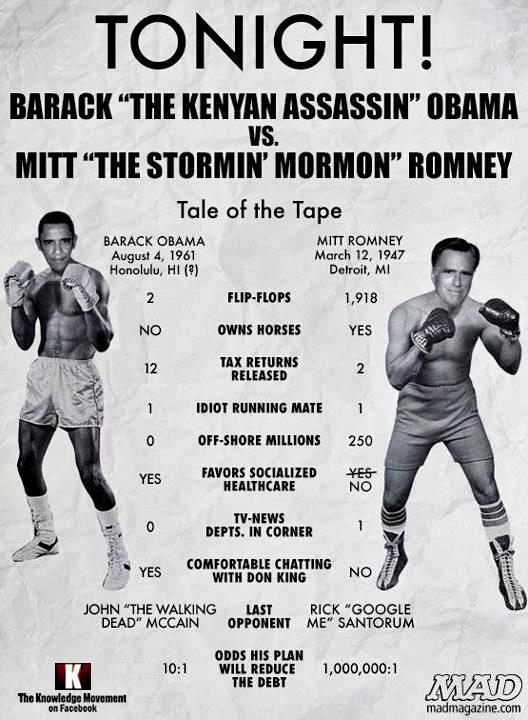
Good luck with that, Mittster. I'm afraid that horse has been out of the barn on that one for a long time.  I expect Mr. Obama is well prepared for a comeback which won't knock him out of the ring, and won't hit below the belt, but it will be a well-placed blow to the midsection.

Obama just needs to stay cool and calm and, well, presidential. Gracious. Not aloof. Not weary or tedious or bored. And, on message: Forward!


Mitt will be the new dog in the pack, trying to become the New Alpha Dog.

I don't expect any barking or growling - maybe a few snapping and biting comments - but the debates will provide some interesting insights into human behavior under the scrutinizing eyes of the world.

This is no dog-fight. I mean, we are talking about the election of the man (Le sigh!) who will be the leader of one the most powerful and influential nations in the world for the next four years. 

The first debate is always considered the most crucial one, but they are all important because so many people tune in to see the two candidates go toe to toe.

Here is Romney’s last chance to present his vision and connect with the American people. Can he pull it off? Does he have a vision? Will he show us who he really is and what he really thinks about the issues?

Can President Obama keep his cool, while still projecting the image of a resolute leader? Can Romney rattle Obama? Can Obama corner Romney? Can Romney use a flash of humor to take down Obama?

As entertaining as all that is - well, for poly-sci and behavioral science geeks like me - it won't be anything compared to the commentaries on both sides, after the debate.

Bark, bark, bark, BARK. Woof. Growl. Oooooooo.......

I may have to get out my spray bottle. 

Is it November 7th yet? 

Monday, October 01, 2012

Pay Attention

Kenn Princeton Beal

This weekend, I downloaded a few more of my CDs onto iTunes so I could upload them onto my iPad, iPhone and iPod.

It's been like finding old friends you haven't heard from in a long time.

One of the CD's I uploaded was "God Help Us" by the Miserable Offenders.  Lord, do I miss them! I selfishly harbor a wish that they would reunite - even if for just one more performance which someone would record and turn into a CD for their many loyal fans.

The two women who made up the group - Deborah Griffin Bly and Ana Hernandez - have gone their separate ways - as artists sometimes do. (Are you reading this, you two?) There are many songs of theirs that I love, but this one has been haunting me today - especially these words:
This is it, more or less
And who would ever guess
This is the best of times
This is the worst of times
And it's passing
Pay attention.
If you read this blog with any regularity, you've no doubt heard me repeat that wise aphorism, "The Bible is not a rule book, it's a guide book."

In order to gain any wisdom from Scripture - or, for that matter, from life - you have to pay attention.

Pay. Attention.

Yes, there is a cost attached to attention. And, it's not just about your eyes or your ears.

The artist Ken Princeton Beal writes,
"When we listen with our heart, and soul, and mind together, we are listening to our creator, to God. Listening separately with only the heart, or the soul, or the mind is knowledge. Listening with the heart, soul, and mind together is wisdom.
Anyone can acquire knowledge. What is done with that knowledge - how it is applied - is the true test of learning. Listening with heart, soul and mind together is wisdom. In order to attain wisdom, you must pay attention.

When I was in seminary, one of my professors said that the role of religion was not to give you answers to life's questions; rather, it is to get you to pay attention to life.

Every now and again, he would pass me in the hallway or around the seminary close and he would smile and ask, "Are you paying attention?"

I'm sure I'm not the only one to whom he said that, but I'm quite certain that, with me, it was intentional.

I am genetically predisposed to busyness. I like being busy. I like having things to do. People to meet. Places to go. Things to discover. Questions to ask and have answered.

It comes - at least in part - from being part of  a second generation immigrant family. We had something to prove. A dream to attain. Busyness made us feel worthy. Important. Significant.

I've come to learn that busyness is a drug - a powerfully addictive drug. It alters your sense of perception. It numbs the senses and inflates the ego and can place one directly on the path that leads into the Land of Grandiosity.

I confess that there are moments when someone comes up to me and says, "Excuse me, I know you're a very busy person but if I could have just a moment of your time......" when my ego kicks into hyper drive and I can feel my sense of self importance inflating.

See?  I'm busy. I must be doing something important. And, if I am doing something important, I must be a Very Important Person.

I've come to understand that it's all an illusion.

There is no person of greater importance than the one who has time for the seemingly insignificant.

I'm not always that person, but I'm working on it by understanding my insignificance in the grand scheme of things, and how very important work that is. Somewhere within me beats the heart of a once young, noble, altruistic girl who thought she could save the world. This woman now understands that I can only save the world one person at a time - beginning with myself.

That's not narcissism masquerading as spirituality. It's humbling. It's challenging. It's empowering. It's exciting. And, it begins with paying attention. When religions and religious people understand this, and help other people to do this, we can save the world. Or, at least, begin to change it for the good.

Paying attention provides the architectural framework for an ethical life.  Paying attention helps you to answer the question at the center of the human enterprise: How, then, shall I live?

I have come to understand that, in those years when I was content - well, somewhat - to rely on my religion to supply the answers for that question, I was being essentially indolent.  Lazy.

Of course, I was carefully taught that it was an act of humility to surrender to the great thinking of - mostly white dead - men who were smarter and wiser than I and had dedicated their entire lives to knowledge and wisdom. Who was I - little, insignificant me - to disagree with such great minds?

"Trust and obey / for there's no other way / to be happy in Jesus / but to trust and obey."

Listening
Religion, I was carefully taught, was a "binding together" of these great thoughts and beliefs, to which I was to bind myself. If I didn't believe every word, comma, semi-colon and period, I was - gasp! - a "Cafeteria Catholic" - someone who picked and chose among various thoughts and beliefs and fashioned for myself an ethical way of life.

Imagine! Fashioning a belief system for oneself! Using one's mind, heart and soul to yes, read and consider what other great minds had once thought, but to determine the path God had set out before me to learn how to love God, myself and others.

Why, it was positively, absolutely......unthinkable!

Indeed!

It's 'religious sloth', is what it is. Eventually, I came to understand this. I grew up. I matured. I became an Episcopalian. Ever since, I've never worked harder at what it means to be Christian - and, trying to live that belief in my life.

Mark Twain wrote, "whenever you find yourself among the majority, it is time to pause and reflect."

It's a human problem, as old as time. 

Writer Sophie Rebekah Beal (I'm not sure she's related to the artist) notes,
The ancient prophet Isaiah of the Hebrew Bible essentially threw up his hands and said, "I'm living in this complicated world full of imperfect people! I don't have any answers. So how do I live amongst all this?"

G-d responds to Isaiah, "Go and say to this people: 'Keep listening, but do not comprehend; keep looking, but do not understand.'" (Is 6:9) Well that really clears some things up, doesn't it? But there's another translation of this verse, based on the Greek version, that reads:
You will be ever hearing, but never understanding; you will be ever seeing, but never perceiving. This people's heart has become calloused; they hardly hear with their ears, and they have closed their eyes.
I think some religions help us to hardly hear with our ears and help us keep our eyes closed to what is all around us.  Or, as Deborah Griffin Bly writes: What is hiding in plain sight. 
Learn what you must learn,
go where you must go;
when you stop running, stand still, listen,
you will know that you can find God where you are
hiding in plain sight.
We run and run, constantly busy with the frenetic pace of life. When we finally stand still, we are sometimes too exhausted to hear or think or feel for ourselves and know that, where we are, God is.

That's the only reason I can come up with for the recent flurry of religious foolishness.

Archbishop John Myers
Newark (NJ) Archbishop John Myers, recently wrote a letter last week saying Catholics have a “duty” to cast their vote based on opposition to same-sex marriage and abortion rights. Catholics must embrace his views, he said, and those who refuse should not take Holy Communion.

This was preceded by the announcement from the Roman Catholic Church in Germany which determined that all those who declined to pay their "church tax" (resulting in $16 billion per year for the church) would be denied the sacraments of the church - that includes communion, absolution, matrimony, even burial.

Then, there's a group of Muslims who appealed to the United Nations to ban insults on the Prophet Mohammed. But, not Jesus. Or, The Buddha. Or any other prophets of God. Just Mohammed. Because, you know, Islamophobia is all the rage (as it were). No Christians being persecuted anywhere. No Jews, either.

Yes, there are limits of free speech. Yes, we all need to practice religious tolerance. I got it. Understood. But, okay, boys - Christian, Muslim and Jew. Time to take a deep breath. Time to open up the eyes and ears of your mind, your heart and your soul.

Time to throw up your hands like the Prophet Isaiah and say, "I'm living in this complicated world full of imperfect people! I don't have any answers. So how do I live amongst all this?"

Time to listen to how God answers. Listen. Pay attention.

One thing you of which you can be certain: It's not all about you. And, it is all about you.

It's about how you choose to live in a world of pluraform truths and determine what is true for you. And, to understand - with your mind, heart and soul - that what is true for you may not be true for others. It is to find the courage to live what you know is true, even though others may not only disagree with you, but they may mock and deride you for what you believe and how you live what you believe.

Support your local sacred musician
It's really hard to pay attention in today's world where so many people - so many things - compete for our attention.

It's so much easier to shut them out - to shut ourselves down - to follow blindly on the path someone else has set - than to pay attention to that which is placed on our own path in life.

And then, one day, you come to understand that nothing else in life is more important than this moment in time - what is right before you - hiding in plain sight.

You discover that this moment is it, more or less. And who could ever guess that this moment - right here, right now - is the best of times. It's also the worst of times.

And, it's passing.

Pay attention.