Come in! Come in!

"If you are a dreamer, come in. If you are a dreamer, a wisher, a liar, a Hope-er, a Pray-er, a Magic Bean buyer; if you're a pretender, come sit by my fire. For we have some flax-golden tales to spin. Come in! Come in!" -- Shel Silverstein

Sunday, February 09, 2014

The Episcopal Church: Abortion & Contraception

I was recently asked a simple enough question: Where does The Episcopal Church stand on Reproductive Justice issues such as contraception and abortion?

The answer is very simple and yet not easily expressed.

I think that's because our discussions on this issue have been emotionally charged and filled with hyperbole, exaggeration, inaccuracies and, well,  drama.

If one is "pro-life," one is, therefore, "anti-abortion" and, necessarily "bad" for limiting a woman's choice but "good" for "protecting the un-born or pre-born" but "bad" for not making provisions to care for the life of the child after it is born.

If one is "pro-choice" one is, therefore, "pro-abortion" and, necessarily "bad" for "murdering babies" but "good" for "respecting the sacred right of a woman to be her own moral agent" but "bad" for "not respecting the 'personhood' of the fetus". 

It's all black and white with no shades of gray and heavily sprinkled with double doses of drama.

That's a difficult position on a good day for The Episcopal Church, which is a faithful pilgrim on the 'via media' or 'middle road' of classic, traditional Anglicanism.

While it may sound like a batch of classical Anglican Fudge, if you read our official resolutions on the matter, it is fair to say that The Episcopal Church seeks to promote the sacredness of human life - all human life - including that of the woman and the children for whom she is responsible.

The bottom line is that The Episcopal Church has voted in strong opposition to any abridgment to a woman's access to a safe means of terminating pregnancy.

That means that The Episcopal Church wants the means of legal abortion to continue while working to address conditions - such as poverty, inadequate education, unemployment, etc., as well as access to information about human reproduction including effective, affordable contraception methods, devices and medicines - which would make abortions a less frequent occurrence.

Though the fact that The Episcopal Church is regularly identified as being pro-choice is accurate, it would be a misstatement to suggest that TEC is "in favor of abortions" or "promoting abortion."

Which means, we're not so different from most Americans.

A recent article in Atlantic magazine maintains that public opinion about abortion is remarkably stable. "Since the 1970s, we have seen considerable changes in attitudes towards gay marriage and marijuana legalization but not in opinions about abortion."

"Take a question that Gallup has asked more than 50 times since 1975: Should abortion be legal in certain circumstances? That year, 54 percent said yes. When CNN’s pollsters asked the same question in May 2013, 54 percent gave that response, with 20 to 25 percent at the extremes."

To my knowledge, no poll has ever been done specifically asking these question of those who are baptized members in good standing or are ordained to lead a congregation, much less simply sit in the pews of The Episcopal Church of a Sunday morning.

My sense, however, is that Episcopalians are like most Americans - we hold two differing opinions simultaneously in tension with each other, and our official position, as stated in resolutions passed by our General Convention, reflect that tension.

Two major pollsters that ask people whether they are pro-choice or pro-life show narrow divisions on the question. Gallup’s May 2013 poll showed that 45 percent called themselves pro-choice and 48 percent pro-life. In Fox News' April 2013 poll of registered voters, 49 percent called themselves pro-choice and 44 percent pro-life.

If you want to know what The Episcopal Church, in General Convention, has said about Reproductive Rights like contraception and abortion, you'd have to dig through the Archives of The Episcopal Church to discover that answer.

You can find resolutions which have been passed by General Convention here .

You will have to work a bit to "connect the dots" but, with some diligence you will discover that, as early as 1930, The Lambeth Conference (an international gathering of Anglican bishops at Lambeth Palace, the official residence of The Archbishop of Canterbury) "approved contraception for the purposes of family planning." (Resolution 15)

Of course, there is the curiously worded Resolution 115 by the 1958 Lambeth Conference which essentially reaffirmed Aquinas's appeal to conscience in terms of husband and wife's decision about the size of their family.

Neither were exactly ringing endorsements of contraception, and there's lots high church language, but the approval is clear.

The 1994 General Convention reaffirmed this position, which appeared under a primary concern "that rapid global population growth adversely affects the prospects for peace and justice by exacerbating poverty, deprivation and suffering, and depleting environmental resources . . ."

I don't have links to the following facts because the Episcopal Church didn't begin making resolutions available online until the early 90s. However, in looking through some old convention journals, I discovered that The Episcopal Church at its 1964 General Convention stated, "The Church continues (from a resolution in 1958) to condemn non-therapeutic abortions...." 

However, three years later, at the very next General Convention in 1967, we approved abortions where "the physical or mental health of the mother is threatened seriously," and in cases where the child would be born with disability or was conceived in rape. 

In 1976, the Episcopal General Convention reaffirmed this statement and went further.  It expressed "unequivocal opposition to any legislation on the part of the national or state governments which would abridge or deny the right of individuals to reach informed decisions in this matter and to act upon them." 

We did so again in 1982. 

In 1985, we passed resolution A085 which also reaffirmed our position and asked
That this 68th General Convention request the several dioceses to initiate studies to consider the pastoral, personal, sociological and theological implications of abortion. We suggest appointing appropriately representative diocesan commissions to oversee a process of study which includes those local congregations willing to be involved. We commend to all a study of the official position of this Church as expressed in the resolutions on abortion adopted by the General Conventions of 1976, 1979 and 1982. We suggest to all a study of the paper of the House of Bishops Committee on Theology: "Theological Reflection Paper on Abortion." Finally we direct the Standing Commission on Human Affairs and Health to receive all information arising from these diocesan studies.
I couldn't find either a study of the dioceses or the bishop's theological paper on abortion online (I'm sure someone has copies buried in their files somewhere), but at the1988 General Convention, we were condemning violence to abortion clinics and those persons who seek services there and issued a statement essentially reaffirming our previous position.

In 1991, we were opposed to the requirement for parental consent or notification of parents when minor women seek safe abortion, and we firmly rejected conception for the sole purpose of harvesting fetal tissue for medical research.

In 1997, we did not reject but rather expressed "grave concern" about third trimester abortions, except in "extreme circumstances".  

In 2000, we passed a resolution which, interestingly enough, commended the work done by a Commission on End of Life Issues and asked for a similar study be done on Beginning of Life issues, such as - and I quote - "babies born alive during induced abortions".

I have not found evidence of the existence of that study, much less that a commission was convened. I have serious doubt that either entity ever saw the light of day.

In 2000, we also acknowledged the existence, for men and women, of something called "post abortion stress" and asked for pastoral care for all who suffer from it. 

I think we've come to know that, while some are certainly stressed after the termination of a pregnancy, either through abortion or miscarriage, there is no official medical condition known as "post-abortion stress" and I do not know of any official action regarding this issue from The Episcopal Church.

Officially, we can hardly be described as "pro abortion". However, it can be said that we are unequivocally "pro choice" - in a very traditionally nuanced Anglican sort of way.

Let's take a closer look at our "official" position on Abortion which can be found most succinctly stated in Resolution 1994-A054.  Allow me to lift up some of the language to show you what I mean:
All human life is sacred from its inception until death.

As Christians we also affirm responsible family planning.

We regard all abortion as having a tragic dimension, calling for the concern and compassion of all the Christian community.

While we acknowledge that in this country it is the legal right of every woman to have a medically safe abortion, as Christians we believe strongly that if this right is exercised, it should be used only in extreme situations. We emphatically oppose abortion as a means of birth control, family planning, sex selection, or any reason of mere convenience.

In those cases where an abortion is being considered, members of this Church are urged to seek the dictates of their conscience in prayer, to seek the advice and counsel of members of the Christian community and where appropriate, the sacramental life of this Church.

Whenever members of this Church are consulted with regard to a problem pregnancy, they are to explore, with grave seriousness, with the person or persons seeking advice and counsel, as alternatives to abortion, other positive courses of action, including, but not limited to, the following possibilities: the parents raising the child; another family member raising the child; making the child available for adoption.

We believe that legislation concerning abortions will not address the root of the problem. We therefore express our deep conviction that any proposed legislation on the part of national or state governments regarding abortions must take special care to see that the individual conscience is respected, and that the responsibility of individuals to reach informed decisions in this matter is acknowledged and honored as the position of this Church;

Resolved, That this 71st General Convention of the Episcopal Church express its unequivocal opposition to any legislative, executive or judicial action on the part of local, state or national governments that abridges the right of a woman to reach an informed decision about the termination of pregnancy or that would limit the access of a woman to safe means of acting on her decision.
Now, I may quibble about the phrase about human life ". . . from inception . . .", and some have taken exception to "the tragic dimension" of abortion or that it should be utilized only in "extreme situations", but there's no arguing with the "unequivocal opposition" to anything that "abridges the right of a woman" or "limit(s) the access of a woman to a safe means of acting on HER decision.

We are pro-choice but that doesn't make us pro abortion.

You can not possibly make the claim that "The Episcopal Church promotes abortion" - unless, of course, your penchant or preference is to consistently utilize hyperbole or exaggeration or drama as your primary rhetorical device.  

Indeed, I think the position of  The Episcopal Church makes us decidedly pro-life in the sense that we hold ALL life sacred - including the lives of women - as well as those unwanted pregnancies which lead to the birth and the life of a child who has basic human rights to shelter, food, clothing, access to adequate medical care and, oh yes, love.

The issue of reproductive justice in general and abortion in particular will continue to be pushed into national conversation by special interest groups, most of which are religiously-based.

I predict that, ultimately, we will see the same result from this issue as we have with issues of marriage equality. All the hyperbole and drama and appeals to scripture as the only rationale for undermining abortion or reversing Roe v Wade will begin to fall, more and more, on deaf ears.

At the end of the day, I do believe that the position of The Episcopal Church is reflective of and articulates the position of the majority of Americans:

+ Keep abortion safe and legal, accessible and affordable while we continue to work on conditions that would make abortion a less frequent occurrence.

+ Contraception is an integral part of normal, preventative health care for women which should be affordable, accessible and covered under her health insurance plan. 

+ Respect for the sacredness of all life - from womb to tomb - including the life of a woman to be her own moral agent and make the decisions that are right for her and her family, as well as respect for every child to have the basic human rights of food, clothing, shelter and love.

Friday, February 07, 2014

Religious Freedom: A More Perfect Union


Note: This is a presentation I gave at the Coalition for Liberty and Justice Forum, held at George Washington University in Washington DC. The Coalition for Liberty and Justice is a broad alliance of faith-based, secular and other organizations that works to ensure that public policy protects the religious liberty of individuals of all faiths and no faith and to oppose public policies that impose one religious viewpoint on all. I was asked to present an Episcopal perspective as it pertains to religious liberty on a panel of speakers which included a Baptist minister from Religious Coalition for Reproductive Choice, a Roman Catholic lay woman from Catholics for Choice and a Rabbi from Concerned Clergy for Choice. They gave me 10-15 minutes. I asked several friends to define The Episcopal Church's perspective on Religious Freedom and most joked that we were for it. So, here's what I said:

I don’t know about you, but sometimes, as I listen to conversations about Religious Freedom, I am transported back to my 6th grade Civics class. I know I showed up for it every day. I wonder if some people – especially our legislators and political leaders – cut class or Civics class just wasn’t offered in their school system.

I went to Catholic schools, and the nuns of my youth didn’t play around with our education. We learned stuff. They made certain of that. As Tina Fey is quoted as saying,. “Those nuns (were) mean old clams and they sleep on cots and they’re allowed to hit you. And at the end of the school year you hated (them) but you knew the capital of Vermont.”

Besides memorizing prayers and our Catechism and all 50 Nifty United States and their capitals, we memorized poems by Longfellow and Wadsworth and the Bill of Rights and the Preamble to the Constitution. We just didn’t learn to memorize them, we studied them and learned about them and understood them.

I am deeply grateful for the education I received and believe I am the priest I am today because of their role model of leadership in community – religious and secular.

They taught us about Thomas Jefferson and his Declaration of Independence and the American Revolution that announced universal principals of liberty. 

We learned that Jefferson, alongside the Marquis de Lafayette, framed a French proclamation of The Rights of Man. 

We learned that, because of the brilliance of Thomas Jefferson and James Madison, we have the Virginia Statute on Religious Freedom, and, without that, there would be no basis for the most precious clause of our most prized element of the Bill of Rights – the First Amendment to the United States Constitution,

All of this important history would become important to me as I later left the church of my youth and became a member of The Episcopal Church.  Years later, in 1986, I became part of the first wave of women to be ordained priest.

It’s probably apocryphal, but I love the story that those who wrote the formative documents of the newly emerging United States by day at Constitution Hall In Philadelphia walked down the street by night to Christ Church and began to write the Constitution and Canons of The Episcopal Church, which was, itself, emerging from The Church of England and Anglican Communion.

If you look at the way The Episcopal Church operates, you will see a reflection of the same governance in our constitution and laws.  We, too, have a bicameral system of government. While bills must pass the House and the Senate before becoming law, our resolutions must pass both the House of Bishops and House of Deputies (clergy and laity) before they become canon law.

Our church meets every three years in General Convention where these resolutions are proposed and sent to legislative committees and discussed in hearings and finally come to the floor of both houses to be debated and voted upon – just as you might see in the House or the Senate. 

We do not elect representatives or delegates to General Convention. Instead, we elect deputies – four clergy and four laity from every diocese – who do not represent nor are they beholden to a particular constituency or church or diocese; rather, they are “deputized” to vote their conscience, having be led by thoughtful reflection, prayer, and their own sense of autonomy which is balanced by an understanding that we are part of the “one, holy, catholic (small c) and apostolic” church. (Yes, we too say the Nicene Creed. Every Sunday.)

The notion of Balance of Power can be seen reflected in our government. The final authority in our church rests not with a single person like the Presiding Bishop or Diocesan Bishop or even the Archbishop of Canterbury; rather, final authority church matters rests in legislation passed at General Convention – by deputies who are laity and clergy as well as bishops. 

What a radical idea for religious authority! 

Guess where that came from?

The idea of States Rights can also be seen reflected in the way we structure our dioceses.

No diocesan bishop can tell another how to run his or her diocese. Not even our Presiding Bishop has the authority to do that – not unless the good bishop is in violation of the doctrine, discipline or canon law of The Episcopal Church. And then, there is a lengthy, complicated process to deal with that.

Which is why, for example, some of you may have noticed that, while our General Convention authorized trial liturgical rites for the Blessing of the Covenants made by people of the same gender, not all bishops in all dioceses have authorized them for use in the local churches in their dioceses.

That’s because our canon law, presently, defines marriage as between one man and one woman.   

Some bishops feel caught at the intersection of church and state. How about that for a conundrum! Some dioceses are in some states where there is Marriage Equality, but some bishops feel bound by the definition of marriage in our canon laws. 

Other bishops in states where Marriage Equality is not yet a reality still feel compelled to authorize our priests to bless the covenants made between two people of the same gender, even though they can’t legally marry them, arguing that the state has no right to interfere with what the church deems is right to bless.

The argument goes: We don’t allow the state to tell us who to baptize or confirm. We don’t allow the state to tell us we can’t bless icons or prayer books or liturgical garments or new cars or boats before the sail or hounds before the hunt or motorcycles before the charity run.

Why should we allow the state to tell us we can’t bless the covenants made between two people of the same gender?

So, it follows that The Episcopal Church - or any religious denomination or organization - cannot dictate our theology (or ideology) to the state nor impose our doctrine on those citizens who may believe differently than we do.

You can be certain that, when The Episcopal Church gathers for our next General Convention in Salt Lake City, Utah in 2015, there will be more than a few resolutions which propose a change to the language and specificity of gender in our marriage canons.

Will that be messy? No doubt. Will that be painful for some? Absolutely. Will it be perfect? Positively not. 

Which leads me to finish my presentation by saying something about in the language of the Preamble to the United States Constitution, which, I think speaks to where The Episcopal Church is in terms of Religious Freedom. 

It is a term which President Barack Obama used to title his famous Race Speech.  

 The words are: “We the people, in order to form a more perfect union . . .”. 

The idea I want to focus on is “a more perfect union.”

I think the elements of “a more perfect union” summarize, for me, not only the ideal state of government but the characteristics of a religion which understands, protects and defends the religious freedom guaranteed by the First Amendment to The Constitution.

It is important, first, to note that we are not a "perfect" but a “more perfect” union. 

That means that we recognize that life together will be forged from our difference. 

E pluribus unum. Out of many, one. 

It means that we understand that uniformity does not guarantee unity. 

Indeed, uniformity is not a prerequisite for unity; it may, in fact, undermine unity.

I once was privileged to be invited to a Rabbinical group to study parts of the Torah. My Rabbi friend warned me that for every Rabbi, I would hear at least two opinions on the same issue. I laughed and said, “That’s okay. I’m an Episcopalian; we have at least two, if not three opinions on the same issue.”

Unity does not mean everyone walking along together in lockstep. Indeed, we may not even be on the same path. 

As Elie Wiesel once said, “There are many paths, but one way to God.” 

We may be united in the same destination, but some of us will take different ways to get there. Some may even create their own paths. 

As J.R.R. Tolkien once wrote in a poem in Lord of the Rings, “Not all those who wander are lost.” 

In order to be a more perfect union, I believe religious and secular people must have a tolerance for differences.

One of the marks of Anglicanism is tolerance. That can feel uncomfortable to some. As a woman who is ordained and has been in a committed relationship with another woman for 38 years – we were recently married this past August when Marriage Equality FINALLY came to Delaware (and they said it wouldn’t last) – I know how it feels to be “tolerated” in The Episcopal Church.

It’s not the best, but I can tell you one thing: it feels a far sight better than being excluded. 

As Anne Lamott once said, “You can safely assume you've created God in your own image when it turns out that God hates all the same people you do.”

Tolerance of differences is important but tolerance requires a spiritual and emotional maturity in order to tolerate ambiguity and paradox. Our world is diverse and complex and filled with pluriform truths and beliefs. There are many shades of black and white and, as we now know, at least fifty shades of gray.

Finding what is true for you will be very different from what I have found to be true. That does not make you right and me wrong.

In The Episcopal Church, we talk a great deal about the Three Legged Stool of Anglicanism: Scripture, Tradition and Reason. 

When we confront an issue or a problem, we look to scripture first, but then we read it again through the lens of the tradition of the church. Then, we take all the information we have gathered and we employ the gift God has given to us all: our intellect and ability to reason, which we understand is also shaped and formed by personal experience. 

There are Episcopalians among us who do not go beyond Scripture. Some do progress to read what is said in our church tradition but they take only that which supports their interpretation of what they find in Holy Writ. 

Indeed, some of those same Episcopalians chide those of us who add reason to our methodology and quest for truth, saying that we elevate reason and intellect over scripture and tradition, almost to the status of sin.   

In my estimation, that’s a huge improvement from the original sin of The Episcopal Church of a former, more glorious day: not being able to distinguish and properly use one’s salad or dinner fork from one’s dessert fork.

Nevertheless, tolerance of differences and ambiguity and paradox are requirements for the “more perfect union” of The Episcopal Church – and, indeed, any religious organization – if we are to have a more perfect union of these United States of America.

One of my favorite spiritual meditations embraces the paradox of the reality of my spiritual and emotional life. After I have centered myself, I inhale and say, “I am enough.” Then, I slowly exhale and say, “I can not do it alone.”

I am enough. I can not do it alone. 

There, in the midst of the paradox that is a breath – two opposite but equal truths: one must breathe in and then breathe out in order to take a breath – is the paradox that I am sufficient and I need others. As surely as I need air to breathe, I need others to help me achieve my goals. And, I am enough.

Sometimes, God sends me people I like to call “Divine Sandpaper”. They are the people who “rub me the wrong way”, but, in so doing, they also bring out my beautiful inner grain so that it can be seen and really shine.

When I allow “Divine Sandpaper” into my life – be it Sarah Palin or Paul Ryan or any one of the Teapublicans whose rants about Reproductive Justice or Food Stamps or Education or Marriage Equality regularly pull my last, poor, tired lesbian nerve – I eventually find that something they have said has helped to reexamine and clarify and perfect my thoughts toward a more perfect union of my beliefs with my faith and my citizenship in this more perfect union in which we live.

The Episcopal Church is far from perfect. The same can be said of this country. I think both can become “more perfect” if we let go of our ideas of what is "perfect" - or think our particular religion and/or religious expression is "perfect" - and practice tolerance.

We need to understand that our unity is not dependent upon uniformity. 

E pluribus unum. Out of many, one. 

Even with our differences. 

Especially with differences.

Freedom – all freedom, including the freedom of religious belief and expression is a precious gift and responsibility. You cannot pick and choose which freedom you are going to support and defend.

Neither does one freedom guarantee the right to suppress another freedom. 

As one of the nuns of my youth once said, “You have the right to swing your arms as wildly as you like, but that freedom stops at the end of my nose.”

My prayer for a more perfect union of church or state - and, perhaps, even church and state - is that we may all know that freedom and practice it with responsibility and generosity of spirit. 

Thank you.

Saturday, February 01, 2014

The Song Tracks of Our Lives

I suppose every generation has a song track that plays in the background whenever memories surface.

Or, sometimes, it's a song that brings back a memory.

You hear a song and suddenly remember where you were when you first heard it - or where you were and who you were with when it once played.

The music of my generation - the 60s and 70s - was, probably more so than any other modern generation, intimately intertwined with and reflective of what was going on in our contemporary world. It also helped to change our culture and our society.

There were the "folk singers" like Bob Dylan, Pete Seeger, Woody Guthrie, Joan Baez, Peter, Paul & Mary, Buffy St. Marie, Odetta, Judy Collins, The Weavers and The Staple Singers who were singing songs about love and peace and harmony and protesting the Vietnam War - or any war - and advocating civil rights and rejecting the status quo and being a non-conformist, while reflecting the absolute best of what was good about the "simple life" of living closer to the land and being kind to one another as generations before us had done.

So, when I hear Dylan sing "Blowin' In The Wind" or "Like a Rolling Stone", I can see myself in bell bottom flower print pants with a peasant shirt, my hair long and thick and out of control, and I can even smell the patchouli oil I used to use. I can also catch an occasional whiff of pot, which, of course, the patchouli oil was used to mask.

Oh, and for the record, yes, I smoked AND inhaled. Truth was, I didn't like it. Just made me . . . um . . . . ."excited" . . . . and hungry for Oreo cookies. I'd eat a whole bag and a quart of milk, which was really so I didn't act on my  . . . um . . . "excitement".  At least, not in public.

Even more clearly, I can see the confusion mixed with disgust and more than a modicum of concern on the faces of both my parents.

And then 'rock 'n roll' really began breaking sound barriers as well as marking clear barriers between  generations. The night that Elvis "The Pelvis" Presley appeared on The Ed Sullivan Show marked a schismatic shift in my family life.

I. LOVED. Elvis.

I couldn't really explain why. His music seemed dangerous. Raw. What was suggested by the words and music were made explicit by the movement of his body.

It was "Rock 'n Roll" and even I got the euphemism for what happened in bed.

I was absolutely transfixed.

My parents were absolutely horrified.

The combination made Elvis and his music absolutely irresistible.

About that same time, I became more and more aware of music that was known as "Motown".  Some of it sounded a lot like the music Elvis sang - coming from a deep, dangerous, raw place in the human psyche, a place my adolescent self was just becoming aware of and simultaneously wanting and fearful to explore.

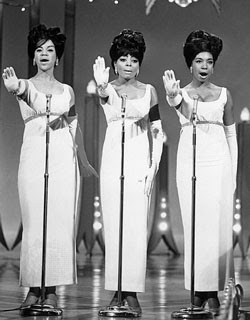
The night that Diana Ross and the Supremes appeared on the Ed Sullivan show was also another huge watermark in my life and that of my family.

Here the truth of it: At that age, I had never personally seen an African American - male or female.

I lived a very isolated life, ensconced as I was in my neighborhood which was, in actuality, a little Portuguese village, where everyone spoke English and Portuguese and everyone knew everyone else and a neighbor was as likely to smack you upside the head if you did something wrong and then march you by your ear or the back of your neck to your parents where you were smacked again.

We were intentionally isolated. It was protective. We were the butt of jokes and object of scorn and prejudice among the lighter skinned previous immigrants from England and Ireland and Canada who were brought in to work the mills and the factories.  We looked different and smelled of different spices. We were the "greenhorns". The "dirty Portuguese".

Our parents kept us isolated to keep us from being ridiculed and hurt. It didn't work, of course, but that was really the impulse. I don't think it's much different from some immigrant groups today.

Oh, I had seen Africans, but only on the pages of National Geographic or the Encyclopedia Britannica. They were always naked from the waist up, sitting or standing in front of straw huts with thatched roofs.

But, beautiful black-skinned women? American women? In glamorous gowns? With beautifully coiffed hair? Singing, "Come See About ME."? Or, "Stop in the Name of Love"?

Well, they crooned more than sang. And moved their bodies slowly and gracefully and beautifully.

Everything about them sent strong messages about a woman's sexuality to my newly awakening adolescent hormonal level and sense of my own sexuality as one whose skin was darker than many in my high school class.

I. LOVED. Them. 

I was absolutely transfixed.

My parents were absolutely horrified.

I mean, what was the world coming to?

It was 1964. The war in Viet nam was still raging. The Civil Rights Movement had gained a powerful momentum.  The Women's Liberation Movement was in full swing. The whole world seemed chaotic. So were our personal lives.

It was one thing, huffed my father, that Nat King Cole had achieved stardom, but his talent was undeniable. My father could barely stand Johnny Matthus - he thought he was too "effeminate" (who knew my father had 'gaydar'?).

But this - THIS - was beyond the pale for my father.

"Colored people" (well, that's what he called them when he didn't use the "N-word") enjoying the same status as "White" people? Well, that just wasn't my father's understanding of the way the world worked - or, should work.

Pretty soon, he figured, they would start taking jobs away from White men, and you know that wasn't right. Not in my father's immigrant world which had fought for unionization of the factories because, well, they had previously been treated "like slaves". What right, asked my father, did former slaves have to come in and take away a job from a white union man? (Emphasis on the 'man'.)

Meanwhile, of course, the white rich folks who owned the factories and sweat shops still raked in the profit and laughed up their sleeves as they watched the immigrants and working class do their dirty work and fight with the African Americans.

It kept us right where they wanted us. Fighting over crumbs while they had the largest share of the pie.  It was ever thus. 

Before long - and just to keep the peace - I was going over to my friends' houses after school "to do homework" but, truth be told, we watched American Bandstand first and THEN we did our homework.

We watched - and danced - as Chubby Checker sang and did The Twist, and Marvin Gaye and Jackie Wilson and Otis Redding and James Brown sang in ways we never could and moved in ways we tried - we really, really tried - to emulate, but failed miserably.

Some of us even began to question why the kids who danced on American Bandstand were overwhelmingly Caucasian. Slowly, slowly, slowly, even that audience began to change.

Mary Wells sang "My Guy" while the Temptations sang, "My Girl". Aretha Franklin did me in every time she opened her mouth. "R.E.S.P.E.C.T. Find out what it means to me. R.E.S.P.E.C.T. Hey boy, TCB". Sock it to me. Sock it to me. Sock it to me"

The sexual innuendos were not lost on this budding adolescent.

Groups like the Marvelettes and Gladys Knight and the Pips and Smokey Robinson and the Miracles and the Shirelles and the Four Tops, and Commodores, and the Jackson 5 were simply, absolutely, amazingly, undeniably talented.

The first time I heard Little Stevie Wonder play his harmonica and sing "Everybody say 'Yeah!"on his first major hit, "Fingertips," I knew I would be a fan for life. And, that hasn't changed.

So, when the Beatles began The British Invasion with their 1964 appearance on The Ed Sullivan Show, we were ready for them. When John Lennon sang, "Twist and Shout", we not only loved their music, we marveled that a White (and British at that) man could sing almost as well as a Black man.

That, in my estimation, really signaled that integration, despite the protestations and other evidence to the contrary, had begun. By the time The Stones sang their R&B and bluesy, sexy music, we knew that the deal was signed, sealed and delivered.

Well, at least musically.

Nevertheless, it was a powerful symbol which was not lost on the previous generation.

I recently saw "Motown The Musical" on Broadway, and all those memories came flooding back. It was different for the people of color with whom I attended the performance.

They knew the facts about the performers the way some people keep track of stats of their favorite sports teams.  One was highly critical of the performers, not because of their performance, but because the actors didn't resemble the originals closely enough.

The guy who played Stevie wasn't tall enough. The woman who played Diana wasn't thin enough.

And, hey, "everyone" knew that if you wanted to sing in a black male group at that time, you had to have all "Three T's": "Tall. Thin. Talented." The guys who played The Temptations on stage had only one of the three. They were talented, alright, but neither particularly tall nor thin.

What's up with THAT?

Of course, since Berry Gordy, the founder of Motown Records, wrote the play, the man who played his character all but wore a halo, and you know that ain't right. 

The symbolic importance of the integration of The Motown Sound into the fabric of the life of this country seemed not as important to her as it was to me.

Motown music, for her, was the triumph of equality for a people long oppressed that was, of course, important; so important that she wanted all the facts of the story to be right.

I've been thinking that 'integration' sounds on some ears the way 'inclusive' sounds on mine.  I can only be "included" in a congregation if the people think I'm not already. But, I am. By virtue of my baptism, I'm already included. How "white" of them to "include" me into "their" home!

I don't know for certain, but I suspect there may be a similar sentiment, at least among some people of color, that "integration" has a similar odious ring. They are citizens of these United States. They are part of "We the people". How "white" of us to include and "integrate" people of color into of the foundational rights of "liberty and justice FOR ALL."

What part of "All" don't we understand?

Music, I think, does understand that.

Which is why music remains so important to me and to so many of my generation.

It provides a song track to the events of our lives. It's one of the reasons I love the movies "Forest Gump" and "The Big Chill," and, more recently, "The Butler". 

In some places, music fills in the blanks of parts of the story when words fail. In other places, it provides the crucial conversation - the conversation just below polite social banter - where the real meaning is kept hidden.

I understand that Billy Joel's "We Didn't Start The Fire" is included in some high school history classes. Its lyrics include brief, rapid-fire allusions to more than 100 headline events between January 1949 (Joel was born on May 9 of that year) and 1989, when the song was released on his album Storm Front.

Every time I listen to it, I hear - and remember - something different. 

If you have Pandora Radio, listen for a while to the music of the various decades. The music of the 40s and 50s gives you a very different feel than the music of the 60s and 70s.  As far as I'm concerned, we could forget the music of the 80s and all be better for it, but those were the Regan years, weren't they? I'd like to forget those, thank you very much.

The emergence of Rap and Hip-Hop tell us some very important things about what was going on, culturally, at the time. Even those musical genres have undergone significant transformation.

Even with all the variations, tune into some of your local radio station sometime. I know many stations these days are "specialty stations" - Latino, Rap, Oldies, etc. Listen to a sampling of them all. Listen to the music people are listening to in your area. Listen to the commentary from the DJ.

You may just learn more about what's really going on in the world - in the lives of people - from the music you hear than any "fair and balanced" news broadcast can tell you.

Even in retrospect, Motown music has important history lessons to teach us.

If you've got the chance, go see Motown The Musical.

You'll leave 'dancing in the streets' - and gaining renewed respect for the history lessons music has to offer us. If we listen.

Wednesday, January 22, 2014

Roe at 41

 
As I've been reflecting on the 41st Anniversary of Roe v. Wade, I've been remember conversations from my youth, seemingly disconnected, but all of a whole.

I remember the time, as a curious child,  I found a bottle of Lysol tucked behind the toilet. I wondered aloud why it wasn't in the cabinet with the cans of Borax and Ajax and other detergents.

My mother seemed embarrassed and flustered. "That's just where I keep it," she said sternly, in an attempt to cut off conversation. That, of course, just peaked my curiosity.

"But, why there?," I asked, looking intently at her face for clues. "Why are you hiding it?"

"I'm NOT hiding it," my mother said, raising her voice. "It's just where I keep it."

"But, why?" I persisted.

"It's how . . . It's how a woman . . . it's feminine hygiene . . . . which is how a woman . . . how she keeps herself clean . . . and . . . safe .... Oh," she said, flustered and embarrassed, "you're too young to understand! Now, get out of here and . . . and . . . go clean your room."

My father was at the kitchen table, drinking coffee and reading the newspaper, listening in and clearly enjoying hearing the squirm in my mother's voice.

"It's Catholic Birth Control," snickered my father from behind his newspaper.

My mother shot him one of her looks that would stop a clock, which meant that I would spend the next year or so telling my girlfriends about the incident and setting up our own detective agency to uncover the mystery of the brown Lysol bottle that was tucked under the toilets in all of our homes.

It wasn't until I was in nursing school that I learned that "feminine hygiene" was a euphemism for contraception, in a day and age when "The Pill" was not yet available.

Diaphragms and condoms were available over the counter but they would never be encouraged by good Roman Catholic doctors - the only kind in my community - to good Roman Catholic women.

So, women - of all faiths who didn't want to get pregnant - douched. With Lysol - an antiseptic soap whose pre-1953 formula contained cresol, a phenol compound reported in some cases to cause inflammation, burning, and even death. By 1911, doctors had recorded 193 Lysol poisonings and five deaths from uterine irrigation.  Those are the ones they knew.

Despite reports to the contrary, Lysol was aggressively marketed to women as safe and gentle. Once cresol was replaced with ortho-hydroxydiphenyl in the formula, Lysol was pushed as a germicide good for cleaning toilet bowls and treating ringworm, and Lehn & Fink's, the company that made the disinfectant, continued to market it as safeguard for women's "dainty feminine allure."

But if false advertising with highly suspect results weren't bad enough, the ads promoted a level of misogyny and female insecurity both laughable and frightening by today's standards.

Images of wives locked out their homes or trapped by cobwebs are surrounded by text asserting a woman should "question herself" if her husband's interest seemed to have faded. If her husband is treating her badly, the message was, "she was really the one to blame."

All of that had a logic all its own that fit into the logic of the messages I got from the Roman Catholic Church of my youth.

I clearly remember the morning I forgot to bring my mantilla to church. A mantilla is a small, white, usually lace scarf which were mandatory head gear for women and girls to wear to church.

Well, women and young women wore long, lace scarfs.  Adolescent girls wore shorter mantillas, which came to their shoulders. Young girls in my church wore little white circular lace caps which we secured to our hair with bobby-pins. They looked very much like a yarmulke, except they were flat and thin and lacy.

It was like the difference between a brownie, girl scout and troop leader uniform for The Roman Catholic Church.  You knew your age and status by the length of your mantilla.

I didn't have mine. I had left it in my coat pocket and, since it was a warm, spring morning, I had only worn a sweater to church. My grandmother fussed a bit and then pulled a handkerchief from her purse, smoothed out the place where she had wiped the tobacco snuff from her nose, found some bobby-pins she also kept in her purse, and fixed it on the top of my head.

"Why do I have to wear this stupid thing?" I huffed and squirmed as she pinned the wretched, smelly rag to my head.

"Why do you always ask so many questions?" my grandmother scolded.

"Well, why?" I persisted.

She stopped and put her hands on my shoulders and looked me squarely in the eyes.

"Some people will say it's because women are unclean. Others will say that women need to cover their hair so they won't distract men from their prayers. But," she pulled herself up, straightened her spine and squared her shoulders, encouraging me to do the same, "When I put on my mantilla, I think of myself as a Bride of Christ."

She smiled and turned my body to the entrance of the church. She may have felt like a Bride of Christ, but I felt like the Bride of Frankenstein with a slightly-soiled handkerchief pinned to my hair that smelled of tobacco.

I made a mental note to wash the handkerchief - and my hair - in Lysol when I got home.

My other memory is of a young girl in my junior class in high school. For the life of me, I can't remember her name. She was very pretty, as I recall, and I was so very envious of her fair skin and beautiful, long blond straight hair.

My skin color was described as "olive" - could there be a more unattractive descriptive for a teenage girl? - and my hair was very black and very thick and very curly, which practically shouted to everyone, "I'm Portuguese!" - not something one was very proud of in my High School.

She was on the Varsity Cheerleader Squad, sat at the lunch table with all the "cool kids" and, as the euphemism of the day went, was "very popular with the boys." I was certain she would marry the devastatingly handsome Captain of the Soccer Team and they would have beautiful babies and live in a beautiful home with a dog and a cat and a fenced in yard.

Happily every after.

One very bleak and cold February morning, the news ran through the school corridors like a small brush fire. She had committed suicide. The word was that she had taken some of her mothers pills and drank her father's whiskey, then slit her wrists as she sat in the bathtub while her parents were out at one of their 'smart parties'. 

What? Why? For the life of me, I couldn't figure it out. She seemed happy and had great parents who were professional people (unlike my factory worker parents) and bought her fashionable clothes (no hand-me-downs like me) and drove her to school (I had to take the stupid bus). She was young and beautiful and popular and going steady with the most handsome boy in school.

Her life seemed so much better and her future infinitely brighter than mine.

Why on earth would she commit suicide?

A few weeks after her death, the school grapevine was set ablaze again. People said she had just learned that she was pregnant.

"She got herself pregnant" That's what everyone said. As if she could have done that by herself.

People took great pains to say that it was definitely - definitely! - NOT the guy she was going steady with, Oh, no! Not him - the captain of the soccer team.

She 'ran around on him', see? She was, you know, a S.L.U.T.

Other, more sympathetic voices asked, well, what else could she do? Have the baby and ruin her life? No, better to take her life than bring that kind of shame on herself and her family.

Some people said she did the noble thing.  Better than going to a back alley to have an abortion.

Which, come to think of it, was the first time I ever heard the word "abortion". 

Those memories are all pre-Roe v. Wade.  These events all took place all before "The Pill" became readily and conveniently available. They were expensive, however, and even the few people I knew who had health insurance did not find that birth control measures of any kind were covered by their insurance policies.

Indeed, each of these events happened long before there were "pro-life" and "pro-choice" movements.
 
That's because there weren't any real choices for women.

Well, except for Lysol.

The thing of it is that those attitudes about women and pregnancy still animate the so-called 'pro-life' movement. In many parts of these United States, in the early years of the second decade of the third millennium, women are still considered 'unclean' and unreliable and therefor, unable to make decisions for herself about her own body and her family and her future.

A woman is still considered "noble" is she puts her life in jeopardy rather than jeopardize the potential for life within her.

And, women who elect to have an abortion? Why, they are murderers! Evil! Monsters! Wanton sluts! Women who need to put a put a baby aspirin between their knees, lest they have a baby in their belly.

Better they should kill themselves than "kill" the "beautiful precious life" she's carrying.

Because, you know, if you're pro-life, it's all about the "beautiful precious baby" - but not the beautiful, precious, intelligent, responsible life of the woman.

I've never understood why it is that the same woman who can't be trusted to make an important decision like abortion is somehow to be trusted with a baby.

What really confounds me is that the same people who are anti-abortion are also opposed to contraception.  It's as if all of the progress we've made in science and medicine and as a culture of people has completely passed them by. Or, they've willfully ignored it.

The anti-abortion folks were out in force today, marching on Washington as they have every year for the last 41 years, protesting Roe v. Wade.

The anti-abortion folks have been out in force in what has become, once again, the hot political issue which is animating the Republican party for the senate and presidential election processes.

Forty-one years later, the controversy of Roe v Wade is as strong as it ever has been.

I suspect the heart of the controversy has a lot to do with the memories I have as I reflect on life before Roe v. Wade.

It's not really about the question of when life begins or "personhood" or even our Puritan-Victorian heritage which complicates our attitudes about human sexuality.

Those things just create a smoke-screen which cloud the issue.

The real issue is about the personhood and dignity and nobility and responsibility and liberty of being a woman.

It comes down to this: Either a woman has the right over her own body or she doesn't.

Misogyny and sexism are ancient bacterial strains of societal disease. 

And, not even Lysol, I'm afraid, can rid us of that. 

Sunday, January 19, 2014

Dignity at Work

Four clergy from The Episcopal Diocese of Newark have submitted a resolution to Diocesan Convention, asking the bishop to convene a Task Force to develop a policy to address the bullying, harassment and abuse of clergy by lay persons.
 
It is very much worth reading the supporting information.

While Title IV Disciplinary Canons address in detail policies and procedures for bullying, harassment and abuse by clergy, there is no policy or procedure to address bullying, harassment and abuse of clergy.
 
Click on the following link to read the resolution and supporting information:

RESOLUTION 2014_AC140_3  DIGNITY AT WORK

I think this diocesan resolution begins to break the silence of a widely systemic problem which needs close examination by the whole church.
 
I am very proud of the diocese of my canonical residence for addressing this problem and I hope this resolution begins a crucial conversation in the wider church.

The title of the resolution, "Dignity at Work," comes from the title of a wee bookie that was published by The Church of England in 2008. 
 
Unfortunately, I'm told by friends across the pond that, "The problem is that not all dioceses have done much about it.  A number have not officially adopted a policy, let alone published it. Where they have the identity and contact details for the harassment, advisers can be almost impossible to find so it is a policy on paper only."
 
Meanwhile, in other parts of the church:  Citing bullying and isolation, a group of United Church ministers has teamed up with Canada’s largest private-­sector union to create Unifaith, the nation’s first union for clergy.
 
In a recent article in the London Free Press, the following quotes give an interesting insight into part of the problem. 
The formation of a union comes amid unprecedented upheaval in the United Church, with the closing, on average, of one church a week. That pressure has been tough on ministers and congregations, leading to problems such as bullying, said Rev. Jim Evans of New Vision Community Church in St. Thomas.
“Somebody once said to me: ‘You can’t kick God, but you can certainly turn to God’s representative and kick her,’ ” said Evans, who served as interim president of the union chapter.

Evans said the wider church is aware of issues of workplace violence and harassment and has made efforts to address them. But ministers, often working in isolation, need more support than the church has provided.
This is a complex but not complicated problem. 
The causative factors are simple enough to understand. Bullying and harassment are always perpetrated by an imbalance - perceived or real - of power.
 
The "solution" is simple: We ought to have a Zero Tolerance Policy for Bullying and Harassment. At all times. By and for all people.  Everywhere. Especially in the church - by and for laity and clergy and, yes, by and for Bishops.
 
In the church, the simple solution is made more complex by the power structure inherent in our admittedly (whether or not we want to admit it for whatever particular purpose) hierarchical structure of governance.
 
I have heard concerns that the above resolution will "disempower laity even more . . . . . . devolving into a place where laity fear speaking up."
 
Here's my response: Generations of laity who have known their clergy as 'Father' (and now 'Mother' ) and laity who have assumed the attendant roles as "God's children" in "the church family" complicate the power dynamic.
 
I think the problem is not that the laity do not have any power. They DO have power. Our canons are guided by the principle of a balance of power between bishops, clergy and laity.

One example: The bishop has the power to ordain, but the ordinand must have congregational (laity) support and endorsement as well as the consent of the Standing Committee - made up of clergy and laity. Without that, the bishop can't ordain.
 
Balance of power. It's a beautiful thing. When it works.  When the balance of power is maintained.

The problem is not that the laity don't have power. It's that they don't think they have it or can use it. (It's the old "church family" dynamic stuff about "Fathers" and "Mothers" and "children").
 
Or, it's the dynamic of "magical," "mythical," "archetypal"  powers some ascribe to priests.
 
Or laity have lived in a hierarchical structure long enough that they really don't believe they either have power or can use it. This is a set up for passive-aggressive - or just flat out aggressive - behavior.
 
Or, they simply don't care to engage in conflict or have the emotional energy to invest in the situation and so they walk away. Or, walk to another church. Or, another denomination.
 
That, I think, is another part of the problem.

Bishops and diocesan leadership who avoid or ignore or are otherwise adverse to conflict add to the complication.
 
I know more and more clergy - good, competent, wise, experienced clergy - who have had breathtaking and heartbreaking experiences with a few, hand full of parishioners who have driven the congregation to near rupture or complete rupture and the sent the clergy fleeing for the protection of their hearts and souls and minds and yes, even bodies.
 
I understand - unofficially - that there are more clergy out on Medical Leave for PTSD following congregational conflict than ever before.
 
One clergy person out on Medical Leave whose bishop and canon essentially added to the conflict, tells me that whenever the CPG representative calls, there is always a profusion of apology.

Are there incompetent, controlling, unwise clergy who have broken boundaries, betrayed trust, bullied, harassed, and driven good Christians from their spiritual homes?
 
No doubt.
 
We have Title IV Canons - flawed and faulted as they are, in my opinion - to deal with these clergy and situations. That is prime facia evidence of the existence of clergy who have bullied and harassed members of the laity.
 
The flaws and faults I see in Title IV Canons, I believe, are part of the problem.
 
The balance of power has, in my opinion, been "over-corrected," placing too much power into the hands of the bishops, changing their jobs from "Chief Pastors" to "Judge and Jury".  Clergy are now presumed guilty until proven innocent - and all in the name of "reconciliation"
 
The balance of power is decidedly off-balance.
 
I have heard the argument that "legislation is not the solution". You won't find an argument here. Title IV, I think, proves that point.
 
But, please, do read this resolution again. It does not call for legislation. However, our polity does require the legislative process to ask the diocesan bishop to appoint a Task Force to look into the issue and develop a policy.

The legislative process is just how we roll in The Episcopal Church. It's how we got the Title IV canons in the first place.

In my opinion, this diocesan resolution is a pretty modest request. Indeed, it allows the bishop to appoint whatever members of his choice to the Task Force. It is certainly within the realm of possibility for him to set up a small group of people who will be blind and deaf to the problem and see no reason for a policy and process to be defined.
 
He won't, I'm quite certain, and while it is certainly a cynical view, it certainly is true that it places the power to define in his hands.
 
That having been said, the resolution is an important first step to admitting that there is a problem and that we have nothing in our polity - no tools, no policy, no canon - with which to address it, beyond the unsatisfactory 14 day excommunication which then sends the problem to the bishop's desk. (See that discussion above and below).

In my experience, excommunication simply creates martyrs and martyrs live on longer than the original conflict - or, worse, perpetuate the conflict, long after the initial incident has been resolved.
 
Besides, the 14 day excommunication is the "Father/Mother" in the "church family" equivalent of being sent to one's room without any supper. It's a rubric which emerged from another time in the life of our church that, perhaps, also needs to be reexamined and reconsidered.

A policy which defines the problem and begins to define a process to deal with the problem is, I think, the intended goal of this resolution. (But, please do read the supporting information.)
A diocesan policy to balance national canons is a pretty modest attempt to provide an avenue of some remediation for bullying and harassment of clergy by laity.
 
Forgive me if I repeat: The "legislation" of Title IV is not a solution to the problem.  In fact, I believe it is a contributing factor to the problem.
 
It places enormous power in the hands of the bishop, who, if they are adverse to conflict and/or unskilled in dealing with conflict (as so many are); or, as is the increasing case, are of the attitude that "clergy come and clergy go but the congregational pledge must always increase - at least incrementally", they tend to either make the situation even worse.
 
I have heard some clergy describe the feeling that some bishops see clergy as "ecclesiastical toilet paper," (this term was actually heard by an office worker being said by a bishop who, in absolute horror and disgust reported it to her rector) wiping up the mess in congregations, tossing them out and getting another in.
 
Wipe, rinse, mess, repeat. 

Some bishops always see the clergy person as at fault and the "solution" to the "problem" is to initiate "dissolution of a pastoral relationship" (without a thorough examination of the situation or characters or actors or dynamic involved, so "the problem" continues).
 
Or, some bishops simply strongly - but earnestly and tenderly and kindly- suggest to the clergy person to leave - quietly, sometimes requiring the clergy person to sign a statement that they will never speak of the situation.
 
And then, these same earnest, kind, tender bishops hang them out to dry in the deployment process while the congregational members continue to make phone calls and run a whisper campaign.
 
Is it any wonder that there are so many "unhealthy, dysfunctional congregations" in the Church?
 
Are there bishops in the church who are strong leaders, more concerned with congregational health and vitality than the congregational pledge to the diocese? Of course. Unfortunately, the anecdotal evidence strongly suggests that they are few and far between.
 
Then again, since silence is such a big part of the problem, how would we really know? 

As President / Convener of The Episcopal Women's Caucus for 10 years, I can't tell you how many conversations I've had with clergy - mostly women, but some men - who have been under attack by a small group of congregational members. The stories have sickening similarities which are all there for the reading and understanding in a series of excellent books by various authors on the subject.
 
I am reminded of this quote from one of those books, "Clergy Killers" by G. Lloyd Redinger: "The record of human history shows that the tribe that kills its shaman loses its soul."

Other good resources include (but are not limited to):
When Sheep Attack
I'm glad we're talking about this. Out in the open. As mature adults.

Specific solutions will come.

First, we talk and acknowledge, learn and discuss.


Saturday, January 11, 2014

The Bully from NJ

QUOTATION OF THE DAY (NY Times)

"I am who I am. But I am not a bully." 

GOV. CHRIS CHRISTIE OF NEW JERSEY, as he apologized for his administration's ordering traffic lanes closed at the George Washington Bridge as an act of political revenge. 

I don't know where you live, but here in "The First State" - well, at least down where I live in Lower, Slower Delaware  - it's been "all-Chris-Christie-all-the-time" (ad nauseum).

Even some of the conversations at local diners and coffee shops, men and women who normally don't care two figs about New Jersey or New York are all abuzz about "Bridgegate".  

Unless you've been living in solitary confinement or on silent retreat in a monastery or convent somewhere, you no doubt know what I'm talking about. 

Seems as if some of the top staff order the closing of some of the lanes from Ft. Lee, NJ into the George Washington Bridge, which delayed traffic for hours. 

It was more than just a dirty political trick. Conspiracy theories abound, but the allegation is that the closing of lanes and ensuing traffic jam was ordered to "punish" the Democratic mayor of Ft. Lee for not endorsing Governor Christie in his bid for re-election as Governor.

Problem was, it meant that thousands of kids were late for school and thousands of adults were late for work. Emergency services were also delayed, apparently resulting in the delay of the ambulance transport of one 91 year old woman to the hospital; the woman later died. And, it also hampered the search for an abducted child.

Not cool.
 
No joke.
Part of what I was hearing today, in conversations from "the locals" included these observations:
"Either he's lying or he's a bad leader not to have known what his staff was up to."
"Well, his staff must have thought they were doing what they needed to do to make their boss look good. At least he took responsibility for that. But why did it even occur to them to do something like that? What else have they done that 'the boss' doesn't know about?"

"If you can't be trusted in small things, you can't be trusted in big things. Says so right in the Bible. (I'm just reporting here). So, if he's a bully about small things, he's going to be a bully about big things, too. He's from NJ. What do you expect?"
"Seems to me that when a leader does something you agree with, he's 'decisive'. When he does something you don't like, he's a 'bully'."

"Yeah, and if you like a leader and he stays on task, he's 'focused'. If you don't like him and he does something you don't agree with, he's arrogant.
"Yeah, well what about Benghazi?  Four people died in Benghazi! Who died in NY?
Okay, forget that last one. This is Sussex County, DE. None of our legislators voted for Marriage Equality. That will give you the temperature of the political water here where it's still "All-Benghazi-All-The-Time".

What caught my ear was the conversation about "decisive v bully" and "focused v arrogant".

It's a slippery slope, isn't it?

Where is the line between being absolutely clear about what is right, and fighting for what you believe is right?

Where is the line between being focused on your task and being blind to the rights of others?

I think the proof is in the pudding.

A long time ago, one of my political mentors gave me this standard: "You have the absolute right," he said, "to wave your arms as wildly as you wish; but that right ends at the tip of my nose."

Yes, Governor Christie and his administrative staff have the absolute right to pursue a course of action that he and they believe is consistent with what they believe and what they believe is best for the people who elected them to office.

No, they do not have the right to hurt people in the process.

Ah, but here comes the rub: What constitutes 'hurt'? 

Opponents of everything from the Affordable Care Act to Reproductive Justice to Marriage Equality say that these laws 'hurt' them, and hurt this country.  They even claim that their 'religious freedom' is being compromised.

There are a surprising number of law suits and pieces of litigation pending concerning these three areas of social concern which allege 'harm'.

In the strict sense of personal affront, they may well be absolutely correct. In terms of the law of the land, however, their claim holds no weight.

Indeed, their claims distort the principle of 'freedom of religion' to a state where the principle itself is barely recognizable.

Not so with "Bridgegate".  Not only were people actually hurt - one woman died! - but the act itself was against the law. This is no doubt why several of the men involved have "taken the fifth" when asked for their testimony unless granted immunity from prosecution.

How does stuff like this happen? Well, it can't be denied that there are lots of 'political dirty tricks' that happen every day which fly under the public radar. Stuff that actually hurts individuals. That is an unfortunate reality of political life.

Bridgegate, however, goes way past 'decisiveness' and 'focus' and is a perfect example of bullying and arrogance. It's pretty clear that this was mean-spirited political retribution. 

The leader sets the tone. Governor Christie is known for his sharp, pointed political rhetoric. He is, in a word, blunt, even calling the staff person who lied to him about Bridegate "stupid".

No argument here on that, but might there have been a different adjective he could have used? Oh, there is no doubt. "Ill-advised". "Unwarranted." "Not smart." And a few others come to mind.

"Stupid" pushes the point of necessity and is unnecessarily demeaning.

But, the truth is that Christie has gotten accolades for being a "straight talker". Indeed, he won reelection as Governor by a whopping 24 points. Remember, he's a Republican in a Democratic state.

He fits the stereotype of someone from New Jersey, but it's just a stereotype, same as the 'hick' from the Midwest, the 'city slicker' from New York, the 'granola head'  from California or 'cheese head' (full of holes) from Wisconsin.

He "doesn't mince words" and "tells it like it is." It's "refreshing," some say, for a politician to say what he means and mean what he says because "you can trust him".  He's "one of us" - a "Joisey boy" - who doesn't put any spit and polish on public discourse. We understand him.  He may be "a little rough around the edges" but, see?, "he gets the job done".

Well, it seems that would not always be the case.

More to the point, that kind of standard for rhetoric and action creates a climate and an environment which sets the stage for a Bridgegate to become possible.

Indeed, I think the Governor of NJ needs to do a little soul searching this weekend. A little of what the nuns he and I both grew up with would call "an examination of conscious".

When Christie takes responsibility for establishing an administrative environment which permitted - and, in fact, encouraged - the behavior of his staff, I'll start to believe that he is 'presidential material'.

That would be "refreshing". I'll start to believe he may be worthy of "trust" (as politicians go).

I'm remembering all those things my grandmother and mother and nuns taught me:
When you point a finger, just remember there's a nail at the end.

When you point a finger, just remember that there are three more pointing back at you.

When you try to make someone else look bad, you never make yourself look good
I'm also remembering what Shakespeare would have said about his statement "I'm not a bully" - which is reminiscent of Nixon's "I'm not a crook.
"The lady (man) doth protest too much, methinks."  (Gertrude, scene ii)
Unless and until the Governor of NJ begins to take some personal - not just professional, personal - responsibility for "Bridgegate," he'll just be "The Bully from New Jersey".

Not a focused, decisive leader who is worthy of election as President of The United States.