Come in! Come in!

"If you are a dreamer, come in. If you are a dreamer, a wisher, a liar, a Hope-er, a Pray-er, a Magic Bean buyer; if you're a pretender, come sit by my fire. For we have some flax-golden tales to spin. Come in! Come in!" -- Shel Silverstein

Tuesday, October 28, 2014

Let not your heart be troubled.

Have I mentioned that I have the best job in the world?

So, I recently admitted a 92 year old man, dying of cancer. Up until about three months ago, he was able to travel into the center of town on his motorized scooter, visiting local shops and restaurants and churches and, he says, "just spreading the love of God."

He's a retired, ordained minister in the church of the Assembly of God. He had worked for 20 years as a skilled laborer when, one day, he says, he "got the call". He retired from his job and went off to seminary and has pastored several small congregations, and, he says, "I always left the place better than I found it".

I have no doubt.

He's been failing this last month, and called for the chaplain today, "so I can get ready".

We chatted a bit and then I asked him what piece of scripture brings him the most comfort now. His face lit up and he began quoting Ecclesiastes 3:1-8. 

The whole entire passage. From his heart.

To every thing there is a season, and a time to every purpose under the heaven:
A time to be born, and a time to die; a time to plant, and a time to pluck up that which is planted;
A time to kill, and a time to heal; a time to break down, and a time to build up;
A time to weep, and a time to laugh; a time to mourn, and a time to dance;
A time to cast away stones, and a time to gather stones together; a time to embrace, and a time to refrain from embracing;
A time to get, and a time to lose; a time to keep, and a time to cast away;
A time to rend, and a time to sew; a time to keep silence, and a time to speak;
A time to love, and a time to hate; a time of war, and a time of peace.
"There's a time for everything," he said, "Now is the season for me to prepare to take my leave. I am not yet ready to go, but I'm at peace as I begin to hear my Lord calling me home. "

I wish you could have seen his face as he recited scripture to me. Serene only just begins to  describe it. And his energy was high. I could imagine him a fiery preacher in his youth, filled with passion for the Gospel of Jesus Christ.

So, I got a bit bold. I asked him if he had a Word of knowledge - a piece of Scriptural Truth - for me. And, if he did, would he favor me with it, please?

He bowed his head in solemn prayer for a few moments and then looked at me intently and said, "John 14, beginning at the first verse. Do you know it?"

"You mean, 'In my father's house there are many rooms . . . .'?"

"From the beginning," he said, "beginning at the first verse. 'Let not your heart be troubled: ye believe in God, believe also in me'." And then, he went on to recite the entire chapter, in proper King James version, which I confess that I had never heard.

Actually, I have really only read the first few verses - about there being "many mansions" in God's house. Oh, and of course, bits and pieces. But hearing the whole chapter in it's entirety was very different and in KJV - well, I guess that's one of the downsides of the lectionary. Or, perhaps, my over dependence on it. And, my own laziness in reading beyond it's parameters.

In that context, I wasn't even disturbed as I usually am by the "no man cometh unto the Father, but by me". I was too busy listening to the presence of Thomas and Philip and Judas (not Iscariot) and their conversation with Jesus as interpreted by this amazing 92 year old man.

If you haven't read the whole of John 14 in a while, here it is. In proper King James version (with apologies for the exclusive language).
"In my Father's house are many mansions: if it were not so, I would have told you. I go to prepare a place for you.
And if I go and prepare a place for you, I will come again, and receive you unto myself; that where I am, there ye may be also.
And whither I go ye know, and the way ye know.
Thomas saith unto him, Lord, we know not whither thou goest; and how can we know the way?
Jesus saith unto him, I am the way, the truth, and the life: no man cometh unto the Father, but by me.
If ye had known me, ye should have known my Father also: and from henceforth ye know him, and have seen him.
Philip saith unto him, Lord, show us the Father, and it sufficeth us.
Jesus saith unto him, Have I been so long time with you, and yet hast thou not known me, Philip? he that hath seen me hath seen the Father; and how sayest thou then, Show us the Father?
Believest thou not that I am in the Father, and the Father in me? the words that I speak unto you I speak not of myself: but the Father that dwelleth in me, he doeth the works.
Believe me that I am in the Father, and the Father in me: or else believe me for the very works' sake.
Verily, verily, I say unto you, He that believeth on me, the works that I do shall he do also; and greater works than these shall he do; because I go unto my Father.
And whatsoever ye shall ask in my name, that will I do, that the Father may be glorified in the Son.
If ye shall ask any thing in my name, I will do it.
If ye love me, keep my commandments.
And I will pray the Father, and he shall give you another Comforter, that he may abide with you for ever;
Even the Spirit of truth; whom the world cannot receive, because it seeth him not, neither knoweth him: but ye know him; for he dwelleth with you, and shall be in you.
I will not leave you comfortless: I will come to you.
Yet a little while, and the world seeth me no more; but ye see me: because I live, ye shall live also.
At that day ye shall know that I am in my Father, and ye in me, and I in you.
He that hath my commandments, and keepeth them, he it is that loveth me: and he that loveth me shall be loved of my Father, and I will love him, and will manifest myself to him.
Judas saith unto him, not Iscariot, Lord, how is it that thou wilt manifest thyself unto us, and not unto the world?
Jesus answered and said unto him, If a man love me, he will keep my words: and my Father will love him, and we will come unto him, and make our abode with him.
He that loveth me not keepeth not my sayings: and the word which ye hear is not mine, but the Father's which sent me.
These things have I spoken unto you, being yet present with you. But the Comforter, which is the Holy Ghost, whom the Father will send in my name, he shall teach you all things, and bring all things to your remembrance, whatsoever I have said unto you.
Peace I leave with you, my peace I give unto you: not as the world giveth, give I unto you. Let not your heart be troubled, neither let it be afraid.
Ye have heard how I said unto you, I go away, and come again unto you. If ye loved me, ye would rejoice, because I said, I go unto the Father: for my Father is greater than I.
And now I have told you before it come to pass, that, when it is come to pass, ye might believe.
Hereafter I will not talk much with you: for the prince of this world cometh, and hath nothing in me.
But that the world may know that I love the Father; and as the Father gave me commandment, even so I do. Arise, let us go hence.
After he finished reciting the chapter to me, he leaned back in his bed, closed his eyes, and took a few deep breaths. Then, he opened his eyes, looked at me and asked, "Do you understand?"

"Yes," I said, "I believe I do."

"This is what I want you to know," he said, looking at me intently and with more energy than I thought he could muster. "You may think you are alone. But you are not. You're never alone. God was with you before your beginning. God was with you as you were beginning. God is with you even when you don't think God is with you. And, God will be with you as you begin your new life in heaven with him forever."

He leaned forward in his bed and said, "So, let not your heart be troubled. You don't do this alone. You can't do this alone. You couldn't do this alone. Not without God being with you every step of the way."

"Do you understand?" he asked again, with intensity.

"Yes," I said, "I believe I do."

"Well, then," he said. "Alright. It's alright. So," he said, sitting back in his hospital bed, "next week you will come back and see me. We will have communion together. You will serve me. I will serve you. And, Jesus will be present. Because . . . what?"

"Because I'm not alone," I said softly.

He nodded his head like a teacher pleased with his student and he said, "We are not alone. Not ever. So," he said again, "Let not your heart be troubled. To everything there is a season, and a time for every purpose under heaven."

He lowered his head and said, "Come, let us pray together. I'll start and then you follow."

I'm not really sure what happened next. All I know is that it was a moment of intense prayer.

And then, I said my goodbyes and I left, not knowing why, exactly, he had chosen that particular passage for me, or thought of that particular message, but I knew, without a shadow of a doubt, that I had just been on holy ground.

Like one of his congregations, he left me better than when he first found me.

Have I mentioned that I have the best job in the world?

Sunday, October 26, 2014

Walls

A Sermon preached at St. Paul's, Georgetown
Pentecost XX - Proper 25A - October 26, 2014
(the Rev. Dr.) Elizabeth Kaeton

Track 1

Deuteronomy 34:1-12
Psalm 90:1-6, 13-17
1 Thessalonians 2:1-8
Matthew 22:34-46
 
Note: I love the little congregation of St. Paul's, Georgetown, and I am so grateful to their rector for allowing me to preach and preside there when he needs some time off. The people are kind and generous and allow me to experiment with "preaching from a prepared heart". No notes. Just standing in the center aisle, "leaning on the everlasting arms". So, here's basically what I said.

I'm so grateful to our visiting organist, Ms. Janice, for that prelude.  You may not have recognized it, but it's a staple in the Methodist Hymnal. "God will take care of you," 
Refrain:  God will take care of you,
Through every day, o’er all the way;
(S/)he will take care of you,
God will take care of you.
It is a great theme song for this morning's scripture lessons.

At the 8 o'clock service, someone asked whether Moses, like Jesus, was born to the task. Was it his destiny to liberate the Hebrew Nation from bondage in Egypt and  lead them to the Promised Land? Just as it was the destiny of Jesus to lead us from the bondage of sin into the promise of Eternal Life?

That led to a wonderful, rich discussion about destiny vs. free will. What if Moses had said 'no' to God? What if Jesus had 'let this cup pass' from him?

Certainly, they had lots of obstacles in their path. What if they had just stopped there?

What if Jesus had allowed the "trick questions" of the Sadducees (which we heard last week) and now the Pharisees to stop him? Instead, he took their trick question and turned it around. Where the intent had been to stop Jesus, he stopped them in their tracks.

And then, there's Moses. When we meet him this morning, he has been allowed to see the Promised Land, but not to live in it. He dies at the ripe old age of 120. 

Do you know why it took forty years of wandering around in the desert before they got to their destination? I wondered that, too, and then I remembered learning about that, way back when, in seminary. I remember reading in Numbers 13:1-33 how Moses sent out 12 scouts to check out the land of Canaan, but 10 of them thought it was too dangerous to inhabit because, they thought, it was inhabited by giants.

You can almost see Moses having a 'face palm moment', sighing, and saying, "Oy!" He figured out right quick that these people - his people, the people God had called him to serve - had lived in slavery for so long they were afraid of freedom.

So, he figured he'd wander around the desert with them until the 'slave generation' died and then the new generation, those who had never felt the sting of the whip or suffered the pain of hunger to be able to fully embrace life in the Promised Land.

As my dear friend, Louie Clay says, "Where there's death, there's hope."

Jesus turned the tables on the wall. Moses followed it for awhile.

Which reminded me of a story my father told me.

My father was not an educated man. He was pulled out of school in the sixth grade to work on his father's farm during the Depression. Then, when he was 18, he was drafted into the Army during WWII and fought on the Pacific Front.

One of the top three things I remember about my father was the nightmares he would have about his experiences in war. My father was also an alcoholic. I believe my father suffered from post traumatic stress disorder (PTSD) and used alcohol to 'medicate' himself from the pain he felt.

Life with Father was never easy, but I treasure this story as one of the few but precious gifts he gave me.

He said he was in the Philippines during WWII and, at one point, he and about four or five of his buddies got separated from their battalion. Before they knew it, night fell and, he said, in the jungle the sky was so dark he couldn't see his hand in front of him, much less figure out their location by looking at the compass.

Suddenly, a wall appeared before them. They couldn't tell how high it was. They couldn't tell how long it was. It seemed to go on forever. 

So, they walked along it, feeling their way in the dark.

They did this all night. In the pitch black night. No knowing where they were. No knowing where they were going. Cursing the wall until exhaustion took over and they fell asleep at the wall.

When they awoke, the morning light was filtering through the trees and, over the wall, they could hear the sound of men's voices. One of the men lifted another man up so he could peer over the wall. When he came down, he was as pale as a sheet. He said, 'Guys! It's the Japanese. The enemy!"

As they all let that truth sink in, they also realized that the very wall they had been cursing all night was also the same wall that had been protecting them all night. That, in fact, without that wall, they might all be dead.

And, my father said, "Elizabeth, never curse a wall. It might be there to protect you."

There are times, in life, when we are on the path we believe God has called us to follow and suddenly, an obstacle appears. And, in those moments, we have a choice.

Actually, we have a few choices. We can stop and turn around and end our journey.

Or, like Jesus, we can turn the tables on the obstacle and stop it rather than have it stop us.

Or, like Moses, we can just walk along it for a while, until the time is right to make your move.

Either way, when a wall appears, it's not the end of the story. You have some choices. Your destiny is dependent upon your free will, your ability to choose how you will deal with the walls life sometimes puts in our path.

And, either way, no matter what you decide, God will take care of you.

Amen.

Saturday, October 11, 2014

Pain touches pain

Sometimes, you know, the phone rings and you just never know what's going to be set into motion.

So, a week ago I got a call from a local business man - someone I know only from occasional pleasant conversations over the counter. His wife died suddenly and unexpectedly and he asked if I would preside at the funeral. He said he had called his former church - an Episcopal Church in the NE Corridor (not saying which diocese - it doesn't matter) - but found that it had closed 5 years ago.

This was the church where he and his wife had gotten married. It was where all three of their kids were baptized and confirmed and one was married. His wife had chaired the hospitality committee and both had taught in the Church School and organized and lead girl and boy scout troops. His wife had served on the Altar Guild and he had served on the Vestry, including two terms as a Warden, one during a capital fund drive as well as a time on the Search Committee. 

It was also the place where he practiced "sacrificial giving" and pledged - no matter what. Indeed, he's continued to send a check at the end of every year, for the 10 years since he moved here.

He said he knows that all the checks he's sent for the past ten years have been cashed. No one sent him a thank you note - which he didn't expect nor want - but neither did anyone send him a note telling him that the church had been closed. He wistfully and sadly wondered what had happened to those five checks and hoped they went to some good.

But, he wondered if I would be willing to preside at the Celebration of Life ("That's what they're calling it these days," he said, sounding confounded) and Memorial Service at the funeral home chapel - the service directly from the Book of Common Prayer, please, but no communion, thank you - and that I would kindly understand if he was really, really angry at the church and would probably be for a very, very long time.

In my pastoral work, we have a saying: Pain touches pain.

It was very clear that the pain of the sudden, unexpected death of his wife was touching the pain of his sudden, unexpected learning of the death of his beloved church.

The intensity of all that pain was almost too much for him to bear. 

So, when I went to the house the next day to plan the service with him and his daughter, we talked a bit about the closed church and the checks.

He was grieving too deeply to be concerned about the money. But the daughter? Well, she was furious.

No, wait. She passed the Exit for Furious about 10 minutes after she heard the story from her father and was on the road to Heads Will Roll.

So, while I was there, she called the diocesan office. She put the speaker phone on so everyone would be able to hear.

To my surprise and delight, the person who answered the phone at the diocesan office did exactly what was needed: 
Offered sincere condolences.
Assumed the veracity of the complaint and didn't challenge it or get defensive. 
Apologized, profusely.

Listened, actively.

Empathized, warmly.

Assured the caller that, "I, personally, will get to the bottom of this and get back to you."
There are lots of possibilities I can imagine about what happened to that money - everything from theft by an individual to incompetence of a bookkeeper to an overwhelmed diocesan staff to the indifference or arrogance or the "hands off" leadership style of the diocesan bishop.

And, I'm sure there are things I can't possibly imagine. 

It's important to know what really happened so that, yes, if there was any wrong doing, there can be accountability and appropriate consequences, but especially so that procedures and policies can be put in place so it never happens again.

The daughter's response was equally surprising and delightful.

She said, "Look, bottom line, we don't want the money back. We want it to be put into a fund that provides pastorally for the congregation after a church is closed."

"You can use it to pay someone, if necessary, to search the parish records and books and make sure letters go out to everyone to notify them of the church's closing. I don't care if half of the letters come back marked 'undeliverable'. The cost would be worth it to make the good faith effort to make sure everyone knows what happened to their church."

I cringed at the use of the term "good faith effort" which seemed poignant in the circumstance. 

"The only thing I ask is that it not be used to pay some or part of diocesan staff position," she said.

"My mother would want to help the bishop be the bishop: The Chief Pastor. I want to help the bishop and the diocese to be pastoral. Is that too much to ask?" she asked, her voice trembling with emotion.

Again, the person at the diocese who answered the phone was very pastoral and said quietly, "Of course not. That is not an unreasonable request. It's a perfectly reasonable expectation."

She again apologized profusely, offered sincere condolences, promised again to "get to the bottom of this" and get back to her. "I will call you no less than a week from today to give you an update of where I am," she said as they exchanged pleasantries and hung up.

A few days later, I presided at the funeral. It was in the chapel of the funeral home and it was lovely. I was in cassock, surplice, tippet and hood. The service was directly out of the Book of Common Prayer. The music was piped in over a Really Good sound system. It was solemn and respectful with moments of poignant humor and absolutely infused with a sense of celebrating this woman's life.

It was everything the Burial Rite in the Book of Common Prayer promises: A belief in the resurrection so deep and so profound that it creates a safe place where people can grieve and mourn while also rejoicing in the precious gifts of faith and life.  In that moment of communal worship, God's people can weep and laugh, all without concern for judgement.

It was not in "A" church but the church was there in that funeral home chapel. It was an honor and a privilege, as it always is no matter where I am, to be the church's representative at a moment of intense individual family loss and pain and grief and emotion.

I don't yet know if the diocese has gotten back to the daughter. I pray for the best possible outcome.

That's not why I'm writing this blog. The money is not the important thing here. It's just money. It's gone and the family doesn't want it back.

It's the relationships we have in Christ that are more valuable that fine gold. The breach of trust in that relationship may have caused irreparable harm to an entire family.

I'm writing this blog because, after I posted this story on my FaceBook page, it became clear that this is not an isolated incident. One person wrote that, after her church was closed, she drove by and noticed that "someone" had thrown out the parish registers in the dumpster.

Seriously.

I'm writing this blog because I hope a few folk read it and call their diocesan offices and ask if there is a diocesan policy for pastoral care for congregations of closed churches. And, if there isn't one, to insist that one be developed.

If necessary, write a resolution for your next diocesan convention as an opportunity to educate the diocese on this issue, and get everyone on board with the policy.

I also hope some seminary faculty or seminarians read this and begin to ask what kind of pastoral care might be required for a congregation when their church closes. There are going to be more - not less - of these pastoral challenges in the years ahead. 

I understand that the Episcopal Diocese of Connecticut has such a policy. You can find it here.

I especially like the Pastoral Care section but I don't see a specific area that deals with making an attempt to reach out to parishioners who have moved away. 

There may be others. If your diocese has such a policy, please do share a link to it in the comment section. 

I think it's incredibly important that dioceses take responsibility to insure the pastoral care of all parishioners of all closed congregations.

Even the ones that have moved away.

Especially the ones that keep contributing.

Because, you know, sometimes the unexpected and unthinkable happens.

And then, the phone rings.

I don't think, for a clergy person anyway, not answering the phone is an option.

UPDATE:  A note from Joan Gundersen, Archivist from the Diocese of Pittsburgh
A number of dioceses do not have an archivist. Every diocese should.  The position doesn't need to be full time, depending on the circumstances.   There is an organization for individuals serving a parish or diocesan archivists and they offer training at their annual meetings.   It is NEHA (National Episcopal Historians and Archivists).  If your diocese does not have someone designated to handle these responsibilities, it is not meeting its pastoral obligations or serving as good stewards.

Sunday, October 05, 2014

Stewardship of Community

 
The Vocation of Community
Brooklyn, NY – October 5, 2014
(the Rev’d Dr.) Elizabeth Kaeton

Good evening. Before I begin my sermon, I’d like to claim a few moments of personal privilege. I’ve known your rector since he was a seminarian at Drew. That wasn’t all that long ago, but, oh, my, my, my we have come a long way, baby.

I am so proud of this man, I could simply burst. I can’t tell you what an absolute delight and honor and privilege and joy it is to be invited into his pulpit, to have earned a share of his trust.

So, I’m going to stop now before I break into tears like a proud woman who is honored to be known as one of his mentors.  Please pray with me.

Holy God, take my mouth and speak through it, take my spirit and breathe through it, take my heart and set it on fire with a passion for your Gospel. Amen.

So, as I understand it, this Evensong kicks off for you at St. Luke and St. Matthew, the Season of Stewardship – a time when you, as a community of faith, will be looking at all the different aspects of the vocation of stewardship.

Tonight, we’ll be looking at the Stewardship of Community. Which is why I chose this passage (John 19:25-27) from John’s Gospel when Jesus, from the cross, is heard to say, “Woman, behold your son.” And, turning to the beloved disciple, he said, “Behold your mother.”

You may recognize this passage as part of the “Seven Last Words” of Jesus – seven moments during the three hours Jesus reportedly hung from the cross when Jesus said some deeply profound things. You may have heard some of these “Seven Last Words” preached by various people in a Good Friday Service.

It is of great significant that Jesus spoke of caring for his mother from the cross. Now, this is a detail he could have taken care of any time. He had been talking about his death for weeks – maybe even months. He could have whispered something to someone at any time – even leaned over to the Beloved Disciple over the table at The Last Supper.

But, he waited until he was in agony, naked and hanging from the cross, to say something about caring for his mother. Which, of course, raises a question about the larger context of his words. Many scholars agree that what Jesus was saying was something much deeper, much more significant, than, “Take care of my mother.”

I believe that, with those words, Jesus was calling us into deeper intimacy of relationships. Some people call that “the family of God”. Or, make reference to our being “brothers and sisters in Christ”. And call us a “church family”. Indeed, some of you may call your rector, “Father Michael” and you might refer to me as “Mother Elizabeth”.

Whenever I hear those kinds of descriptions of church, I confess to feeling a cold chill run up and down my spine. It’s sort of like that New Yorker cartoon I once saw. It’s a large auditorium with three or four people sitting in various chairs around the otherwise empty room. There is a person at the podium on stage. And, above the podium is a banner which reads, “Annual meeting of adult children of functional families.”

Hi, my name is Elizabeth and I’m a member of a dysfunctional family. Gold star level. 

Can I see a show of hands? How many here are members of what we lovingly refer to as “dysfunctional families”? Right! Just as I thought.

So, why in heavens name do we want to recreate that mess in our church? The Body of Christ? The New Jerusalem? The Community of Faith?  Why would we recreate our dysfunctional families as our “church family”? Because, you know, that’s often what we do. We don’t mean to, or intend to, but we do it anyway. And, the impact can be devastating.

I’m a Hospice Chaplain and I can tell you that a clear 85-90% of my patients do not have a “church home”.  Some of it is due to the fact that, as people age, they are unable to get back to church. We pray for those people every week but the euphemism “the shut ins.”

 I’m here to tell you that they are not so much “shut in” as they are “shut out”.  No one comes to re-member them into the community of which they were once a vibrant, integral part.

Then, there’s the majority of that 85-90% who are “homeless” because they left their church due to some conflict in the church. Sometimes, it was over theology or philosophy, but, more often than not, it was over something stupid like how the linens were folded, or the color chosen to replace the carpet in the narthex. Hand to Jesus! As I listen to the story, it has all the markings of a stupid family squabble. That’s because, you know, it is.

Maybe it’s just me, but I’m hearing Jesus saying more than just “Take care of my mom after I’m gone.” I’m hearing Jesus calling us, from the cross, to deeper, more intimate relationships – relationships that are beyond blood and DNA, kith and kin, clan and tribe.

I’m hearing Jesus calling us to look beyond the blood we might share and into the blood he shed for us. I’m hearing Jesus calling us out of the placental water from which we were born and into baptismal water to be born again. I’m hearing Jesus calling us to separate out the strands of familial DNA and dive deeply into the intricate matrix of being a new creation in Christ.

And that’s it, you see. It’s about calling. Vocation. I hear Jesus calling us into the vocation of community. Community is a vocation.  Just let that thought sink in for just a moment. Let your brain wrap itself around that thought: The vocation of community.

I do believe that communities of faith are not as haphazard a thing as it might first appear, at least on the surface. I think there is an amazing grace to the ways in which we are called into specific communities at specific times in our lives – and, at specific times in the life cycle of a community of faith.

It’s like chaos theory, you know? As author Mark Helprin writes in A Winter’s Tale:
“Nothing is random, nor will anything ever be, whether a long string of perfectly blue days that begin and end in golden dimness, the most seemingly chaotic political acts, the rise of a great city, the crystalline structure of a gem that has never seen the light, the distributions of fortune, what time the milkman gets up, the position of the electron, or the occurrence of one astonishing frigid winter after another. Even electrons, supposedly the paragons of unpredictability, are tame and obsequious little creatures that rush around at the speed of light, going precisely where they are supposed to go. They make faint whistling sounds that when apprehended in varying combinations are as pleasant as the wind flying through a forest, and they do exactly as they are told. Of this, one is certain.”

“If nothing is random, and everything is predetermined, how can there be free will? The answer to that is simple. Nothing is predetermined; it is determined, or was determined, or will be determined.”
You see, we may think we “just happened” to find this amazing place, or that Michael’s coming here was chance or an amazing piece of good luck. Oh, we can talk about “God’s will” but I’d rather talk about God’s call to us to be together and live together in the intimacy of being part of the body – the very sinews and muscle, the red and white blood cells, the bones and teeth and hair – of Christ.

I don’t think it is so much God’s “will” as it is God’s “call.” We have a choice in whether or not – or even how – we answer that call. We have the gift of free will. Community is a vocation. A calling from God to be the incarnate, resurrected  Body of Christ. And, we are called into intimacy which takes us beyond social constructs of “mother/father” “sister/brother”. We are beyond mere “family” and into what the Hawaiians call “o’hana’. O’hana are not people of the same family blood. O’hana are people of the same land.

Christians are not necessarily people of the same family blood. Christians are people of the same blood of Christ which makes us the family of God.

There is no prescribed way to be a Christian community. There is only your way. Each part of the Body of Christ will have its own, distinctive quality, based on its own unique vocation. For many of us, it’s a wonderful merger of cultures and difference in beliefs, reflecting how we come to faith from a variety of multicultural perspectives and pluraform truths.

Here’s what I know to be true: An authentic community of faith is one that is strong enough to be risk being vulnerable to each other. It is one that is willing to surrender the cherished part for the sake of the even more precious whole. It is to enter into conversation with the intent of conversion. To risk personal transformation for the sake of the revolution of the Gospel.

That is why we must be good stewards of community. Because it is a precious, divine gift. It needs tending and watering so that it might blossom and flower and bear fruit.

We have a shot at redemption here, you know: To redeem the dysfunction of our families of origin by living more fully as a new creature in the new creation of the family of God.
We don’t have to treat each other like our biological sisters and brothers or mothers and fathers – God forbid! – especially if you are bearing a grudge or carrying around some unfinished business.  To be a good steward of community is to let that stuff go – prune the branches, cut out the weed or clear out the underbrush that is stunting growth – and allow yourself to grow, as St. Paul says, into the full stature of Christ.

That hard work is also part of the Stewardship of Community.

So, church, when you look at each other, please see in each other not a dollar sign, but the sign of the cross. Look at each other and allow the Christ in to  behold the Christ in the other. 

See Christ alive and living in this place, not just in the Sacraments of the church but in your everyday, ordinary sacramental lives of faith in which we are broken and poured out and consumed in the name of Christ so we can be the true presence of Christ in the world.

Take each other into the very heart of your hearts – where truth and love, honesty and authenticity abide and make a dwelling place– to live together in peace. And, love one another, as God loves you.

Unconditionally.

Abundantly.

Beyond boundaries of reason and respectability.

And the peace of God, which passes all human understanding, will be in your hearts and in your minds and in your community of faith.

Amen.

Sunday, September 14, 2014

The forgiveness connection


Pentecost XIV - Proper 19A - September 14, 2014
St. Paul's Episcopal Church, Georgetown, DE
(the Rev'd Dr.) Elizabeth Kaeton

N.B. I preached this morning, as Herb O'Driscoll says, "from a prepared heart". I did not have a manuscript in front of me - Which, you must understand, is absolutely terrifying to me. The good folks at St. Paul's, however, make it so much easier. What follows is what I remember saying. 

Track 1

Exodus 14:19-31
Psalm 114

Romans 14:1-12
Matthew 18:21-35

So, I'll start with a confession.

On October 18th I will celebrate the 28th Anniversary of my my ordination to the Priesthood.

As you may know, the Eucharistic lectionary runs in a three year cycle (Pragmatically and without a hint of dramatic flourish  known as Years A, B and C). So, if  you do the math, you will see that I have preached on this set of lessons .... well, more that a few times.

Sometimes, the three lessons fit together like the proverbial hand in a glove.  There's some theme that connects them all, and they are reflective of each other.

And then, there are times like this morning.

Here's my confession: For the life of me, I can't tell how it is that the story of The Parting of the Red Sea fits with the Parable of the Unforgiving Debtor. And Paul's Epistle about judgement really doesn't give us much help.

Can you? Can anybody here give me a clue? No? Well, okay, then. I guess that old saying is really true: Misery does love company.

Except, I had a bit of an epiphany this morning at the eight o'clock, thanks to something Gerry said, bless his heart. But, I'll get to that in a minute.

So, here's the thing: Jesus says that we must forgive not seven but seventy-seven times. What does that mean, do you think? Someone is saying that it means that forgiveness sometimes takes a long time. Yes, I think that's true, depending on the offense.

Someone else is saying that it means that forgiveness is what all Christians have to do. That's true enough. Someone else is saying that forgiveness is hard work.  In my experience, that's also sometimes true. Sometimes, the offense is so minor as to almost be understandable and it's easy to "forgive and forget". Other times, it confounds us how someone could behave in that way towards us and so it takes a lot longer to forgive.

This weekend, I spent some time visiting a dear friend in New Jersey who is having some difficulty in his family which has been going on for the past year. Not surprisingly, with the conflict still ongoing, he's having difficulty finding forgiveness.

On the three and a half hour drive home (I have to stop a few times along the way), I listened to a few Public Radio Stations and heard two modern stories, seemingly unconnected, that shed a great deal of light on this morning's two ancient, seemingly unconnected stories.

The first story came as a surprise in the midst of an interview with Maureen Corrigan, about a book she has recently written: "So we read on: How The Great Gatsby Came To Be and Why It Endures."

Corrigan just happen to mention that F. Scott Fitzgerald died in 1940, in his lover's apartment in LA. The Roman Catholic Archdiocese of Maryland would not allow his body to be buried in the family plot in the Roman Catholic cemetery, she said, because the Archbishop declared, in a great religious euphemism, that  he was "not a practicing Catholic at the time of his death."

Meaning, of course, that he was a heavy drinker and was unfaithful to his wife, Zelda.

He was buried in "a Protestant cemetery" - I don't know which one, which one would be your guess? Right! - until 1975 when his daughter convinced the Bishop that his body ought to be exhumed and allowed to lie at rest with the rest of his family.

I thought to myself, my goodness! Thirty-five years is a long time for a religious institution (and, trust me, it's not just the Roman Catholics) to hold a grudge! They are no better than the slave in today's Gospel who demanded mercy and forgiveness for himself, but would not provide the same for one who was in his debt.

I wondered if that's what Jesus meant by "seventy-seven times" of forgiveness, for surely, that's what the church needed to do in order to forgive Fitzgerald as well as their own rigidity.

I mused over this story about F. Scott Fitzgerald and then, about an hour and a half more down the road, came another story, seemingly disconnected to the one that continued to run through my head.

The second story involved four GIs during WWII who were, as they say, "a band of brothers". They were from all over the country and forged their relationship in the rigors of boot camp of Ft Dix and the fox holes of the European Front.

During a particularly fierce battle on a field in the countryside north of Paris, one of them took a bullet and died. The three remaining friends were bereft and did not want to leave their comrade on the battlefield. Looking up, they noticed that there was a small Roman Catholic church on the rise of the hill which was surrounded by a cemetery.

The three men gathered up their friend's body and carried him to the church. Knocking on the door, they begged the priest to buy their friend in their graveyard, for which they would pay the good cleric whatever he asked and promised that, after the war, would return to pay any outstanding debt as well as their final respects to their friend.

The priest only had one question: Had the soldier been baptized?

The three soldiers were confounded. They had talked long hours into the night about their childhood, their families, their homes, their dreams, even politics. But, never religion. They thought he was a Christian but had no idea if the man had been baptized, much less what particular religion he practiced, if any.

The priest said, sadly, that he could not bury the man in the consecrated ground of this cemetery.

The three soldiers were shocked and horrified. How could this be? How could this man of God, of whatever religion, make such a coldhearted decision? They pressed upon the priest to make some kind of accommodation, please, for the love of God!

The priest finally conceded that he would bury the American soldier - outside the fence that surrounded and enclosed the cemetery.

The soldiers gladly accepted the compromise, paid the priest, and said their goodbyes to their friend.

Five years later, the soldiers returned to the cemetery, looking to pay respects to their friend. Alas, they could not find the grave. They searched and searched but could not find a gravestone outside the parameter of the cemetery fence.

Trying hard not to let anger rise, they knocked on the door and asked for the priest. "Where is he?" they demanded, "What did you do with our friend? He's nowhere in the cemetery!"

The priest looked down at the floor, then looked up at the soldiers and said, "I thought a great deal about what you said. And, I considered carefully what you did for your friend. And," he added slowly, "I moved the fence."

I don't know when, in those five years, the priest moved that fence. I wondered how many shovels full of dirt - more than seventy-seven, no doubt - it took to accomplish the task.

I do know that the priest had to forgive the soldier for not letting anyone know whether or not he was baptized. And, he had to forgive himself for not assuming the best and bury him in the cemetery.

The two stories, years and continents apart, were, nonetheless connected to each other and the Gospel story about forgiveness.

And then, all of a sudden and from out of nowhere this morning, I "got" the connection with the story of the Parting of the Red Sea.

At least, I think there's a connection there, and I don't think I'm stretching the metaphor beyond credibility.

You see, many of the Israelites believed that their time of bondage in Egypt must have been because of something they did that was so very wrong, it displeased God so much, that God allowed them to be slaves to the Egyptians.

Indeed, many scholars see the Levitical Codes as the way the nation of Israel made absolutely certain that, not only would they would regain their identity as a people, but they also set a standard of life so "pure" that they would never again anger or disappoint God. Hence, "The Purity Codes" of Leviticus.

The story of the Parting of the Red Sea is evidence, proof-positive, that God loves us so much that God will go to any length to provide a pathway for us to find forgiveness and salvation for ourselves. God will even push back the waters of the Red Sea for the Israelites to pass into liberation and then, in those same waters of liberation, drown the Egyptians, the vehicles of their oppression.

Forgiveness does not just happen. It is a process. Sometimes a long process that takes hard work, shoveling through the dirt and very ground of our beliefs. Or, parting the baptismal waters of our faith and drowning the anger that has enslaved us in them.

It's something we do, not just for the one who hurt us, but mostly, in fact, for ourselves. For the health and well being of our own souls and hearts and minds and yes, bodies.

There's a saying in the 12-Step Program that, living with anger towards someone who has hurt us is like taking rat poison and expecting the other person to die.

That's certainly been my experience.

There is an unmistakable connection between our anger and our ability to forgive - but sometimes it as difficult to find as the connection between the stories of the Parting of the Red Sea and the Gospel Parable of the Unforgiving Debor. 

The thing to remember about these words of Jesus - that we must forgive seventy seven times - is that it's not an invitation or a suggestion.

It's a statement of reality.

Amen.

Thursday, September 11, 2014

Thirteen years later

Every year on this date, I wake up and find it difficult to catch a full breath. And then I look at the calendar or my iPhone and I remember.

It's September 11.

"9/11".

Today is the 13th Anniversary of that awful day that changed so much in our lives that we had taken for granted and didn't know we'd miss until after their absences became part of the "New Normal, Post 9/11 Reality".

The 'Patriot Act" (Uniting and Strengthening America by Providing Appropriate Tools Required to Intercept and Obstruct Terrorism Act of 2001) was signed into law by President George W. Bush on October 26, 2001, and with it, we began living into the bizarre notion that giving up some of our personal freedoms - our "inalienable rights" - would keep us "safe".

The Authorization for Use of Military Force (AUMF), passed by the United States Congress on September 14, 2001, authorizes the use of United States Armed Forces against those responsible for the attacks on September 11, 2001. The authorization granted the President the authority to use all "necessary and appropriate force" against those whom he determined "planned, authorized, committed or aided" the September 11th attacks, or who harbored said persons or groups.

The AUMF was signed by President George W. Bush on September 18, 2001.

Guantanamo Bay Detention Camp ("Gitmo") was established in January of 2002 "to detain extraordinarily dangerous prisoners, to "interrogate" prisoners in "an optimal setting", and to prosecute prisoners for war crimes. Detainees captured in the "War on Terror", most of them from Afghanistan and much smaller numbers later from Iraq the Horn of Africa and Southeast Asia were transported to the prison.

The Transportation Security Administration (TSA)  was signed into law by President (you guessed it) George W. Bush in November 2001. Originally part of the US Department of Transportation the TSA was moved to the Department of Homeland Security on March 9, 2003.

In November of 2002, The Homeland Security Act was passed to "make America secure from terrorist attacks."

In effect, TSA and Homeland Security have made the experience of air travel completely odious and noxious in particular and life in general in these United States less and less united about more and more things we once simply understood to be part of what made us Americans. 

In the almost predictable but always foolish wave of jingoism fueled by revenge that followed, we were plunged - or, allowed ourselves to be plunged - into two wars - Afghanistan and Iraq. Both wars were supposed to have ended once we "got" Osama bin Ladin and Saddam Hussein - but have not.

I really believe The Tea Party was born on 9/11/01 and, with it, the beginning of the War(s) on Women, Reproductive Justice, The Voting Rights Act, and Immigration.

The budget appropriation for the NDDA (The National Defense Authorization Act), which specifies the the budget and expenditures of the United States Department of Defense, increases ($607 billion for 2014) every year as the budget for programs to help the poor have the basic human rights of food, clothing and shelter is slashed - year after year after year.

In June of 2014, the NDDA was expanded and passed by Congress so that detainees may be brought to the United States for "detention pursuant to the Authorization for Use of Military Force" (AUMF). In plain English, that means the policy of indefinite detention by the military, without charge or trial, can now be carried out here at home.  

And, don't even get me started on the National Security Administration (NSA) surveillance and "domestic government spying".

I think the reason I wake up every year on this date and find it hard to catch a full breath is not just because of my memories of that day and the days that immediately followed.

Somewhere, deep in my heart, I'm really afraid that the terrorists have won, after all.

We were told that we were attacked on 9/11 because "they hate our freedom".

Well, we seem to have given up quite a bit of it to prove "them" wrong.

In the raw, gaping holes and broken concrete and twisted steel left in New York and Washington and Pennsylvania terrorists seem to have exposed the dark underbelly of this country.

They have revealed to us that we are, in many ways, still fighting the Civil War.  Tribalism. Racism. Sexism. Greed. Slavery. All these things still exist and we are still doing battle with them.

It's no surprise - well, not to me, anyway - that with the recent war and now tenuous truce in Gaza and the rise to power of ISIS/ISIL and their barbaric beheading of two American journalists, many religious folk are using this 13th Anniversary to talk about The End of Time.

The Apocalypse.

The Parousia

It's not a surprise to me because I think a sad reaction and result of "Never Forget(ing) 9/11" has been that on focusing on the destruction and the deaths that happened on this day, we've not allowed ourselves to heal. Not even "an eye for an eye and a tooth for a tooth" which some thought we'd achieve in the brutal death of Osama bin Ladden and Saddam Hussein have "settled the score".

Some will argue that we haven't yet had enough time to heal. Perhaps. I would argue that as long as we keep focusing on what "they did to us" as opposed to working to right the wrongs in the systems of our own country, we will continue to use 9/11 as an excuse to water our own seeds of prejudice and oppression and violence and we will never heal.

In the meantime, we are loosing - if some of us have not already lost - our souls.

Henri Nouwen says something very interesting about end time behavior in his book, "Bread for the Journey":
The great danger of the turmoil of the end-time in which we live is losing our souls.  Losing our souls means losing touch with our center, our true call in life, our mission, our spiritual task.  Losing our soul means becoming so distracted by and preoccupied with all that is happening around us that we end up fragmented, confused, and erratic.  Jesus is very aware of that danger.  He says:  "Take care not to be deceived, because many will come using my name and saying, 'I am the one' and 'The time is near at hand'  Refuse to join them" (Luke 21:8).

In the midst of anxious times there are many false prophets, promising all sorts of "salvations."  It is important that we be faithful disciples of Jesus, never losing touch with our true spiritual selves.
I think that means that it is important - now more than ever - for those of us who profess to follow Jesus, that we get on with the work of the Gospel.  You know, the "Good News". 

Thirteen years later, I am hearing the words in Philippians 4:8-9 in a new, more compelling way. I am hearing them as a way to honor the 2, 976 lives of those who died on 9/11.

So, I leave these words with you as a way to get through this sad anniversary in our common lives.
Finally, brothers and sisters, whatever is true, whatever is honorable, whatever is right, whatever is pure, whatever is lovely, whatever is of good repute, if there is any excellence and if anything worthy of praise, dwell on these things. The things you have learned and received and heard and seen in me, practice these things, and the God of peace will be with you.
With that as the "new normal", I do believe I'd wake up on this anniversary able to catch a full breath.

Sunday, September 07, 2014

What you say to one another is eternal.


Pentecost 18A – September 7, 2014 
St. George’s Chapel, Harbeson, DE
(the Rev’d Dr) Elizabeth Kaeton 
Track 1

Exodus 12:1-14

Psalm 149

Romans 13:8-14

Matthew 18:15-20


So, let me put this morning’s gospel into context for you.

Jesus and his disciples have been traveling all over Israel. They’ve been up to the very northern part of the country, way up in Caesarea Philippi – an area known for pagan worship where, interestingly enough, Peter made his confession that he thought Jesus was the Messiah (we heard that story last Sunday). It's also where Jesus took a few of the disciples alone to a mountain top and he was Transfigured.

After that, they returned south to the region of Galilee, stopping at Capernum. All along, Jesus is teaching his disciples by parable and ‘ground rules’, about what it means to be his disciple.

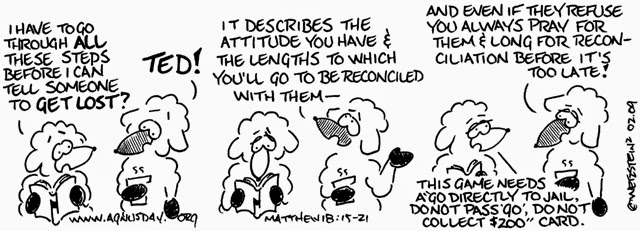
They are now back in Judea, making their way beyond the Jordan, on their way to Jerusalem, and Jesus gives them the ground rules for resolving conflicts among church members.  This is so important to hear, I want you to listen to this passage again, this time in Eugene Petersen’s translation which we find in The Message:
Matthew 18:15-20 (The Message)

   15 "If a fellow believer hurts you, go and tell him—work it out between the two of you. If he listens, you've made a friend. 16 If he won't listen, take one or two others along so that the presence of witnesses will keep things honest, and try again. 17 If he still won't listen, tell the church. If he won't listen to the church, you'll have to start over from scratch, confront him with the need for repentance, and offer again God's forgiving love.

   18 "Take this most seriously: A yes on earth is yes in heaven; a no on earth is no in heaven. What you say to one another is eternal. I mean this. 19 When two of you get together on anything at all on earth and make a prayer of it, my Father in heaven goes into action. 20 And when two or three of you are together because of me, you can be sure that I'll be there."
So, this passage is important because it provides the ground rules for resolving conflicts among members of the same community of faith. The Body of Christ. The Church.

Wait a minute! Hang on!  Church members have conflicts?!?!

Get out of town! Church members don’t’ have conflicts! Right? That’s just for people on Soap Operas or SitComs or Reality TV like The Kardashians, or the Atlanta or New Jersey or LA (or wherever) Housewives, right?

Any actual, true, followers of Jesus have so much love in their heart and peace like a river flowing in their soul and the sweet song of Kumbya on their lips that there are no conflicts in church!!! 

There's no conflict in church, just like there’s no crying in baseball!!!

Right?

Ahem! WRONG! (Especially if you're a Red Sox fan but we'll talk about that later.)

For some reason, people - even people in the church - think that following Jesus is easy.

Everything Jesus ever taught is easily understood by one and all; easily agreed on by one and all; and all the consequences and specific actions are easily followed by one and all. Right?

And our individuality is washed away at baptism and we leave our intelligence on the church steps and we all think alike and act alike and walk alike and talk alike and become cookie cutter clones of one another.  Right?

Ahem! Not so! Well, maybe in a cult somewhere, but clearly not in The Episcopal Church..

Here’s a newsflash: Real churches have - or should have, actually - real conflicts.

Partly these will arise from individual human faults and failings that need to be confronted for the sake of the well-being of the community.

And partly these will arise from good people simply disagreeing about exactly what following Jesus requires of them in their particular context.

The only real harm that will come to a church community is to refuse to deal with conflicts.

UMC pastor and writer David Ewart writes “Conflicts do not kill churches. Refusing to deal with conflict kills churches. And, in fact, Jesus knows this, and gives specific instructions for dealing with conflict and offensive behavior - including telling members to leave as a last resort.”

This is an especially important ground rule because, as I mentioned, Jesus is coming from the northern parts of Israel down to Judea on his way to Jerusalem. And, we know what is going to happen in Jerusalem, right? There will be conflict of major proportion. Indeed, the disciples will squabble amongst themselves and abandon Jesus in his hour of need, Judas will betray him and Peter, who we heard last week confess Jesus as Messiah will deny him, not once, but three times.

Jesus will be charged with blasphemy by the religious leaders of his day and trumped up charges of treason by the political leaders of his day. He will be beaten, mocked and tortured, paraded through the streets of Jerusalem while being whipped and made to carry the cross on which he will be crucified and on which he will die.

Conflict? In the church? The Body of Christ? 

It’s in our DNA.

As Pastor Ewart says, “Conflicts do not kill churches. Refusing to deal with conflict kills churches.”

As many of you know, I’m a Hospice Chaplain. When someone asks me what I do, I often find myself offering a list of activities.

Well, I have lots of patients - most, actually - who aren't Christians, or who disavow themselves of any denomination or set of beliefs. Lots of "former Roman Catholics". Or, "Well, I was baptized in a non denominational evangelical church and I love the Lord, but I don't go to any church."

And, why is that so? Mostly they've left the church because - you guessed it - conflict.

What I hear myself say for those who are Christians, and for those who request them, is that I administer the sacraments, I anoint dying persons and hold prayer vigils at their bedside with family members.

But, you know, I have found that, for lots of Christians – even some who have gone to church all their life, including some Episcopalians – it’s not the “activities” of the church – the sacraments and anointing or even the prayers, that bring comfort and lead them to a peaceful death.

I have found that what people want most – for themselves and for others – is precisely what Jesus is talking about this morning. It’s all about forgiveness and reconciliation. 

Dr. Ira Byock, in his book, “Dying Well," writes that there are five key things that people need to say before they die. They are:
I love you.

Please forgive me.

I forgive you.

Thank you.

Goodbye.

Saying “I love you,” is, not surprisingly, the easy part for most people. Which is good, because that’s an important place to begin. It’s the next two – the, “Please forgive me” and the “I forgive you,” – that often provide the most difficult terrain and landscape to travel in the last days of our earthly journey. They are important, however, if a person – the one with the terminal illness, is, as well as the people who are left behind are – to get to a place of gratitude for what has been in order to find the strength and courage to say “Goodbye”.

Last year, I was visiting a patient, an elderly man with cancer, who was very near death. He had stopped eating and was sleeping a great deal, but was having moments of being awake and alert. His wife had called me because, she said, her husband wanted to talk with me and it seemed important.

When I arrived, he had been sleeping, but, after a few moments, he was awake and smiling. He asked his wife if he could have a cup of tea – and one for the chaplain and you, please. His wife smiled at me sadly, knowingly. Clearly, whatever the man wanted to tell me, he didn’t want his wife to hear. She left the room quietly, and I could hear her putting the kettle on and fixing a tray with the tea pot and china.

The man looked at me and said, “I want you to promise me something.”

I smiled and said, ‘You know, I learned long ago never to make promises I know I can’t keep. So, why don’t you tell me what you need to tell me and I’ll let you know if I can promise it.”

“Well,” he said, “I want you to tell my wife that I’m sorry. I’m so very sorry. You see, about 25 years ago, I had an affair with someone in my office. My wife never knew about it. It didn’t last long. It was just . . .something stupid . .. .but, I’ve felt guilty about it all these years and I want to tell her how very sorry I am that I did that and betrayed her and my marriage vows to her.”

I looked at him sadly and said, “You know, that’s not my story to tell your wife. It’s not my confession. It’s not my place to ask her for her forgiveness for you. You still have time to tell her and ask for her forgiveness. But, you know, I suspect that, if she knew of your affair, she already has forgiven you. She obviously loves you and has taken such very good care of you these past few months. That wouldn't have happened if she were hurt or feeling betrayed.”

“Do you really think so?” he asked.

“From what I've come to know about your wife, she's a very loving, very forgiving woman,” I answered, “But you really need to tell her what's on your heart, so you can be at peace and leave this earth with a heart filled with gratitude for the life you’ve been given to live.”

“Here’s the one thing I can promise,” I said, “You have expressed remorse for your deeds. God has already forgiven you for what you did. That’s a promise you can take to heaven with you. I have every confidence that one of the first things that Jesus will do when you get there is to open his arms widely and say, “I love you. All is forgiven.”

Just then, I heard his wife coming back into the room. She was having a bit of trouble juggling all the things on the tray so I got up to help her. It only took a few minutes but when we got back to the bedside, it was clear that her husband was taking his last few breaths.”

We stood there, she and I, each holding one of his hands while we held each other’s hand. His wife wept softly, said, “I love you,” a few times while she brushed away the tears. Then, she sighed deeply and said, “Oh, I wish I had told him that, long ago, I forgave him for that silly affair he had with that woman in his office.”

I smiled at her and said, “You know, the nurses I work with say that the ability to hear is the last sense to leave the body. Why don’t you tell him yourself?”

She looked at me a bit quizzically but then she turned to her husband and told him that she knew about the affair.  And, she said, “I forgive you.” And, she said, “I love you.” And, she said, ‘I’m so grateful for everything we had together – the good stuff always outweighed the bad.”

And then, he took his last few breaths and died. And, we said goodbye.

After she composed herself, she said to me, "Do you think he heard me?"

"Well," I said, "we'll never know for certain, but I just love the thought that the last thing he heard before he left this earth was your voice saying, 'I love you. I forgive you.' And, the first thing he heard when he got into heaven was the voice of Jesus saying, 'I love you. I forgive you.'".

"I love that, too," she said, as she squeezed my hand and dried her tears.

This morning, Jesus offers us some ground rules for living together as a beloved community of his disciples. He doesn’t promise us nirvana. He doesn’t promise us paradise – not while we’re on this side of Eden.  

 Because Jesus understands our humanity, and understands that there will always be conflict among us, he offers us a way to find forgiveness and reconciliation.

And, because he understand that we all have a divine spark within us, he reminds us that ”Whatever you bind on earth is bound in heaven and whatever you loose on earth is loosed in heaven.”

Or: “A yes on earth is yes in heaven; a no on earth is no in heaven. What you say to one another is eternal.”

There’s still time. Don’t wait till the last minute. Make sure you seek forgiveness of any wrong you have done. Make sure you offer forgiveness for any wrong done to you.

Jesus has given us the structure – shown us the way – to find the gifts of forgiveness and reconciliation, which are pathways to gratitude. And, a heart filled with gratitude is a heart that which understands a “sacrifice of praise and thanksgiving” which is the very heart of Eucharist..

It is in that heart-breaking place of praise and thanksgiving and Eucharist that we are able to have a foretaste of the banquet that awaits us in heaven where, we are promised, we will find forgiveness and reconciliation and feast on Divine Love for eternity.

Yes, we all believe that are still many miles left to our earthly journey. It’s also true that yesterday is gone and tomorrow is promised to no one. All we really have is today. This day. The present. Which is why it is such a gift.

All we get is this one life, here on this earth, before we complete our earthly pilgrimage and return to the One who loved us into being, loves us unto death, and will love us for eternity.

It’s not too late. You still have time. You don’t have to have a diagnosis with a terminal implication to say the Five Key Things everyone needs to say before they die.

I love you.

Please forgive me.

I forgive you.

Thank you.

Goodbye.

If you can't remember all that, remember the words of Jesus: “A yes on earth is yes in heaven; a no on earth is no in heaven. What you say to one another is eternal.”

Amen.