Come in! Come in!

"If you are a dreamer, come in. If you are a dreamer, a wisher, a liar, a Hope-er, a Pray-er, a Magic Bean buyer; if you're a pretender, come sit by my fire. For we have some flax-golden tales to spin. Come in! Come in!" -- Shel Silverstein

Tuesday, April 19, 2011

Encountering The Spirit #6

It boggles my mind how quickly time passes.

This is the sixth and final entry for "Encountering the Spirit", the required blog/journal for Kwok Pui Lan's class in "Contemporary Spirituality" which I'm taking as part of my work as Proctor Scholar here at EDS.

There is yet a final presentation and a paper due May 16. I am working on a concise presentation of the Spirituality of Coming Out, which will compliment one of the projects I've been working on as Proctor Scholar.

The assignment for this journal entry reads, "... the last entry will be a reflection of your spiritual life in light of what you have learned."

We are to do that in 2-3 pages.

Right.

Those who have been following this blog know that I have thoroughly enjoyed all of the assigned readings, from the work of the Dalai Lama and Thich Nhat Hanh's teachings on love; the fascinating work being done on Brain Science and how that impacts spirituality; the exploration of the intersections of sexuality, spirituality and art; Marjorie Thompson's 'Soul Feast'; and finally - and, for me, most importantly, Lebacqz and Driskill's Ethics and Spiritual Care.

It has been a rich, abundant feast, enhanced by powerful class presentations and conversations in class as well as after class. I have been richly blessed.

In my first journal entry, I wrote:
"For me, the spiritual journey is my spiritual home. It's where I belong. It's where my heart sings and my spirit soars in the wanderlust of the landscape of the Spirit. It is also where I can weep and lament, where my anger is holy and my tears are a sacred gift.

It is a place where the well is deep enough for me to drink from when I thirst, the sky rains down manna when I hunger, and the stars illumine my path when the world gets cloudy or dark. It is a place that offers healing when I am bruised and broken, and hope always beckons to me from the horizon.

It is a place where I can find companions on the journey, to share bread and stories, despair and hope, laughter and tears.

The spiritual journey is where I can become more of who God made me to be."
While that is all still true, I have discovered that the spiritual journey is also the place where I can dance.

Last week, it was my turn to provide the closing ritual for the class. It has been our practice that Pui Lan begins the class by leading us through a silent, centering meditation, using the music of Kitaro The Silk Road, after which someone reads a poem.

The visual focal point for our meditation has been a centerpiece of the artifacts of individual class members. After the meditation and poem, the person who has provided the meditative centerpiece talks about what s/he has brought in as way to talk about his/her spiritual journey.

At the end of the class, one of us leads us in a closing ritual. Last week, my ritual was a reflection of what I have learned about being a Spiritual Leader in this course which was contained in a dance. I'd like to summarize that presentation here as a way to close out this journal entry on "Encountering The Spirit".

First, here’s a story behind the story. This was told to me by my friend, Rev. Lauren Stanley, who has been a missionary to Sudan and is now missionary to Haiti:

During World War II, a musician by the name of Larry LaPrise served in the European Theater. After the war, LaPrise and his friends formed a band called the ‘Ram Trio’ that entertained the crowds coming off a day of skiing in Sun Valley, Idaho. One of the songs he wrote – or so the story goes – is one that all of us know: The Hokey-Pokey. You know this song, right? Most of us have sung it and danced to it, usually as kids and then again, for some unknown reason, at weddings.

The words “Hokey Pokey” come from the words “hocus pocus,” which most of us know are the words you speak when you’re doing magic. The words “hocus pocus” come from the Latin phrase, Hoc est corpus meum – “This is my body,” – the words the priest speaks when he or she elevates the bread during the Eucharist.

In the early years of the church, when the priests would celebrate in great stone cathedrals, they would turn their backs to the people, and sing the Mass: “Hoc est corpus meum!” Their voices would reverberate throughout the cathedrals, and as the echo moved throughout the cathedral, what they would be signing – “Hoc est corpus meum” – would sound like Hoooo-cuuussss pooooocuuuuus . . . . . . .

From that term – “hocus pocus” – LaPrise came up with the “Hokey Pokey” (although there are some who claim that the song and dance existed in England during the war). In 1949, LaPrise and the Ram Trio recorded the song and it soon became nationally known.

Now, someone is asking, "What has any of that got to do with an encounter of the Spirit, much less, with spirituality?"

Well, think again about the words of the song: "You put your whole self in, you put your whole self out, you put your whole self in and you shake it all about. You do the Hokey Pokey and you turn yourself around."

That’s what it’s all about!

That, for me, is the spiritual journey. It is a dance of mystery - but there is no 'hocus pocus' involved. It is a dance of trial and error, of turning yourself around to discover the Holy that is hidden in plain sight.

To deepen your sense of spirituality, you try something out - rosary beads, meditation (sitting, walking, centering, guided, musical), Tai chi, Qigong, Lectio Divina, - whatever it is that flutters over your mind or heart or soul and beckons you to a more disciplined, deeper awareness of God.

You put one part of yourself in - decide you are not so sure - and then take it out. You do that with various parts of yourself, until, one day, you are able to put your whole self into to a philosophy or technique that works for you.

And if, at some point, that gets stale or ineffective, you just try something else, something into which you can put your whole body.

I have come to understand that spirituality is at its best when it flows from an authentic place in your soul and is embodied in your life.

"Hoc est corpus meum!" That's the ultimate message of spirituality.

"This is my body". It is a holy temple, a vehicle in which and through which the spirit flows. It is magical and mysterious and yet profoundly simple and completely attainable by even those who would protest that they are not 'spiritual'.

At the end of my presentation, I had the whole class do the 'hokey pokey' as our closing ritual. It was great fun.

The spiritual journey, like the hokey pokey, is the place where you can put your whole self into the dance of life and 'turn yourself around' in order to become more authentically the person God is calling you to be.

I will leave you to consider these things as you listen to Kitaro's Theme from The Silk Road, which I will take with me from this class as the siren sound of an encounter with the Spirit.

Monday, April 18, 2011

A Parable of Monkeys

Monday in Holy Week.

And so, once again, we begin again to hear the old, old story of the Passion of Jesus. We have heard the story so often over the years that some of us can repeat the story without looking at the words on the page.

The story isn't so much predictable because it is familiar, but rather because we recognize the predictability of human behavior.

Change is the only constant in life. And yet, when someone proposes something new - a new way of doing things, a new way of considering things,  a new perspective on the world - others may get anxious or frightened about the change in status quo.

It's like watching one of those toy mobiles one can find above an infant's crib, with several gently moving, brightly colored shapes hanging on individual strings, each connected to the other and the entirety by a single string.

The unit moves 'round in a synchronized whole until the baby tries to grab for one of the shapes. Then the whole thing swings wildly out of sync until, by sheer force of inertia, it eventually settles down into the same familiar pattern.

Some people can't stand being out of sync - even temporarily - even if they know that eventually, the forces of inertia will have out and everything will settle back down again.

There is something very comforting about the familiar even when anyone can see that the familiar is no longer working or contains toxins or pollutants which mitigate against the process and progress that are inevitable to attaining a healthy life.

Years and years ago, I had a therapist announce rather abruptly, after a little over a year's worth of therapy, that our work was done and she was going to terminate our relationship.

I was stunned. Confused. Hurt. "Why?" I asked.

"Well," she said, calmly, "I see you, you know. You are sitting on top of a huge pile of your own crap. I keep throwing you shovels, saying, 'Here, use this one. You can get yourself out of this mess.'"

"But you keep saying, 'Well, it's not so bad. After all, it's soft. It's actually quite comfortable here. And, after a while, you get used to the smell. Besides, it's just so much work to shovel myself off this pile of crap. Why won't you help me?'"

She lowered her glasses over her nose, looked me square in the eye and said, "Elizabeth, no one is able to change your situation but you. You have to do it yourself. I don't have a magic wand that will make it all go away. Besides," she said, "I'm not going to let you off the hook only so you can blame me when you get uncomfortable with the unfamiliar."

Her words had the desired effect. I started shoveling. For the next three years, I shoveled - hard - as if my life depended on it. Because, in fact, it did. I didn't know it, but I had been suffocating in my own crap.

I remember, once, saying to her later in the therapy, "I don't understand. I'm confused."

"You know, you say that a lot," she said, "You say, 'I don't understand. I'm confused'. I'm wondering: is that how you sabotage yourself from doing the work you need to do? By staying confused? It's a very convenient excuse, isn't it?"

Then, she lowered her glasses over her nose - always a dangerous sign - and asked, "When are you going to see that it's just an excuse to stay a bit longer on your own pile of crap?"

She was good, wasn't she? Tough, but good. I really owe so much of the quality of my present life - indeed, the shape of my ministry - to my work with her.

There's something, as well, about the "One Bad Experience" which can shape and form the psyche and soul of an individual as well as a community.

Someone does something innocent - perhaps even altruistic - to make a change and the result is disastrous. Years later, one can hear, "Well, so-and-so tried that once and look what happened."

Indeed, I've heard some clergy say those exact words about not proposing some change or initiating something new in the congregation.

"I'll know I'll get crucified if I tried anything like that, even though I know and they know that the change is needed. Look what happened to Jesus! He died once, for all, so I don't have to."

I remember being caught in one particular situation of group conflict which was reflective of that sentiment.

It had been a start-up ministry in which the group had spent years fundraising to call their first leader.  After about six months of establishing the ministry and it was starting to find some sense of equilibrium, I began to talk with the board about raising money for the next year.

They panicked!  They really thought they could settle back now and just relax. They had accomplished their task and called a leader. While they loved what was happening and the things I had initiated, they absolutely hated the fact that their work as a board had only just begun.

I called in a retired bishop to act as a consultant. After talking with him for awhile, I remember demurring, slightly, and saying, "You know, bishop, they are good people. They are just scared and confused, is all."

The bishop sat up in his chair, leaned over to me, put on his Big Bishop voice and said, "And who do you think crucified Jesus? They were good people. They were just scared and confused."

Then, he looked me straight in the eye and said, "Your job as their leader is to not let them use their anxiety and fear to sabotage this wonderful, important ministry. If you can't do that - and, you may not be able to do that because they are so scared and confused - then it's time to terminate your relationship with them. Because, if you don't, they'll crucify you and blame you for the failure of the ministry, which would be a lie. "

"And," he added, serious as a heart attack, "as much as I think Jesus loves this ministry, he doesn't want you be be crucified in His name."

Indeed, I left shortly thereafter to accept another position which I believe Jesus put in my vocational path. Last I heard, that ministry lives on, but only Very Part Time. In the end, the board went with what they were comfortable knowing and doing - and able to control.

Meanwhile, I'm told that a discontent simmers just underneath the surface of the board dynamic because they know that this ministry "isn't what it could be". But they sigh and quietly lament and blame it on the leader.

As you consider the events of the Passion of Jesus, I invite you to consider the ways in which you play some part in the human drama that unfolds during Holy Week. You know the story well. You may even know all the words of your lines by heart.

I offer the following 'Parable of Monkeys' which was sent to me by a dear friend. He sent it as a commentary about the current political debates over the budget and the deficit, but I think it has a great deal to say about all institutional and community behavior - including the church.

See if this doesn't resonate with some of your own experience:
If you start with a cage containing five monkeys and inside the cage, hang a banana on a string from the top and then you place a set of stairs under the banana, before long a monkey will go to the stairs and climb toward the banana.

As soon as he touches the stairs, you spray all the other monkeys with cold water. After a while another monkey makes an attempt with same result ... all the other monkeys are sprayed with cold water. Pretty soon when another monkey tries to climb the stairs, the other monkeys will try to prevent it.

Now, put the cold water away.

Remove one monkey from the cage and replace it with a new one. The new monkey sees the banana and attempts to climb the stairs. To his shock, all of the other monkeys beat the crap out of him. After another attempt and attack, he knows that if he tries to climb the stairs he will be assaulted.

Next, remove another of the original five monkeys, replacing it with a new one. The newcomer goes to the stairs and is attacked. The previous newcomer takes part in the punishment... with enthusiasm.

Then, replace a third original monkey with a new one, followed by a fourth, then the fifth. Every time the newest monkey takes to the stairs he is attacked. Most of the monkeys that are beating him up have no idea why they were not permitted to climb the stairs. Neither do they know why they are participating in the beating of the newest monkey.

Finally, having replaced all of the original monkeys, none of the remaining monkeys will have ever been sprayed with cold water. Nevertheless, none of the monkeys will try to climb the stairway for the banana.

Why, you ask? Because in their minds...that is the way it has always been!
The banana at the top of the stairs is the promise of Resurrection.

But first, you have to shovel through Holy Thursday and Good Friday before you can climb the stairs to reach it.

Sunday, April 17, 2011

Lord, have mercy!

No matter the particular font from whence your Christianity flows - East or West - you gotta love the byzantine ways of the institutional church, especially as it calculates the liturgical calendar.

This year, the calendar for Lent, Holy Week and Easter used by most of Western Christianity follows the Orthodox Christian calendar - or, vise versa, depending on the person you're talking with - and coincides on the same schedule and dates.

Today, Palm Sunday happens to coincide with the Jewish celebration of Passover, which, Scripture tells us, is the presenting reason Jesus was in Jerusalem in the first place.

It's all so nice an tidy, isn't it? Must mean that it was all historically accurate, right? Well, this year, anyway. Other years, you're pretty much on your own - historically speaking.

The "Cowley Fathers" in Cambridge, MA - the Society of St. John the Evangelist - had an interesting post in today's daily Lenten email about how today, Palm Sunday, is the 40th Day of Lent.

Here's the explanation:
Enumeration of the days of Lent can follow at least two different schedules: in one, Ash Wednesday and the Thursday, Friday, and Saturday following are not regarded as days of Lent; rather, they are preparatory days for Sunday, the day on which Lent begins. In this system, the fortieth day of Lent will occur on Thursday of Holy Week, the beginning of the so-called Triduum.

The Book of Common Prayer 1979 uses an alternate system which includes Ash Wednesday and the days following as days of Lent, but which excludes Sundays during the season, and therefore culminates with Day 40 falling on Palm Sunday, the beginning of Holy Week, where our focus shifts dramatically.
Well, there it is, then.

It's official: Lent is over.

Break out the chocolates, alcohol or red meat from which you have been fasting.

Wait! Hang on! Not so fast with the not-fasting.

It's not over.  Yet. Indeed, it's about to get even more demanding.

Holy Week has begun.

Well, that's only if you are Episcopalian. If not, you've still got five more days to go.

See what I mean about being byzantine? 

Lord, have mercy!

I learned something new from Penny, my dear, sweet friend of some 30+ years who is Greek Orthodox. She was telling me about the word 'eleison'. We've been saying it a lot during Lent - as in "Kyrie eleison" - "Lord, have mercy".

The word 'eleison' έλεος has as its root in the word 'elison' ελιά. My Greek is Very Rusty, but I think I spelled that right. (Someone will write and tell me, no doubt.)

At any rate, the Greek word for 'mercy' has its root in the word 'olive'.

Penny tells me this is because oil, of course, is extracted from the olives which grow so abundantly in the Middle East and has been used, since ancient times, as an agent of healing and comfort (as well as cooking).

So, when we ask for God's mercy, we are asking to be anointed - bathed, soaked, drenched - in the oil of Divine Healing which we call "mercy".

Not a bad idea as we begin Holy Week - today or, depending on your calculations, Maundy Thursday.

There's another coincidence on the calendar this year - a collision of Good Friday and Earth Day - which has not escaped the attention of The Episcopal Church.

On the church's official website, we are told that it is a "profound coincidence" that Good Friday lands on Earth Day. Or, vise versa, depending on your priorities and point of view.

There is a whole host of educational, liturgical and other resources which one can avail oneself of, should one be so inclined, to assist in exploring the profundity of this coincidence.

The church tells its members "when Earth is degraded and species go extinct, a part of God's body experiences a different type of crucifixion, and another way of seeing and experiencing God is diminished."

Now, I'm a progressive sort of Episcopalian but there are somethings that make me cringe and feel like an old fuddy-duddy. This is one of them.

Look, as a feminist and a Christian, I am committed to Eco-justice and the creation of a more sustainable, compassionate economy and way of life. I do what I can to recycle, use energy efficient light bulbs, wear a sweater instead of turning up the heat on a cold night, and turn off the faucet when I'm brushing my teeth.

I'm also an Episcopal priest who, like many of my colleagues, knows her way around a metaphor. I can wring the life out of a metaphor with the best of them, and have a few drops left over for another sermon.

I understand the temptation to equate the crucifixion of Jesus with the extinction of plants and animals and the killing of innocent human beings and the devastation of all life forms during 'unholy' wars.

But, Good Friday and Earth Day? Really?

It strikes me that this connection out-byzantines the most intricately, convoluted byzantine among us. It probably ought to earn some kind of award as the Metaphor of the Year by The Association of Episcopal Clergy.

It's a coincidence, to be sure. 'Profound'? Well, I suppose that's in the eye of the beholder.

Sort of the way Palm Sunday - or, is it Maunday Thursday? - marks the end of Lent. Or, depending whether or not you are looking East or West, when Lent begins and Easter is celebrated.

If someone is passionate about Eco-Justice and finds a deeper meaning to their vocational work and the crucifixion of Jesus and the joy of Easter, then, well, is that a bad thing? Really?

It's not that The Episcopal Church is saying, "Thus saith the Lord: thou shalt, henceforth and furthermore, celebrate Earth Day on Good Friday and read, mark, learn and inwardly digest this 'different form of crucifixion, another way of seeing how God is diminished'."

It's simply an opportunity to make a connection between our daily faith and our daily lives. It's a way to raise awareness about one way to make our faith come alive in the world around us.

Which - Lord, have mercy! - is not a bad thing.

As I look out my window, I see glorious colors of the deep brown earth contrasting against the evermore brilliant shades of green grass as the forsythia buds open in stunning colors of yellow. There are white sage and purple and blue ground ivy and pale blue speedwell and rosy dead nettle blossoms springing up everywhere.

It's as if the whole 'round earth is coming alive again. It's an earthly resurrection of - dare I say it? - 'profound coincidence', happening, as it is, during Passover, the end of Lent and the beginning of Holy Week and the 'three holy days' of The Triduum. 

It's a wonderful metaphor crying out to be used and simply begging to be exploited.

Frankly, I think Jesus gets confused about where he's supposed to be on any given day on the calendars of all the various parts of His Body, the Church. It's an exhausting schedule. I'm sure glad I don't have to be Him.

I'm not so concerned, these days, with a strict observance of the calendar of the church as I am being in sync with the rhythm of nature as a manifestation of God's ways which can not be contained.

I'm less and less interested in how we mark the days of our lives than the quality with which we live them. Ultimately, I think God is, too.

I don't give two figs - or, olives, for that matter - about whether or not you earned an attendance check mark for going to church today or waved your Palm branch around as you walked to your car parked on the side street near the church or had the children weave your palm branch into a cross to pin on your lapel for all to see when you walked into the Coffee Shop or Diner after church.

I'm much more interested in what part you have to play in the Story of The Passion and what you do about the corruption of power and state sanctioned execution.

I want to know if you have ever betrayed or been betrayed and what that felt like and whether or not you sought or found forgiveness.

I want to know if you have stood by, helpless and hopeless, as you witnessed the unjust, unmerited suffering of a friend - or, even a stranger.

I want to know if you have suffered for something you believe in and were willing to let a part of yourself die for your convictions.

It is the intricate, convoluted, byzantine stories or our lives that make the most sense to me - not the imposed calendar of the church - and how those stories reflect the narratives of our faith as they are given to us in Holy Scripture.

The Church, in all of her foolishness and foibles, tries to call us to that work. Sometimes, She does it with such breathtaking profundity as to cause a transformation in our lives. And, other times, well, She just makes me giggle.

In and through it all - the sublime and the ridiculous - God anoints us with healing and compassion and forgiveness and hope.

Ultimately, it may well be that there are only two appropriate responses to the miracle of all the Holy Weeks and Easters of our lives:

Kyrie eleison! And, Alleluia!

Mother Church, in Her way, has taught us that, for which I am forever and eternally grateful.

Have a Most Blessed Holy Week!

Saturday, April 16, 2011

Those were the days?

A dear friend sent me these advertisements from the 50's with a note that said, "You'll never see these ads again."

And my response to some of them was, "Thanks be to God!"

Like, this one:

It already brings a tear to the eye, doesn't it?

Or, for example, this one, which makes me just want to run out and buy vitamins:

Well, now I know why no one would ever accuse me of being "cute".  I just don't take enough "Pep" vitamins, is all.

If you want to know why some men never quite made it with the ladies (or why some women went running from the room), check out this ad:


Believe it or not, I was one of these girls:

Blame it on all that comfort food my mother made.

Funny, I don't remember Lane Bryant making clothes for children - just women. Then again, we always got our "half-sizes" for "chubbies" at Robert Hall. Well, for special occasions. Otherwise, they were all "hand-me-downs" from older cousins.

And, oh by the way, being a 'chubby' was not an insult in my family. It was, in fact, a source of pride. It meant that you had good parents who could afford to feed you well.

In my neighborhood, little kids were supposed to be a little 'chubby'.  You could worry about working off your 'baby fat' when you went to junior high and high school and became part of one of the "lady's" sports teams. Kids were supposed to look like kids, not mini-versions of Brittany or Taylor.

Now, here's an ad for a time when men were men and no one had to wonder about the status of their manliness (click on the image to enlarge if you want to read the small print):

How about THAT for 'family values?

Here's one extolling the virtues of television for your children (click on image to enlarge).

When the term "family values" was used, this is pretty much what it meant. Dad, Mom and the kids all gathered 'round the Motorola watching a 'wholesome' program.

If only Howdy Doodie were back on TV and men carried guns, all would be right with the world again!

Then again, maybe we're just not using the right toothpaste:


Or, perhaps nursing mothers are missing that " little something extra" for themselves and their babies.


And, to make it easier for dad to help and join in on the . . . "experience" . . .


Ah, see, we've not only realized our dream, we've surpassed it!

Except, in some places, maybe, not so much (click on image to enlarge):


Advertisements in print and visual media shape and reflect our culture in both subtle and powerful ways.

I still love the work of feminist Jean Kilbourne on the images of women in the media.

If you don't think this is important, just take a look at this clip from Kilbourne's work:

Killbourne says that "advertising sells products, of course, but it also sells values and images, it sells concepts of love and sexuality, or romance and success, and perhaps most important, of normalcy. To a great extent, advertising tells us who we are and who we should be.... What it tells us about what's most important about women is how we look."

It has ever been thus.

The next time you try to dismiss advertising as something you simply "tune out" and "don't pay any attention to," think again.

I wonder what our children and our grandchildren will think, looking back on this time of advertising.

Oh, I suppose they, like me, will chuckle about how absurd we look.

I hope that they, like me, will also raise a skeptical eyebrow and ask, "Those were the days?"

Friday, April 15, 2011

Comfort Food

The other night, when it was cold, drizzly and rainy, I came home and, even though I was weary and tired, nothing else would do but to fix myself a grilled cheese sandwich and a hot cup of tomato basil garlic soup.

Comfort food.

I'm not exactly certain what it is about comfort food that is so comforting. I suspect it's a combination of the relatively effortless nature of cooking it, and the soft, easy nature of eating it along with the pleasant, warm memories the food itself evokes.

Rainy days and grilled cheese sandwiches combined with a cup of hot tomato soup is a meal reminiscent of a dismal Saturday afternoon of my youth. The sight, the smell, and the taste make me feel like I'm 9 years old again and in my mother's kitchen.

Of course, the grilled cheese sandwich of my youth would not be made with the whole wheat, multigrain bread I now use. Neither would it be filled with a combination of sliced provolone and Swiss cheese.

My mother's grilled cheese sandwiches were made of Wonder Bread (which was so light and so white you wondered if it was really bread) and a thick slab of Velveeta Cheese cut from a large rectangular block of the stuff that was wrapped in thick plastic and came in a yellow box.

The soup? Had to be made by Mrs. Campbell and shipped to the grocery store in a round metal can - the one with the smiling rosy-plumped-faced kid, holding a spoon - which was purchased at the local market, brought home, opened, and then dumped into a pot and mixed with an equal can of fresh whole milk.

It was "Mm-mm Good!" In some ways, it was better than my own homemade Tomato Basil Garlic Soup which has to be cooked and then pureed.

For most of us, comfort foods are far from gourmet and generally epitomize home cooking. They invoke feelings of nostalgia, safety, and security.

For some people, that could be as simple as a peanut butter and jelly sandwich, or it could include a little more complicated fare like meatloaf, mashed potatoes, brisket pot roast, fried chicken, baked beans, chili, chicken pot pie, macaroni and cheese, chicken and dumplings, spaghetti, beef stew and good ol' tuna casserole.

Dessert? My memory takes me immediately to bread pudding, rice pudding (with lots of cinnamon on top), banana creme pie, or hot apple or blueberry pie with a thick scoop of ice cream melting on top. 

My mother had several "specialties" which she only made at certain times or for certain reasons.

Salmon Pie was her Lenten specialty - a Friday evening treat at the end of a long week and after attending bi-weekly, mandatory Stations of the Cross.

She served it with her special "white sauce" - a little something she picked up when she was in Home-Ec class and applied to a variety of resourceful adaptations.

Because of the Great Depression, my mother had to leave school when she was in the 9th Grade. She went to work in one of the many garment factories in Fall River, MA, so she could earn money for the family.

It broke her heart, she said. There was no missing the sadness on her face whenever she mentioned it.

She loved Home-Ec class because there she learned how to cook "American" food - tuna casseroles, meatloaf and mashed potatoes, and chicken pot pie - which, to her, was downright exotic compared to the Portuguese peasant food she learned to cook at home.

It became a symbol of the hope and promise of new life, an embodiment of The Great American Dream, served up on a 12 inch plate.

It began, she said, when she was taught to make "creamed eggs". This recipe, for some reason, was reserved for those kids who were not feeling quite 100%. You couldn't be Really Sick for my mother's Creamed Eggs because you were required to help with the assembly.

While the eggs were boiling, she began to make a 'white sauce' of equal parts butter and flour, salt and pepper, which she stirred and cooked together until it formed a thick yellow paste. Then, she'd add the milk and stir slowly, always in a figure-eight in the pan, which was always the task reserved for the kid for whom this treat was being made.

By the time the white sauce was thick, the eggs would have been boiled. They were immediately bathed in cold water, cracked, and then opened. The white part of the egg would be carefully separated from the hard yellow and then sliced into bite sized pieces and added to the white sauce.

Meanwhile, the bread would have been toasted and thickly buttered so that the Creamed Egg mixture could be poured on top.

Then, the fun part - always reserved for the kid who was the intended recipient of this epicurean delight - pushing the hard yellow yoke through a sieve to make a delicate sprinkle of garnish on the top.

The whole affair is not finished, however, without a very light dusting of paprika and a few garnishes of chopped parsley.

Oh. My. Soul!

I didn't realize until I was much older that this dish tastes so good because it also carried my mother's hopes and dreams.

I suppose I did a similar thing with Mac 'n Cheese and Shepherd's Pie - both of which I learned in the home of a classmate of mine who was of Irish and English descent.

The Mac 'n Cheese is always - always - made from scratch (never that orange stuff in a blue box), using my mother's basic white sauce. The cheese is shredded and mixed in with the cooked macaroni. The whole thing is sprinkled with buttered bread crumbs and baked in the oven.

The Shepherd's Pie is always magnificent in its simplicity. I always make it using equal parts of ground lamb, beef and pork because. . . well. . .because that's the way I was taught. Sauteed onions and garlic mix with the ground meet to make a glorious aroma.

The whole thing gets topped with a thick layer of mashed potatoes and then baked to a golden brown perfection.

The house absolutely reeks of love and care and comfort.

Whenever our kids would come home from college or, even now, when I haven't seen them in a while and they are coming over for a visit, their first request will be for Mac 'n Cheese or Shepherd's Pie.

Nothing made me happier than when one of our daughters asked if I would come by and teach her how to make Mac 'n Cheese. Seems as if her own daughters had been asking for some of Nana's Mac 'n Cheese.

Made my heart sing!

I remember one Pentecost Sunday when one of the inner city congregations I was serving at the time decided to celebrate this great but often neglected Feast. The church celebrated its identity as a multi-cultural, international community, so nothing would do except to have a festive Pot Luck International lunch out on the lawn after the service.

We delighted on stewed goat, and Jamaican meat pies, and Rice and Beans and a whole host of delicacies from the West Indies and West Africa, along with a huge vat of collard greens, Mac 'n cheese, Three Bean Salad, Fried Apples and great, black cast iron pans of corn bread.

It was Ms. Manning, however, the quintessential New Yorker, who delighted us all by bringing what she called "Island Food".

"Island Food?" we asked, looking at the glorious pans of meat loaf and pots of mashed potatoes.

"Yes," she said, demurely, "Long Island, Staten Island, and the great island of Manhattan."

One of these days, I'm going to whip up a batch of my Grandfather's Double Stuffed Potatoes. It was the hit of the neighborhood of my youth.

He had his own kitchen and oven in the garage where my Grandmother insisted he cook up his own meals of the fish he had caught. She didn't want him underfoot in her kitchen and she didn't want him smelling up the house with his fish.

My Grandfather would begin by baking the potatoes he had grown in his garden. While they were baking, he would saute onions and garlic (also from his garden) and then add ground beef, which was pretty inexpensive in those days.

After the potatoes were done, he would cut them open, scoop out the baked potato and add them to the mixture of cooked, ground beef. Then, he would fill the shells up with the mixture, sprinkle some shredded cheese on top, and put them back into the oven to bake to a golden brown.

I don't know how it happened - perhaps the glorious odors of the Twice Stuffed Potatoes began to waft out to the neighborhood - but suddenly, our yard would be filled with kids, all clamoring for a potato of their own.

We didn't need plates or utensils. We just ate them from our hands, licking our lips and wiping the grease from our faces and hands on our clothes.

There was always more potato than ground beef, but that was okay. Everybody always had enough to eat. It was a miracle akin to the Loaves and Fishes.

Funny. My Grandfather seemed to make these Double Stuffed Potatoes when one of the shops or mills or factories were on strike. We never knew who was poor or hungry in my neighborhood. There always seemed to be some neighbor who was fixing up something amazing for everyone to share.

I have always been struck by the fact that Jesus wanted to be remembered not by the miracles he performed or the words that he said or the things he did.

Jesus wanted to be remembered whenever we break bread and drink wine together.

Whatever comfort food we are enjoying, we can take additional comfort in the fact that Jesus promises to be with us. Always. When there's food and in those times when there isn't enough to eat.

In return, He only asks us to remember Him in those times when we are being comforted by food and drink and memories and love.

Comfort food.

Wiki defines it as
"foods consumed to achieve some level of improved emotional status, whether to relieve negative psychological affect or to increase positive.. . . However, the term is meaningful not as a list of particular items, which will vary considerably from individual to individual, as well as culturally and by situation and emotional trigger, but as a psychological category of behavior."
Whatever that means to any particular individual, there isn't anyone who doesn't know what it generally means - even if it ultimately means that we are necessitated in seeking a little postprandial relief from an antacid of individual, preferred choice.

It means home. It means comfort. It means love. It means family and friendship. It means memories, hopes and dreams.

It means food for the body and the mind as well as the heart and the soul of what it means to be a human being in the human family.

There's nothing more delicious than that.

Thursday, April 14, 2011

Civil Unions in Delaware

About half an hour ago, 'round about 7 PM on Thursday, April 14, the Delaware house of representatives voted to legalize civil unions for same-sex couples. The proposal passed the senate last week and Gov. Jack Markell intends to sign the bill.

The bipartisan vote was 26 to 15. The Democratic-controlled chamber approved the proposal, which would provide same-sex couples in civil unions with the same rights and responsibilities as married couples, "to the extent possible".

Comparable same-sex unions including marriages from other jurisdictions would be recognized as civil unions in Delaware.

According to a report in The Advocate:
Last month, polling results released by Equality Delaware showed that 62% of voters supported civil unions. Opponents led by the Delaware Family Policy Council charged that the measure would open the door to marriage equality in the state.

Doug Napier, an Alliance Defense Fund attorney, repeated that claim in his testimony on the floor.

“It is riddled with all sorts of unintended consequences,” he said, while vowing to challenge the law in court. “Don’t be deceived. This bill is a precursor to same-sex marriage.”
Oh, Mr. Napier. I don't think anyone is deceived.

The hope - the prayer - is that this bill WILL, in fact, be a precursor to Marriage Equality. It's clearly an "intended consequence".

You know. Just what the Constitution guarantees.

The fear mongers were out in force, apparently, and barely able to contain either their anxiety or their bigotry:
Another witness, family law attorney Glynis Gibson, expressed concern for the law’s potential impact on children. She said the measure would give preference to a stepparent over a biological parent in some instances.

“This legislation is new and it is world-changing. It is life-changing,” she said. “And we need to think about what we’re doing when we are elevating parties to a civil union to the same level as a stepparent.”
It's breathtaking, isn't it?

I mean, when you can actually hear the fingernails of desperation scratching downhill on the slippery slope of heterosexism and homophobia while someone cries, "Save the children!"
Lisa Goodman, an attorney and president of Equality Delaware, responded to Napier in her testimony.

“It’s hard to know where to start with those since I don’t really think those were legal comments,” she said. “This bill does not change the definition of marriage under Delaware law.
Indeed.

The truth is that nothing has really changed, in terms of the spirit of the law. It's that the State of Delaware has begun to recognize that they need to rewrite the letter of the law to reflect the spirit of the law of the land - and the will of 62% of the residents of Delaware.

Thank you, Equality Delaware for your hard work. Thank you to all the clergy - including our own Mark Harris - for your prophetic leadership.

Moving back to Delaware at the end of May is beginning to look better and better.

Wednesday, April 13, 2011

Wouldn't take nothing for my journey now

I got halfway through yesterday when it hit me.

I was ordained to the transitional diaconate on April 12, 1986 in my sponsoring congregation, The Cathedral of St. Luke, Portland, Maine.

That's the reredos above the main altar at the Cathedral pictured above, featuring "Our Lady of Portland" there in the middle. Here's a description of it from the Cathedral web page:
Central in the Reredos itself stands the Virgin Mary with the Child in her arms. She is known as Our Lady of Portland and has a unique quality in that she was carved with the Native American communities in mind. Her dress and hair are modeled after typical native fashion and the Baby Jesus is wrapped as a papoose. The figures of the Blessed Mother and Child are almost life-size. Below on either side, in low relief, are kneeling figures representing Saint Luke, who in his Gospel tells the human story of the birth, and Saint John, who gives the divine meaning of the event. A panel between these two has the seals of the four evangelists, suggesting the scriptural basis of the whole work.
I spent many an hour contemplating the stunningly beautiful images in that reredos.

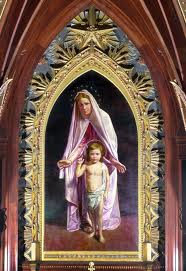
When I wasn't there, I was in All Saints' Chapel, meditating on this image of the Madonna and child.

You may recognize it as LaFarge's "American Madonna".

I love how Mary hovers protectively over Jesus, her arms outstretched, pre-figuring the posture her son would take on the cross.

However, Mary can neither prevent nor protect him from accepting the risks of his own vocation. 

She can only hover protectively as He takes his first steps and begins to rise to the full stature of his life.

It's a posture many parents know and understand.

It's a posture those who are baptized with Him and called into the priesthood of all believers understand about their own ministry in the church. 

Mary has been a model and an inspiration for my ministry of ordained leadership in the church - being a God bearer and a Christ representative, having the courage to love the people of God enough to allow them to take the risks of their own vocations.

It's a model that has served me well, lo these twenty five years of ordained service in the church.

My Silver Anniversary in the Church. Or, as Ms. Conroy would say, I have just begun my 26th year of ordained ministry.

But, who's counting?

I suppose landmarks like that present a time for reminiscence and nostalgia - a time for looking back and remembering and celebrating.

I suppose. I'm just not so inclined.

Well, I did raise a glass of wine after supper in the refectory in celebration of all the women and men who made my ordination possible.

I stand on the shoulders of some pretty amazing Giants of Justice in the church. I am overwhelmed by a deep sense of gratitude for the road they paved for me.

Despite a pleasant little sojourn to the Cathedral website, I find that I am not quite comfortable sitting around bathing in the warmth of nostalgia. I am too excited about the future to remain for too long a time on Memory Lane.

This is an amazing time to be a Christian who is an Episcopalian. Haven't you noticed?

The Anglican Covenant? Fuggedehboutit! Oh, it may pass a majority of Provinces in the Anglican Communion, but, in the end, it really won't make no nevermind. When the history of this time gets written, I am convinced the Anglican Covenant will be relegated to a sad footnote.

Schism? Schmism! As my grandmother used to say, "Dead wood always splinters." We're already seeing that in the alphabet soup of schismatics who think they've got it exactly right and have special ownership rights to Jesus.

Declining membership? Yup. We've done it to ourselves. And, maybe it's not such a bad thing. This is a perfect time to get our priorities in order.

Mission. Evangelism. Pastoral Care. Education. Good liturgy, done well. Relevant sermons that confront and challenge and question and inspire.

Oh, and did I mention mission?

I will share one memory in service of mission.

Years and years ago - too many now to count - I heard a prison chaplain - a woman who was an Episcopal Priest - whose particular assignment was death row in a state prison. She said that, when she hears confession from an inmate, there are three consistent regrets expressed in the form of wishes:

I wish I had had a family.

I wish I had never picked up drugs.

I wish I had learned to read.

I've never heard a clearer vocational call to the church to strengthen families who are reeling from the grinding realities of poverty, work to provide early intervention and treatment of drug addiction and advocate for better school systems and literacy programs.

If the church did those three things - just those three things - we would not only reduce crime and decrease the prison population, but our churches would be filled to overflowing.

There's an old saying that a church that lives for itself dies by itself.

That has never been more true.

Here at the Episcopal Divinity School in Cambridge, MA, I am surrounded by young, enthusiastic men and women who understand that. They are not sitting around waiting for the institutional church to do mission. They are equipping themselves, while they are here, with the skills and knowledge to do the work of the gospel beyond the walls of the church.

They still hover protectively over the institutional church, but their arms are open and ready to embrace Her new incarnation outside and beyond the walls of the church.

It makes me very excited about the future.

More importantly, I think it makes Jesus smile so broadly the whole round earth just shimmers and shines with possibility and hope.

I am deeply grateful for the last 25 years, but I am profoundly hopeful for the next 25 years of ministry.

It's a GREAT time to be a Christian.

So, you'll forgive me if I don't sit around thinking of the past. I've got my sleeves rolled up, my shoes laced, and my work gloves on.

As that old gospel song goes, "Wouldn't take nothing for my journey now."

Well, nothing except what I'll need to continue working for Jesus for at least the next 25 years.

Tuesday, April 12, 2011

1 + 0 = 1

There's a new way of doing math which is shaping and forming the "dominion politics" which we saw most clearly at play during the recent 11th hour shenanigans over the federal budget.

It's contained in a chilling story told by Darrow L. Miller in his book, Nurturing the Nations
A radio preacher was talking about Christian marriage, pondering the meaning of Genesis 2:24: “And they will become one flesh.” The preacher asked, “How can the two become one?” After a moment, he answered his own question: “Only if the woman becomes a zero. One plus zero equals one!”
This New Math comes to us from the Christian Reconstruction Movement and their "dominion theology" which holds that the human male is the "image and glory of God in terms of authority, while the woman is the glory of man."

That is, men are in the image of God in terms of authority over their households; women are created in God’s image in a decidedly different way, sometimes called "reflected glory."

Reflected glory.

I know. Pretty unbelievable, right? If you don't believe me, read it for yourself in "The Tenants of Biblical Patriarchy" by Doug Phillip - if you have the stomach.

It gets worse. Much worse.

Christian Reconstruction dominion theology is rooted in the creation story in Genesis in which God creates Adam and Eve and tells them to exercise dominion over the Garden of Eden.

Phillips argues that while men are to exercise dominion, women are to assist their husbands' dominion by serving in the home. Women in the "exceptional state" of being unmarried, according to Phillips, may have "more flexibility" but it is not the "ordinary and fitting role of women to work alongside men as their functional equals in public spheres of dominion."

Fathers are responsible for the education of their children, primarily in the home (hence, the enormous rise in home schooling). Grown sons may leave their father’s home but daughters should not so until they are married to suitable spouses found by their fathers.

Male leadership "carries over from the family to the church insofar as only men are to lead the church" and "a God-honoring society will likewise prefer male leadership in civil and other spheres as an application of and support for God’s order in the formative institutions of family and church."

So, now you're thinking, "Well, there are wackadoodles in every religion. This is just a small number of people from an insignificant organized religious cult."

Think again.

As the Public Religion Research Institute poll released in the fall of 2010 demonstrated, there is a "significantly outsized proportion of white evangelical Christians in the Tea Party movement."
* Nearly half (47%) also say they are part of the religious right or conservative Christian movement. Among the more than 8-in-10 (81%) who identify as Christian within the Tea Party movement, 57% also consider themselves part of the Christian conservative movement.

* They make up just 11% of the adult population—half the size of the conservative Christian movement (22%).

* They are mostly social conservatives, not libertarians on social issues. Nearly two-thirds (63%) say abortion should be illegal in all or most cases, and less than 1-in-5 (18%) support allowing gay and lesbian couples to marry.

* They are largely Republican partisans. More than three-quarters say they identify with (48%) or lean towards (28%) the Republican Party. More than 8-in-10 (83%) say they are voting for or leaning towards Republican candidates in their districts, and nearly three-quarters (74%) of this group report usually supporting Republican candidates.
Earlier this year, the Pew Forum on Religion in Public Life released a poll which found that white evangelicals—44% of them—were the religious group most likely to agree with the Tea Party agenda, and least likely to disagree (8%).

As PRRI president Robert Jones has noted, more than half of the 81% of Tea Partiers who identify as Christian also report engagement in religious right political activism.

We dismiss them as a 'lunatic fringe' at our own peril.

Indeed, Republican legislators like Tea Party "rain maker" Jim DeMint from South Carolina frame their agenda as being broadened to include "moral issues" rooted in "Judeo-Christian" values.

Thus everything - including the economy - falls into that category.

It's a grand dream to "build a better yesterday".

It's a return to "the way we were" when "things were all so simple then".  However, "time has re-written every line" so that now many of us understand the gross inequality inherent in the dominion theology that shapes and forms dominion politics.

What's that other line from "The Way We Were"? Oh, yes. "What's too painful to remember, we simply choose to forget."

Should we choose to dismiss the Christian Reconstruction Movement and forget the painful lessons of history, we risk living the mistakes of the past all over again.

The attack on funding Planned Parenthood is not just about abortion and reproductive rights for women. It is, make no mistake - especially in terms of denying reproductive choice and birth control to unmarried people.

More importantly, it is part of a larger ideological and religious goal to "take back America" to its Judeo-Christian roots and restore the (white, Christian) male dominant social, cultural and religious paradigm.

As Bill Maher is quoted as saying, "New Rule: I don't want my country back. I want it forward."

Make no mistake: The attack on Planned Parenthood and NPR won't go away, even after all the columns of numbers have been calculated and justified and the budget is passed and approved and we move on to discuss the Deficit.

This is why it makes perfect sense that the Republican leadership in Congress supported a rider to the budget bill that would strip low income women from access to preventative health care "in order to balance the budget" but they are willing to sign a blank check to defend DOMA - the "Defense of Marriage Act".

It all adds up, if you are using the New Math of the New "Trickle Down Dominion Economics" of The Christian Reconstruction Movement.

If you believe the story of Creation in Genesis and subscribe to the dominion theology of the Christian Reconstruct Movement, your membership card in the Tea Party - and honorary membership in the Republican Party - will be in the mail.

The New Math of dominion theology is the hidden, secret formula behind dominion politics and dominion economics.

It's the basis of the War Against Women who must "diminish so that he can increase". Her "soul must magnify the Lord" - of the manor - not her own. And, all will be right with the world again.

And, if it isn't, they will just keep on chipping away - bit by bloody bit - at her rights until she gets the message and hears the "good news" that the "biblical patriarchy" is being restored to its former glory.

As Anne Lamott once wrote in Traveling Mercies, "I thought such awful thoughts that I cannot even say them out loud because they would make Jesus want to drink gin straight out of the cat dish."

Make no mistake: The attack on Planned Parenthood and reproductive choice for women, and health care for women and children who live in grinding poverty, and NPR and freedom of thought, and Marriage Equality and the effort to defend DOMA will all continue unabated.

Of this I am quite certain.

I am also quite certain that these attacks are rooted in the dominion theory, dominion politics and the resulting dominion economics, which have their basis in the Genesis stories of Creation.

If you read the story closely enough, the "original sin" of sexism and misogyny is written in every line.

Lamott also wrote: "You can safely assume you've created God in your own image when it turns out that God hates all the same people you do."

1 + 0 = 1.

Sure sounds like a formula for idolatry to me.

Monday, April 11, 2011

Connecting The Dots

When I was a kid, I loved those "puzzles" where you had to connect the dots.

I suppose it was one of those games which encouraged kids to learn the sequence of numbers while having fun watching the picture emerge from behind the jumble of dots and the numbers.

As you got older, the pictures became more complex, but the theory was still the same. Just follow the numbers, connect the dots, and everything would become clear.

Sometimes, life is like that.

Sometimes, it's not.

Last night was one of those moments in life where the dots came together, but not exactly by following the numbers. It was much more serendipitous than that.

In 1991, I became the Executive Director of the AIDS Resource Center at St. Barbabas Church and the Vicar of St. Barnabas, Newark. It was a scruffy, feisty, inner city congregation in the West Ward of Newark, NJ.

The 1967 riots had devastated the neighborhood. It was, once again, decimated in the early 1980's by the extension of Route I-280 to accommodate the "white flight" out of the densely populated urban areas of Newark and East Orange westward to the rapidly developing Morris County.

The freeway extended from the parent Route I-80 in Parsippany-Troy Hills Township, Morris County to I-95 (New Jersey Turnpike) in Kearny, allowing suburbanites to continue their love affair with the automobile and formed a tar and concrete idol to worship the god of 'rugged American individualism", while being blissfully unaware, for the most part, of their complicity in urban decay. 

Route I-280 and the thousands of suburban commuters who used this route daily did so at the expense of hundreds of poor, inner city, mostly African-American families who were summarily displaced from whatever identity and sense of community they had pieced together after the Great Migration from the South, looking for a better life, free from Jim Crow.

It was urban planning by connecting the dots in a straight line between the suburbs, where people - Caucasian people - could live their picture-perfect illusions of safety and prosperity which were snugly contained behind white picket fences and finely manicured lawns.

Never mind that that line of I-280 cut through the heart of neighborhoods and people's lives. Never mind that those 'dots' where people's lives. The picture that emerged was one of progress.

To not want progress was positively un-American. See?

Shortly after Route I-280 was built, the first waves of the AIDS epidemic began to make it's way across the Hudson and Passaic Rivers that separated New York and New Jersey. It hit Newark. Hard.

The people of St. Barnabas Church had not wanted the AIDS Resource Center located in their parish hall, but since they were a "Mission Church" - where the bishop is rector - they had no right to veto. If the bishop said it was happening, you could take his word to the bank that it was going to happen.

Those still left in what remained of the neighborhood of the once affluent Roseville Section of Newark - so named because there were so many rose bushes in front of so many of the Victorian homes there - were still recovering from the Newark Riots.

They weren't in denial. They knew only too well the devastation and ravages of the disease which had taken from them some of their brightest and best. But, so had unemployment and poverty, drugs and guns, police brutality and violence.

They had an acute understanding - not paranoia, as some White people tut-tutted - of the way AIDS was yet one more plague come to wipe them out in what seemed to them to be an intentional form of urban genocide.

Indeed, by the late 1980s, early 1990s, many African Americans in Newark believed the theory that AIDS was a mutated virus which had been created in a lab at the National Institute of Health in Bethesda, MD and specially designed to wipe out their race as a chemical version of "the final solution".

It was not unlike the theory that many White people had at that same time - that AIDS had been brought to this county from Africa where tribes of "savages" had contracted the virus by eating monkey brains.

It was a wild racial game of 'connect the dots' which always drew lines between Black and White. The emerging picture was one of fear and hatred, xenophobia and paranoia.

Gay people? The folks I knew harbored no ill will against gay people, despite what they heard preached from the pulpit in the Black Evangelical and Pentecostal store front churches.

The fact that African Americans were being lumped together with a group of people even the White people hated but even they got better medical services simply added fuel to a long-simmering fire of racism and race-hatred.

Yes, they understood that the church is supposed to help people. However, they wanted neither the stigma of AIDS attached to their church nor a bunch of White do-gooders with wide grins coming to "rescue" them from their plight.

What a wonderful set up, then, for a young White woman, newly ordained and a former health care professional with a female partner and all those kids, who was filled with a blinding combination of a love of the gospel and the spirit of altruism to be named Vicar of the Church and Executive Director of the AIDS Resource Center.

That would have been me.

Looking back over it all now, I can hear the slogan from the Peace Corp of my youth: "It's the toughest job you'll ever love."

I have lots - TONS - of stories about my five years at St. Barnabas, but I wanted to give you a sense of the context from which this present story emerges.

Believe it or not, I'm exercising great restraint here, but you might want to fix yourself a cup of tea, put up your feet and settle in.

I have a story to tell.

There were many parishioners at St. Barnabas who tied themselves around my heart strings whose faces are portraits of courage and determination. The images of their faces are etched indelibly in my mind and inside the walls of my heart.

More importantly, their names are written on the palm of God.

One such person was a woman named Miz Eula Jefferson.

Born in 1922 in Raleigh, North Carolina, Miz Jefferson had wanted to become a teacher, but her daddy had told her that he couldn't afford to send her to college.

In 1938, toward the end of The Depression, she was but 16 years old when she moved to Newark with some relatives who had moved North as part of the Great Migration. She took a position as a domestic for some of the affluent White families who lived in the Highland Section of Newark.

The Highland Section was home to opera singers and actors, business men, corporate types and entrepreneurs who made the easy commute in their chauffeur driven cars and limos into New York City.  Many African-Americans found employment there as domestics and cooks, nannies, chauffeurs and gardeners.

Miz Jefferson married at age 21 and had three children - two daughters and a son - and began working as a Teacher's Aid where she could be close to her children and still pick up the education, training and skill to achieve her dream.

Eventually, after much hard work and untold sacrifice, she became a Kindergarten Teacher, all the while raising her three kids by herself after her husband left the family. She also provided educational opportunities for her children, sending her two daughters to Montclair State College and her son to New Jersey Institute of Technology.

I don't know how she did it, but she did.

Miz. Jefferson was a dedicated member of St. Barnabas, working quietly to make certain that the brass candle holders were always polished to a faretheewell, the purificators and corporals were bleached, starched, and ironed to perfection, and there was always coffee and coffee cups and, perhaps, one of her famous apple or pineapple upside down cakes for Coffee Hour.

Once, when we were having one of those Altar Guild "Spit-and-Polish" Saturdays in preparation for Christmas or Easter, I came across a thick folder in one of the file cabinets in the sacristy.

I don't know how anyone could have missed it. It had been tucked away in one of the back file folders, crammed-full with pictures of St. Barnabas in its 'hey day' of the 1940's and early 1950s.

Perhaps you've seen pictures like it. Pictures of church school classes of 200 smiling children. Pictures of choirs with thirty, forty people, all stiffly posed in black cassock and white cottas with their priest in front, decked out in black cassock, white surplice, black tippet, academic hood and Canterbury cap or biretta.

Everyone, of course, was White.

Ah, the good old days when the church was "successful"! These are the images many remember and to which they hearken - and harangue - us to return.

I came across one picture which caused me to cover my mouth as I gasped. There, on the sanctuary steps of the church, was a picture labeled "Family Night". It was taken from the audience/congregation, and you could see a packed house.

There, in front of the altar, were six men - some with banjos or drums or clarinet or saxophones - all in 'Black Face'.

"Lemme see that," said Miz Jefferson over my shoulder, as I tried to put it out of sight on the bottom of the pile.

She pulled it out of my hand and pursed her lips together as she looked it over, carefully. "Yes," she said, "there's Mr. Carleton. Oh, and that's Mr. Bottomley - the one playin' the banjo. And that one? At the end? That's Mr. Smith. He was the rector here."

I looked at her, carefully. "The rector?" I said, incredulously.

"Oh, yes, chile. The rector. A priest in God's own house"

I couldn't stop the gasp that came out of my mouth.

"Didn't I tell you that I used to walk by this church every day on my way to work? I would wait out front of the church at the bus stop. One day, I was a bit early, and I noticed that they were having some kind of prayer service at the church. So, I thought I'd just stop by and have me a little talk with Jesus 'fore I went to work."

She spoke in matter-of-fact tones, without even a tinge of perceptible anger or indignation. "But, I didn't get past those front doors. One of the nice gentlemen - Mr. Carelton, as I recall, stopped and told me that 'my kind' wasn't wanted in the church and to 'move along' and 'worship with my own."

She shook her head sadly and then straightened her shoulders and said, "Well, little did he know that Jesus has no 'kind' of people. Jesus loves everybody because his Father made everybody."

"What did you do, Miz Jefferson?" I asked quietly.

"I did what I always do, baby," she laughed. "I waited. Good things always come to those who wait on the Lord."

"Now," she said, "Mr. Carleton is gone. Lives somewhere in Wayne, I heard. You know? Where it always floods? Heard he had to move out of that house because the water done wrecked the 'family room' he had fixed up in the basement. Tore up the fancy carpet, ruined all the furniture, and wrecked the color TV. Heard he had to sell it at a loss. Too many people knows, now, about the way the floods work."

She showed no signs of triumphant justification. She was just reporting the facts.

"Oh, Miz Jefferson," I said, "I'm so sorry."

"Oh, now listen to me, chile. You gots nothin to be sorry for. Wasn't you who treated peoples bad. Wasn't you who was stupid and ugly with hate."

"I know, Miz Jefferson," I said, putting the picture to the bottom of the pile, "but I'm so sorry you were treated that way."

"I know you are, baby. I know," she said, "And I know that it's real. I can see what you're trying to do here. Many peoples can. You have a good heart - a heart for the peoples here. God don't pay no nevermind to what's on the outside of peoples. God pays attention to what's in your heart. That's what you do. We see that. We see you lookin' into our hearts. So, we do the same thing with you."

She straightened her shoulders, took the folder of pictures from my hand and put it back in the file cabinet. "Now," she said, "let's let the past stay in the past. What do you think? These candle sticks and collection plates gonna polish themselves? I got to gather up all these linens and take them home. I got hours of work ahead of me, washin', bleachin', starchin and ironin'. No time to be messin' 'round with stuff that don't do nobody no good."

"Here's the only thing you need to know: I love you. God loves you. Jesus loves you even more. Now," she said, pushing me towards the sink, "get back to work!"

It's important to let the past stay in the past. But, not past relationships that have been such an important part of your formation as a person and a Christian.

I lost touch with Miz Jefferson over the years. I heard she had had a stroke and had moved out of her apartment in Newark to a nursing home somewhere in the Oranges. No one seemed to have any information about her.

I had thought she was now numbered among the saints, and found myself, from time to time, remembering one of the many Miz Jefferson stories I have tucked in the rich, deep, inner recesses of my memory banks.

Last night, I found her!

It was a serendipitous conversation which put me in touch with the former organist at St. Barnabas in which I followed my curiosity and asked a few questions which connected the dots which led me to Miz Jefferson.

She's now 88 years old and living in Senior Housing in Orange, NJ. She's had two strokes, she told me, which "left my right side petty bum". She said she gets around pretty good with a walker, making her way to the market once or twice a week, cooking her own meals, and doing her own laundry.

"I used to go to the hairdresser once a week," she said, "but, after the last stroke, the medicine did something to my hair and it all fell out, so now I just keep it close to my head. People say it looks attractive, but I still miss my hair. I had good hair, you know?"

"Yes, I remember," I said, "it was beautiful and you always kept it so nice."

"That last stroke was really something," she said, "Took my hair and my last daughter. When she heard I had another stroke, she had a heart attack and died."

"Oh, no, Miz Jefferson," I said, "I'm so sorry."

"Yes, well. Lost my youngest daughter years ago in Newark after the first stroke. It's just me and my son now. He come over whenever he get a mind to it. Mostly, it's just me and Jesus here in this apartment."

"Are you able to get out to church?" I asked.

"No. Nothin 'round here interests me anymore. All them preachers talking crazy talk now. Lots of noise and guitars and rapping so fast I don't understand half of what they talking about. My son say I'm 'old school'. I guess maybe he's right."

"Does anyone from St. Barnabas come to call on you, Miz Jefferson?"

"Thirty-nine years," she said in unmistakable tones of sadness and indignation. "Thirty-nine years I was a member of that church. And do you think there might be one - just one - righteous person left who would come to call on me? No, not one."

I cleared my throat and said, "Miz Jefferson, I'm going to be back in New Jersey for a wedding the end of the month. Might I come by and visit with you?"

"Oh, baby, of course. Of course you can come visit me. I'd like that. I'd love that. Write this down. I'ma give you my address. My apartment is 502. Way upto the fifth floor. You have to ring the bell marked 502 and I'll ring the buzzer - ring it for a good long while - so you can open the door and take the elevator up to the apartment. That's number 502. You won't forget, will you?"

"No, ma'am," I said, "I have the address and the apartment number written down right here in my book."

"Oh, I knew'd you would find me! I knew'd you would come! I always loved you baby, you know that, right? I always loved you. All. Ways. I know some of the peoples gave you the blues because you was White and because of your family and all, but I always loved you. I looked on your heart, just like God do, and I could see it was good."

"And, I always loved you, Miz. Jefferson," I said. "All. Ways. I've always kept you in my prayers. I'm so glad that I finally found you."

"Didn't I tell you?" she said, "Didn't I always tell you that good things come to those who wait on the Lord?"

"Yes, Miz Jefferson," I said, fighting back the tears, "I believe you always did."

"Yes, chile, and even death," she said, "even death is a good thing that comes to those who wait on the Lord."

"Now, Miz Jefferson," I said quickly, "don't you be going anywhere until I see you in a few weeks. You hear me?"

"Oh, I ain't planning on going nowhere, except to my bed after an hour or so of TV and some prayers," she laughed, "but, you never know. And, if it do come, it's alright. It's okay. Me and Jesus been talking about this for awhile now. I'm ready whenever he calls. I hope he don't call me too soon, 'cuz I have to see my Yankees beat them pesky Red Sox of yours for just one more season," she laughed, "but I have to tell you that, after all this time, just hearing your voice and having this little visit with you on the phone makes my heart so glad I could sing."

And then, she started to sing:
Well I started out a-travellin'
For the Lord many years ago
I had a lot of heartaches,
Met a lot of grief and woe
But when I would stumble,
Then I would humble down
And I can say thank the Lord
I wouldn't take nothin' for my journey now
She laughed and said, "I still got the voice, don't I? Yes, yes, I can still raise this weary old voice and sing to the Lord. Ain't as pretty as it once was, but I do alright. Yes, I ain't got neither my hair nor my voice, but by the grace of God and a little help from my friends, I do alright."

We shared some laughter and then she said, "I feel connected again - to something bigger than me and this little apartment. Something that was once important. Something I thought I had lost but now have found and I wasn't even lookin for it. That's the way life do, sometimes, chile."

"Yes, ma'am," I said.

"It's like one of those math puzzles I used to teach my Kindergarten Kids. You know the ones? You just keep connecting the dots and, all a sudden, not only are you learning your numbers, but you got yourself a picture of a flower or a dog or a house or President Lincoln."

"Sometimes," she said, "that's the way life do. You just keep putting one foot in front of the other and, 'fore you know it, you find yourself comin' back 'round and pickin' up the things you thought you had lost."

"Good things come to those who wait on the Lord," she said, "Didn't I tell you that? Didn't I always tell you that? You just gotsta be patient - wait for Jesus to show you the way to the next dot. That's all. That's the secret."

We shared a few more pleasantries before she said, "I love you, baby. I always have. I always will."

"I love you, too, Miz Jefferson," I said.

"I know that, baby. I know that.," she said, "I can't wait for you to come visit."

Neither can I.

I was so excited I had a hard time falling to sleep last night. So many memories. So many stories. So many dots suddenly making so many connections.

I fell asleep smiling and pleased with the picture of my life that began to emerge. It's a picture rich and with relationships and friendships, life lessons and learnings, some tears but lots more laughter and smiles.

I fell asleep hearing Miz Jefferson singing:
There's nothin' in the world
That'll ever take the place of God's Love
Silver and gold could never buy
A mighty touch from up above
But when my soul needs a healin'
And I begin to feelin' His power
I can say thank The Lord
I wouldn't take nothing for my journey now.

Well, I wouldn't take nothin' for my journey now
I'm gonna make it to Heaven somehow
Though The Devil tempts me and tries to turn me around
He's offered everything that's got a name
All the wealth I want and worldly fame
If I could, still I wouldn't take nothin' for my journey now
Won't somebody in the church give me an "Amen"?

Amen. Amen. And, again I say, Amen.

Sunday, April 10, 2011

Miss Ellie

Sometimes you have to go down - way down - down to the bottom rung and out to the margins of human existence - down where the streetwalkers and performers, the artists and musicians, the hotel maids and restaurant barkers, the alcoholics and 'recreational' drug users live and move and have their being, amidst the broken and not-quite-lost-but-not-quite found - to find the ones who carry the Light.

It's the place where the restorative mercies of unconditional love can be found.

The streets of 'end of the world' communities like Provincetown are such a place.

That's where you'll find people like Miss Ellie.

Rumors of his February demise were, to paraphrase Mark Twain - and, like the rest of her life - just slightly exaggerated.

While it was true that s/he had been seriously ill, Eliot Castillo, Provincetown's own "Miss Ellie" did not die in February.  Apparently, s/he had one more encore to perform.

S/he did finally succumb, however, after a valiant battle with pancreatic cancer in her hospital room overlooking Hyannis Harbor at Cape Cod Hospital on April 8th.

Estimates vary, but s/he was somewhere between 78 and 80 years old.  

Young.

Ageless.

Eliot Castillo was the father of five children, a grandfather, and a Baptist minister who moved to Provincetown in November of 2001, found a job at a supermarket deli, and, at age 70, became "Miss Ellie" - a sidewalk chanteuse, showgirl and promoter of the restorative mercies of Provincetown.

“I knew Provincetown was an open, accepting place, and I knew if there was any place that I would be comfortable, it would be Provincetown. I am happy now to be the woman I’ve always wanted to be,” s/he says in one of several online videos s/he’s posted.

The entire Provincetown community - which is amazingly diverse - warmly embraced Miss Ellie and her campy sense of fun and showmanship. Even for some of the conservative folk who live here (yes, even conservative folk live her), her sheer joy and loving nature proved to be absolutely irresistible.

Provincetown and Miss Ellie. It was a match, as the saying goes, made in heaven here on earth.

Anyone who has visited Provincetown and strolled Commercial Street over the last 10 years - especially during the tourist season - has seen or heard Miss Ellie perform.  She loaded up her sound system in a wagon which she pulled with one hand; she held a microphone in the other.

The sign on her wagon variously proclaimed, "Dreams R2B Realized,", or "Living My Dream."

Here s/he is, performing in August of last year.

Yes, I know. The sign says "78 years old."

A true lady never reveals her age - unless, of course, it is to her advantage.

By all accounts, Miss Ellie was a true lady.

And, one helluva dame!

Miss Ellie eschewed labels or strict definition. When questions, like “Are you transgender, a transvestite, a homosexual?” were asked, s/he answered simply, “I am a human being.”

My friend Alicia had gone to the Performer's Place in front of Town Hall on Friday night and placed some flowers and a neon green sign expressing love for Miss Ellie.

By Saturday afternoon, it had quickly grown into an impromptu memorial of flowers, votive candles and notes of love and condolence.

Small groups of people gathered there to mourn her loss and share stories and memories of the last decade of "living her dream".

One young woman talked about how she shared a room in Miss Ellie's apartment with a few other people. She had fallen at work and broken her leg, but didn't know how she would get to the hospital so she hobbled her way back to her room.

Miss Ellie took one look at her and picked her up "like a rag doll," she said, and carried her to the hospital where her leg was set and put in a cast.

"S/he took me home," the woman said, "and fixed me soup, feeding it to me like a baby."

Miss Ellie also helped her with recovery as well as her hospital bills. The woman sighed sadly and said, "S/he had a real generous heart. I'm so going to miss her."

Someone else said, "S/he's a real cultural icon of Provincetown."

"Our Lady of Provincetown," someone in the crowd said.

No one laughed. No one even smirked. That statement had been neither an exaggeration nor a joke.

As serious as one can be about the exaggerations of life in Provincetown - where, for some, a commitment to "living your dream" rises to the level of religious experience - the folk who gathered at the Miss Ellie memorial were as serious as a heart attack.

I can already imagine the new monument at Town Hall Square. Replacing - or across from - the statue of the soldier with a gun in his hands will be a statue of Miss Ellie in a miniskirt, low cut tank top and Joan Crawford open-toed shoes with a microphone in her hand.

A small bronze plaque will read, "Miss Ellie: Our Lady of Provincetown."

People will leave flowers and prayer cards at the base of the statue.

No. Joke.

A young man in the crowd then told a story about some kids who had set up a lemonade stand one summer to collect money for People with HIVD/AIDS. Miss Ellie went over and emptied her entire tip jar into their collection box.

That act of generosity, he said, inspired everyone around the kids to empty their pockets to contribute to their cause for People with HIVD/AIDS.

"That's just the way s/he was," he said. Everyone else smiled sadly. A few people began to huddle against the chilly Spring wind as they cried softly into each other's shoulders.

It's clear that Miss Ellie not only had a fan base but will continue, even in her absence, to have a real presence in this community.  Her generous spirit is irreplaceable and will leave a deep void in the life of this community.

Parker Palmer, the great Quaker theologian and educator, once said that it's not death we're afraid of - what we fear most is living.

Not Ms. Ellie.

S/he lived fearlessly and boldly, embracing and living the gospel that "Dreams R2B Realized".  I'm sure s/he did not "go gently into that good night"- but it wasn't because s/he was afraid.

She just knew she had run out of encores on this side of Paradise.

So, here's to Miss Ellie: A free spirit of a human being who "lived her dream" out, loud and proud, unconfined by definition of gender, age or sexual orientation, with a song in her heart -  manifested in her sonorous baritone voice - and a spirit that was - and will always be - indomitable.

Rest in peace, Miss Ellie.

May you rise in glory that far surpasses even your own expectations or wonderful, creative imagination.

Because sometimes, as Miss Ellie knew , you have to reach down - you have to reach way, way down - in order to touch a real Star. 


Read Miss Ellie's obituary.