Come in! Come in!

"If you are a dreamer, come in. If you are a dreamer, a wisher, a liar, a Hope-er, a Pray-er, a Magic Bean buyer; if you're a pretender, come sit by my fire. For we have some flax-golden tales to spin. Come in! Come in!" -- Shel Silverstein

Showing posts with label Nature. Spiritual reflection. Show all posts

Monday, February 27, 2012

My Lenten Exile Home

Llangollen, our wee cottage on the marshes of Rehoboth Bay, is getting a face lift.

It's been a long time coming. We've dreamed of - and planned, and scrimped and saved for - this moment for about 10 years. Ever since we first bought the house as a summer place and eventual home, we've wanted to make it "our own".

So, new roof, windows, doors, siding (aspen white), trim (cedar green), gutters, and downspouts. The former sun room - an addition that was never really properly constructed - is going today. That's a picture of it above. It will be replaced by a Very Large deck.

Next year, new kitchen. The year after that, the bathrooms get an update.

Slowly, slowly, slowly it goes. We're trying to be gentle to our budget.
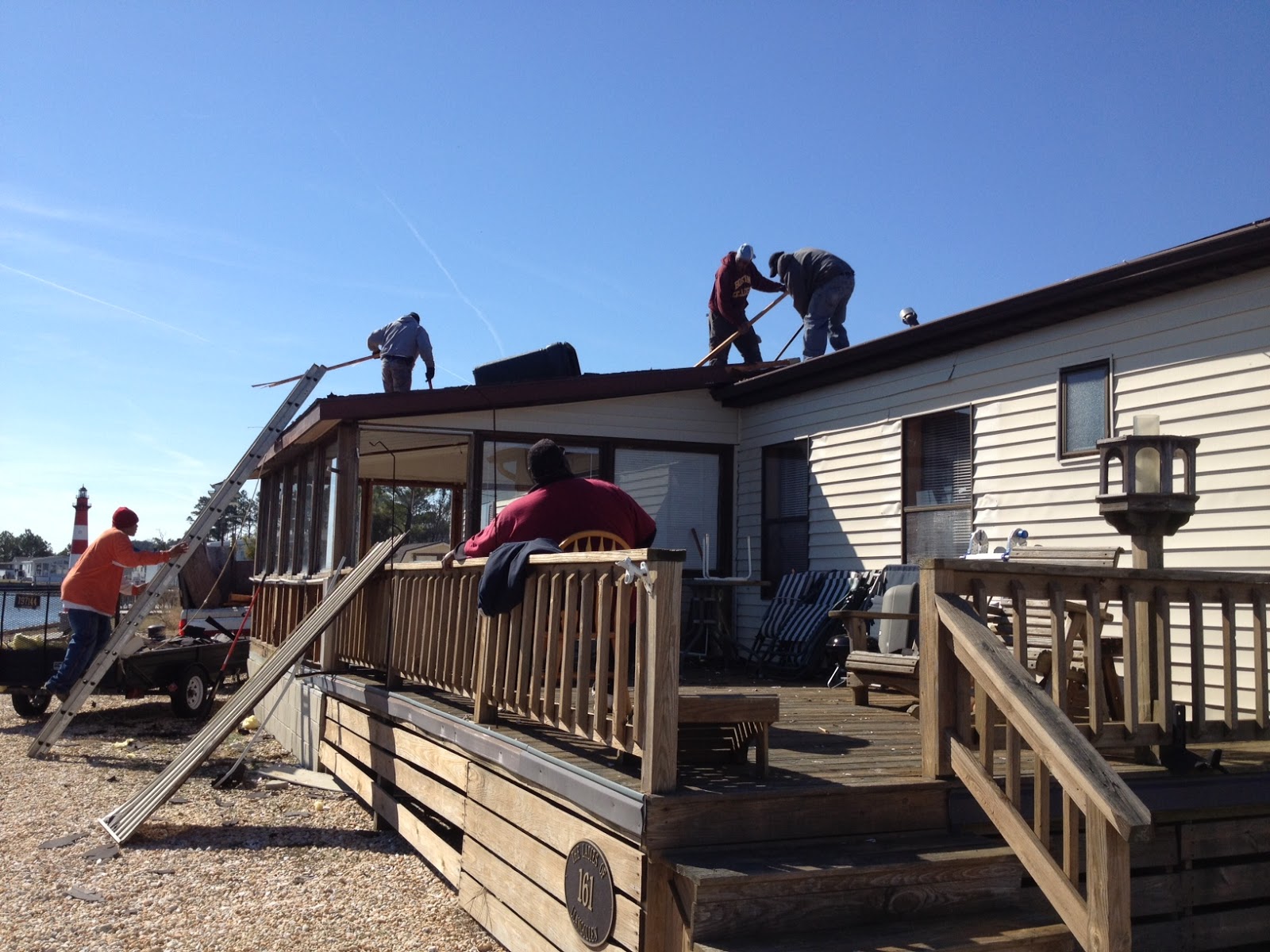
"The Crew" arrived today for the first phase. The crew chief is a Very Large man named "Mr. Big Bunny". Well, his Christian name is "William" but his Momma named him "Bunny" and that's what everyone calls him.

Well, his crew calls him "Big Bunny" - I suppose it's a bit more, um...'masculine'...as well as being more descriptive.

The man has to weigh in excess of 400 pounds if he weighs an ounce. I think his heart might be just as big. I can't believe he's charged me so little to do this work.

Nice man. Not a lot of schoolin', but clearly knows what he's doing. And, he knows how to run a crew.

That's them in the picture above. James is on the ladder. Marvin is near the trash bin on the roof along with Andre and Willie. I'll let you figure out which one is Big Bunny. Hint: He's not on the roof.  (Note: Thanks be to God).

Because my grandmother's motto was, "Hey, ya gotta eat," I just made them some pumpkin bread and a big pot of coffee and took it out to them for their break. They were so grateful it made my heart sing.  I love to cook and bake but, you know, cooking and baking for an appreciative audience has to be something close to heaven.

And, because we do not live by pumpkin bread alone, I told them that I was going back inside the house to pray for them. I asked Big Bunny if there were any special petitions he wanted me to make.

He said, ""I just pray every morning when I get outta bed that the work is done well, there ain't no property damage and my boys don't get hurt". I told him I would ask y'all to join me in that prayer. He said, "Much obliged, Rev."

I think we got us a little church right here at Llangollen.

My friend Ann commented on FaceBook that I was, "becoming an exile while living in one's own home - just right for Lent."

You know, she's right. And, she isn't.

This Thursday, March 1, I leave for Thailand. I'll be there for three weeks. Well, I'm leaving here on February 29th and traveling to a hotel about six miles outside of Dulles Airport so I can catch the plane at my leisure the next day.

I'm going to visit one of my dearest friends who turns 70 on the 20th of March. He was the Chair of the Commission on Ministry when I went through the ordination process.

He was, initially, opposed to the ordination of women. He became an enthusiastic supporter of my process and has become committed to the full inclusion of all the baptized in all the sacraments.

He is one of my dearest friends.

No matter where he's lived, we've always been together on a birthday of his that ends in a "0".

When he turned 40, we were in Maine. We celebrated his 50th when he was in Vermont. At 60, he was in Hawai'i. And now, in his 70th year, he's retired and living in Thailand.

So, what's to be done? I have to go, right? I mean, what are friends for?

So, Phase I of the work is that the sun room comes down today. In two weeks, our dear friend Bill comes to put the railing and the finishing touches on the new deck.

Phase II - the new roof - begins when I return at the end of March. That way, Ms. Conroy and our pups and I won't have to go through any of it alone.

Phase III is the instillation of the new windows and doors. That should be done by Palm Sunday.

Holy Week is the tentative schedule for Phase IV: the new siding, gutters, downspouts, etc. 

After Easter, we'll begin Phase V: The yard work.  New stones for the yard. Down comes the 'fish cleaning' station at the dock and up goes a outside shower by the back door to the laundry room. We'll put up some planter boxes by the north side of the house and, I'm hoping a trellis at the walkway as you come into the living room entrance.

Bill has already put up a solar powered, motion-detection light on the shed by the car port. He'll be installing a new yard lamp post, too.

All that will be after I come home from Thailand. While I'm there, I plan to spend my mornings and early afternoons visiting lots and lots of Buddhist temples and, as my friend Dasch likes to hear me say, "chanting anything that isn't nailed down".

My afternoons and early evenings will be spent poolside at my friend's apartment complex where he has rented me a place for the month. Not to worry. I'll be taking lots of pictures for FaceBook and blogging from there.

My nights are promised to my friend and his band of merry men who have plans for lots of frolic and fun, including visits to more 'girly-man' shows than is absolutely necessary.

The contrasts promise to hold the most interesting - if not flat-out exotic - Lent I think I've ever spent.

We do plan to take a few trips to Bangkok and trek to Cambodia and Viet Nam. You know, because as long as we're there, we might as well. I suspect we'll have lots of very interesting conversations about the economy and human trafficking and things most tourists to that area don't talk about.

There's lots of beauty in Thailand, but there's a whole lotta ugly, too.

It promises to be quite an adventure.

I'm going to take the puppies out for a walk soon. Mr. Theo, Mr. Lenny and The Divine Ms. CoCo have been in the master bedroom all morning. They are not pleased with all the noise. They have no vote in the matter, but lots of voice, which they have been exercising liberally all morning.

They will love it when the work is done and they have a big old deck to run around on and sun themselves to their heart's content. Mr. Theo is already the "harbor master" and checks out the boats as they go by. Ms. CoCo, of course, barks and sasses them while Mr. Lenny - who, poor dear, 'takes the short bus to school' - usually watches quietly when he's not flat-out bewildered.

A few of my neighbors are getting their boats ready to go back in the water. The deck should be all finished by the time they start rolling by. The pups will thank me, then. Or, not. Either way, it will be alright. Llangollen will really begin to look like "ours".

As I write this, the sun room/new deck project is just about half done.

They have removed the roof, the door and all the windows and will begin to take down the frame.

Then, the carpet comes up and they will sand the deck and clean everything up before they leave.

If you're on FaceBook, I'll have the finished pictures up by dinner time, I'm sure.  I can't wait to see Ms. Conory's face when she walks through the door tonight.

An exile in my own home, preceded by an exile in another country, and then home again, home again, jiggidy jig to finish up the rest of Lent.

Just in time for the Resurrection, without which I think, the Ashes don't mean much at all. It's the good news I'm after. The life after death. Eternal life. It's worth the price of the Wilderness.

I heard the preacher on Sunday say that the thing about the wilderness of Lent is that we don't choose it; the wilderness chooses you.

I'd say this particular wilderness will be a bit of both for me. 

It's okay. Either way, as an exile in the wilderness of my own home or of a far away country, I know I'm right where I need to be.

Home is not so much a place as it is a place in the heart.

As Robert Frost once said, "“Home is the place where, when you have to go there, they have to take you in.”

Friday, February 24, 2012

Divine Creativity

I have long been fascinated by the intersection of the creative process and the Divine.

Yes, I'm a "blogger" - whatever that means - but I blog what I write. Sometimes, that's about controversial subjects like reproductive rights, politics, and, of course, the Anglican Communion in general and The Episcopal Church in particular.

Other times, it's just my musings about a conversation or an incident, or something that has happened to me in my life on which I reflect and presume to share with whomever happens to be wandering and wondering around cyberspace and finds me.

I think there is a deep, inexplicable longing in each heart and soul that not only seeks to find the expression of the questions of the realities of our lives - the good, the bad, and the ugly - but also desires to communicate with other souls who may or may not have been asking similar questions or concerns.

Child Art - Age 4.5 years
Art has a language all its own, in different forms and dialects. Poetry, prose, sculpture, pottery, music, painting, photography, stained glass, textile, fashion, knitting, cooking, sewing, architecture, and landscaping are but some of the major forms of artistic expression with all sort and manner of components and subdivisions within each category.

It starts with an idea - sometimes with great clarity - which seeks to find shape and form.

Other times, it starts with a question and, once the artist has surrendered to the creative process, ends up somewhere completely different than where s/he originally began.

Vincent Van Gogh once said, "If you hear a voice within you say “you cannot paint,” then by all means paint, and that voice will be silenced."

Until, of course, the voice speaks again, daring to be silenced. Van Gogh was certainly tormented by that inner voice which he tried to silence his whole life, leaving us gasping at the inexplicable beauty of his art.

I'm still fascinated by this talk given by Elizabeth Gilbert (author of "Eat, Pray, Love") on Nurturing Creativity. Do check it out, when you have 18 minutes or so to spare.

She muses on the impossible things we expect from artists and geniuses, and shares the radical idea that, instead of the rare person "being" a genius, all of us "have" a genius.

What a fascinating idea, right?!? I guess it's the same idea which captured the imagination of my childhood notions of a "genie" in a bottle who has to be "rubbed" into reality, and we only have three wishes - any three wishes - that will be granted and come true.

In Christian circles, we talk about "being inspired by the Holy Spirit". Is this the church's version of a 'genie' - the 'third person' of a Holy Trinity bottled up inside of us? What do we have to 'rub' - or what 'rubs' us - that will release that Spirit we 'have' that sometimes produces 'genius' we often call 'creativity'?

Anais Nin once said, "If you do not breathe through writing, if you do not cry out in writing, or sing in writing, then don’t write, because our culture has no use for it."

I remember - long, long ago in a galaxy far, far away - listening to Martin Smith who was then head of the Society of St. John the Evangelist in Cambridge, who said something that has never left me.

In his marvelous, clipped British accent, he said, "Whenever you get to a place where you find yourself asking, 'Hmmm... what am I to make of this?', that place is a place of a call into creativity with the Creator. It is a vocational call to 'make' something of 'this'- whatever it is - with God."

Oscar Wilde once said, "No great artist ever sees things as they really are. If he did, he would cease to be an artist."

Kid Art
Children are much better at this than adults. Unless they have already been otherwise carefully taught, they don't have the cultural filters many adults have and are not incapacitated by a sense of failure or paralyzed by a sense of shame.

Many have not yet discovered the terrorism of 'perfection', so they splash paint on paper or canvas or scrawl letters on wrinkled paper or instinctively color outside the lines or draw figures or images that bear only vague resemblance to what we know in reality.

They somehow know that it's the emotion that is evoked from the art form that is far more important than someone else's sense of "right" or "wrong" or "perfection".

Pablo Picasso once said, "Some painters transform the sun into a yellow spot, others transform a yellow spot into the sun." I think the child in each of us intuitively knows how to do this.

Check out the program at St. Peter's here.
I'm very keen on a project that has been started by a friend of mine, Sharon Sheridan, at St. Peter's Episcopal Church in Morristown, NJ. It's called a "Children's Day of Art" which seeks to offer children from ages 6-13 with an opportunity to express their creativity.

There will be workshops led by regional artists in cartooning, drama, poetry, pottery, eco-sculpture and music. During lunch, they'll also have a chance to dabble in and enjoy some "edible art" with a local chef.

One of the things I love about this project is that, to raise some start up money for the event - to pay for supplies and food and to provide some of the local artists who will be offering the workshops - Sharon has engaged a wonderfully creative fundraising idea.

It's called "Kickstarter" - a website that will allow people to contribute online and provide funds that will, well, 'kickstart' the program. I think it's brilliant. If you have a moment, go over to the web page and check it out. And, if you are of a mind and are able, please make a contribution.

I think the communal, societal need for art and artistic expression is ageless and timeless, but in uncertain times like these where boundaries are obscured and life feels especially fragile, I think there is an even greater need for creativity and imagination.

Indeed, I really believe that the decline in churches is a direct fault of lack of religious imagination. We seem so wed - no, actually, addicted is a better word - to our organizational structures we seem not to know what else to do or how to do it.

Scribbled by a one-year old
So, we just keep our noses to the bureaucratic grindstone, trying to fit our ecclesiastic pegs, made smooth and round by years of polished tradition, into cultural holes that are now made square or rectangle or triangular by post-modern concepts and ideas and realities.

Over the past ten years or so, I have come to think of my priesthood as art. Despite my years of education and training and experience, I often venture forth into the world of human relationships and community with nothing more than a thought or idea and have absolutely no idea where I will land or what the final outcome will be.

Oh, I THINK I know where its going, but, more often than not, if I open my mind and my heart and my soul to be fully present with another, I'm the one who is changed and transformed. I'm the one who is led to a new understanding, a new perspective, a new idea I never thought myself capable of seeing or thinking all on my own.

Which is, of course, because I'm not. Alone.

One story by way of explanation from that galaxy far, far away.

When I was a Chaplain at Lowell University in MA, a young woman appeared at my office door one day. She had recently discovered that she had been adopted as an infant and, though she adored her parents, she was consumed with the idea that she had a birth mother she had never known.

She was not only intensely curious about this woman and the story of what had led her to give her daughter up for adoption, she felt that being disconnected from that story was part of the indescribable pain and longing she felt, despite her happy childhood and present life and wonderful, loving parents.

So, we set off on a year long journey together, to check into birth records and research her branch of the roots of her family tree. She did all the hard work, really. I served in the role of part guide, part cheerleader, part prayer partner, part reality check as she followed her quest for identity and meaning.

I'll never forget the day we discovered that her birth mother had died. We found the death certificate which lead us to her birth certificate which led us to her maternal grandparents.

Eventually, and after long, often difficult conversations, I went with her to visit them. They had not known about their granddaughter's existence. They knew their daughter had died, but they didn't even know where she had been buried. They thought they knew which cemetery - in point of fact, they knew the cemetery which was less than 10 miles from where they lived - but the painful circumstances of their daughter's life and death prevented them from knowing anything more.

After long discussions, we decided to go together - the four of us: parents, daughter and priest - to find the grave site and, perhaps, find some solace and peace for years of painful memories.

We searched and searched but could not find a grave marker with her name on it. I offered to go to the cemetery office to see if there were any unmarked or "pauper's" graves and, perhaps, find her there.

My hunch proved to be correct. There was a section of the cemetery that was no longer used for that purpose - the practice of cremation has changed all that - but which had once been set aside as a mass burial ground for those who could not afford a place of rest of rest for their own moral bodies.

There we stood - a pair of brokenhearted parents and their young, hopeful granddaughter - each carrying a small bouquet of flowers. The parents held daisies - the flower they remembered as their daughter's childhood favorite. Their granddaughter carried white roses because she remembered from her church that white roses were given to mothers on Mother's Day who had lost their mothers.

The Luck Pine - Rafael Messa, age 9
We stood in silence over this unmarked plot of graves - I with a vial of Holy Water in one hand and an unopened Prayer Book in the other, dressed in my cassock, surplice and stole - which contained the bodies of who-knows-how-many other mother's children, once born to great hope and expectation, given a special and unique name - now inscribed in an old cemetery register, tucked away on a dusty shelf -  who were buried deep in the hard, cold ground, anonymous and unknown to all but God.

The dead silence in that spot was suddenly broken open by my student who turned to me and asked, her voice chocking with emotion, "Please pray for her."

I have no memory of what I said. My words are as lost to me now as the woman's life was then to her parents and daughter. I remember blessing the grave with Holy Water. I remember praying for her soul and the love that was once lost but now, by some amazing grace, had been found buried beneath the cold, hard ground.

I remember tears and weeping and sobbing. I remember the four of us holding each other in a tight circle around the grave. I remember grandmother and daughter placing flowers on the grave.

I remember the grandparents saying, "We forgive you. We hope you can forgive us."

I remember the daughter saying, "I forgive you. I don't understand, but I forgive you. I thank you for giving me such wonderful, loving adoptive parents and leaving me with these wonderful, loving grandparents. Even though I never knew you, I hope you know how much I will always love you for the act of unselfish love which led to such happiness in my adoptive family. I hope you are at peace."

As we stood there for a few more silent moments, I remember thinking, "Ah, and this is the essence of being a priest: Standing at an unmarked grave, saying prayers for someone I never knew, helping people I don't really know to find peace and solace in the knowledge of the Communion of Saints and the unconditional, abundant, lavish, wasteful, amazingly beautiful love of God."

It is the work of an artist to make something of beauty, something that communicates that which words alone can not carry. Something that takes us beyond our present reality and points us to something bigger, something better, something greater than ourselves.

Something that the world might consider foolish and wasteful and lavish. A luxury that we discover to be an absolute necessity to the continued beat of the human heart and the soaring of the human spirit.

I did not know I could do that. I only showed up at my office faithfully each day which one day called me to make a journey in faith with a confused, brokenhearted young woman on a quest. I traveled with her to wherever her path led, even to strangers who became her relatives. It ended as we stood together at the door of death and, together, found new life waiting for us both.

I am a priest. This is what I do. It's an amazing vocation and I am deeply, richly blessed.

I don't think this is solely the work of a priest.

Tree of Life
I think it is the work of divine creativity which is buried deep within the soul of the enterprise of being human. Sometimes, it finds expression in what the nuns of my youth called "corporal works of mercy". Sometimes, it finds expression in other, less pragmatic, more artistic forms.

This work awaits being uncovered or discovered or recovered by risking and daring and dreaming that, together with the God of Creation, we might call order out of chaos and life out of death.

William Faulkner once said, "The aim of every artist is to arrest motion, which is life, by artificial means and hold it fixed so that a hundred years later, when a stranger looks at it, it moves again since it is life."

As I begin this season of Lent, I find these words calling me on, leading me to the resurrection I know awaits after forty days and forty nights in the wilderness.

Lent, I am discovering, is the ultimate, artistic journey into Divine Creativity. 

I pray that the Divine Creativity, by whatever name she is known - genie, muse, genius, the Holy Spirit, Shekinah - will find us where we are and help us to see that the ancient tombs of our lives are not empty.

They are filled with imagination.

And, love.

Wednesday, February 22, 2012

Ashes to stay

Ashes to Go.

All the cool kids are doing it.

At least, that's the way it feels. And, I think the truth of it is that this is the presenting issue of my discomforts with it.

However, it goes much, much deeper than that.

I mean, look, I get it. People live very busy, often frenetic lives. Places of employment do not allow people time to go to church on Ash Wednesday the way they once did - not without negotiating some time taken from the employee's "time bank" (vs. specified vacation and sick days, and designated holidays in the past).

Why not go to where people are, it is argued, and provide the church's service "on the go"?

And, I get the argument about how people have drifted away from the church ("I'm spiritual, not religious") because the church has not been willing to meet people where they are.

"Ashes to go," it is argued, brings the church to the world. And, isn't that what Jesus would have us do? It will make the church more relevant in people's lives. If we're willing to meet them at the train station and bus stops, hopefully people will "get" that we are willing to meet them wherever they are - no matter where they are on their spiritual journey.  See?

And, hey, what a great opportunity for  "evangelism", right? On this one day, anyway, The Episcopal Church is certainly getting our "market share" of the news and for once, it's not "controversial".

Look, Ma, The Episcopal Church is doing something "good" and it's not about ordaining women or LGBT people and it's not about (gasp!) abortion or reproductive rights.

I get it, I get it, I get it.

I'm not going to argue against those arguments. (Well, I don't really know if it's "evangelism" or "publicity", but I'm not even going to go there right now.)

None of this dispels my greater concerns.

Part of what concerns me is that I fear this is a short term solution with dubious efficacy to a long term problem. Imposing ashes on someone's forehead who is not at all interested in church seems to me to be the ecclesiastical equivalent of putting a band aid on a large, gaping wound.

By taking the imposition of ashes out of the church and its liturgical context and onto the streets, aren't we, in fact, doing something that's more "spiritual" than "religious"?  Is that bad? Is that good? I don't know. You tell me.

I'm asking a question.

I know, I know. Grace can't be contained or controlled. It's a gift from God, given freely and undeservedly.  We are but the vehicles of God's grace. Who knows how the imposition of ashes will affect or impact the recipient? 

I know this, but here's the thing: While Grace is a mystery, it's not magic. I think this concerns me most. Not that clergy aren't clear that they're not involved in a magic show at the train station; rather, I'm afraid that the "spiritual but not religious" folks don't know that.  How would they? Who's going to tell them? How are we going to tell them?

I'm asking a question.

Maybe it's the name. "Ashes to go". I don't know.  The title is clever and all but it makes it sound like we're offering "McChurch". Spiritual 'fast food' for important people with important jobs and important lives. But, are we offering 'good spiritual nutrition'?


I don't know. I'm not sure.
Which brings me to another concern. It's the power of a liturgical symbol - especially when it is taken out of its liturgical context.

We 'break bread' with friends - some of them spiritual friends - over a 'table' but does that make it Eucharist?  We can impose ashes on each other's foreheads, and even say the words from Genesis, "Remember that you are dust and to dust you shall return," but if that's said and done apart from "the story" of our faith, does it convey the same meaning?

I'm asking a question.

I guess that's what really concerns me - separating sacred symbol from sacred story. Further, it removes the clergy from an engagement with the sacred stories of people's lives. I think that impoverishes everyone involved.

Well, maybe not 'impoverish' - that may be too strong a word - but it's certainly not as enriching and fulfilling as understanding the story of our mortal lives within the greater story of the hope and resurrection we know in Christ Jesus.

Ashes and Lent, for me, anyway, mean nothing apart from the whole, on-going story of God's action in the world. It's just one part of the Salvation Story. Ashes are but one symbol of that story. Baptismal water is another. Bread and Wine are two significant other symbols.

Reminding people of their mortality through the symbol of ashes is not really spreading hope. The Gospel is all about hope. It's the "Good News". Where is the "Good News" in the symbol of ashes apart from the other symbols of our faith?

I'm asking a question.

I guess, for me, I would be very happy doing an abbreviated Ash Wednesday service and taking it to the lobby of an office building, or inside a commuter rail station building, or even on the platform of the train station or bus stop or a homeless shelter or the outside porch of a home near a bus stop or train station or wherever.

But, just the ashes? All by themselves? I just don't know.
Truth is, I can't articulate - yet - what concerns me about that, but I know it has something to do with the power of symbol and liturgy and story within the context of a community of faith.

It's all very pragmatic and convenient and I guess, from my own personal experience, that's what bothers me the most.

Religion - like faith - is neither pragmatic nor convenient.  It's messy and demanding and confusing and compelling.

Like, for example, love.

Jesus is God's love made incarnate. That's what we teach and preach. How does the imposition of ashes on the forehead of someone standing at the platform of a commuter rail station or bus stop fully communicate the love of God incarnate in Christ Jesus?

I'm asking a question.

All that being said, it's what all the cool kids are doing, and - at least on the surface - it doesn't seem to hurt anything or anyone.

So, why not, right? If all the cool kids are doing it, it must be, well, cool, right?

I guess I'm just going to have to let the 'cool kids' be cool and sit this one out again this year. I'm going this evening to the Ash Wednesday Service at the church where I'm a member.

I'm going to listen to the story of our faith and reflect on it within the context of the story of my own life. I'm going to be with some people who know me and I know them and some others I may never see again, after tonight.

I'm going to smell the mixture of the sacred oil and ashes and sing some of the old, old songs of the church and hear the prayers which call me to a Holy Lent.

I going to take full advantage of the luxury of one hour to get away from the usual and customary and comfortable places of my life and sit with my discomfort about the world and the church and my faith and pray that I may be a vehicle of grace - in the church and of the church and through the church and into the world.

I'm not getting my ashes to go.

I'm getting my ashes to stay.

Monday, February 20, 2012

Smelling out death

Can you believe it? Ash Wednesday is this very week. Only two days away.

I'll spare you the Winter riff on the seasonal lament, "Where does the time go?"

As I have been preparing myself for the beginning of Lent, wandering through what the church has to say about the Doctrines of Human Nature and Sin and Death and Resurrection, I came across this quote from Rowan Williams in Christian Century:
"Rowan Williams, archbishop of Canterbury, says doctrine is needed in order to help Christians know how God acts in creation and in transformation. We must have doctrine in order to know what it is that we are to be attuned to. "But if doctrine doesn't make possible poetry and contemplation, then doctrine is a waste of time," he says. This "is where the poetic and contemplative touch the prophetic, because the prophetic is all about the diagnosis of dead words and false acts. The prophetic task is to smell out death in a situation. (Williams, A Silent Action)
Oh, Rowan, Rowan, Rowan!

There you go again. Setting up false dichotomies. This time, between the poetic and the prophetic and twisting it 'round in order to defend the need for church doctrine.

Okay, so this quote is taken out of context and I admit to not having read A Silent Action: Engagements with Thomas Merton.

Maybe he didn't mean exactly what he wrote here.  To be fair, perhaps in context he meant something else entirely.

You know, like the way Rowan once wrote about homosexuality when he was Bishop in Wales and then did something else entirely when he was Archbishop of Canterbury.

Don't even get me started about the treatment of women in the episcopacy in the Church of England.

And, you don't want to go anywhere near the Anglican Covenant.

Quite frankly, I am weary of 'engagements' with Rowan. More often than not, he makes my head hurt when he's not causing my heart to ache, so I'm not going to even go there with him in terms of whether or not "We must have doctrine in order to know what it is that we are to be attuned to," because I think, mostly, doctrine is a waste of time precisely because it doesn't "make possible poetry and contemplation".

Well, doctrine often gives rise to serious theological contemplation, perhaps, but poetry? Well, perhaps John Donne and Gerard Manly Hopkins, but honestly, when was the last time doctrine gave rise to poetry? Not anything I've read that was written in the last 200 years, at least. Not directly.

Because of the flaws genetically inherent in all doctrine, it naturally gives rise to the prophetic.

In many ways, doctrine is dead on arrival, having been thoroughly masticated and regurgitated by hundreds of men for hundreds of centuries before it gets written down and some other, dried up old man dressed in heavy brocade and silk and lace dribbles some wax and impresses his seal of approval on it.

But, I said I didn't want to engage Rowan.

I do want to engage this idea about the poetic and the prophetic, and what Rowan says, "The prophetic task is to smell out death in a situation".

The problem, for me, is that so much of church doctrine is not only dead, it can easily be used as an instrument of death - or, at least a cudgel to beat the life out of the life-blood of the church.

The very idea that we need doctrine "in order to help Christians know how God acts in creation and in transformation" is not only false, in my estimation, it is killing us not-so-softly but silently with words.

But, I said I didn't want to engage Rowan.

In preparation for Ash Wednesday's herald of the Season of Lent, I've come across some poetry which makes the case that we need both the poetry of the prophetic and the sometimes prophetic nature of poetry to help people of faith know how God acts in creation and transformation.

Take this one, for example, by Sarah Rossiter. It's called "Stripped" which is about Death and Resurrection and one of the best images I know for Lent.
This is the season, trees stripped
clean and what was hidden now
is seen, the path that leads into
the woods, the littered leaves,
the crooked walls that once marked
fields where grass grew tall,
remnants of a time long past,
reminding me that nothing lasts.

Will death be like this, do you think,
the day the breath does not return,
will our true nature be revealed when
stripped of memory, heart, bone,
sight, will we, too, open to the sky,
and, like the forest, fill with light?
See what I mean? If this poem doesn't 'smell out the death' in the church's doctrine of Sin and Human Nature, I don't know what else does.

To my mind, no one dances on the line between the prophetic and the poetic like Mary Oliver. No, not dances. She often performs an elegant ballet, with breathtaking pirouettes and daring arabesques across deep theological thoughts and images from Creation.

I think her poem Wild Geese challenges the death in the doctrines of Human Nature and Sin to resurrect itself and take her on, leading us to a new idea of Lent.
You do not have to be good.
You do not have to walk on your knees
for a hundred miles through the desert repenting.
You only have to let the soft animal of your body
love what it loves.
Tell me about despair, yours, and I will tell you mine.
Meanwhile the world goes on.
Meanwhile the sun and the clear pebbles of the rain
are moving across the landscapes,
over the prairies and the deep trees,
the mountains and the rivers.
Meanwhile the wild geese, high in the clean blue air,
are heading home again.
Whoever you are, no matter how lonely,
the world offers itself to your imagination,
calls to you like the wild geese, harsh and exciting
over and over announcing your place
in the family of things.
I know. I know. No mention of God. Not even a whisper of Jesus. And yet, those who have ears can hear the Divine calling clearly over the words on the page to radical acts of faith and love.

A long, long time ago, in a galaxy far, far away, I took a few amazing courses in seminary with Womanist Ethicist Katie Geneva Canon.

She said lots of things in those course that I carry with me to this very day. One of them is this:  That the prophetic task of the pastor and the preacher was three-fold:
Name the pain.
Touch where it hurts.
Offer hope.
That, I think, is the challenge of 'smelling out the death' in doctrines which gives rise to the poetic and the prophetic.

I confess that it is the prophetic poetry of Judy Chicago's work "And Then" which offers hope as I sift through the ashes of my life in my Lenten Discipline:
And then all that has divided us will merge
And then compassion will be wedded to power
And then softness will come to a world that is harsh and unkind
And then both men and women will be gentle
And then both women and men will be strong
And then no person will be subject to another's will
And then all will be rich and free and varied
And then the greed of some will give way to the needs of many
And then all will share equally in the Earth's abundance
And then all will care for the sick and the weak and the old
And then all will nourish the young
And then will cherish life's creatures
And then all will live in harmony with one another and the Earth
And then everywhere will be called Eden once again.
Oh, that I might hear this sort of prophetic poetry from the pulpits in some churches! Oh, that I might even have the courage to move past dry, dusty, ashen doctrine to proclaim an image of the Realm of God which does not smell of death but is alive with the intoxicating aromas of the presence of a Living God in the midst of the death and decay of life.

No, I'll not be taking any of the church's doctrine into Lent with me this year. I will not be contemplating the dead words of dead men to lead me through the ashes of my human nature and into the fullness of a life of Christ who lives in my soul.

Instead, I'll be packing some bits and scraps of prophetic poetry from some of the women in my life as nourishment and inspiration along the way.

I may even try my hand at writing some of my own poetry. I confess, I really suck at poetry. I'm too embarrassed to reprint any of it here.

It is poetry, however, that, more often than not, leads me to the path toward my own salvation. I don't know how else to better express the power and magnificence of my experience of God. Even then, it falls woefully short. But, it is alive, filled with passionate questions and certain doubts which I think are at the center of an experience of the Living God.

It is not doctrine, put prophetic poetry which helps me "to know how God acts in creation and transformation". I must have prophetic poetry "in order to know what it is that we are to be attuned to".

But, I said I wasn't going to engage Rowan.

Instead, I'll leave you with one of my favorite of my many favorites of Mary Oliver's poetry.

May it guide your steps through Lent as it has mine.

It's called, simply, "The Journey"
One day you finally knew
what you had to do, and began,
though the voices around you
kept shouting
their bad advice--
though the whole house
began to tremble
and you felt the old tug
at your ankles.
"Mend my life!"
each voice cried.
But you didn't stop.
You knew what you had to do,
though the wind pried
with its stiff fingers
at the very foundations,
though their melancholy
was terrible.
It was already late
enough, and a wild night,
and the road full of fallen
branches and stones.
But little by little,
as you left their voices behind,
the stars began to burn
through the sheets of clouds,
and there was a new voice
which you slowly
recognized as your own,
that kept you company
as you strode deeper and deeper
into the world,
determined to do
the only thing you could do--
determined to save
the only life you could save.
Well, Rowan got this much right: "If doctrine doesn't make possible poetry and contemplation, then doctrine is a waste of time."

In two short days, we shall hear it said, over and over again, "Remember that thou art dust, and to dust thou shalt return (Genesis 3:19)."

Now, there's a doctrine that is both poetic and prophetic. 

Smelling out the death in a situation is not only poetic and prophetic.

I believe it is the on-going work of being Christian.

Lent prepares us to begin that work, and so, makes us better, more alive Christians for the task of ushering in the Realm of God for Christ's sake.

Not to enshrine our beliefs in doctrine, but to be better able to live our faith with honesty and integrity and the kind of transparency that leads to transformation.

Because, as Mary Oliver says, the world will continue to spin and God's grace and salvation will continue to be available, "whether or not you have ever dared to be happy / whether or not you have ever dared to pray".

Wednesday, February 08, 2012

Unplugged

I'm here in a wee cabin by the lake at Kanuga Conference Center in the Western part of North Carolina where I am privileged to be a GOE (General Ordination Exam) reader.

The schedule is brutal but the conversation and companionship are wonderful and the work is intellectually stimulating and spiritually satisfying.

There are no televisions to be had. My smart phone, I've discovered, isn't so smart without a cell tower to link the AT&T signals to my phone. I can't call, text, IM, check my Facebook or email or other blogs or send the pictures I've taken.

The Wifi in the main lodge works fine but the connection here in my cottage is iffy at best. I've lost the signal on my laptop twice just typing this.

I am, for the most part, unplugged.

And, ya know what? It really ain't half bad. I mean, I'm not even annoyed. It's okay. Really.

There was life before technology.

There is life without technology.

I'm not even really sure I can claim that life is better with technology.

Oh, we're saving tons of forests (and money) by having everything available online and, when I'm near the main lodge, I can access it easily. And that is good.

However, I'm not sure that being plugged into the world for the greater part of my waking hours is as important as I once thought it was. I'm not entirely sure it is good for either my soul or my psyche.

Oh, I'd like the convenience of making a few phone calls, but mostly, I can live without the constant chatter of conversations through social media that I've grown so accustomed to being the "background noise" of my life.

On Monday night, we heard an absolutely stellar presentation from the Rev'd Dr. Patrick Malloy who is a GOE chaplain and a professor of liturgics at the General Seminary in Manhattan.

He talked about the Triduum - the three Holy Days of Maundy Thursday, Good Friday, The Great Vigil of Easter - which prepare us for Easter Day.

Beyond being three separate liturgies which are parts of a unified whole, they are celebrations of our history as well as the reality of the present. In other words, because of those historical events, we can celebrate the mystery of our faith:
Christ has died. Christ is risen. Christ will come again.
I always knew that, of course, but hearing it in a fresh, new way has sparked something in me that deeply resonates with my present circumstance of being 'unplugged'.

I think I spend so much time being connected to the present that I sometimes miss the miracle of the moment that is right in front of me.

It's ironic and paradoxical and it's true.

I think I'm realizing that being plugged in has become a false god of sorts - a jealous, demanding god who requires more attention than it probably deserves.

No, I'm not going to dump my smart phone and lap top in the lake. Neither am I going to stop using technology to assist me in my work.

I think what I'm trying to say is that, after I leave here, I'm going to try to be smarter about using technology, so that I don't allow it to use me.

I'm not going to be so much "unplugged" as I will try to be connected to things in a new and different way.

It's a pretty liberating thought, actually.

I'm going to take a walk now, before dinner, and listen to the Canada geese and ducks out by the pond. I'm going to plug into the sounds of Mother Nature and try to turn down the noise in my head just from reading the batch of almost 100 emails that were waiting for me to read when I finally plugged back into technology.

Who knows what new thing I'll see or hear or think while I'm unplugged from one information source and plugged into another?

Tuesday, June 07, 2011

Conversation with a Terrapin

The jetty at North Shores, Cape Henlopen State Park, DE
There are lots of things I love about living at Llangollen, our wee cottage on the marshes of Rehoboth Bay.

I love watching the sun rise from my deck, and the way it begins to sparkle and shimmer and shine on the water. I love the way the gulls soar in front of it, shouting their Hosannas to the Lord of Life.

I love the way the fish jump up out of the water as if to pay their homage from The Deeps.

I love the 'unexpected guests' who swim by and sometimes come close for a visit.

For many years, we have had a family of ducks who nest in our yard. Not so this year. I'm not certain why, exactly. I've seen them swim by but no one has availed themselves of our hospitality.

However, this year holds a special delight. There is a wonderful gaggle of Canada geese who have taken to swimming by our deck several times a day.

They are not very interested in me but they are intensely interested in each other. One of them will stretch his neck, tilt his head back and honk. Loudly. I suspect it's part of some kind of mating ritual because, eventually, the 'honker' will disappear into a small cove in the marsh grass with one of the..... um... 'honkees'.

The rest of the gaggle sort of hangs out for a while while the other two have obvious 'gotten a room' for a wee bit of privacy.

It's obviously all business and no foreplay for these two - or, perhaps, the honking was the foreplay - and they soon emerge from the marsh cove and join the rest of the gaggle.

Not even time for some mood music and a cigarette and a drink.

Sigh. Whatever happened to romance?

This morning, there was a special treat - a diamondback turtle swam by my deck.

At first, I wasn't sure what it was, exactly. From a distance, I thought it might be a snake because all I could see was his head. As he came closer, I realized that it couldn't be a snake, so I went off my deck to get a closer look.

What was fascinating is that, as I came closer to the water, so did the turtle. He was a curious about me as I was about him.

We stared at each other for a while as he tread water. I could see the distinctive diamond patter of his shell through the water and make out some of the markings, which is why I decided that he must be a diamondback terrapin. 

Through the water, his shell looked to be brown and gold and orange in color. It was simply beautiful, especially when the sun's rays played with the colors and sent them shimmering in excitement.

His eyes were intensely curious. I suspect mine were, as well. I decided he must be waiting for some crusts of bread, so I went into the house to get some. Finding none (I've been dieting), I reached into a box of Cheerios and grabbed a handful, putting them into a plastic baggie.

By the time I returned to the water, he was gone, but I looked down the waterway and saw that he had joined another turtle who was sunbathing on a stump of a tree that had lodged itself on the bank of the marsh during one of the winter storms.

They were soon joined by another turtle and then another and yet another, forming a curious little 'terrapin cue', all jumbled up, one against the other.

I decided to walk down into my neighbor's yard and closer to the tree stump to get a closer look. They were maybe eight or ten feet from where I stood, seemingly nonplussed by my appearance.

I reached into the little baggie of Cheerios and tossed a few into the water. That aroused a bit of curiosity on the part of one of the terrapins, who decided to jump into the water to check it out.

That caused the entire 'terrapin cue' to disrupt its balance, and they all tumbled into the water. After a few moments of confusion, they decided to follow the leader and swim toward me to see what glad tidings I might have brought.

I began to throw a few Cheerios onto the water, delighting as they swam toward them to scoop the small morsel treats into their mouths.

Well, all except one. I couldn't be certain, of course, but I thought sure it was the first turtle I met this morning. He just kept staring at me - through me, really - treading water as our eyes locked.

It's so easy to project one's one stuff onto animals. Sometimes, their eyes become a reflection of what's going on in one's own soul. Sometimes, they are just looking at you with the same curiosity you are looking at them.

We stared at each other, my terrapin friend and I, as I mindlessly dipped my hand into the plastic baggie, pulling up a few morsels, and scattering them on the water while the three other turtles swam to scoop them up.

I remembered an old Native American story about the turtle, and decided to tell it to him. Later, when I returned to the house, I was delighted to know that I had been pretty faithful to the story from the Iroquois Nation which I found online.

Here's the Iroquois story of the Turtle Woman
Iroquois Turtle Woman
In the beginning there was no earth to live on, but up above, in the Great Blue, there was a woman who dreamed dreams.

One night she dreamed about a tree covered with white blossoms, a tree that brightened up the sky when its flowers opened but that brought terrible darkness when they closed again. The dream frightened her, so she went and told it to the wise old men who lived with her, in their village in the sky.

"Pull up this tree," she begged them, but they did not understand. All they did was to dig around its roots, to make space for more light. But the tree just fell through the hole they had made and disappeared. After that there was no light at all, only darkness.

The old men grew frightened of the woman and her dreams. It was her fault that the light had gone away forever. So they dragged her toward the hole and pushed her through as well. Down, down she fell, down toward the great emptiness. There was nothing below her but a heaving waste of water and she would surely have been smashed to pieces, this strange dreaming woman from the Great Blue, had not a fish hawk come to her aid. His feathers made a pillow for her and she drifted gently above the waves.

But the fish hawk could not keep her up all on his own. He needed help. So he called out to the creatures of the deep. "We must find some firm ground for this poor woman to rest on," he said anxiously. But there was no ground, only the swirling, endless waters.

A helldiver went down, down, down to the very bottom of the sea and brought back a little bit of mud in his beak. He found a turtle, smeared the mud onto its back, and dived down again for more.

Then the ducks joined in. They loved getting muddy and they too brought beakfuls of the ocean floor and spread it over the turtle's shell. The beavers helped-- they were great builders-- and they worked away, making the shell bigger and bigger.

Everybody was very busy now and everybody was excited. This world they were making seemed to be growing enormous! The birds and the animals rushed about building countries, the continents, until, in the end, they had made the whole round earth, while all the time they sky woman was safely sitting on the turtle's back.

And the turtle holds the Earth up to this very day.
After I told the story of the Turtle, he dipped his head into the water for a few seconds and then came up and looked at me again.

I tossed a few more Cheerios into the water and this time, the others hung back as he scooped up the three or four circular morsels into his mouth.

I sprinkled the remaining treats from my bag, and all of the turtles ate heartily until there was no more.

I don't know why, but I found myself doing a bit of a bow to my terrapin friends before saying goodbye.

As I started to walk away, each of the four turtles dipped their head into the water and then swam back to their tree stump and onto the serious business of bathing in the glorious morning sun.

I realize that, in many ways, I a woman who has fallen through the sky and landed in this place, this amazing place I have named Llangollen.

I realize that I am home. This is where I will build my home, on the back of years of the dirt and grit of dwelling in the city, among concrete buildings and pavement and steel and noise.

Oh, I miss the city - the ability to walk anywhere and, within 10 minutes, find a great cup of coffee or a delicious meal, chosen from the cuisine of many nations. I can catch public transportation and, within thirty minutes time, be by the water, or at a great museum, or in an open park or at the symphony.

I'm more dependent on my own car these days, to take me where I want or need to be, but in exchange, Nature has given me a great gift.

In the quiet of my home, I began to hear phrases from Psalm 115:
1 Not to us, LORD, not to us
but to your name be the glory,
because of your love and faithfulness.

2 Why do the nations say,
“Where is their God?”
3 Our God is in heaven;
s/he does whatever pleases her.
4 But their idols are silver and gold,
made by human hands.
5 They have mouths, but cannot speak,
eyes, but cannot see.
6 They have ears, but cannot hear,
noses, but cannot smell.
7 They have hands, but cannot feel,
feet, but cannot walk,
nor can they utter a sound with their throats.
8 Those who make them will be like them,
and so will all who trust in them.

9 All you Israelites, trust in the LORD—
s/he is their help and shield.
10 House of Aaron, trust in the LORD—
s/he is their help and shield.
11 You who fear her, trust in the LORD—
s/he is their help and shield.

12 The LORD remembers us and will bless us:
S/he will bless her people Israel,
S/he will bless the house of Aaron,
13 S/he will bless those who fear the LORD—
small and great alike.

14 May the LORD cause you to flourish,
both you and your children.
15 May you be blessed by the LORD,
the Maker of heaven and earth.

16 The highest heavens belong to the LORD,
but the earth s/he has given to humankind.
17 It is not the dead who praise the LORD,
those who go down to the place of silence;
18 it is we who extol the LORD,
both now and forevermore.

Praise the LORD.
I'm home. This is my home. Among the creatures of the earth and sea. Amidst the beauty of nature. It is here that I will build my home, until I am called back to my once and future and eternal home in the heavens.

I think I've always known that, but it took a conversation with a terrapin to make it right in my heart.