Soon and very soon, it will be Fathers' Day.
This year, on June 19, 2011, I have a proposal for the Church.
I think we should use the day to begin a movement to give up 'Father' as an honorific title for male clergy.
And, I think it needs to be a movement led by men.
Well, let me refine that. I know that the Roman Catholic Church calls Her clergy 'Father' - and, of course, all Her clergy are male. I'm not worried about them because, frankly, they are not my central concern. Neither is The Episcopal Church theirs.
And, I know that the practice is not uniform in The Episcopal Church. However, I have noticed that more and more of my younger male colleagues are Very Comfortable with being called 'Father'. More and more younger female clergy are countering that inequality by insisting on being called 'Mother'.
While I understand and applaud my colleague's insistence on gender equality - indeed, as anyone who knows my email address quickly recognizes, I have insisted on it, as well - I'm not liking this movement. At. All. Indeed, I fear I have become unintentionally complicit in it.
I have come to believe that The Episcopal Church has reached a stage of spiritual growth and development where we can finally give up calling our male clergy 'Father' - and, as that happens, our female clergy 'Mother'.
I must admit that, ever after 25 years of ordained service in the church, it still makes my skin creepy-crawly whenever I'm in a room with male clergy, all about the same age, who are dressed in clerical collars and wearing long, white dressed, who call each other 'Father'.
As Annie Lamott says, it's enough to make Jesus drink gin straight out of the cat dish.
I understand. The roots go deep and wind themselves around the hearts and minds of many devout Christians who are Episcopalian.
Women have been ordained priests in The Episcopal Church since 1974. The Episcopal Church changed its canons in 1976 to 'allow' that the 'irregular' ordinations of eleven women at the Church of the Advocate in Philadelphia, and the four women ordained in Washington, DC, were, in fact, 'regular' and began 'allowing' the ordination of women in 1977.
That's thirty-seven (37!!!) years, people. Even if you are scrupulous (as some are), and begin the count from when the ordination of women was "actually legal", that's thirty-five (35!!!!) years.
I think we're old enough, now, to move away from needing "Daddy" and "Mommy". Don't you?
Why do I think it's a bad idea to refer to clergy as 'Father' and 'Mother'?
Well, let's start with Jesus, shall we? He said, "And do not call anyone on earth 'father,' for you have one Father, and (he) is in heaven." (Mt 23:9)
Of course, Jesus was not saying that one could not apply that term to one's own father. Rather, Jesus was referring to the practice, in his day, of Rabbis claiming that title to denote authority, eminence, superiority, a right to command, and a claim to particular respect.
Jesus is saying that this title belongs only to God in whose eyes we are all one, all equal. Christ is teaching that the source of all life and truth is God, and we ought not to seek or receive a title which properly belongs to God.
So, there's that - but, there's more.
I have come to believe, after 25 years of ordained ministry, that the whole paradigm of "church family" sets up a dynamic that is fraught with problems - indeed, many 'dangers, troubles, toils and snares'.
Yes, I understand that St. Paul said that we are "sisters and brothers in Christ" - but I don't think he was thinking of Cain and Able or the rape of Tamar when he wrote those words. Yes, he was calling us to a "new relationship in Christ" but, unfortunately, it doesn't often work out that way. Not in my experience of the post-modern church community, anyway.
Indeed, I think the whole "church family" paradigm allows for so much of the dysfunction and, in fact, spiritual violence we see in our church today. So many people are working out their own unresolved issues of their 'family of origin' that it makes my head spin.
The whole "Father/Mother" title only compounds that dysfunction and, I suspect, invites some of the spiritual violence many clergy are feeling "when sheep attack" - or, when the shepherd attacks the sheep.
I can hear some of my colleagues countering with the need for honorific titles as a way to communicate authority. I understand. There is an even longer tradition in the church of referring to clergy as "Mr." More recently, that has become "Mrs." Or, "Ms.".
We have no problem calling the President of the United States, "Mr. Obama". If a sense of formality is needed or desired, why shouldn't clergy be satisfied with "Mr. Smith" or "Ms. Doe"?
I rather like the idea of, "the Rev'd Mr. . . ." or "the Rev'd Ms......" and then, in formal settings, to be called "Mr." or "Ms.".
What do we do with other honorific titles, like "Canon" or "Dean" or "Chaplain" or someone with a doctoral degree?
One of my former seminarians, when he's being a wisenheimer, will call and say, "Hello Reverend Doctor Canon Deputy Chaplain Kaeton." If he were my son, I would smack him on the arm. But, he's not. He's my colleague. And, I adore him. Enough to get the humor and laugh.
Actually, I think it all really depends on the person and the situation. I'm no Emily Post, but I think, in formal situations, it's fine to say, "I'd like to introduce the Rev'd Dr. Elizabeth Kaeton," which gives me the opportunity, depending on the situation, to say, "Please call me Dr. Kaeton" or, even more preferably, "Please call me Elizabeth."
When people with children insist that their children refer to me with an honorific title, I usually ask what they call their male clergy and take the female version of that. More often than not, this means that "Father" becomes "Mother." I don't like it, but I think that's a less confusing translation for kids.
'Mother' is such a loaded title - especially for people from Roman Catholic backgrounds. Anyone who has read Freud, however, can tell you that the subconscious or unconscious mind is very powerful and images of 'Mother' can have positive and negative effects - not all of them desirable or particularly helpful.
In my last congregation, we settled on "Rev. Elizabeth". It's not exactly grammatically correct, but it lends a certain formality without being too stuffy.
I grow so weary of being introduced to someone while wearing my collar and, after noting the bemused or befuddled look on the face of the person I've just met, being asked, "Ummm..... What do they call you?"
I generally smile and say, "Elizabeth. It's what God calls me."
These days, my smile is growing thin. Especially after the person to whom I've just been introduced talks about the previous rector, "Father Smith."
Which is why I think this whole movement ought to be led by male clergy. I am convinced that it's really the only way things are going to be changed.
Indeed, I think male bishops ought to take more of a lead. Many now introduce themselves as "John," or, "Steve," and seem not to mind when people call them that, but they do not stop them when some people call them "Bishop".
I think that has its appropriate place and time, but if more bishops talked about 'servant leadership' - and, in fact, practiced it themselves - we'd not only see greater acceptance of women clergy, but the building up and respect for the priesthood of all believers.
Which is really the point.
So, I'm challenging my male colleagues to work this theme into their sermons on Sunday, June 17th. Or, write about it for the weekly parish email newsletter. Or, talk about it at the announcements or at the Adult Forum after church.
When men begin to be be more egalitarian, setting aside the honorific title that is so problematic, so antithetical to what Jesus taught, the greater the chances are of successfully changing the paternalistic culture from a "church family" to a "faith community".
Language is very powerful. So are titles. It's time to change them and rethink the way we are church. I have a strong suspicion that as we move from a "church family" to a "faith community," we may just stop squabbling like so many infantile children and find ourselves praying together a whole lot more as adults.
I hope I can rely on my colleagues - male and female - to help in this movement. But, it's going to take male colleagues to give up a bit of their power and authority before others can have a more equal share.
When the ones who have the most to gain from the system begin to give up or share what they have, we'll be better able to see more of the "Beloved Community" of Jesus.
"There is neither Jew nor Greek, slave nor free, male nor female, for you are all one in Christ Jesus". Galatians 3:28
"Finally, I suspect that it is by entering that deep place inside us where our secrets are kept that we come perhaps closer than we do anywhere else to the One who, whether we realize it or not, is of all our secrets the most telling and the most precious we have to tell." Frederick Buechner
Come in! Come in!
"If you are a dreamer, come in. If you are a dreamer, a wisher, a liar, a Hope-er, a Pray-er, a Magic Bean buyer; if you're a pretender, come sit by my fire. For we have some flax-golden tales to spin. Come in! Come in!" -- Shel Silverstein
Friday, June 10, 2011
Thursday, June 09, 2011
Mendacity, Hypocrisy and Death
Apparently, "Our Rowan" has gotten himself in a bit of a mess. Again.
And, once again, it is of his own making.
The Archbishop of Canterbury has launched a full-frontal attack on the government's polities. His two-page critique, titled “The government needs to know how afraid people are”, published in "The New Statesman," is "the most forthright political criticism by such a senior cleric since Robert Runcie enraged Margaret Thatcher with a series of attacks in the 1980s".
You can read the entire article here.
The report from across the pond is that "Lambeth Palace is braced for an angry response but Dr Williams, who became Archbishop of Canterbury nine years ago, is understood to believe that the moment is right for him to enter the political debate."
Already, one blogger is reporting,
I heard myself say, "Well done, sir. Good form!"
Well, that was until I read this quote from His Grace that caused me to raise my left eyebrow before bursting into ironic laughter:
Covenant Contract, right?
No. No, the man is criticizing the government for doing precisely what he has donein to the Anglican Communion.
I feel compelled to point out the obvious: The Archbishop of Canterbury was appointed - not elected by the people - yet, he has imposed himself in the affairs of churches over which he has no jurisdiction or authority.
You simply can not make up this stuff.
Didn't Jesus say something about beams and motes? Why, yes.... yes, in fact he did: "Thou hypocrite, first cast out the beam out of thine own eye; and then shalt thou see clearly to cast out the mote out of thy brother's eye. " KJV, Matt 7:5)
Is there no end to the amount of hypocrisy we will have to endure from the current administration at Lambeth Palace?
I fear not.
Perhaps the belief that "the time is right for him to enter the political debate" is part of a strategy to divert attention from the mess he's made of the Anglican Communion.
It won't work.
Indeed, I think the authority of the Archbishop of Canterbury is so weakened by his silence about the continued oppression of Queer people in Africa (and don't even get me started about the 13 bishops in the Church of England who are reported gay), his obvious sexism and misogyny as publicly manifested in his treatment of the Presiding Bishop of The Episcopal Church when he refused to allow her to wear her miter during her visit to Southwark Cathedral, combined with his obvious disdain for allowing women to be be "appointed" bishops in the Church of England, and the fact that he is ramming what he calls an "Anglican Covenant" down the throats of everyone in the Communion - "for which no one voted" - that, instead of becoming a prophetic voice, he'll be seen as the Voice of Mendacity.
Tennessee Williams, in his play, "Cat on a Hot Tin Roof" has "Big Daddy", one of his characters say,
It's the smell of mendacity, hypocrisy . . . . . . and, I fear, death.
And, once again, it is of his own making.
The Archbishop of Canterbury has launched a full-frontal attack on the government's polities. His two-page critique, titled “The government needs to know how afraid people are”, published in "The New Statesman," is "the most forthright political criticism by such a senior cleric since Robert Runcie enraged Margaret Thatcher with a series of attacks in the 1980s".
You can read the entire article here.
The report from across the pond is that "Lambeth Palace is braced for an angry response but Dr Williams, who became Archbishop of Canterbury nine years ago, is understood to believe that the moment is right for him to enter the political debate."
Already, one blogger is reporting,
"The left are looking to make more of his comments in the New Statesman than are actually there, and the right is attacking him for things he hasn't said.I must say that I am not all all well versed in the politics of the United Kingdom but I will say that, at first blush, I was pleased to see a prominent church leader speaking out about the injustices of the affairs of State.
In the entire article, Rowan does not actually criticise a single government policy. What he does say is that people are afraid of them, and the government needs to explain what is going on better."
I heard myself say, "Well done, sir. Good form!"
![]() |
| Cartoon by MadPriestt |
“With remarkable speed, we are being committed to radical, long-term policies for which no one voted,” the Archbishop says. “At the very least, there is an understandable anxiety about what democracy means in such a context.”Surely, the man is talking about the Anglican
No. No, the man is criticizing the government for doing precisely what he has done
I feel compelled to point out the obvious: The Archbishop of Canterbury was appointed - not elected by the people - yet, he has imposed himself in the affairs of churches over which he has no jurisdiction or authority.
You simply can not make up this stuff.
Didn't Jesus say something about beams and motes? Why, yes.... yes, in fact he did: "Thou hypocrite, first cast out the beam out of thine own eye; and then shalt thou see clearly to cast out the mote out of thy brother's eye. " KJV, Matt 7:5)
Is there no end to the amount of hypocrisy we will have to endure from the current administration at Lambeth Palace?
I fear not.
Perhaps the belief that "the time is right for him to enter the political debate" is part of a strategy to divert attention from the mess he's made of the Anglican Communion.
It won't work.
![]() |
| Presiding Bishop at Southwark Cathedral |
Tennessee Williams, in his play, "Cat on a Hot Tin Roof" has "Big Daddy", one of his characters say,
"What's that smell in this room? Didn't you notice it Brick? Didn't you notice a powerful and obnoxious odor of mendacity in this room?...There ain't nothin' more powerful than the odor of mendacity...You can smell it. It smells like death."If you're wondering what that smell is, coming from across The Pond, you need look no further than Lambeth Palace.
It's the smell of mendacity, hypocrisy . . . . . . and, I fear, death.
Wednesday, June 08, 2011
A Teachable Moment?
Last night, as I was getting ready for bed and sorta-kinda listening to the news - especially for the weather and sports report (Go Red Sox!), I left the room to fix myself a cup of tea and returned to hear Jay Leno say,
And then I thought, "Hmmm . . . might the otherwise hideousness of the 'all-Weiner-all-the-time' reports provide a teachable moment for the church?"
Might the deplorable situation with the whole host of public officials - Republicans and Democrats - hold an opportunity for the church to provide some catechesis on "Love and Marriage" as well as "Human Sexuality"?
I mean, if we could set aside our obsession with homosexuality for one red hot second.
We do have Resolution D039 of the 73rd General Convention (2000), which says that "We expect such relationships will be characterized by fidelity, monogamy, mutual affection and respect, careful, honest communication, and the holy love which enables those in such relationships to see in each other the image of God," and that such relationships exist throughout the church.
Might not this be a good time to talk about that? I mean, each one of those things - fidelity, monogamy, etc - and what they mean for Christians who are Episcopalians?
I'm thinking, if you hung out a sign in front of the church that said . . .
I suspect it might be a heck of a lot more appealing than sitting home watching "Minute to Win It" for lots of folks.
Perhaps this is a wonderful opportunity to talk about male sexuality and how that differs from female sexuality.
I remember one parishioner, a long-time, faithful member of the choir, telling me, "Well, my husband knows what I'm doing every Thursday night. He thinks I don't know what he's doing every Thursday night. I guess he doesn't realize that when I change the bed linens every week, I see his porn magazines and videos under the mattress."
What Anthony Weiner (D-NY) did on Twitter or Rep Chris Lee (R-NY) did on Craig's List is what a lot of man are doing and have done in the "privacy of their homes" for a very long time - except, now it's being done on "social media platforms".
I'm not judging that. I'm just sayin', it is what it is, folks. Why do we play polite games about it? Maybe if we talked about it more openly, it wouldn't be such a big deal.
Either way, it amazes me that none of these men ever thinks anyone else will find out.
Actually, what Weiner and Lee have done is really no different from what the marketing industry has done for years. Open any magazine, look at any billboard, and you'll see men and women in their underwear in provocative poses - many of whom are 'disembodied' - no face, just a jockey full of junk and a bra that pushes up and abs on both men and women that look like they couldn't be part of a normal human body.
Most of the stuff that passes for 'dancing' or 'reality TV' or 'entertainment' qualifies as 'soft porn', even when you 'bleep' out the obscenities.
Is this committing "adultery in your heart," as Jimmy Carter once said? What does that mean, anyway? And, what relevance does that have for today's Christian who is Episcopalian?
We know what some of our "non denominational, evangelical" sisters and brothers have to say about this. What does The Episcopal Church have to say to help provide guidance to teens, young adults, parents and grandparents?
While we tut-tut and titter as Weiner twitters - or just look away - are we missing a teachable moment?
Or, shall we rely on Jay Leno to be our moral compass?
"Lawyers are now working on special wording for a "no cheating" clause in the marriage contract. Really? Do we need a "no cheating clause"? I thought that's what the marriage vows were all about."I'm no fan of Leno, but I thought, well, good for him.
And then I thought, "Hmmm . . . might the otherwise hideousness of the 'all-Weiner-all-the-time' reports provide a teachable moment for the church?"
Might the deplorable situation with the whole host of public officials - Republicans and Democrats - hold an opportunity for the church to provide some catechesis on "Love and Marriage" as well as "Human Sexuality"?
I mean, if we could set aside our obsession with homosexuality for one red hot second.
We do have Resolution D039 of the 73rd General Convention (2000), which says that "We expect such relationships will be characterized by fidelity, monogamy, mutual affection and respect, careful, honest communication, and the holy love which enables those in such relationships to see in each other the image of God," and that such relationships exist throughout the church.
Might not this be a good time to talk about that? I mean, each one of those things - fidelity, monogamy, etc - and what they mean for Christians who are Episcopalians?
I'm thinking, if you hung out a sign in front of the church that said . . .
"SUMMER LOVE. The church, sex, marriage, adultery, Craig's List and Twitter. Thursday night. 7 PM. Followed by Ice Cream Social at 9 PM".. . . you'd get a more than a few folk out on a Summer Evening to see what the heck was going on behind the red doors of The Episcopal Church down the street.
I suspect it might be a heck of a lot more appealing than sitting home watching "Minute to Win It" for lots of folks.
Perhaps this is a wonderful opportunity to talk about male sexuality and how that differs from female sexuality.
I remember one parishioner, a long-time, faithful member of the choir, telling me, "Well, my husband knows what I'm doing every Thursday night. He thinks I don't know what he's doing every Thursday night. I guess he doesn't realize that when I change the bed linens every week, I see his porn magazines and videos under the mattress."
What Anthony Weiner (D-NY) did on Twitter or Rep Chris Lee (R-NY) did on Craig's List is what a lot of man are doing and have done in the "privacy of their homes" for a very long time - except, now it's being done on "social media platforms".
I'm not judging that. I'm just sayin', it is what it is, folks. Why do we play polite games about it? Maybe if we talked about it more openly, it wouldn't be such a big deal.
Either way, it amazes me that none of these men ever thinks anyone else will find out.
Actually, what Weiner and Lee have done is really no different from what the marketing industry has done for years. Open any magazine, look at any billboard, and you'll see men and women in their underwear in provocative poses - many of whom are 'disembodied' - no face, just a jockey full of junk and a bra that pushes up and abs on both men and women that look like they couldn't be part of a normal human body.
Most of the stuff that passes for 'dancing' or 'reality TV' or 'entertainment' qualifies as 'soft porn', even when you 'bleep' out the obscenities.
Is this committing "adultery in your heart," as Jimmy Carter once said? What does that mean, anyway? And, what relevance does that have for today's Christian who is Episcopalian?
We know what some of our "non denominational, evangelical" sisters and brothers have to say about this. What does The Episcopal Church have to say to help provide guidance to teens, young adults, parents and grandparents?
While we tut-tut and titter as Weiner twitters - or just look away - are we missing a teachable moment?
Or, shall we rely on Jay Leno to be our moral compass?
Tuesday, June 07, 2011
Conversation with a Terrapin
| The jetty at North Shores, Cape Henlopen State Park, DE |
I love watching the sun rise from my deck, and the way it begins to sparkle and shimmer and shine on the water. I love the way the gulls soar in front of it, shouting their Hosannas to the Lord of Life.
I love the way the fish jump up out of the water as if to pay their homage from The Deeps.
I love the 'unexpected guests' who swim by and sometimes come close for a visit.
For many years, we have had a family of ducks who nest in our yard. Not so this year. I'm not certain why, exactly. I've seen them swim by but no one has availed themselves of our hospitality.
However, this year holds a special delight. There is a wonderful gaggle of Canada geese who have taken to swimming by our deck several times a day.
They are not very interested in me but they are intensely interested in each other. One of them will stretch his neck, tilt his head back and honk. Loudly. I suspect it's part of some kind of mating ritual because, eventually, the 'honker' will disappear into a small cove in the marsh grass with one of the..... um... 'honkees'.
The rest of the gaggle sort of hangs out for a while while the other two have obvious 'gotten a room' for a wee bit of privacy.
It's obviously all business and no foreplay for these two - or, perhaps, the honking was the foreplay - and they soon emerge from the marsh cove and join the rest of the gaggle.
Not even time for some mood music and a cigarette and a drink.
Sigh. Whatever happened to romance?
This morning, there was a special treat - a diamondback turtle swam by my deck.
At first, I wasn't sure what it was, exactly. From a distance, I thought it might be a snake because all I could see was his head. As he came closer, I realized that it couldn't be a snake, so I went off my deck to get a closer look.
What was fascinating is that, as I came closer to the water, so did the turtle. He was a curious about me as I was about him.
We stared at each other for a while as he tread water. I could see the distinctive diamond patter of his shell through the water and make out some of the markings, which is why I decided that he must be a diamondback terrapin.
Through the water, his shell looked to be brown and gold and orange in color. It was simply beautiful, especially when the sun's rays played with the colors and sent them shimmering in excitement.
His eyes were intensely curious. I suspect mine were, as well. I decided he must be waiting for some crusts of bread, so I went into the house to get some. Finding none (I've been dieting), I reached into a box of Cheerios and grabbed a handful, putting them into a plastic baggie.
By the time I returned to the water, he was gone, but I looked down the waterway and saw that he had joined another turtle who was sunbathing on a stump of a tree that had lodged itself on the bank of the marsh during one of the winter storms.
They were soon joined by another turtle and then another and yet another, forming a curious little 'terrapin cue', all jumbled up, one against the other.
I decided to walk down into my neighbor's yard and closer to the tree stump to get a closer look. They were maybe eight or ten feet from where I stood, seemingly nonplussed by my appearance.
I reached into the little baggie of Cheerios and tossed a few into the water. That aroused a bit of curiosity on the part of one of the terrapins, who decided to jump into the water to check it out.
That caused the entire 'terrapin cue' to disrupt its balance, and they all tumbled into the water. After a few moments of confusion, they decided to follow the leader and swim toward me to see what glad tidings I might have brought.
I began to throw a few Cheerios onto the water, delighting as they swam toward them to scoop the small morsel treats into their mouths.
Well, all except one. I couldn't be certain, of course, but I thought sure it was the first turtle I met this morning. He just kept staring at me - through me, really - treading water as our eyes locked.
It's so easy to project one's one stuff onto animals. Sometimes, their eyes become a reflection of what's going on in one's own soul. Sometimes, they are just looking at you with the same curiosity you are looking at them.
We stared at each other, my terrapin friend and I, as I mindlessly dipped my hand into the plastic baggie, pulling up a few morsels, and scattering them on the water while the three other turtles swam to scoop them up.
I remembered an old Native American story about the turtle, and decided to tell it to him. Later, when I returned to the house, I was delighted to know that I had been pretty faithful to the story from the Iroquois Nation which I found online.
Here's the Iroquois story of the Turtle Woman
![]() |
| Iroquois Turtle Woman |
In the beginning there was no earth to live on, but up above, in the Great Blue, there was a woman who dreamed dreams.After I told the story of the Turtle, he dipped his head into the water for a few seconds and then came up and looked at me again.
One night she dreamed about a tree covered with white blossoms, a tree that brightened up the sky when its flowers opened but that brought terrible darkness when they closed again. The dream frightened her, so she went and told it to the wise old men who lived with her, in their village in the sky.
"Pull up this tree," she begged them, but they did not understand. All they did was to dig around its roots, to make space for more light. But the tree just fell through the hole they had made and disappeared. After that there was no light at all, only darkness.
The old men grew frightened of the woman and her dreams. It was her fault that the light had gone away forever. So they dragged her toward the hole and pushed her through as well. Down, down she fell, down toward the great emptiness. There was nothing below her but a heaving waste of water and she would surely have been smashed to pieces, this strange dreaming woman from the Great Blue, had not a fish hawk come to her aid. His feathers made a pillow for her and she drifted gently above the waves.
But the fish hawk could not keep her up all on his own. He needed help. So he called out to the creatures of the deep. "We must find some firm ground for this poor woman to rest on," he said anxiously. But there was no ground, only the swirling, endless waters.
A helldiver went down, down, down to the very bottom of the sea and brought back a little bit of mud in his beak. He found a turtle, smeared the mud onto its back, and dived down again for more.
Then the ducks joined in. They loved getting muddy and they too brought beakfuls of the ocean floor and spread it over the turtle's shell. The beavers helped-- they were great builders-- and they worked away, making the shell bigger and bigger.
Everybody was very busy now and everybody was excited. This world they were making seemed to be growing enormous! The birds and the animals rushed about building countries, the continents, until, in the end, they had made the whole round earth, while all the time they sky woman was safely sitting on the turtle's back.
And the turtle holds the Earth up to this very day.
I tossed a few more Cheerios into the water and this time, the others hung back as he scooped up the three or four circular morsels into his mouth.
I sprinkled the remaining treats from my bag, and all of the turtles ate heartily until there was no more.
I don't know why, but I found myself doing a bit of a bow to my terrapin friends before saying goodbye.
As I started to walk away, each of the four turtles dipped their head into the water and then swam back to their tree stump and onto the serious business of bathing in the glorious morning sun.
I realize that, in many ways, I a woman who has fallen through the sky and landed in this place, this amazing place I have named Llangollen.
I realize that I am home. This is where I will build my home, on the back of years of the dirt and grit of dwelling in the city, among concrete buildings and pavement and steel and noise.
Oh, I miss the city - the ability to walk anywhere and, within 10 minutes, find a great cup of coffee or a delicious meal, chosen from the cuisine of many nations. I can catch public transportation and, within thirty minutes time, be by the water, or at a great museum, or in an open park or at the symphony.
I'm more dependent on my own car these days, to take me where I want or need to be, but in exchange, Nature has given me a great gift.
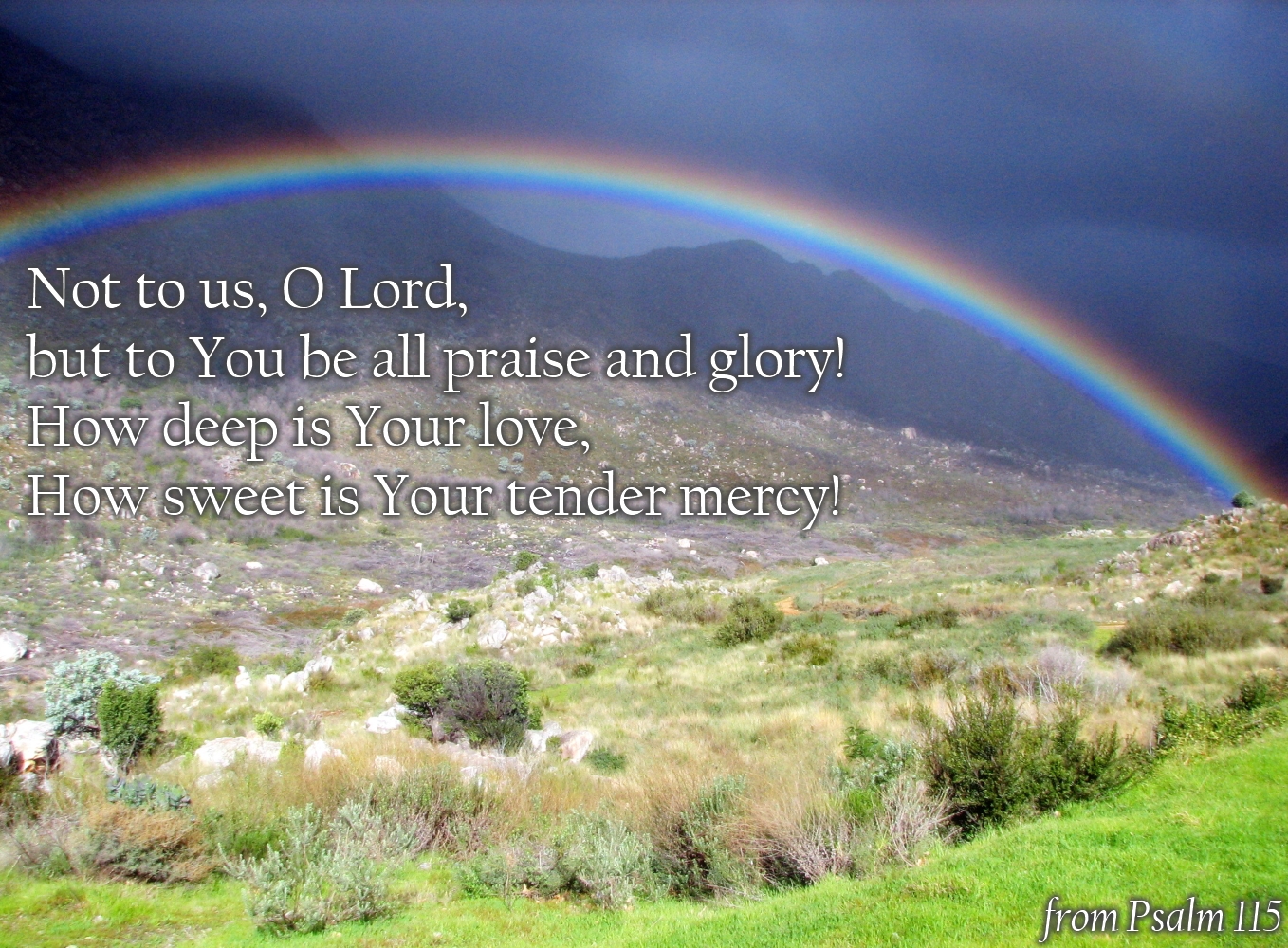
In the quiet of my home, I began to hear phrases from Psalm 115:
1 Not to us, LORD, not to usI'm home. This is my home. Among the creatures of the earth and sea. Amidst the beauty of nature. It is here that I will build my home, until I am called back to my once and future and eternal home in the heavens.
but to your name be the glory,
because of your love and faithfulness.
2 Why do the nations say,
“Where is their God?”
3 Our God is in heaven;
s/he does whatever pleases her.
4 But their idols are silver and gold,
made by human hands.
5 They have mouths, but cannot speak,
eyes, but cannot see.
6 They have ears, but cannot hear,
noses, but cannot smell.
7 They have hands, but cannot feel,
feet, but cannot walk,
nor can they utter a sound with their throats.
8 Those who make them will be like them,
and so will all who trust in them.
9 All you Israelites, trust in the LORD—
s/he is their help and shield.
10 House of Aaron, trust in the LORD—
s/he is their help and shield.
11 You who fear her, trust in the LORD—
s/he is their help and shield.
12 The LORD remembers us and will bless us:
S/he will bless her people Israel,
S/he will bless the house of Aaron,
13 S/he will bless those who fear the LORD—
small and great alike.
14 May the LORD cause you to flourish,
both you and your children.
15 May you be blessed by the LORD,
the Maker of heaven and earth.
16 The highest heavens belong to the LORD,
but the earth s/he has given to humankind.
17 It is not the dead who praise the LORD,
those who go down to the place of silence;
18 it is we who extol the LORD,
both now and forevermore.
Praise the LORD.
I think I've always known that, but it took a conversation with a terrapin to make it right in my heart.
Monday, June 06, 2011
'Out' the snipers!
To 'out' or not 'to out'?
It's a perennial question in the gay community - and the Church - which pops up every so often.
Many of us who are 'out' of the 'closet' of homophobia know what a very difficult thing it is to do to be honest about the fullness of your humanity with yourself and people who say they love you.
The risks - and the costs - are high.
There are many levels of 'coming out'. First, to yourself, of course, which is the hardest step. I've known more Queer people who laugh and say, "It was funny. Each and every time I 'came out' to a friend or relative, they did not seem at all surprised. I seemed to be the last person to know."
I remember being turned down for a position with an LGBT organization because I wasn't "out enough". It was felt that, because I had a partner and six kids, we were, in the not-so-delicate words of one gay man, "aping the cultural stigmata" of heterosexism.
Really. Hand to Jesus.
I know some people who don't think you're 'out' until you've had a Letter to the Editor, in which you've identified yourself as Queer, published in the NY Times.
Personally, I think you're really 'out' when you just go about your life, living it out in the way you think God has called you to do. I call them 'Main Street America' heroes. They cut their lawns, pay their taxes, send their kids to school, attend PTA and town council meetings, and are otherwise contributing members of society and strive to be good citizens of the universe.
No matter how a person chooses to live their lives as honestly, authentically, ethically and with as much integrity as one can possibly have, many parts of society seem to always be in waiting for the opportunity to send us right back in the closet.
It doesn't matter, really, even if you are not involved in any PDAs - Public Displays of Affection. As soon as you begin talking - all normal-like because, well, it is - about a vacation or a family event and someone who doesn't know you begins to 'get it', you can see the realization begin to dawn on them by their facial expressions.
Sometimes, you get, "Umm.... but.... you mean?....Ah....."
Other times, you just get a sour smile. If you watch closely enough, you can almost hear the gears in their head shifting through the information and deciding how to handle it in a social situation.
It can be quite humorous, actually, depending on the situation.
A Queer person soon discovers that 'coming out' is not a one-time deal. Even after many, many years, there are thousands of ways a Queer person has to defend against prejudice and bigotry.
The worst of it is the occasions of 'micro-oppression' - the heterosexist assumptions people make about Queer people which we find we have to explain.
"No, she's not my sister/brother."
"No, she's not my mother/father."
I used to introduce Ms. Conroy as my "partner", until one day, when I was doing a gig for The Oasis in Texas, a very nice gentleman in a business suit and tie, complete white Cowboy hat and boots asked, "Your partner? And, what is your business?"
He was as serious as a drought in the cattle business. He thought Ms. Conroy was my business partner.
I smiled and said, "Oh, it's just 'family business'".
The real effects of the 'micro-oppression' come on the way home, in the car, as you have a discussion in your head about whether or not that was the best way to have handled it.
I also remember the time when the pressure was on to find a job so I could be ordained. Ms. Conroy thought it would be a nifty idea to apply for a Chaplaincy position with the Armed Forces.
I had no idea what I was supposed to do with her or the children, but I humored her and went for the physical. At the end of all the exams, I met with the doctor to review my record.
"Any problem with alcohol?" he asked, not looking at me.
"No, sir," I said.
"No problem with drugs, I presume?"
"No, sir."
"And, um... yes, you have children, so no problem with homosexuality?"
"No, sir," I said, honestly, "I have no problem with homosexuality."
I'vespent wasted countless hours going over and over and over and over again in my head how to handle situations like those.
Because, you know, it's important - not only for my own sense of dignity and integrity but for the next Queer person that person will meet. One never knows when the 'teachable' moment will arrive and whether or not it will be your turn at bat to 'bunt' or go for a "line drive", or hit one over the wall with all the bases loaded.
Sometimes, a 'bunt' or a 'walk' can at least get a Queer person on base.
It can be exhausting - especially when all you really want to do is get to 'home' - or at least, feel more at 'home'. You know. Just like everybody else.
So, perhaps you can understand why it is that those of us who are 'out' become very annoyed when we meet other Queer people, especially those in positions of power, authority or influence - or those who seek positions of power, authority or influence - remain closeted.
It's annoying AND frustrating when one discovers that the closeted person remains so to his/her own benefit and remains silent in the face of discrimination and oppression of Queer people.
It's annoying, frustrating and flat out infuriating when one discovers that the Queer closeted person is sniping at other Queer people from the closet.
The whole issue of 'outing' came out again when Colin Coward, a priest in the Church of England who is gay and married to another man, and directs an organization called "Changing Attitude" got fed up and angry with the homophobic shenanigans at Lambeth Palace and reported on his blog that he personally knew thirteen (13) bishops in the Church of England who are gay - some of whom have been appointed in the last 12 months.
Closeted - deeply closeted - but gay.
He noted in the comment section of his blog that this means that "over 10% of bishops in England are gay".
Colin said the he "could" name names but "As Director of Changing Attitude, the guidance from trustees (and Tina has commented above) is that Changing Attitude does not out people".
Good form. I absolutely agree. Well, to a point.
Let me begin by saying that 'coming out' is an intensely personal decision. No one should 'come out for you'. You have to do it for yourself. So, I applaud 'Changing Attitude' and any Queer Christian organization that has as a policy not to 'out' other people.
That doesn't mean that some of us are 'forced' into it - either through pressure from family or friends or flat out blackmail - or, when some nice, straight person wants to be your personal hero.
Over the years, I've known many, many Queer people who have been 'outed' to their bishops in their ordination process by well-intended Rectors or Presidents of Standing Committees or Chairs of Commissions on Ministries.
By well-intended, I mean that I really believe that this is the operative, conscious dynamic. They want to 'force the issue' in the diocese and feel that they could muster the support to 'help' the person receive the necessary approval to proceed with ordination.
I've never known that to work. The bishop still has final authority and power to decline the "advice and counsel" - and that's all it is, ultimately - of those bodies and people of influence.
If the bishop is all about being a 'symbol of unity in the church', and feels that ordaining a Queer person would harm that unity in any way, s/he will decline to ordain that person - however otherwise well qualified.
I have known one bishop who graciously transferred the approved candidate for ordination to another "friendly" diocese. However, that also comes with cost. Some folks in some diocese feel that they are participating with institutional oppression by making it 'easy' for a bishop not to ordain an otherwise qualified candidate.
It's complicated.
All that being said, I'm convinced that the issue is not so much about 'forcing the issue' so there will be justice, but it's really about someone trying to be a 'hero'.
Bottom line: Coming out is a process which requires a life-long commitment. It should not be done lightly or inadvisedly or without prayer. And, it certainly isn't good, no matter how 'well intended' for others to 'out' a Queer person.
So, is it ever okay to "out" someone? My answer is no - but not unequivocally.
My personal credo, which has evolved over the years, is "Out the snipers."
I've never done that, personally - never been in a position to do so - but I always cheer when it is done.
You know. People like Larry Craig, former Republican senator from Idaho. Former Republican Representative Mark Foley of Florida. Rep. Ed Schrock, a Republican congressman from Virginia, who dropped out of his re-election race in 2004 after a Web log published allegations that he used a gay dating service. Senator Lindsey Graham has long been rumored to be in an hermetically sealed closet and so remains the Senior Senator from South Carolina.
Senator Barney Frank from Massachusetts, who has been 'out' since at least before the invention of sliced, white bread, says that "There are probably five or seven in the House and at least three senators," who are Queer and in the closet.
Which is fine. Really. As long as they vote the right way on issues of justice for Queer people. When they make homophobic remarks and try to influence a negative vote on repealing DOMA or DADT, I start to get angry - enough to cheer when these scoundrels are outed - and ousted from office.
Even so, it's a tricky thing. The whole thing can backfire - unless there is conclusive evidence. You know, like being caught in a public men's room or in the bushes at night in a public park.
Should the thirteen bishops of the Church of England who are reportedly Queer be 'outed'?
Well, my hope is that, in the face of all the hypocrisy now in the Church of England, these men would be able to step out from behind the Lavender Curtain and begin to tell the truth about their sexual orientation.
I know. They won't. The personal cost is, perhaps, incalculably high. I have no doubt that many of these men (and, they're all men, of course), have wives and children.
In the Queer community, this is known as "having a beard" - as in something that makes you look more "masculine".
In urban slang, it's known as being "on the down low" or "on the D.L". Sometimes, it's meant to suggest that the man is 'bisexual', which, I suppose, is meant to mean "not that bad" - or, "not that gay". Masculinity intact, as it were.
In any event, it's complicated.
Actually, I do hope that these closeted Queer bishops might come out - privately - to ABC Rowans and ABY Sentamu. First, however, they'd have to come out to themselves. And, their wives and families. What they do, after that, is really up to them.
My real hope is that they won't do anything that directly hurts Queer people. You know, in the name of Jesus and the 'unity of the church'.
It's not just the secrecy. It's the hypocrisy.
And, when that secrecy and hypocrisy hurt other Queer people and they perpetuate the oppression and prejudice and bigotry, I say, "Out the snipers!"
It's a perennial question in the gay community - and the Church - which pops up every so often.
Many of us who are 'out' of the 'closet' of homophobia know what a very difficult thing it is to do to be honest about the fullness of your humanity with yourself and people who say they love you.
The risks - and the costs - are high.
There are many levels of 'coming out'. First, to yourself, of course, which is the hardest step. I've known more Queer people who laugh and say, "It was funny. Each and every time I 'came out' to a friend or relative, they did not seem at all surprised. I seemed to be the last person to know."
I remember being turned down for a position with an LGBT organization because I wasn't "out enough". It was felt that, because I had a partner and six kids, we were, in the not-so-delicate words of one gay man, "aping the cultural stigmata" of heterosexism.
Really. Hand to Jesus.
I know some people who don't think you're 'out' until you've had a Letter to the Editor, in which you've identified yourself as Queer, published in the NY Times.
Personally, I think you're really 'out' when you just go about your life, living it out in the way you think God has called you to do. I call them 'Main Street America' heroes. They cut their lawns, pay their taxes, send their kids to school, attend PTA and town council meetings, and are otherwise contributing members of society and strive to be good citizens of the universe.
No matter how a person chooses to live their lives as honestly, authentically, ethically and with as much integrity as one can possibly have, many parts of society seem to always be in waiting for the opportunity to send us right back in the closet.
It doesn't matter, really, even if you are not involved in any PDAs - Public Displays of Affection. As soon as you begin talking - all normal-like because, well, it is - about a vacation or a family event and someone who doesn't know you begins to 'get it', you can see the realization begin to dawn on them by their facial expressions.
Sometimes, you get, "Umm.... but.... you mean?....Ah....."
Other times, you just get a sour smile. If you watch closely enough, you can almost hear the gears in their head shifting through the information and deciding how to handle it in a social situation.
It can be quite humorous, actually, depending on the situation.
A Queer person soon discovers that 'coming out' is not a one-time deal. Even after many, many years, there are thousands of ways a Queer person has to defend against prejudice and bigotry.
The worst of it is the occasions of 'micro-oppression' - the heterosexist assumptions people make about Queer people which we find we have to explain.
"No, she's not my sister/brother."
"No, she's not my mother/father."
I used to introduce Ms. Conroy as my "partner", until one day, when I was doing a gig for The Oasis in Texas, a very nice gentleman in a business suit and tie, complete white Cowboy hat and boots asked, "Your partner? And, what is your business?"
He was as serious as a drought in the cattle business. He thought Ms. Conroy was my business partner.
I smiled and said, "Oh, it's just 'family business'".
The real effects of the 'micro-oppression' come on the way home, in the car, as you have a discussion in your head about whether or not that was the best way to have handled it.
I also remember the time when the pressure was on to find a job so I could be ordained. Ms. Conroy thought it would be a nifty idea to apply for a Chaplaincy position with the Armed Forces.
I had no idea what I was supposed to do with her or the children, but I humored her and went for the physical. At the end of all the exams, I met with the doctor to review my record.
"Any problem with alcohol?" he asked, not looking at me.
"No, sir," I said.
"No problem with drugs, I presume?"
"No, sir."
"And, um... yes, you have children, so no problem with homosexuality?"
"No, sir," I said, honestly, "I have no problem with homosexuality."
I've
Because, you know, it's important - not only for my own sense of dignity and integrity but for the next Queer person that person will meet. One never knows when the 'teachable' moment will arrive and whether or not it will be your turn at bat to 'bunt' or go for a "line drive", or hit one over the wall with all the bases loaded.
Sometimes, a 'bunt' or a 'walk' can at least get a Queer person on base.
It can be exhausting - especially when all you really want to do is get to 'home' - or at least, feel more at 'home'. You know. Just like everybody else.
So, perhaps you can understand why it is that those of us who are 'out' become very annoyed when we meet other Queer people, especially those in positions of power, authority or influence - or those who seek positions of power, authority or influence - remain closeted.
It's annoying AND frustrating when one discovers that the closeted person remains so to his/her own benefit and remains silent in the face of discrimination and oppression of Queer people.
It's annoying, frustrating and flat out infuriating when one discovers that the Queer closeted person is sniping at other Queer people from the closet.
The whole issue of 'outing' came out again when Colin Coward, a priest in the Church of England who is gay and married to another man, and directs an organization called "Changing Attitude" got fed up and angry with the homophobic shenanigans at Lambeth Palace and reported on his blog that he personally knew thirteen (13) bishops in the Church of England who are gay - some of whom have been appointed in the last 12 months.
Closeted - deeply closeted - but gay.
He noted in the comment section of his blog that this means that "over 10% of bishops in England are gay".
Colin said the he "could" name names but "As Director of Changing Attitude, the guidance from trustees (and Tina has commented above) is that Changing Attitude does not out people".
Good form. I absolutely agree. Well, to a point.
Let me begin by saying that 'coming out' is an intensely personal decision. No one should 'come out for you'. You have to do it for yourself. So, I applaud 'Changing Attitude' and any Queer Christian organization that has as a policy not to 'out' other people.
That doesn't mean that some of us are 'forced' into it - either through pressure from family or friends or flat out blackmail - or, when some nice, straight person wants to be your personal hero.
Over the years, I've known many, many Queer people who have been 'outed' to their bishops in their ordination process by well-intended Rectors or Presidents of Standing Committees or Chairs of Commissions on Ministries.
By well-intended, I mean that I really believe that this is the operative, conscious dynamic. They want to 'force the issue' in the diocese and feel that they could muster the support to 'help' the person receive the necessary approval to proceed with ordination.
I've never known that to work. The bishop still has final authority and power to decline the "advice and counsel" - and that's all it is, ultimately - of those bodies and people of influence.
If the bishop is all about being a 'symbol of unity in the church', and feels that ordaining a Queer person would harm that unity in any way, s/he will decline to ordain that person - however otherwise well qualified.
I have known one bishop who graciously transferred the approved candidate for ordination to another "friendly" diocese. However, that also comes with cost. Some folks in some diocese feel that they are participating with institutional oppression by making it 'easy' for a bishop not to ordain an otherwise qualified candidate.
It's complicated.
All that being said, I'm convinced that the issue is not so much about 'forcing the issue' so there will be justice, but it's really about someone trying to be a 'hero'.
Bottom line: Coming out is a process which requires a life-long commitment. It should not be done lightly or inadvisedly or without prayer. And, it certainly isn't good, no matter how 'well intended' for others to 'out' a Queer person.
So, is it ever okay to "out" someone? My answer is no - but not unequivocally.
My personal credo, which has evolved over the years, is "Out the snipers."
I've never done that, personally - never been in a position to do so - but I always cheer when it is done.
You know. People like Larry Craig, former Republican senator from Idaho. Former Republican Representative Mark Foley of Florida. Rep. Ed Schrock, a Republican congressman from Virginia, who dropped out of his re-election race in 2004 after a Web log published allegations that he used a gay dating service. Senator Lindsey Graham has long been rumored to be in an hermetically sealed closet and so remains the Senior Senator from South Carolina.
Senator Barney Frank from Massachusetts, who has been 'out' since at least before the invention of sliced, white bread, says that "There are probably five or seven in the House and at least three senators," who are Queer and in the closet.
Which is fine. Really. As long as they vote the right way on issues of justice for Queer people. When they make homophobic remarks and try to influence a negative vote on repealing DOMA or DADT, I start to get angry - enough to cheer when these scoundrels are outed - and ousted from office.
Even so, it's a tricky thing. The whole thing can backfire - unless there is conclusive evidence. You know, like being caught in a public men's room or in the bushes at night in a public park.
Should the thirteen bishops of the Church of England who are reportedly Queer be 'outed'?
Well, my hope is that, in the face of all the hypocrisy now in the Church of England, these men would be able to step out from behind the Lavender Curtain and begin to tell the truth about their sexual orientation.
I know. They won't. The personal cost is, perhaps, incalculably high. I have no doubt that many of these men (and, they're all men, of course), have wives and children.
In the Queer community, this is known as "having a beard" - as in something that makes you look more "masculine".
In urban slang, it's known as being "on the down low" or "on the D.L". Sometimes, it's meant to suggest that the man is 'bisexual', which, I suppose, is meant to mean "not that bad" - or, "not that gay". Masculinity intact, as it were.
In any event, it's complicated.
Actually, I do hope that these closeted Queer bishops might come out - privately - to ABC Rowans and ABY Sentamu. First, however, they'd have to come out to themselves. And, their wives and families. What they do, after that, is really up to them.
My real hope is that they won't do anything that directly hurts Queer people. You know, in the name of Jesus and the 'unity of the church'.
It's not just the secrecy. It's the hypocrisy.
And, when that secrecy and hypocrisy hurt other Queer people and they perpetuate the oppression and prejudice and bigotry, I say, "Out the snipers!"
Saturday, June 04, 2011
Aspiring, Discerning, Deciding.
![]() |
| The Eucharist - He Qi |
I've never been to Paris in April but I'm willing to bet that even Parisians are envious of the Delmarva Peninsula in June.
June is the month of weddings and ordinations. Ask any clergy person what they are doing on any given Saturday in June and they will tell you they either have a wedding to officiate or an ordination to attend.
It's also the month when I get the most questions about ordination. Not marriage, interestingly enough. Ordination.
Sometimes, I get questions from people from people who have been so inspired by the ordination ceremony that they want to know more - about the training and education and spiritual preparation that goes into the power of the day.
For others, the ceremony kindles something that has been a wee spark in their soul. They begin to wonder if that still small voice they have been hearing is calling them to a life of ordained ministry.
For others, it's about a realization that says, "Hey, I love the church, and I spend so much of my time giving to the church. Maybe I should get ordained, too. That would be cool."
I find myself going back to something Louie Crew wrote in 1998. He called it "Quean Lutibelle's Advice to Lesbigay Aspirants for Ordination in the Episcopal Church".
It's so good - such sound, wise advice from someone who knows the Church well and loves her still - that, with a little bit of translation, it still holds solid for non-Queer folk.
So, I'm going to reprint it here. You can always click on the title of his piece above (or, here) and find it. Please note that the material is copyrighted.
I offer this one note to help you with your 'translation' to 'Queer Talk'.
When Louie writes about 'coming out', think about whatever it is about you that you keep secret or hidden. Bring that out into the light - to yourself and God and your community of faith. Whatever it is, it will be discovered anyway. Indeed, it may be the very thing God wants to use to be able to witness to the truth and the transformative power of the Gospel.
So, read, mark, learn and inwardly digest these words. And, may God, who has given you the will to do these things, also give you the grace to perform them.
I'll hush now, and let the master speak:
I receive quite a few requests for advice from lesbigay persons regarding ordination to ministry in the Episcopal Church. To help in that discernment process, I offer these suggestions.There's some other really good advice like, "What to do if your diocese will not ordain Queer People", and "How to find a supportive bishop".
1. Be sure about your call.
If you are not already doing ministry as a lay person, you should seriously doubt that you have been called. No Commission on Ministry (COM) should take you seriously unless they have clear evidence that you have taken God's call seriously. You don't need a collar to do ministry: much ministry cannot be done nearly as well if you do have a collar. Take very seriously the priesthood you already have as a baptized person--sacred priesthood after the order of Melchisedec.2. Come out -- to yourself, to God, and to your religious community.
Do not limit evidence of your current ministry to in-house church matters. Include those, yes, but all ministers, lay and clergy, are called to bring Christ into the world--to the uttermost parts of it. How are you doing that now? Most especially to whom "among the least of these" your sisters and brothers are you ministering? I did not set this criterion: Jesus did. All disciples will be held accountable to it on the 'Great Gettin Up Morning.'
Spend much time in prayer and the reading of scriptures. Give God a chance. She has much that She wants to say to you. You'll have to hush to hear her.
Do not mistake an earnest desire to be good or respectable as a call to priesthood. The Good News is not about Respectability. Jesus said all that needs to be said about Respectability at Calvary. Those who would follow Christ must be willing to give up their Respectability, not seek to enhance it. The church is ill served by those who limit footwashing to a photo-op once a year. Jesus was a friend of sinners, not their scold. If you minister as Jesus did, you should have most of your problems from those who think they are righteous. If that is not true now, a Commission on Ministry would be foolish to think that it will be true after you go through the ordination process.
Test your call. Try running away from it for several years, fleeing ordination and doing as much ministry as possible without it. Wait till persons start asking you on the basis of your service, "Have you thought about ordained ministry?" Don't start asking yourself first and then jumping to the conclusion that God made you ask.
Do it for your personal integrity. Don't set yourself up to live as a divided person. You will abuse both your spirituality and your sexuality: God intends for us to integrate all our parts. You can be neither hale nor holy if you are not whole. In Old English, all three were one word, hal. The three still are one.3. What to do if the call persists
The Church does not need any more closeted priests. All disciples need to live without dissembling. The church does not need to be put on hold while you go off to be another self.
Come out now, not later. "But let me get in the process first" or "Let me get my degree first" or "Let me get ordained first" or "Let me get a rectorship first" or "Let me bury my father and mother first...." Let the dead bury the dead. If you want to be Jesus's disciple, come without delay.
Come out for God, not for the camera. We are not supposed to be the center of our own ministry. Some will think that you have catapulted yourself into the center of yours when you surprise them by coming out. You must never buy into their misperceptions, lest you lose the importance of your disclosure in the first place: it is to free you up to be yourself in service to others, not to be caught in a tiresome spectacle of trying to discover who others say you are. Resist the limelight. You can do that most easily if you serve others, especially those whom no one else is noticing, the despised, the rejected. They will bring you face to face with Jesus, who has never successfully been trapped in glorious stained glass.
Connect to lesbigay community. Connect to all of it, not just the parts that seem respectable. Find the most broken lesbigay person you can find and become that person's friend. Nurture that person's talents in ways that person has long forgotten to do. Forgive that person's trespasses against you and others even before they happen. Set no conditions upon your love for that person. You will see Jesus.
Join lesbigay organizations, and give generously of your time and your substance. You would not even be able to think about being ordained had they not been working for those possibilities for a quarter of a century. Make sure that three generations from now all this natter will seem as vague and confusing as do the battles over whether you have to be cut or uncut if you want to be a Christian. Don't struggle alone.
Alert those in your local congregation. Ideally they have first approached you, not you them. In either case, give them an ample opportunity to know you, not just in your identity at church. Bring folks from the parish with you into your ministry in the world, and into your life in the world. Break bread together with them in your home. Visit them. Share books. Share ideas. Go to the theatre together. Go to the Ghetto together. Take them to the Lesbigay Scenes, not just the nice ones, but to those where need most glares. There they will also see Jesus. Enter extensive email correspondence with one or more of them. Include the rector, but not the rector only. Do none of this with strings attached, none of this as a means to win their approval. Assume that some may not be able to take that reality; but trust God to move their hearts. You are seeking their discernment with you, not their seal of approval. You are not writing a resume, you are being a disciple.4. Understand whence the call comes and to whom it comes.
Inform yourself of every detail of the ordination process in your diocese. Don't count on your rector or your parish discernment committee to do this work for you. In many parishes you may be the only person to be considered for ordination in many years, and perhaps the only one about whom the persons on your committee have had to make a decision. Very early, write to the chair of your Commission on Ministry and request any guidelines your diocese might have for aspirants, postulants, and candidates. You may find the addresses of all dioceses at http://andromeda.rutgers.edu/~lcrew/diosnail.html . You may find the addresses of all diocesan bishops at http://andromeda.rutgers.edu/~lcrew/bishops/index.html#D
Get your finances in order. You will have three years of graduate education to pay for. You will have marginal employment for your first assignments after ordination. You cannot possibly anticipate the expenses, nor likely have all the money upfront. God will provide: Help Her.
God calls. Persons think we hear. God calls other persons to test our perception.5. If knowing you, they would not ordain you, then don't seek ordination in that place.
Respect the ministry of those whom you ask to test your call. Do not put yourself into an adversarial relationship with those who oversee the ordination process in your diocese. They are called to a special ministry, and their call has been tested by processes that led to their holding the diocese's trust. Everyone who comes before them feels she or he has heard God's call to do so. Their task is to discern whether God is calling their diocese to hear a call to ordain this person.
Do not dissemble. Give them every opportunity to know you, and take some time to know and value them, not just as your reviewers, but as your sister/brother ministers. All who are on a Commission on Ministry or a Standing Committee are there because they have been doing, and still are doing, other ministry. Bond with one another out of that common service
Ordination is no one's by right. One has to earn that privilege. No one, straight or gay, is "eligible for any position." All should be eligible only to be considered. From that point on, one should be judged solely on one's qualifications for the leadership role under consideration.
As a member of the Standing Committee of my diocese, I do not approve of candidates for priesthood based on their sexual orientation. Lesbigay folks have as big a share of people who shouldn't be priests as do straights. We have many fine lesbigay priests, and we have some .... Well, you know. Straights have those too.
As chair of the University Senate and member of the Board of Governors, I do not determine the merits of proposals based on the sexual orientation of the proposers. Lesbigay colleagues can come up with as much foolishness as can straight colleagues.
I'll let you go to Louie's site to get that information. Just click here.
The advice is also helpful to women who are still judged by a different, higher standard in many places - consciously or unconsciously - if they are not ever-so politely yet ever-so painfully excluded from the Ordination process.
Okay, so you are inspired by an ordination service, but you do not feel called to ordained ministry, but you seek discernment and/or clarification about the direction of your ministry. What do you do?
Actually, I think all of the above applies to you, as well. You're just going to have to be even pushier about getting what you need from bishops and clergy and people in your community of faith, despite all the "church-talk" you'll hear from the pulpit about "priesthood of all believers".
As Louie writes: "You don't need a collar to do ministry: much ministry cannot be done nearly as well if you do have a collar. Take very seriously the priesthood you already have as a baptized person--sacred priesthood after the order of Melchisedec."
We have come to think of ministry only in terms of ordination or service directly relating to the church. Don't believe that for a second. It is a lie some people in the institutional church perpetuate in order to tend to the institution.
This is about serving God through your faith and love in Christ Jesus by the power of the Holy Spirit. Find a spiritual director/anamcara/soul friend with some training and experience in discernment. Talk with your rector. Form your own discernment committee in your community of faith.
Write to me, if you like. I'm happy to help you work through your initial questions and concerns. Better yet, write me and we'll exchange telephone numbers and either talk on the phone or Skype. It's not the same as face to face, but we'll get a much better sense of each other than through email.
I also have an outline of issues and questions for those seeking to discern or clarify a vocation to ministry in 'real life' that I use in spiritual direction and pastoral care. That is much better done with someone in person than all by yourself.
Theologian Frederick Buechner has written that ‘Vocation is where our greatest passion meets the world’s greatest need’. There is something Jesus needs done in the world that only you can do. Seek that first - seek the Realm of God first - and all these things shall be added unto you. Alleluia!
I hope these words of wisdom from Quean Lutibelle/Louie Crew will touch you or someone you know, and provide at least a modicum of guidance and be of some assistance to you in your journey.
If you didn't already know it, Louie's words are what 'truth spoken in love' looks like.
As Louie himself says, "Joy to you in your journey. May your ministry bring news genuinely good to absolutely everybody!"
Friday, June 03, 2011
Gloating
I'd never have to work another day of my life.
And, those are just the ones I know. There are many, many, many more. Hundreds of thousands, is my guess. We are blessed by their presence in our church.
You don't hear about the numbers because, well, for one thing, we don't keep those kinds of records. I don't ever remember sending a request for a Letter of Transfer to a Roman Catholic Church, the way we do when an Episcopalian leaves one church - for whatever reason - and joins another.
I just talk with the former Roman Catholic about the Episcopal Church, offering classes if s/he prefers, and offer Reception by the Bishop when he did his visitation or when we have diocesan/district Confirmation/Reception.
You'll certainly not see any news articles in Episcopal Life or on the Episcopal News Service about how many former RCs have become members of The Episcopal Church.
So, it's pretty much a silent, albeit massive, exodus from Rome to Canterbury - or The Episcopal Church Center at 815 Second Ave, New York.
You'll forgive me, then, as I sit here, scratching my head at this news article from NCR (National Catholic Reporter), with a headline that screams: "With a thousand Anglican converts, ordinariate gets going."
The article is written by a man who identifies himself as someone who was "an Anglican before becoming a Catholic 45 years ago".
I'm tempted to snark, "Misery loves company" but I'm trying to show some restraint here.
The article claims,
In England, the only country so far where the ordinariate is up and running, almost a thousand ex-Anglicans, composed of groups of laity with 64 of their pastors, of whom 54 have applied to become Catholic priests, have come over in the first wave. The ordination of the former Anglican clergy is being fast-tracked for Pentecost. The Congregation for the Doctrine of the Faith is calling the shots, for the local Roman Catholic bishops had wanted these clergy to undergo a year’s preparation.
Three former Anglican bishops, all of them married, all now with the title of monsignor, are the leaders. One, Keith Newton, has been appointed the ordinary, may carry a crosier and wear a miter, and participates in meetings of the Catholic Bishops’ Conference of England and Wales with an equal voice. In an echo of the Anglican synodical tradition, he is required to consult with a governing council of priests and laity, and future holders of his office will be appointed from a list of three candidates drawn up by this council, not by the nuncio.
![]() | |
| CNS/Marcin Mazur |
I'm not exactly sure what to make of that description.
Anyway, the author goes on to say that:
"At present, he and his wife are still living in the capacious Bishop’s House at Dry Sandford just outside Oxford. They are preparing to move out, for the ordinariate in England cannot take any Anglican churches or buildings with it. We talk in his study, where there is an altar, a prie-dieu, candles burning."Capacious house, eh? Well, hopefully he'll still have room for the prie-dieu and the candles at his new digs, where he'll serve as "Monsignor".
The author also notes that
Newton . . has been appointed the ordinary, may carry a crosier and wear a miter, and participates in meetings of the Catholic Bishops’ Conference of England and Wales with an equal voice. In an echo of the Anglican synodical tradition, he is required to consult with a governing council of priests and laity, and future holders of his office will be appointed from a list of three candidates drawn up by this council, not by the nuncio (diplomatic representative).So, the bishop gets to keep all of his pretty dresses, use his own prayer book, preside at proper Anglican Eucharists and services of prayer, and have at least some semblance of Anglican tradition in a more democratic election.
And, and, AND.... he's protected from those nasty "women cooties" anywhere near the altar or on the councils or in the corridors of power.
Well, good for him, I say. If that's what makes him happy. I, personally, have never been happy with prejudice or bigotry, but well, in Rome, it's a "man's, man's world."
Here's the last quote from the article:
"Though still tempted to look over their shoulders at the factions in the church they have left, they have no need to worry about that anymore. They are free now, they feel, for mission to everyone, Anglican style. They are determined to make the experiment work: They know they have to mix in, while bringing their particular gifts. They come with humility, they say, and stress their gratitude for the warmth of their welcome.""Free.... now"? "for mission to everyone"?
Freedom to live with the shackles of the sin of sexism and misogyny on your soul is hardly freedom. Then again, it is they who put on those shackles willingly and, near as I can tell, happily. And, what do you do when one calls a woman into the church and she is called by the power of the Spirit to ordained leadership in the church?
Uh-oh. Better revise that "mission to everyone" statement. It needs a few disclaimers.
Gratitude for the "warmth of their welcome"?
I'll just bet they were welcomed warmly. The Roman Catholic Church sure could use some good press, right about now. Imagine! While thousands and thousands are swimming the other way on the Tiber because of the abuse of institutional power concerning the abuse of millions of children, or the archaic pre-Neanderthal attitudes and policies about the status of women, a mere thousand want to join them.
And, this is news. Big news. Imagine!
I can't. I simply can't imagine it. You'll forgive me, but I just can't get my head wrapped around that.
All that being said, what really sets my teeth on edge is the whole tone of the article. I know that poor Mother Church in Rome needs a bit of a lift these days, but, as you read the article, you can't miss the gloating.
Gloating: "To feel or express great, often malicious, pleasure or self-satisfaction: Don't gloat over your rival's misfortune".
It's so . . . um. . . well, here's a good Anglican word for it: "unseemly".
It's bad form, is what it is. Flat out. Bad form.
There's a part of me that wants to "Fight fire with fire" - even though I've learned, over the years, that this only leads to both sides getting burned.
I want to write a resolution for General Convention next year that, henceforth and furthermore, we begin keeping track of how many Roman Catholics convert to The Episcopal Church; and, furthermore, be it resolved that those statistics are reported by each and every congregation in The Episcopal Church in the Annual Parochial Report; and furthermore, be it resolved that those statistics are reported in the Episcopal Annual Report for wide distribution in the Episcopal News Service.
That's my wicked fantasy, anyway. Truth be told, it's just gloating in return for gloating, and I don't think Jesus would be at all pleased.
So, I'll do my little rant in the safety of my little blog and be done with it. At least, that's the hope.
The truth of it is that I really don't care where it is one finds one's spiritual nourishment. I'm just delighted that the institutional church in whatever shape or form continues to provide some semblance of spiritual sustenance for God's people - even if the nutrients in some of those institutions are not of the highest gospel quality.
I'm thinking about that passage in the 9th Chapter of Luke's Gospel where John tells Jesus that “we saw someone driving out demons in your name and we tried to stop him, because he is not one of us.”
Jesus responded, “Do not stop him,” Jesus said, “for whoever is not against you is for you.” (Luke 9:50).
So, fine. You want to be a Roman Catholic? Terrific. Godspeed.
Don't let the red church door hit you from behind as you walk out. And, thank you ever so much for leaving the furniture and "capacious" buildings intact. That was good of you. Then again, it was good of the CofE to allow you to live there this past year, after you had left Canterbury and were busy swimming the Tiber. Well done, boys. Well done.
Just please, don't gloat. It makes me think that you're not so much for Jesus as you are against the ordination of women.
Have you already forgotten your proper Anglican manners?
It's bad form, gentlemen. Bad form, indeed.
Thursday, June 02, 2011
AIDS: 30 years later
It was the summer of 1981 - probably late August or early September. I had just learned that I was pregnant with our last child, who was born in May of 1982.
A buzz was going through the hospital where I was working as Maternal Child Health Coordinator in Maine - as well as in the gay community there - about a heretofore unknown but highly contagious and deadly disease called GRID.
GRID = Gay-Related Immune Deficiency.
It was so named shortly after the June 5, 1981 issue of the MMWR (Morbidity and Mortality Weekly Report) newsletter reported unusual clusters of Pneumocystis pneumonia (PCP) caused by a form of Pneumocystis carinii in five homosexual men in Los Angeles.
In the next report, on July 4, 1981, the number jumped to 28 homosexual men, this time in LA, San Francisco and New York City. By August of 1981, the numbers continued to increase at an alarming rate, so much so that people were beginning to grow increasingly concerned.
A few cases were reported in Boston, but, so far as anyone could tell, it had not yet reached Maine.
Yet.
Health authorities soon realized that nearly half of the people identified with the syndrome were not homosexual men. The same opportunistic infections were also reported among hemophiliacs, heterosexual intravenous drug users, and Haitian immigrants - male and female.
By August 1982, the disease was being referred to by its new CDC-coined name: Acquired Immune Deficiency Syndrome (AIDS). By then, however, the damage had been done. AIDS was the "gay disease" - and many religious communities were quick to proclaim that AIDS was the judgment of God on homosexual men.
Well, truth be told, while some people felt some sympathy for those with hemophilia, no one really cared about intravenous drug users and people of color - especially Haitians - either.
While the medical profession and gay community were buzzing with this newly identified and still mysterious disease, the government was even more mysteriously silent.
It was the years of the Reagan Administration which would not speak about the disease. However, it did "allow" the CDC and the NIH (National Institute of Health) to report on it and begin to disseminate information and education.
That silence on the part of the Reagan Administration would prove to be the major contributing factor to the AIDS epidemic becoming a world-wide AIDS pandemic.
Thirty years later, I'm still trying to find forgiveness in my heart for that historical fact.
The gay community, however, slowly began to realize that our own silence about the fullness of our humanity - including our sexual orientation - made us part of the problem. Indeed, we could have easily been indicted for our complicity in the silence.
More and more gay men began to 'come out' of the closet of secrecy and silence - usually at the high cost of losing the love of their parents, siblings and families.
Undaunted, they began to form liaisons and partnerships with communities with which they had never previously been associated - people of color, Intravenous Drug Users, and lesbian women.
Oh, there had always been heterosexual women who had played with and fawned over gay men. They were known as "fag hags" who loved the sense of fun and fashion known in the gay community. But, lesbians? Well, we were a whole 'nother smoke.
In the past, most relationships between gay men and lesbian women were formed out of a collusion to keep our sexual orientation secret. We would take vacations and cruises together, or go out to a good restaurant together - just two couples having a grand time. Except, of course, the "couples" were of the same sex, one of whom would slip into the other's cabin or bedroom at the end of the night.
It is my observation that there were, at least at the time, more lesbians in the field of Public Health than in any other area of medicine. My theory is that Public Health medicine - especially Public Health nursing - offered women more freedom and independence than any other specialized area of medicine or nursing.
You may have noticed that lesbians are, for the most part, a pretty feisty, independent lot, so it shouldn't come as a huge surprise that we could be found in places that allowed us to think and act without the usual male physician looking over our shoulder.
Indeed, in Public Health Nursing, many of the doctors relied heavily on our ability to assess symptoms and suggest alterations in treatment plans. That became critically important as hospitals became overcrowded with AIDS cases and doctors sought to manage care from the person's home.
When we began to see more and more people with AIDS in our home care patient census, a liaison began to develop between gay men and lesbians. It was uneasy and awkward at first - like teenagers at a High School prom who really didn't want to dance together - but the intensity and severity of the progress of the disease tore down walls and quickly melted any lingering barriers.
In 1987, six gay activists in New York formed the Silence = Death Project and began plastering posters around the city featuring a pink triangle on a black background stating simply ‘SILENCE = DEATH.’
In its manifesto, the Silence = Death Project drew parallels between the Nazi period and the AIDS crisis, declaring that ‘silence about the oppression and annihilation of gay people, then and now, must be broken as a matter of our survival.’
The slogan thus protested both taboos around discussion of safer sex and the unwillingness of some - especially religious communities - to resist societal injustice and governmental indifference. The six men who created the project later joined the protest group ACT UP and offered the logo to the group, with which it remains closely identified.
Artist Keith Haring embellished that logo by adding, "Ignorance = Fear", which was a message not only to the gay community to break their silence and insist on the information they needed to fight AIDS, but it also served as a judgment against all those whose ignorance about human sexuality, sexual orientation and the disease itself was contributing to the second epidemic:
AFRAIDS - Acute Fear of AIDS.
It was June, 1983 before I met my first Person With AIDS. His name was Jimmy. Jimmy Mac. He was a handsome man in his early twenties who was a popular DJ with one of the Boston radio stations.
I was doing my first rotation of Clinical Pastoral Education (CPE) at Boston City Hospital that summer. I was assigned to the Oncology Unit where, because their immune systems were as suppressed as people receiving chemotherapy, most of the AIDS patients were being sent.
I can't tell you how shocking a sight it was to see young men in the prime of their lives whose faces were gaunt and marked with angry-looking, purple Kaposi's sarcoma. Their bodies were so emaciated, the scene looked like something out of a picture of an interment camp in Nazi Germany or a famine in Africa or Asia.
I remember the first time I walked into Jimmy's room, trying not to look shocked and stunned, and silently grateful for the required paper cap, gown, boots, mask and latex gloves I was wearing.
Jimmy took one look at me, saw the fear in my eyes, and said, "Well, girlfriend, in case you didn't know, you are just a fashion mess!"
I started to giggle and said, "What, isn't light blue paper "in" this year?"
"Oh, no, honey," he said, "It's much worse than that. Look at you," he said, pointing a thin finger from my head to my toes. "Your gloves don't match your shoes."
We giggled and laughed for at least a few minutes.
I'll tell you this - when you can laugh in the midst of such devastation, something shifts in your soul. I've discovered that, in such situations, laughter is not only a statement of faith, it forms a bond that even death can not destroy.
After Jimmy was discharged from the hospital, we became a team - Jimmy and I - working together on the Interfaith AIDS Coalition, bringing important information and education to churches and synagogues in Boston. We were quite something together. Jimmy would always introduce us by saying, "She's the 'priestess with the mostest' and I'm the pretty boy with AIDS."
I think the key to our success was that we made people laugh. Oh, we also made them cry - who wouldn't, looking at Jimmy's once handsome face riddled with KS lesions. It's amazing how invisible they became once Jimmy got us to laugh. Which he did. Often.
Tears soften the heart, but the laughter allowed the mind to open.
We also broke a few rules in our time together - like always offering to accompany people when they went to be tested anonymously at the local clinic - but, as Jimmy always said, "A girl's gotta do what a girl's gotta do."
I have many, many 'Jimmy Mac' stories, but I'll leave you with this one which has become, for me, emblematic of the most important lesson I learned from AIDS. (You knew you couldn't escape without a story, now did you?)
It was the last time I ever saw Jimmy alive. He was back in the hospital. He was as weak as a kitten, his breathing labored and his voice raspy.
"Thrush," he said, referring to a fungal infection, "in my throat and mouth."
His voice that was just above a whisper, but I distinctly heard him say, "Reminds me of a date in Chelsea who also left a bad taste in my mouth."
We giggled. Wickedly. Again. Like we always did. This time, however, his laughter set off a paroxysm of coughing. I rushed to his side, holding his thin, frail, paper-thin hand in mine, which was covered by a latex glove.
When the coughing had stopped and he caught his breath and regained a bit of his strength, he said, "You know the worst part?"
"No," I said, fighting back the tears.
"I've been here almost a week. In that whole time, no one has come near me. No one has touched me, except when they have on those damned latex gloves. And, you know," he said, unable to resist the humor, "I've never been one for latex."
He looked at me - through me, really - his eyes brimming with tears. "Touch me," he said. "Take off the damn gloves and the mask and touch me. Please?"
Even though I knew the rules - even though I knew I was breaking the rules - I took off my mask and gloves, crawled into bed with him, and held him in my arms, rocking him gently.
I started to sing softly to him, "Jesus loves me, this I know. For the Bible tells me so. Little ones to him belong. We are weak but he is strong."
We were like that for a while, not moving, even when a nurse came in the room and saw us, and heard us singing, "Yes, Jesus loves me. Yes, Jesus loves me. Yes, Jesus loves me. The Bible tells me so."
She simply nodded her head and slipped silently out of the room.
Love changes everything. Love has the potential to change the world, if we just open our hearts to it.
Love fills your heart and breaks it open, like so much sacramental bread, allowing you to have the courage to break a few rules when you need to.
To open your mouth and break the silence that is killing you.
To open your mind and break the ignorance that binds you in fear.
To find forgiveness in your heart when people don't live up to your expectations.
To break down walls and barriers that keep us from loving each other as Jesus loves us.
Thirty years later and we seem not to have learned this lesson.
Want to cure AIDS?
Here's my unscientific answer, based on years of experience:
Love the world so much that it breaks your heart and you break a few rules and tear down a few walls.
Thirty years after the beginning of the AIDS epidemic and well into the second decade of a world-wide AIDS pandemic, we've got nothing else to lose - and everything to gain.
A buzz was going through the hospital where I was working as Maternal Child Health Coordinator in Maine - as well as in the gay community there - about a heretofore unknown but highly contagious and deadly disease called GRID.
GRID = Gay-Related Immune Deficiency.
It was so named shortly after the June 5, 1981 issue of the MMWR (Morbidity and Mortality Weekly Report) newsletter reported unusual clusters of Pneumocystis pneumonia (PCP) caused by a form of Pneumocystis carinii in five homosexual men in Los Angeles.
In the next report, on July 4, 1981, the number jumped to 28 homosexual men, this time in LA, San Francisco and New York City. By August of 1981, the numbers continued to increase at an alarming rate, so much so that people were beginning to grow increasingly concerned.
A few cases were reported in Boston, but, so far as anyone could tell, it had not yet reached Maine.
Yet.
Health authorities soon realized that nearly half of the people identified with the syndrome were not homosexual men. The same opportunistic infections were also reported among hemophiliacs, heterosexual intravenous drug users, and Haitian immigrants - male and female.
By August 1982, the disease was being referred to by its new CDC-coined name: Acquired Immune Deficiency Syndrome (AIDS). By then, however, the damage had been done. AIDS was the "gay disease" - and many religious communities were quick to proclaim that AIDS was the judgment of God on homosexual men.
Well, truth be told, while some people felt some sympathy for those with hemophilia, no one really cared about intravenous drug users and people of color - especially Haitians - either.
While the medical profession and gay community were buzzing with this newly identified and still mysterious disease, the government was even more mysteriously silent.
It was the years of the Reagan Administration which would not speak about the disease. However, it did "allow" the CDC and the NIH (National Institute of Health) to report on it and begin to disseminate information and education.
That silence on the part of the Reagan Administration would prove to be the major contributing factor to the AIDS epidemic becoming a world-wide AIDS pandemic.
Thirty years later, I'm still trying to find forgiveness in my heart for that historical fact.
The gay community, however, slowly began to realize that our own silence about the fullness of our humanity - including our sexual orientation - made us part of the problem. Indeed, we could have easily been indicted for our complicity in the silence.
More and more gay men began to 'come out' of the closet of secrecy and silence - usually at the high cost of losing the love of their parents, siblings and families.
Undaunted, they began to form liaisons and partnerships with communities with which they had never previously been associated - people of color, Intravenous Drug Users, and lesbian women.
Oh, there had always been heterosexual women who had played with and fawned over gay men. They were known as "fag hags" who loved the sense of fun and fashion known in the gay community. But, lesbians? Well, we were a whole 'nother smoke.
In the past, most relationships between gay men and lesbian women were formed out of a collusion to keep our sexual orientation secret. We would take vacations and cruises together, or go out to a good restaurant together - just two couples having a grand time. Except, of course, the "couples" were of the same sex, one of whom would slip into the other's cabin or bedroom at the end of the night.
It is my observation that there were, at least at the time, more lesbians in the field of Public Health than in any other area of medicine. My theory is that Public Health medicine - especially Public Health nursing - offered women more freedom and independence than any other specialized area of medicine or nursing.
You may have noticed that lesbians are, for the most part, a pretty feisty, independent lot, so it shouldn't come as a huge surprise that we could be found in places that allowed us to think and act without the usual male physician looking over our shoulder.
Indeed, in Public Health Nursing, many of the doctors relied heavily on our ability to assess symptoms and suggest alterations in treatment plans. That became critically important as hospitals became overcrowded with AIDS cases and doctors sought to manage care from the person's home.
When we began to see more and more people with AIDS in our home care patient census, a liaison began to develop between gay men and lesbians. It was uneasy and awkward at first - like teenagers at a High School prom who really didn't want to dance together - but the intensity and severity of the progress of the disease tore down walls and quickly melted any lingering barriers.
In 1987, six gay activists in New York formed the Silence = Death Project and began plastering posters around the city featuring a pink triangle on a black background stating simply ‘SILENCE = DEATH.’
In its manifesto, the Silence = Death Project drew parallels between the Nazi period and the AIDS crisis, declaring that ‘silence about the oppression and annihilation of gay people, then and now, must be broken as a matter of our survival.’
The slogan thus protested both taboos around discussion of safer sex and the unwillingness of some - especially religious communities - to resist societal injustice and governmental indifference. The six men who created the project later joined the protest group ACT UP and offered the logo to the group, with which it remains closely identified.
Artist Keith Haring embellished that logo by adding, "Ignorance = Fear", which was a message not only to the gay community to break their silence and insist on the information they needed to fight AIDS, but it also served as a judgment against all those whose ignorance about human sexuality, sexual orientation and the disease itself was contributing to the second epidemic:
AFRAIDS - Acute Fear of AIDS.
It was June, 1983 before I met my first Person With AIDS. His name was Jimmy. Jimmy Mac. He was a handsome man in his early twenties who was a popular DJ with one of the Boston radio stations.
I was doing my first rotation of Clinical Pastoral Education (CPE) at Boston City Hospital that summer. I was assigned to the Oncology Unit where, because their immune systems were as suppressed as people receiving chemotherapy, most of the AIDS patients were being sent.
I can't tell you how shocking a sight it was to see young men in the prime of their lives whose faces were gaunt and marked with angry-looking, purple Kaposi's sarcoma. Their bodies were so emaciated, the scene looked like something out of a picture of an interment camp in Nazi Germany or a famine in Africa or Asia.
I remember the first time I walked into Jimmy's room, trying not to look shocked and stunned, and silently grateful for the required paper cap, gown, boots, mask and latex gloves I was wearing.
Jimmy took one look at me, saw the fear in my eyes, and said, "Well, girlfriend, in case you didn't know, you are just a fashion mess!"
I started to giggle and said, "What, isn't light blue paper "in" this year?"
"Oh, no, honey," he said, "It's much worse than that. Look at you," he said, pointing a thin finger from my head to my toes. "Your gloves don't match your shoes."
We giggled and laughed for at least a few minutes.
I'll tell you this - when you can laugh in the midst of such devastation, something shifts in your soul. I've discovered that, in such situations, laughter is not only a statement of faith, it forms a bond that even death can not destroy.
After Jimmy was discharged from the hospital, we became a team - Jimmy and I - working together on the Interfaith AIDS Coalition, bringing important information and education to churches and synagogues in Boston. We were quite something together. Jimmy would always introduce us by saying, "She's the 'priestess with the mostest' and I'm the pretty boy with AIDS."
I think the key to our success was that we made people laugh. Oh, we also made them cry - who wouldn't, looking at Jimmy's once handsome face riddled with KS lesions. It's amazing how invisible they became once Jimmy got us to laugh. Which he did. Often.
Tears soften the heart, but the laughter allowed the mind to open.
We also broke a few rules in our time together - like always offering to accompany people when they went to be tested anonymously at the local clinic - but, as Jimmy always said, "A girl's gotta do what a girl's gotta do."
I have many, many 'Jimmy Mac' stories, but I'll leave you with this one which has become, for me, emblematic of the most important lesson I learned from AIDS. (You knew you couldn't escape without a story, now did you?)
It was the last time I ever saw Jimmy alive. He was back in the hospital. He was as weak as a kitten, his breathing labored and his voice raspy.
"Thrush," he said, referring to a fungal infection, "in my throat and mouth."
His voice that was just above a whisper, but I distinctly heard him say, "Reminds me of a date in Chelsea who also left a bad taste in my mouth."
We giggled. Wickedly. Again. Like we always did. This time, however, his laughter set off a paroxysm of coughing. I rushed to his side, holding his thin, frail, paper-thin hand in mine, which was covered by a latex glove.
When the coughing had stopped and he caught his breath and regained a bit of his strength, he said, "You know the worst part?"
"No," I said, fighting back the tears.
"I've been here almost a week. In that whole time, no one has come near me. No one has touched me, except when they have on those damned latex gloves. And, you know," he said, unable to resist the humor, "I've never been one for latex."
He looked at me - through me, really - his eyes brimming with tears. "Touch me," he said. "Take off the damn gloves and the mask and touch me. Please?"
Even though I knew the rules - even though I knew I was breaking the rules - I took off my mask and gloves, crawled into bed with him, and held him in my arms, rocking him gently.
I started to sing softly to him, "Jesus loves me, this I know. For the Bible tells me so. Little ones to him belong. We are weak but he is strong."
We were like that for a while, not moving, even when a nurse came in the room and saw us, and heard us singing, "Yes, Jesus loves me. Yes, Jesus loves me. Yes, Jesus loves me. The Bible tells me so."
She simply nodded her head and slipped silently out of the room.
Love changes everything. Love has the potential to change the world, if we just open our hearts to it.
Love fills your heart and breaks it open, like so much sacramental bread, allowing you to have the courage to break a few rules when you need to.
To open your mouth and break the silence that is killing you.
To open your mind and break the ignorance that binds you in fear.
To find forgiveness in your heart when people don't live up to your expectations.
To break down walls and barriers that keep us from loving each other as Jesus loves us.
Thirty years later and we seem not to have learned this lesson.
Want to cure AIDS?
Here's my unscientific answer, based on years of experience:
Love the world so much that it breaks your heart and you break a few rules and tear down a few walls.
Thirty years after the beginning of the AIDS epidemic and well into the second decade of a world-wide AIDS pandemic, we've got nothing else to lose - and everything to gain.
Wednesday, June 01, 2011
Talk Soup
I am becoming more and more convinced that we are in danger of losing the art of conversation.
I mean the ability to talk with one another - in real time - face to face.
Writing 'online' in email, text, tweet, and IM is really not 'conversation'. We talk 'to' one another. In that medium, it's next to impossible to talk 'with' one another.
I'm not saying that online chat, natter, or posting a comment isn't a form of conversation. It is. Indeed, it's surprising how much you can learn about someone from reading comments and following the pattern of what they have to 'say'.
Neither am I saying that it is completely without merit. I'm simply saying that I think we are coming perilously close to elevating online 'chatting' as a higher form of conversation.
I don't think it is. Indeed, I think it's a poor substitution for an honest to goodness, face to face, in real time way of relating to one another.
You know, watching for and listening to the body language as well as what comes out of someone's mouth.
Hearing the incomplete sentences, dangling participles, and mispronunciations that no program of spell or language check can correct before hitting 'send'.
Trying to determine, while you're listening to the words, what part of the country this person was born, or where they spent their formative years as a clue to why they are saying what they are saying.
Listening to what subject they talk most about and what patterns emerge about what excites them, what ignites their passion, what makes them sad, what they show absolutely no interest in, what they refuse to discuss.
Who does this person remind me of - the way she put her hand to her chin just then like a few of my relatives.
The way he sucks in his breath, looks out the window and scratches his head, choosing his words carefully before he opens his mouth - just the way my father used to do.
Rolling his eyes when she was talking, just like my brother used to do.
And then, discovering how I adjust my pattern of conversation to 'what' is in the room as well as 'who' is in the room.
It's all a very delicate dance, this art of conversation-in-real-time, which we don't get to practice nearly enough since the advent of our increased reliance on electronic communication.
I can't tell you how many times, in this piece alone, I've deleted entire sentences I've written because they didn't express what I was trying to say. Or, didn't have the clarity I was seeking. Or, it was simply a poorly constructed sentence.
One does not get a chance to do that in conversations-in-real-time. And, I think, that makes us poorer for the lack of color and shade and nuance.
Then again, as a preacher, I know that there is a huge difference between writing for the ear and writing for the eye. I've written lots of sermons I thought were absolutely brilliant, but it failed miserably from the pulpit because I was aiming for the eye and not the ear.
Writing for the ear is like writing music. You never really know how it's going to 'sound' until you start to play it.
I realized, just this morning, that I have begun to 'think' for the eye and not for the ear, so, when I open my mouth, I'm not always sure I have communicated what I intended.
I suspect more and more of us are thinking this way - for the eye and not for the ear. And so we wonder why the impact of what we're saying isn't always what we intend.
Conversely, some things are written for the ear - as if we expect the reader to 'hear' them when they are, in fact, reading them.
The Book of Common Prayer is, for the most part, intended to be read in public prayer. Which is why I find it so dissatisfying to read one of the Daily Offices alone. I miss the sound of the rhythm and the meter of the language, the way its poetry flows into my heart and my soul.
I find myself reading Compline to my pup Theo at bedtime. He's soothed by it, as am I in the reading. Sometimes, I chant the Psalms, which he also likes.
Truth be told, so do I. It's much more deeply satisfying than talking to God, alone in my room.
I suspect this is, at least in part, the problem with religious language. The AnglicanCovenant Contract comes immediately to mind. Most of it is all so much religious gobbledygook. That's because, I think, the authors were writing it as a sermon or lesson. We are clearly being 'lectured' in what it means - for the authors, at least - to be Anglican.
It sounds to the ear of my eye like "Yadda, yadda, yadda." Which is Yiddish for "Nothing, nothing, nothing." Blah, blah, blah.
When I went to England for the 1998 Lambeth Conference, I quickly learned that most of the British folk I spoke with on public transportation really just wanted to be listened to. I discovered that all I needed to know were three phrases and an Englishman would talk the whole of the day away - or, at least until one of us got off the bus or train.
The first is, "Right". This doesn't mean agreement. It simply means that you get the point they are trying to make. Vary the inflection just a bit and it can be a more or less forceful.
The second is, "Well, there it is, then." By which you mean, "You've made your point." Not that you agree with the point, mind you, but that your companion has made it clear what s/he is trying to say.
The third is like unto it. "Well, and there you have it." Again, it's very polite, but pointless, except for letting your companion know that you have been listening and engaged in what s/he is saying.
Now, there is absolutely nothing in the world wrong with leaving that script and more fully engaging the person's thoughts or opinions with some of your own.
You don't have to, mind you, but you can if you wish. If you chose to simply consider your companion's thoughts, you can still engage in the conversation by letting him or her know that you are actively listening.
There is something to be said for this, actually.
This is all part of the art of conversation - active listening, which is not just about words.
You can't get that from chatting online - which is decidedly, sadly, one dimensional.
Me? I much prefer a good, hearty 'talk soup', complete with a dash of tone, a few sprinkles of inflection, a soupçon of eye contact, and thickly sliced chunks of body language all floating in the spicy broth of human interaction.
Like any good soup, it gets better over time, allowing all the different flavors of the various ingredients "marry" each other until you have a rich, hearty blend that is ever so much more satisfying than the thin broth of a posted comment or an Instant Message or Text Message.
Then again, all I may have actually revealed in this little post is just how conservative and old fashioned I am about some things.
Right.
Well, there it is, then.
And there you have it.
I mean the ability to talk with one another - in real time - face to face.
Writing 'online' in email, text, tweet, and IM is really not 'conversation'. We talk 'to' one another. In that medium, it's next to impossible to talk 'with' one another.
I'm not saying that online chat, natter, or posting a comment isn't a form of conversation. It is. Indeed, it's surprising how much you can learn about someone from reading comments and following the pattern of what they have to 'say'.
Neither am I saying that it is completely without merit. I'm simply saying that I think we are coming perilously close to elevating online 'chatting' as a higher form of conversation.
I don't think it is. Indeed, I think it's a poor substitution for an honest to goodness, face to face, in real time way of relating to one another.
You know, watching for and listening to the body language as well as what comes out of someone's mouth.
Hearing the incomplete sentences, dangling participles, and mispronunciations that no program of spell or language check can correct before hitting 'send'.
Trying to determine, while you're listening to the words, what part of the country this person was born, or where they spent their formative years as a clue to why they are saying what they are saying.
Listening to what subject they talk most about and what patterns emerge about what excites them, what ignites their passion, what makes them sad, what they show absolutely no interest in, what they refuse to discuss.
Who does this person remind me of - the way she put her hand to her chin just then like a few of my relatives.
The way he sucks in his breath, looks out the window and scratches his head, choosing his words carefully before he opens his mouth - just the way my father used to do.
Rolling his eyes when she was talking, just like my brother used to do.
And then, discovering how I adjust my pattern of conversation to 'what' is in the room as well as 'who' is in the room.
It's all a very delicate dance, this art of conversation-in-real-time, which we don't get to practice nearly enough since the advent of our increased reliance on electronic communication.
I can't tell you how many times, in this piece alone, I've deleted entire sentences I've written because they didn't express what I was trying to say. Or, didn't have the clarity I was seeking. Or, it was simply a poorly constructed sentence.
One does not get a chance to do that in conversations-in-real-time. And, I think, that makes us poorer for the lack of color and shade and nuance.
Then again, as a preacher, I know that there is a huge difference between writing for the ear and writing for the eye. I've written lots of sermons I thought were absolutely brilliant, but it failed miserably from the pulpit because I was aiming for the eye and not the ear.
Writing for the ear is like writing music. You never really know how it's going to 'sound' until you start to play it.
I realized, just this morning, that I have begun to 'think' for the eye and not for the ear, so, when I open my mouth, I'm not always sure I have communicated what I intended.
I suspect more and more of us are thinking this way - for the eye and not for the ear. And so we wonder why the impact of what we're saying isn't always what we intend.
Conversely, some things are written for the ear - as if we expect the reader to 'hear' them when they are, in fact, reading them.
The Book of Common Prayer is, for the most part, intended to be read in public prayer. Which is why I find it so dissatisfying to read one of the Daily Offices alone. I miss the sound of the rhythm and the meter of the language, the way its poetry flows into my heart and my soul.
I find myself reading Compline to my pup Theo at bedtime. He's soothed by it, as am I in the reading. Sometimes, I chant the Psalms, which he also likes.
Truth be told, so do I. It's much more deeply satisfying than talking to God, alone in my room.
I suspect this is, at least in part, the problem with religious language. The Anglican
It sounds to the ear of my eye like "Yadda, yadda, yadda." Which is Yiddish for "Nothing, nothing, nothing." Blah, blah, blah.
When I went to England for the 1998 Lambeth Conference, I quickly learned that most of the British folk I spoke with on public transportation really just wanted to be listened to. I discovered that all I needed to know were three phrases and an Englishman would talk the whole of the day away - or, at least until one of us got off the bus or train.
The first is, "Right". This doesn't mean agreement. It simply means that you get the point they are trying to make. Vary the inflection just a bit and it can be a more or less forceful.
The second is, "Well, there it is, then." By which you mean, "You've made your point." Not that you agree with the point, mind you, but that your companion has made it clear what s/he is trying to say.
The third is like unto it. "Well, and there you have it." Again, it's very polite, but pointless, except for letting your companion know that you have been listening and engaged in what s/he is saying.
Now, there is absolutely nothing in the world wrong with leaving that script and more fully engaging the person's thoughts or opinions with some of your own.
You don't have to, mind you, but you can if you wish. If you chose to simply consider your companion's thoughts, you can still engage in the conversation by letting him or her know that you are actively listening.
There is something to be said for this, actually.
This is all part of the art of conversation - active listening, which is not just about words.
You can't get that from chatting online - which is decidedly, sadly, one dimensional.
Me? I much prefer a good, hearty 'talk soup', complete with a dash of tone, a few sprinkles of inflection, a soupçon of eye contact, and thickly sliced chunks of body language all floating in the spicy broth of human interaction.
Like any good soup, it gets better over time, allowing all the different flavors of the various ingredients "marry" each other until you have a rich, hearty blend that is ever so much more satisfying than the thin broth of a posted comment or an Instant Message or Text Message.
Then again, all I may have actually revealed in this little post is just how conservative and old fashioned I am about some things.
Right.
Well, there it is, then.
And there you have it.
Subscribe to:
Posts (Atom)