Come in! Come in!

"If you are a dreamer, come in. If you are a dreamer, a wisher, a liar, a Hope-er, a Pray-er, a Magic Bean buyer; if you're a pretender, come sit by my fire. For we have some flax-golden tales to spin. Come in! Come in!" -- Shel Silverstein

Sunday, November 21, 2021

I ain't done crashin'


The Feast of The Reign of Christ
Recovery Sunday
Bread of Life Sunday
 
November 21, 2021
St. Paul's Episcopal Church - Georgetown, DE
Facebook: Sirach 26:10 
 

Well, there are big doins this morning. Lots of stuff on the calendar. It’s the Feast of Christ the King. It’s Bread of Life Stewardship Sunday. And, in The Episcopal Church, it’s Recovery (from Addiction) Sunday. I want to begin this sermon on this very full, highly auspicious Sunday with one of my favorite stories from a friend in Texas:


After an aircraft is repaired, it must be test flown and certified OK by a pilot. An old Cessna Citation (Number 123WB) had some repair work done at Alliance airport and was taken for a spin by a test pilot.


As he approached for a landing, he saw the three green lights that say the landing gear is down and locked, but when he touched down the gear collapsed and he went screeching down the runway at 125 mph trailing a plume of sparks and smoke.

The tower operator saw him go by and shouted into the radio, “Citation Whiskey Bravo! Do you need assistance!?”

The pilot radioed back calmly while keeping the wreck lined up on the centerline, “I don’t know yet, I ain’t done crashin’.”


Hold that thought.


In this morning’s Gospel, we hear Pilate asked Jesus, “Are you the King of the Jews?” And Jesus answered, “You say that I am a king. For this I was born, and for this I came into the world, to testify to the truth. Everyone who belongs to the truth listens to my voice.”


Now, for some unknown reason, the wisdom of those who put together the lectionary readings for today, left out the next line of this exchange between Pilate and Jesus.


In verse 37 Jesus says, “Everyone who belongs to the truth listens to my voice.


In verse 38, Pilate asks a most profound question, “What is truth?”


What is truth? That’s the question that has plagued humanity since The Garden. When confronted by God about who took a bite of the forbidden fruit of the Tree of Knowledge, Adam fudged the truth and said, “Well, Eve gave it to me.” And Eve, not to be outdone by her husband said, “But, the snake gave it to me.”


And, the dog ate my homework.


All truths – even the laws of science – are subject to revision but we operate by them in the meantime because they are necessary and they work. Until they don’t.


All truths – even biblical truths are also subject to revision. We know now what the original writers of the bible didn’t know then. The world is not flat. A person with a seizure disorder has a neurological disease and is not possessed by a demon. People who write with their left hand are not evil (sinister). People are not born with diseases like blindness or deformities because of  “the sins of the father”. Indeed, disease is not a punishment for sin.


The truth is that the bible is a guidebook, not a rulebook. The truth is that the bible is meant to lead us to the truth, not bind us to laws that have not been revised after revelations of the truth have come to light.


The truth is that we don’t often discover the deeper layers of truth until we’ve hit bottom – until we’re done crashin’.


Today is the Feast of Christ the King who said to the man who had his life in his hands, “Everyone who belongs to the truth listens to my voice.” That’s an interesting turn of phrase, isn’t it? To ‘belong to the truth’? What does that even mean? ‘Belong to the truth’? I have come to believe that to belong to the truth is to allow the truth of God’s revelation in the Scriptures to shape our lives. See also: The Bible is a guidebook, not a rule book.


Today is also Bread of Life Sunday here at St. Paul’s. In a few moments some loaves of homemade bread will be brought forward for blessing. The bread will then be brought out to the parish hall where all those beautiful loaves of bread will be readied to be picked up along with an envelope containing financial information about St. Paul’s.


You will be asked to take home and enjoy your bread as you consider the financial support you will give to St. Paul’s this year as you discern the truth of your answer to the question, “What do I do with all that I have after I say I believe?”


Today is also Recovery Sunday in The Episcopal Church. This is the day when we recognize the problem of addiction in our culture and in our church. Addiction to substances like alcohol and drugs are the cause of untold numbers of heartbreak as well as death and destruction of life and families and property. Addiction to food, gambling, and tobacco also bring misery and death. Our cultural addiction to greed, avarice, envy, lust – and some would add pride – are destroying the very fabric of our society.


As anyone who is in a 12-Step Recovery Program can tell you, the path to recovery is a deeply spiritual process which involves not only facing the truth but belonging to the truth.


I want to end this sermon by telling you about the 12 Step Program I sponsored in my office as Chaplain at U Lowell. It was an open meeting, so I was graciously allowed to attend, even though I was technically not in recovery from substance addiction.

Within 4 weeks, my office was filled with faculty, staff and students who had no other weekday meeting to attend, except the one they affectionately called “The Noonie Loonies” at City Hall. 


One day, a young student, new to recovery, got up to share his story – witnessing is an important part of Recovery. At the end of his story, he finished with words that are familiar to many in AA:

“Well, I guess it’s true that you don’t always get what you want but you always get what you need.”

There was polite applause, a few slaps on the back from his friends, and then he sat down.

As the applause diminished, a voice came from deep in the crowded room.“Bull!” he said. (Well, that’s not exactly what he said, but he was in a chair and not in a pulpit.)

We all turned to see an older man, his face lined with a map of the last 100 miles of rough road he had traveled to get to this place in his Recovery. The room hushed to listen to what we knew would be truth and wisdom gained from the crucifying pain of Recovery.

“You don’t always get want you want,” he said, “You don’t always get what you need. You get what you get and you make the best of what you’ve been given. And,” he said, “be grateful.”


I’ve remembered what that man said all these 35 years later because I think those words belong to the truth. Sometimes, a profound truth like that comes to you when the landing gear of your life is down and locked, but when you touch down the gear collapses and you find yourself screeching down the runway at 125 mph trailing a plume of sparks and smoke.


Indeed, sometimes a moment like that leads to a serious crash when you are afraid that you’ve died and equally afraid that you haven’t died because you’ve come crashing face to face with a truth that you can no longer deny because you realize you belong to it. Because that truth belongs to you. Because you’ve been carrying it around for a long, long time and the only way out of it is all the way in.


When Jesus stood before Pilate, he had known the truth about himself for a long time. The truth belonged to him and he belonged to the truth. Pilate, who asked the question about truth, was about to find out the truth.  


He just wasn’t done crashin’. In fact, he had only just begun and he didn’t even know it.


Professor Frank Thomas writes that the Realm (or Kingdom) of God is “God’s government set up in the human heart. God comes into the human heart at the point of regeneration and makes that heart a holy habitation. . . When God occupies a human heart, then the kingdom has come to earth.”


I would add that the Realm of God comes very near when we, like Jesus, embrace and belong to the Truth, no matter how high the cost, regardless of the sacrifice it demands.


I think that man who spoke so many years ago at that Open AA meeting speaks a profound truth about the Realm of God, and about stewardship of our resources as well as recovery from addiction. It’s a truth to which we all belong:


You don’t always get want you want. You don’t always get what you need. You get what you get and you make the best of what you’ve been given. And, most importantly, be grateful.


Because, we ain’t none of us done crashin’ yet. And, I don’t know about you, but that’s why I come to church in the first place. And, that’s why I’m going to be as generous as I can be. Because I’m grateful.


Amen

Sunday, November 14, 2021

Hold Onto Hope


A Sermon preached at St. Paul's Church, Georgetown, DE
and simultaneously broadcast on Facebook: Sirach 26:10 
Pentecost XXV - Year B - November 14, 2022
 

Like any grandparent everywhere, I have a trove of pictures of my grandchildren that I treasure. But, because I am a grandparent in the age of technological advances, I also have videos of my grandchildren that I love so much I watch them over and over again.


One of my favorites is of my granddaughter, Willow, who was about 7 or 8 months old at the time. Her mother was reading that children’s classic, “Good night, Moon,” by Margaret Wise Brown. Willow loved it. No, I mean, she really loved it. Well, I think it was equal parts loving the book and loving the sound of her mother’s voice and watching her mother’s facial expressions.


Her mother begins, “In the great green room/There was a telephone/And a red balloon/And a picture of . . .” Before she could turn the page and say, “ . . . a cow jumping over the moon,” Willow bursts into a full-throated belly laugh.


“And there were three little bears sitting on chairs . . .” (More bell laughs.) “And two little kittens and a pair of mittens.” (High shrieks of laughter now.) “And a comb and a brush and a bowl full of mush . . . and a quiet old lady who was whispering ‘hush’”.


At this point, Willow was laughing so hard the joy and delight rippled through her body, bringing tears to her eyes. She ended her laughter with a deep, wondrous sigh of pure, exhausted delight.


I showed this video to the man who had been my doctoral advisor. We were at lunch in a crowded restaurant but, as you may know, grandmothers are absolutely shameless. Well, some of us are, anyway; but I would not be convicted by a jury of my peers (I’m still crazy after all these years).


Fortunately, my friend was enjoying the video with me – it was hard not to laugh right out loud with Willow. He watched it all the way to the end and then said, “You know, that’s the way church should be. We should be so filled with joy to hear the good news of the Gospel that it makes us laugh right out loud and sigh with delight and wiggle in our seats and get up and dance in the aisle – right in front of God and everybody.”


I was thinking of that as I reflected on the story of Hannah, praying in the Temple. When we meet Hannah in this passage, she is in deep anguish. She is in such despair that she leaves the banquet table and goes to the house of God to pour out her silent desperation to God.


The priest, Eli, is there and, watching her closely, surmises that she is drunk and sends her away. Hannah persists and explains her devastation that, despite assurance of love from her husband, she is unable to conceive. Eli prophesies that God will favor her prayer, which time reveals to be true. Hannah conceives and bears the child Samuel, meaning, “God has heard”. Samuel became one of the last of the ruling Judges who anointed Saul the first King of Israel and later anointed David.


Imagine being so deeply, profoundly in prayer that someone might think you are drunk. Imagine being so desperate that you are – almost literally – “beside yourself”. Think about that expression. “I was beside myself,” we say to mean we are ‘out of control’.


Have you ever felt that you were so upset or angry or depressed that you were ‘beside yourself’? Have you ever felt ‘beside yourself’ in prayer? Based on some of what I’ve heard, I think some of you may have gotten a glimpse of that when we got up and danced the ‘Hokey Pokey’ in the church aisles a few Sundays ago.


In our second reading from the Epistle to the Hebrews – which reads more like a sermon than a letter/epistle – the unknown preacher is talking to a community which is surrounded by despair and struggling to maintain a sense of balance as other variations of the faith compete for dominance. 


This is all going on while Roman power is pressing its finger upon the church. The preacher is talking about worship with a deep sense of urgency. The subject of hope is not an idea, but a survival theology. Without this hope in Christ and belief in the transformation of the world, this ancient congregation can easily give in to despair.


Hope is the glue that kept Hannah together though she was beside herself with despair. Hope is the glue that kept the church together during the lowest points of cultural decay and corruption and the highest points of tension for the church.


We are in such a time, are we not? Sr. Joan Chittister describes it this way:


“We are living in a morass of present problems that never seem to go away. And we are surrounded by them. The cities are crumbling. Prices are getting higher but wages are stalled. The house is like a tomb now that kids have left home and we're feeling isolated. The globe is on the brink — or in the midst — of war everywhere. Women are still underpaid. Children are exploited. Misinformation is rampant. The very health of the environment is under assault.


Whatever happened to peace and quiet, friends and neighbors, democratic values and a sense of progress, a sense of contentment and security?”


This morning’s Gospel echoes the gloom and doom that overshadows the ancient community of Hebrews as Jesus tells the disciples of the destruction of the Temple. “Not one stone will be left here upon another; all will be thrown down,” he tells them.


“When will this happen?” ask the anxious disciples, “Give us a sign!” And Jesus says, Oh, you’re going to hear about “wars and rumors of wars”, and there will be “famine and earthquakes,” but that’s not the end.


No, says Jesus! It’s not even the beginning. It’s only the beginning of the birth pangs! Or in the language every woman who has ever been pregnant will understand, it’s not ‘a labor contraction,’ it’s just Braxton-Hicks contractions – the birth pangs of the uterus getting ready for labor.


I think there cannot be one single generation that has not read this piece of scripture from Mark’s gospel and thought, “Yup! Well, here it is! The end is near! It’s right here in scripture! It’s all going to come to an end! Sooner rather than later.”


This current time is no different. So, take heart, my friends. All of the troubles of our time are very serious but they are not the end. They are not even the beginning of the end. They are the beginning of the beginning which has been beginning since Adam and Eve met a talking snake in the Garden of Eden, took a bite of the fruit of the Tree of Knowledge and got kicked out of Paradise and into the harsh realities of the world.


The good preacher in Hebrews reminds us that we have a great High Priest in Jesus over the House of God and all our sins are forgiven.  The preacher exhorts us, “let us approach with a true heart in full assurance of faith, with our hearts sprinkled clean from an evil conscience and our bodies washed with pure water.” The preacher is talking baptism here, my friends. The ancient preacher is reminding us of the promise of the forgiveness of ALL our sins in baptism.


This modern preacher is reminding us of the five promises we made in baptism. You can look them up in the BCP that’s right there in your pew (You may have noticed that I’ll use any excuse to have you open up that good book) on page304.

But did you also know about the Three Bears of Baptism? No, they’re not in the BCP. I learned this long ago as a child in Church School. The Three Bears of Baptism are:

Bear the name of Christ.

Bear your testimony.

Bear one another's burdens
.


As an adult, I’ve come to learn that within those Three Bears are the seeds of hope for Christ’s Body, the church.


The preacher in the Book of Hebrews continues, “Let us hold fast to the confession of our hope without wavering, for he who has promised is faithful.”


Hold fast to Hope. Hold fast to Hope. Remember the promises you made at Baptism. Remember to Bear the name of Christ. Bear your testimony. Bear one another’s burdens.


The preacher in the Book of Hebrews finishes, “And let us consider how to provoke one another to love and good deeds, not neglecting to meet together, as is the habit of some, but encouraging one another, and all the more as you see the Day approaching.” Isn’t that really what it’s all about?


I know I’m going to sound like a nauseatingly proud grandmother but I think my little granddaughter knew something at 7 or 8 months old. Actually, I suspect we all knew that truth at that age but life somehow causes us to forget. Here’s the truth of it: The Good Book, the Gospel of Jesus Christ, is GOOD NEWS. That’s what ‘gospel’ means – good news. The Gospel of Jesus Christ is not a rulebook but a guidebook. The Gospel of Jesus Christ is filled with joy and hope.


Beloved of God, in the midst of all the change in the world, hold fast to hope. In the midst of all the changes in our culture, hold fast to hope. In the midst of all the changes in the church, hold fast to hope. And, if someone thinks you’re crazy – or like Eli the priest thought of Hannah as she was ‘beside herself’ in prayer, that you’ve been drinking wine – just hold fast to hope.


Hope is contagious. Laughter is infectious. Joy is a communicable social disease. Contaminate yourselves with hope. Infect others with laughter. Come down with a strong case of joy!


One of the most joyful things about the children’s book “Goodnight, Moon,” is that, after you’ve said ‘goodnight stars, goodnight air, goodnight noises everywhere,” and you close the book and drift off to sleep, the next day you wake up to a brand new day, and that night, you get to say, “Goodnight, Moon,” all over again. I think my Willow knew that and took delight in the thought.


It’s not the end of the day. It’s not even the beginning of a new day. It’s the beginning of the beginning of your whole life, which is an amazing string of joyful beginning of endings and ending of beginnings, only to become the beginning of beginnings. Willow, I think, was young enough to still be in communication with the angels who told her that time is just an absurd human construct and the only reasonable thing to do us laugh at it – because soon enough, you’ll be a slave to it.


New life is always about to happen. In two weeks, Advent will be here and we will begin preparing in earnest for the labor pangs that will bring new life – the one we will call Emmanuel, God with us – even Jesus Christ, our great High Priest.


Let us find joy in that. And, hold onto hope.  


Amen.

Sunday, November 07, 2021

When we all get to heaven


All Saints' Sunday
November 7, 2021
St. Paul's Episcopal Church, Georgetown, DE
and live broadcast on Facebook Sirach 26:10 


“The souls of the righteous are in the hands of God,

And no torment will ever touch them. . . . .”


I have heard this piece of scripture from the Wisdom of Solomon read at many funerals. These words have brought comfort and solace to those who grieve the loss of their loved one: They are at peace.


But, what of the souls of the unrighteous? What happens to the sinners and scoundrels? Are people who lied to or betrayed us also going to find themselves in the hands of God after death? Are the words of the old hymn right?


When we all get to heaven / What a day of rejoicing that will be
When we all see Jesus / We'll sing and shout the victory
.


I want to tell you a story I learned just last week, about what the courts had determined was an unrighteous man who is buried right here in St. Paul’s cemetery.


His name was Paul Edmund Savin, Jr. Not much is known about him. If an obituary was written about his life, it wasn’t preserved on the internet. I have a strong hunch that no one wrote one for him. We know that he was born on November 5, 1954 and died in April of 2001.  He was 47 years old.


I learned about him serendipitously when one of my heroes in the church just happened to stop by last Thursday. His name is Fr. Jim Lewis. You may remember him when he made headlines by taking on the chicken industry giants, Perdue and Tyson, and fought for improved, safe working conditions and better pay.


He also started a prison ministry – one in the prison and one for those who had served their time and were leaving prison. That ministry is still in existence today and has deep roots in this church. It’s called “The Way Home”. There are people sitting in this church this morning who will remember cooking and serving meals in the Parish Hall for the people who were the clients of The Way Home.


They were out of prison, many of them with no family to support them and only ‘friends’ who were too quick to entice them back into a way of life that would only lead them back into prison. This ministry, the one founded by Fr. Lewis, intended to help them find the way home, even if it was one they had to construct themselves – with help and support, of course of this important ministry.


All that is remembered about Paul Savin is that he was a client of The Way Home. He had been in prison – no one really remembers what got him there, or if this was his first or fifth time in prison. He was remembered as being homeless and, when he died suddenly – no one remembers why or how he died – there was no one to claim his body, much less make certain he had a proper burial.


Except, there was Fr. Lewis. And, there was this congregation of St. Paul’s. Fr. Lewis tells me that he had an office downstairs in the undercroft of the church (For those of you who are not Episcopalians or have just come to the Episcopal Church, ‘undercroft’ is a fancy word for ‘basement’.)


The Rev’d Michael Bye was the rector at the time and, I’m told, one had to be someone to be buried in St. Paul’s cemetery. My grandmother would call those people “big shots”.

Well, it would seem that Paul Savin was not a “big shot” but he had some people who believed that, despite whatever mistakes he had made, Paul Savin’s life meant something to God and a whole lot to Jesus, and the Holy Spirit was hovering ‘round to make sure that one of the beloved of God was treated with respect and decency.


One of the things I love about The Episcopal Church is that, whether you are a saint or a sinner, a prince or a pauper, you get the same service with the same soaring, poetic language, right out of the same prayer book: The Book of Common Prayer.

We’ve made it easy for you and put everything together in a Service Booklet, but some day I hope you pick up that red BCP and thumb through it. It’s got everything you need to know about what it means to be an Episcopalian. And, since more than 80% of what is in the BCP comes directly from scripture, you could learn a little about what it means to be a Christian, as well.


Paul Savin had a proper burial in this very church, with the same prayers that have been used for Kings and Queens, Presidents and members of Congress, Generals and PFCs. His soul was commended to God in the same way yours and mine will be after you and I die.

If you happened to watch the televised funeral of Colin Powell from the National Cathedral, you noted that our Presiding Bishop, Michael Curry used the same BCP that is used for those who could never dream of achieving what Colin Powell was able to accomplish in his lifetime.

That’s the same BCP that was used for the funeral of Matthew Shepherd, a young gay man who was beaten near an inch of his life and left to die on a fence in a frozen field in Wyoming.


Nevertheless, Michael Bye, the priest and rector of St. Paul’s at the time, blessed Paul Savin’s body which was, no doubt, in a plain pine casket. No one really saw the casket because it was covered with the same beautiful white brocade pall as one of the dignitaries whose funeral was also held in this church.


Not only that, but Fr. Bye went one step further: he found the resources to purchase a cemetery plot for Paul Savin. If you take a walk in our cemetery, you’ll discover a headstone with his name on it – right there among all the other people whose souls have been commended to God.

When Fr. Lewis was out walking last Thursday, with long-time board member of The Way Home, Barbara Carter Del Mastro, and Dick Bennett, Fr. Lewis expressed surprise and delight that Fr. Bly had found the resources to have a gravestone to mark his grave – with his name and his time here on earth.


The name of Paul Edmund Savin, Jr., is engraved in stone. He may have been homeless, he may have been without family. But, there were some in the church who knew that he was someone. Paul Edmund Savin, Jr., was a child of God. He was one of what Jesus called the ‘anawim’ which is Hebrew for ‘beloved’. Paul Edmund Savin, Jr., was beloved of God.


When Jesus went to visit the grave of Lazarus, he asked the people to roll away the stone. Jesus asks us – the church – to roll away the stones that keep us apart, one from the other. Jesus asks us to see ourselves as one with each other and one with those who have gone on before us. Let no stone keep us apart – in life or in death.


After the prayers of the people, we will read the names of those who have gone on before us as two people will light a votive candle, representing the light of their lives and the Light Eternal where they now live. As each name is said, I will ask that you say, “Present” which confirms our belief that, as our Prayer Book says, “life is changed, not ended.” Our loved ones are here with us. Love never dies.


The spirit of Paul Edmund Savin, Jr., will take his place among all the other saints who will be remembered today. No matter what he did in life, the love of God surrounded him in death. The book of Wisdom tells us that it is the “souls of the righteous that are in the hands of God,” but Jesus tells us “(God) causes his sun to rise on the evil and the good, and sends rain on the righteous and the unrighteous.” (Matthew 5:45)


I believe those words of Jesus, and I believe the words of St. Paul in his letter to the church in Rome: For I am convinced that neither death nor life, neither angels nor demons, neither the present nor the future, nor any powers, neither height nor depth, nor anything else in all creation (and I will add, not even ourselves), will be able to separate us from the love of God that is in Christ Jesus our Lord.” (Romans 8:38-39)


No one may remember much of his 47 years of life when he was on earth, but Paul Edmund Savin’s, Jr., presence in our cemetery reminds us of the unconditional love of God, which allows us tosing with confidence:


When we all get to heaven / What a day of rejoicing that will be
When we all see Jesus / We'll sing and shout the victory.


Let all God’s children, saint and sinner alike, say ‘Amen’.


Saturday, November 06, 2021

The UMC Split: Coming soon to your neighborhood


Well, it has started. The church signs are beginning to change in the Methodist churches in my neighborhood.

You can tell the . . . "conservative" (read: homophobic) . . . churches from the "progressive" ones because they have either gotten new signs that say, "Methodist Church" vs "United Methodist Church" or they have inelegantly taped over the "United" - apparently (hopefully) until the new sign arrives.

The interesting thing is that some have, in fact, gotten new signs which say, "Methodist Church" but they still have the highly recognizable UMC symbol of the cross and the flame. I'm told by my UMC friends that this is a breach of the separation agreement.

If a church has left the UMC, it is my understanding that they are not allowed to identify themselves as "United," nor are they allowed to use the logo.

It will be interesting to see who holds whom accountable and how this particular aspect gets argued. It reminds me of the law suit filed by Bishop Bill Wantland, now retired of the Diocese of Eau Claire, to keep the name "The Episcopal Church". He lost, but it was very telling where the whole ACNA thing was going.

I'm also told that some churches are leaving the UMC not (just) because of their "conservative" positions or their theology about the ordination and blessing of the marriage of LGBTQ people, but because it was financially more lucrative for them, given the value of the property which they are allowed to keep (having learned some hard lessons from their Episcopal kith and kin.)

It will be interesting to see who holds whom accountable and how this particular aspect gets argued. It reminds me of the lawsuit filed by Bishop Bill Wantland, now retired of the Diocese of Eau Claire, to keep the name "The Episcopal Church". He lost, but it was very telling where the whole ACNA thing was going.include LGBTQ people and their allies, friends, and families.

However, the conservative narrative is that the "united" part of the church wouldn't include their exclusive theological positions. That should sound familiar. That's exactly what the conservatives in TEC said. "You have to include us, but you have to get rid of those people or we'll leave - and sue you for the property."

I'm told that one local Methodist pastor echoed Ronald Reagan from the pulpit and preached "I didn't leave the United Methodist Church; the United Methodist Church left me."

Cute. And, not true. Although I think it a dubious distinction to be sure to align oneself with the likes of Ronald Reagan. I'm just waiting to hear that this pastor is preaching "trickle-down salvation" vs "sanctifying grace".

Any day now. Any day.

His is also the church which has taped over the word "United" in front of the word "Methodist" on the church sign out front. When I first saw it a few weeks ago, it literally hurt my heart. I remember hearing a small cry of pain escaping my throat when I first saw it.

I wondered what was going through the heart and mind and soul of the person as they put row after row of white tape over the word "united" - on both sides of the sign. Did that make them feel good? Feel awkward? Feel sad? Feel triumphant?

My wonderments turned into prayer from time to time. I didn't get a direct answer but the Holy Spirit did come and provide me with a measure of consolation and hope - and laughter.

It is getting dark earlier and earlier these days here in the Midlantic. I was driving home from some meeting or another which meant that I was going to drive by that Methodist Church at night.

As the lit church sign began to appear on the windshield of my car, I did a double-take. The sign said, quite clearly, "United Methodist Church".

What? Had something happened? Did they have a change of heart which led to a change of mind?

I slowed down as I drove by the sign.

A closer look revealed that the "United" wasn't quite as bright as "Methodist" but when the light illuminated the darkness, the tape could no longer completely blot out the word "United".

There it was - "United" - just waiting for the light that the darkness could not overcome.

Now, like any good Episcopal priest, I can wring at least two, maybe even three sermons out of one metaphor, but I think in this case, there's really only one sermon worth preaching about that sign.

I think God is just slapping her ample thigh and thoroughly enjoying the antics of the Holy Spirit, while Jesus is chuckling behind his facepalm.

I still pray daily for our Christian kith and kin in the Methodist Church, just as I pray for the dioceses and priests and people in The Episcopal Church who are not yet 'on board' - much less united - with the whole inclusivity thing.

I do think, however, that one day the High Priestly Prayer of Jesus will be answered by God's people, and we all will be one, just as God and Jesus are one, no matter how much tape we use to try to cover up our unity.

Jesus said, "I am the light of the world. Whoever follows me will never walk in darkness, but will have the light of life." (Jn 8:12)
 

Sunday, October 24, 2021

What do you want me to do for you?


What do you want me to do for you?

A sermon preached at St. Paul's Episcopal Church, Georgetown, DE

and live streamed via Facebook: Sirach 26:10 

Pentecost XXII - Proper 25B

October 24, 2021 

This is a sermon for Homecoming Sunday. This is a sermon about the magic of the Gospel of Jesus Christ and how it draws us home to Him so that we might draw others make a home in Jesus. This is a sermon about viability and vitality and the dance of the faith needed to take risks.


This morning’s Gospel is a good place to start. Jesus and his disciples have been in the city of Jericho, teaching and preaching and healing. As they were leaving Jericho, they came by a man named Bartimaeus who was sitting by the side of the road.


Now, Bartimaeus was apparently known in the community. Mark knew that he was the son of Timaeus and apparently thought it important enough to note. Mark is silent on the significance of that fact – I’m sure there’s a real backstory to it – but I have a hunch it has to do with the fact that Bartimaeus has been reduced to begging as his only source of income – a real source of embarrassment, no doubt, to him and his family.


However, there is an upside. As a beggar of money, Bartimaeus knew how to make himself heard. He calls out to Jesus, asking not for money but for mercy. His neighbors and other travelers try to shush him but that only made him cry out even louder, “Son of David, have mercy on me!”


And, son of a gun, if Jesus didn’t tell his disciples to call Bartimaeus to him. Well, Bartimaeus didn’t waste a second, even dropping his cloak so he could get himself up and over to Jesus who said to him, “What do you want me to do for you?”


Now that’s a question that begs the obvious, doesn’t it? The man is blind. Jesus is not. He has been reduced to begging. So, off course Bartimaeus says to Jesus, “Let me see again.”


Now, let me pause here for a moment to point out that we may have a hint at the backstory to the blindness of Bartimaeus. “Again,” he said. Bartimaeus said, “Let me see again.”


I wonder what sort of tragedy befell Bartimaeus to steal him of his sight? Was it a health issue? Was it an accident? Might the accident have involved his father, Timeaus? We’ll never know, of course, but Jesus seems to know because he answers, “Go; your faith has made you well.”


Which begs even more questions about how long Bartimaeus has been blind and how long he had been praying for the return of his sight. Jesus didn’t put his hands on Bartimaeus; neither did he claim that he had restored the sight of Bartimaeus by himself or the power of God or some trick of magic.


No, Jesus said, “Go; your FAITH has made you well.”  He must have been praying and never giving up hope. Jesus proclaims that it was Bartimaeus and his faith - Bartimaeus participated in the miracle of his own healing. Mark reports, “Immediately he regained his sight and followed him (Jesus) on the way.”


Which brings me to homecoming. Coming home. By which we mean, to St. Paul’s Episcopal Church, right here on 122 East Pine Street in Georgetown, DE, which we claim to be, as our Catechism states beginning on page 844 of the BCP, “The Body of Christ”.


We are not just “the church”. We are “The Body of Christ”. That’s a pretty bold claim to make, isn’t it? We rely on the promise that Jesus made when he said, “Whenever two or more are gathered together in my name, there I am in the midst of them.” (Mt 18:20).


But, we go even beyond that. We believe that not only is Jesus here in the midst of us, we believe that we ARE the Body of Christ. At the closing prayer at the end of our Eucharistic service, we pray, "... and for assuring us in these holy mysteries that we are living members of the Body of your Son . . . " 


That’s not a statement of magic; that is a statement of our theology. It is our spirituality. It is mystical and a deep and wonderful mystery which is impossible to explain much understand. It is a statement of belief, yes, but it is a statement of faith.


I know I believe that with all my heart. Maybe that's why some people think I'm crazy. That's okay. It doesn't shake my belief or my faith.


Some of you in church this morning have been coming to church faithfully for years. Others of you left years ago and are now back, curious about the stirrings of growth and activity you may have been hearing about.


Still others just want to see this crazy woman they’ve convinced to come here, week after week, in this pulpit and behind that altar who really believes that Jesus is present here in this church, who really believes there is lots of life and vitality here, and Jesus is asking us, in our own spiritual blindness, to come to him so he can ask us to our face, “What do you want me to do for you?”


And, yes, I really believe that. We are all Bartimaeus this morning. We cannot see what Jesus has in store for us but we have faith – our faith is strong – and so we come and sit and pray, “Jesus, son of David, have mercy on us.”


We want this church to be filled with life again. We want an active, vital church that is alive with faith and hope and joy. But that’s not going to happen if we just sit here and call out to Jesus. Like Bartimaeus, we’ve got to put our whole selves in and dare to be specific about what it is we want when Jesus asks, “What do you want me to do for you?”


The question then becomes, “Well, what do we have to do before Jesus will do for us?” Yes, I have an answer to that question but I’m betting solid money it’s not at all what you expect.


Oh, the easy answer is that we have to do the ministry of Jesus and the mission of his gospel of Good News. Yes, of course. The bishop would want me to say that. The wardens and vestry would like me to point out all the wonderful ministry happening here. But, there’s an even deeper answer for which we have to go to the ‘back story’ to find the answer.


First, here’s the story behind the story. This was told to me by my dear friend and colleague, Rev. Lauren Stanley, who has been a missionary to Sudan and Haiti and is now pastor to several little churches on the Rosebud Reservation for Native Americans of the Sicangu Lakota, and the Rosebud Sioux Tribe, a branch of the Lakota people in South Dakota. This is the fun part, so pay attention:


During World War II, a musician by the name of Larry LaPrise served in the European Theater. After the war, LaPrise and his friends formed a band called the ‘Ram Trio’ that entertained the crowds coming off a day of skiing in Sun Valley, Idaho.


One of the songs he wrote – or so the story goes – is one that all of us know: The Hokey-Pokey. You know this song, right? Most of us have sung it and danced to it, usually as kids and then again, for some unknown reason, at weddings.


The words “Hokey Pokey” come from the words “hocus pocus,” which most of us know are the words you speak when you’re doing magic. Now, the words “hocus pocus” come from the Latin phrase, Hoc est corpus meum – “This is my body,” – the words the priest speaks when he or she elevates the bread during the Eucharist. 


In the early days of the church, when the priests would celebrate in great stone cathedrals, the priest would turn his back to the people, and sing the Mass: “Hoc est corpus meum!” His voice would reverberate throughout the cathedrals, and as the echo moved throughout the cathedral, what the priest was signing – “Hoc est corpus meum” – would sound to the people in the pews in the back of the cathedral ("the cheap seats")  like Hoooo-cuuussss pooooocuuuuus . . . . . . .”


From that term – “hocus pocus” – LaPrise came up with the “Hokey Pokey” (although there are some who claim that the song and dance existed in England during the war). In 1949, LaPrise and the Ram Trio recorded the song and it soon became nationally known.


So now some of you are thinking, ‘What are we supposed to do with the information in this story about a silly song and dance?’ Well, think again about the last part of the song: You put your whole self in, you put your whole self out, you put your whole self in and you shake it all about. You do the Hokey Pokey and you turn yourself around. That’s what it’s all about!


Isn’t that what Jesus is asking us to do? Just what he asked Bartimaeus to do? He wants us to turn ourselves around and put our whole selves into Him. Jesus is saying, “Turn around and come home to me. Turn around and make your home in me.” That’s what the Hokey Pokey is telling us to do: Turn ourselves around and put our whole selves in! Turn around (the Greek word for that is Metanoia – meaning ‘repent’ – which means ‘turn around’). Turn around and come home.


You’ve been going one way, now turn around and come home. Come home to Jesus, our home in this life and our eternal home in the next. And, like Bartimaeus, it is our faith – participating in what we say it is we believe – that will heal us and make us whole.


Well, how do we do that, you ask? Well, you start with one hand, because sometimes that’s all you can do. Maybe you start by just coming to church. Then you put in a foot and sing in the choir or take a turn with hospitality. Maybe you agree to provide transportation to church for someone or you agree to stock up the Little Red Cupboard. Then you go for your right side, followed by your left. 


And then, if you can, if you’re willing to be bold – to take a risk for the Gospel, for Jesus, who gave His all for you and wants all of you, just as you are without one plea – if you can have that kind of courage, Jesus asks that you put your whole self into the Body of Christ. As the Body of Christ (known as the church), you turn yourself around and you commit yourself to Christ.


Because, you know, that’s what it’s all about. THAT's what's really important. Not numbers of figures or dollars - although that is important. But, the most important thing to Jesus and so, to this Body of Christ that we claim to be, is that you turn yourself around and you commit yourself to Christ.


It’s something we have to do over and over again, this turning around, this committing ourselves. But we can do it. And we can start to do it through the Hokey Pokey, believe it or not. It’s a silly song, at least on the surface. But when you learn the real meaning of it, when you learn what the words are and what the intentions are, it becomes something a whole lot more significant.


Well, are you willing to do this? On this Homecoming Sunday, are you willing to take a small risk for the Gospel? Are you willing to stand up and dance the Hokey Pokey with me?


Okay, then. Let’s do it. (“Oh no,” you’re thinking, “She’s not going to make us get up!” Oh yes she is!). When I was in Palestine and just last week in Egypt, the people can be heard to say in Arabic, "Yallah!" Which means, "C'mon! "Let's Go!


Yallah! C’mon! Everybody who is able, move out of your pew. That’s it. Let’s do the Hokey Pokey. Right here in church. Ready? Everybody sing and dance!


"You put your right hand in. You take your right hand out. You put your right hand in and shake it all about. You do the Hokey Pokey and turn yourself around. And, that’s what it’s all about."


"You put your left foot in. You take your left foot out. You put your left foot in and shake it all about. You do the Hokey Pokey and turn yourself around. And, and that’ what it’s all about". 


"You put your whole self in, you take your whole self out, you put your whole self in and you shake it all about. You do the Hokey Pokey and you turn yourself around. ‘Cuz that’s what it’s all about." 


Yes, that’s what the magic of the mission of the Gospel, the magic of the Gospel is all about. 


That’s what you have to do in order to have a church that is viable and vital and sustainable. Take a risk. Do something you haven’t done in a long while or have never done. Small steps. First one foot and then the other. Turn yourself around. Come home to Jesus. Ask him to help you see again: Hope and possibility, new life and joy. Again.


As Joe Biden often say, "Here’s the deal":  Bartimaeus did it. You can do it, too!  There's no magic. Stand up. Go to Jesus when he calls. Have him open your eyes so you can see. And, follow him wherever he leads you – which may not be anything you’ve ever seen before or expected.


In fact, when you follow Jesus, expect different. Expect a lot of things to be different. 


There’s no magic. The magic, my friends, is created in the doing. The magic is created by answering Jesus honestly when he asks, “What do you want me to do for you?”


And we, like Bartimaeus, will answer, “My teacher, let me see again.”


Amen.

Friday, October 15, 2021

Remembering Egypt

Sunset on the Nile

I've been home twenty four hours after a week in Egypt. Time-wise, my body is still somewhere over the middle of the Atlantic Ocean. Jet lag is the only thing worse than modern air transportation. 

As I've unpacked and washed all the clothing I brought to Egypt, I realized that, for once, I did not over pack. Oh, there could have been one or two less blouses and I really only needed one pair of jeans instead of two, but I think I've got this packing thing down. I started with a check-on bag that weighed 16 kg and returned with that same bag weighing 18 kg. Not bad and still well under the 50 pound limit. 

What can't be weighed or measured are the memories I've brought home. 

Here are some random thoughts/impressions I didn't have time to note on my daily Facebook posts:

As one who operates from the perspective of feminist liberation theology, one of the questions I always start with is: Who has the power?

There is absolutely no doubt that the answer to that question is men. 

I suppose that shouldn't be a surprise. Egypt is part of Africa, the Middle East and Arabia, not one of those cultures is exactly a bastion of feminism.  More women wear full niqab or burka and hijab than not. The visible presence on the streets of any city in Egypt is overwhelmingly male.
 
FGM (female genital mutilation) is still widespread - although increasingly condemned - in Egypt. In June of 2008, FGM was made illegal. However, a 2014 national survey revealed that 92% of Egyptian women aged 15-49 had undergone FGM, 72% by a doctor. It should be no surprise that, as yet, no one has been convicted of performing FGM.

I wish I had had more time to talk to more Egyptian women about how they see themselves and their status in this culture.  It is significant, I think, that the great nation of Egypt fell under the reign of Cleopatra - which is a title, not a name. The Cleopatra we know was the seventh (some insist her name was Elizabeth Taylor). It seems as if Egypt has not forgiven that woman for their loss of stature. 

I wondered what it must be like to live in the midst of so much ancient history, to be constantly reminded of the glory and splendor that was once Egypt. How does it shape and form your sense of identity to know that your eyes are beholding the same pyramids and sphinx and tombs that Moses and Joseph saw? How are the stories of the ancient Egyptian Gods regarded by a people, 90% of whom are devout Muslim?

One is keenly aware of the poverty - 45% of the people of Egypt lives on less than the equivalent of $2 per day. And yet, there were no visible 'homeless' on the streets of Cairo or Aswan, Luxor or Memphis. 

The merchants, however, are aggressive. Very. Aggressive. They follow you, hovering over you with their wares, repeating phrases in English they've no doubt heard many times before: "Not now? Maybe later?" I found that putting my hands together in prayer, bowing slightly and respectfully, lowering my eyes and saying, "No thank you," was a pretty effective deterrent.

We were advised to bring $200 in $1 bills and I'm glad we were. Tipping is big in Egypt. No, I mean, you tip for everything. Going to the bathroom allows three people entry for $1, which also entitles you to a small amount of toilet paper. There's no 'charge' for use of the toilet, but you are still expected to tip.

When I remembered that half the people in Egypt live on $2 per day, it put my tipping into perspective.

It makes me wonder about the poverty in our own country. 

I also learned that there is absolutely no way I could ever live in a place where temperatures soar into the 100-125 F when it's not even summer! The fact that it was 'dry' heat did not make a whit of difference. I can not tolerate that kind of heat. 

I don't think I can look at another statue of an Egyptian pharaoh or king or military person without remembering that there is important significance to his leading with his left leg. The heart is on the left side of the body, so it is said that a leader leads with his heart, always ready to stamp out evil.

I've been consciously aware of leading with my left foot when I walk, and trying to remember to lead with my heart. 

There are so many more memories that have store themselves under my skin, in my heart, and into the muscles of my body, that I'm sure will continue to reveal themselves over the next  weeks and months. 

Right now, I'm just awash in gratitude for having been able to be in Egypt, on the Nile, with the people whose origins can be traced back centuries.

I have been changed in ways subtle and profound. 

I'm so grateful.

Monday, October 11, 2021

Once upon a time

I have a bad case of "money brain" tonight.

I'm on information overload, without a doubt, but I think I fried a few brain cells out there in the Temples of Karnak. 

It was 52 degrees celsius today. For those of you who don't do math quickly, let me do it for you.

That's 125 degrees Fahrenheit. Oh wait. I'm wrong. That's 125.6 degrees Fahrenheit.

No, there's no humidity but it is rather like standing in front of the open door of a blazing furnace.

I might have starting singing that Louie Armstrong song about Shadrach, Meshach, and Abednego , but to be perfectly honest, I could barely put one foot in front of the other and stay focused on what I was seeing.

Mind you, this is not summer in Egypt. Summer, they tell me, is worse. Much worse. 

I honestly can't even imagine it.

When I looked down at my feet and couldn't see my ankle, I began to think I'd better call it quits and head back to the Visitor's Center which was air conditioned.

I had already guzzled 4 bottles of water but when I finished walking the mile it took to get from the inner Temple to the Center and got into the AC I drank another whole bottle down in three swigs. 

I just haven't been myself since. Oh, I'm fine. Really. Just off. Well, more off than usual. 

I ate a wonderful supper and had a great conversation with some of my fellow pilgrims, but my thinking is a bit fuzzy and I'm having some difficulty staying focused.

No wonder the Egyptians worshiped the Ra father of creation and patron of the Sun. The sun is a force to be reckoned with, demanding to be respected.

I do much better when we are in tombs that are underground. Like the one I'm in pictured above in the tomb of one of the children of Ramses. It's cool and comfortable and I can take my time and read the stories on the wall. 

We left Luxor this afternoon, taking the plane back to Cairo. Apparently, I missed Justin Welby, the Archbishop of Canterbury who was here in Cairo at All Saints Cathedral, Anglican. In 2020 he announced that he had started a new territory for the Anglican Communion, the Province of Alexandria.  It's the 41st Province for the Anglican Communion. 

Welby said that the new province bears the name of Alexandria because it had a great place in the ancient world and covered a very large area from the Atlantic Ocean to the Red Sea, adding: “Alexandria preserved the Christian faith for us in times of hardship and turmoil.”

Honestly? When we returned to Cairo it was as if nothing had happened. No one was cleaning up ticker tape from the streets. There were no distant echos of wild cheers and applause. No vendors were selling "Welby Soap on a Rope" or tea cups or T-shirts emblazoned with the image of the ABC. 

Pity, eh? The man from Canterbury really needs to work on his PR management team.

Tomorrow finds us in Memphis to wander about the Pyramids, the Sphinx and, if we're lucky, a camel ride around the grounds. 

I'll tell you what: If it's as hot in Memphis as it was today in Luxor, I'm staying in the bus with Sr. Joan. 

I'm off to bed as we have a wake up call at 5:30. That would be AM. Breakfast is at 6 and we are out the door at 6:30. 

I've taken a hot bath and a cup of decaf tea and a Melatonin for good measure. Hopefully that will calm the monkey in my brain, who is jumping from one thought to another.

So, I'll end with this. As I've wandered around the inside of Temples and considered the stories being told on the walls, it occurs to me that Temples and Churches all serve the same important function:They keep the stories of our faith. 

Temples have hieroglyphics carved on the walls. 

Churches have stained glass windows. 

People come day after day and week after week to hear the stories. We love stories. We can't get enough of them. That may be due to the fact that since most of us were kids, there were a few magic words that could change and entire afternoon or evening. 

"Once upon a time". We heard those words and we knew to scramble our little selves over to the rug, cross our scrawny little legs in front of us, and settled down to listen to a story.

Our faith is held together by stories, from which we learn something new each time we hear them.

Stories are best when they teach us something not only about our faith, but about ourselves. 

Off I go to bed. On the road to Memphis in the morning. 

There are only two days left to this pilgrimage. Thanks so much for joining me on this journey

Saturday, October 09, 2021

This girl is on fi-ya!

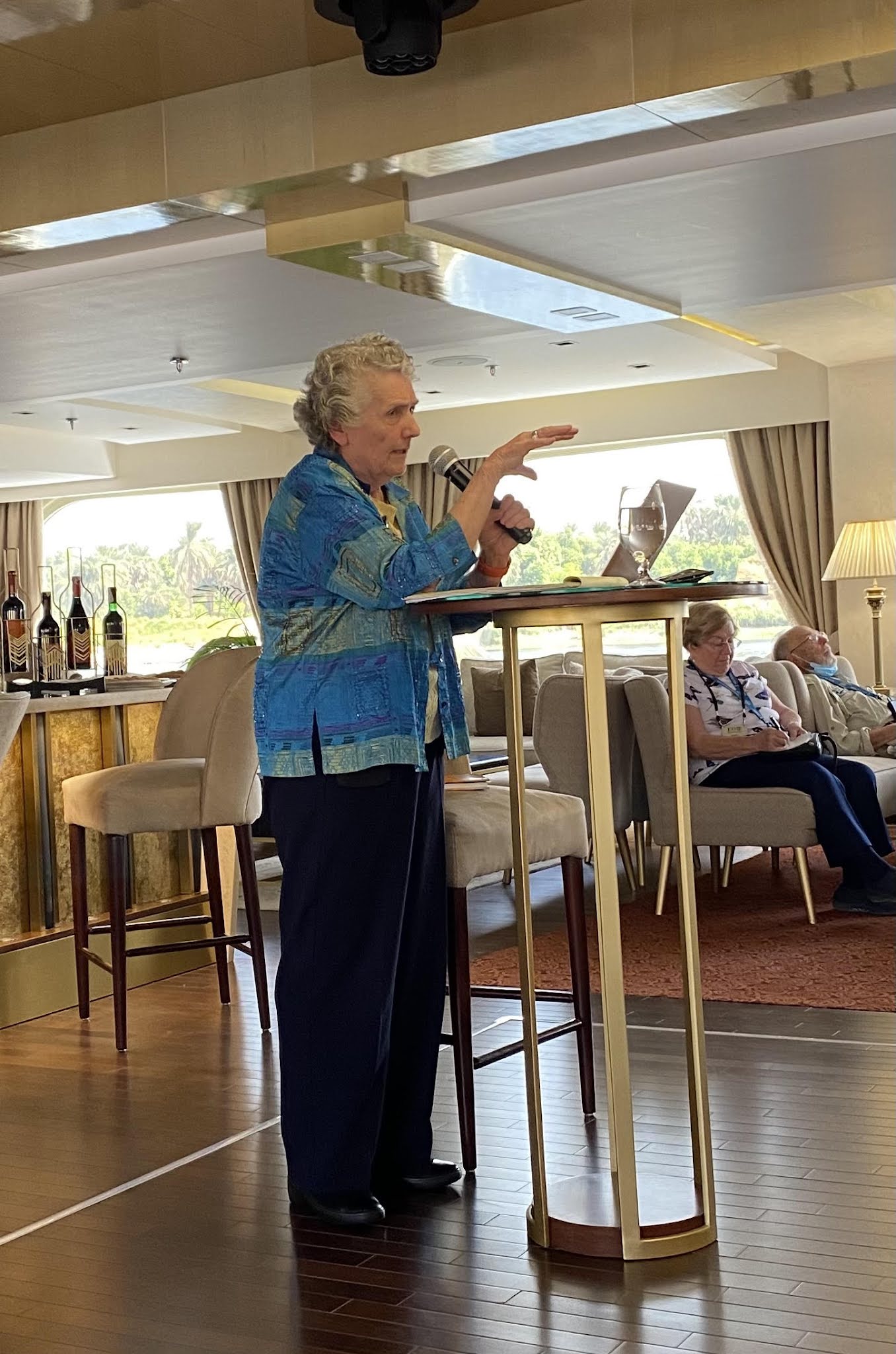
Sister Joan Chittister, OSB, is every bit as amazing as you know her to be in her books. She’s got a razor sharp Irish wit, so there’s the soul of brevity in most everything she says. She’s got a point to make and she makes it with the clarity and passion and forcefulness of the nuns I knew in my youth in Catholic school.


For her, it’s all about Jesus. She believes in and lives out the Jesus story.


Now, if you unpack that, you’ll find more – much, much more – than an 85-year old Roman Catholic nun who might say the same thing and mean that and be obedient to every paragraph, sentence, word and punctuation mark to come out of Rome.


That is decidedly not Sr. Joan.


This girl is on fi-ya with love for the gospel and the person of Jesus Christ.


We had two sessions today with Sr. Joan. She talked about the Pharaohs and the examples they give us of religious leadership and the way they understood the gods. And then, she closed her laptop with a definitive snap and reminded us that, during some of this same time in Egyptian history, a man name Moses – one who had lived among them as one of their own – stood up and said, “There is only one God.”


Well, you would have to understand the pantheon of Egyptian Gods to fully grasp just how radical a statement this was.


But, you’d also have to understand why they built the Temples and the Pyramids to understand that the ideas of Virgin Birth and the Incarnation and Resurrection all came from the Delta – the cradle of civilization and deep religious thought – long before, centuries before Jesus was born.


Then, along came Joseph who pretty much said the same thing about there being one God and saved the very family who had sold him off to slavery from famine and death.


When Constantine declared Christianity the state religion, thousands of people fled to the deserts of Egypt and Syria to live the gospel as they heard it in their hearts and provided hospitality and spiritual to direction to thousands and thousands more people who were starving spiritually and desperate to know how to live the life they heard Jesus calling them to live.

Sr. Joan shared with us some of her favorite stories from the desert mothers and fathers and then asked us to reflect on them from our own lives. She asked questions like, “What is this tory really all about? Why is this story so important? Why do you think it has survived? What does it touch in your life? What does it disturb in you? What good came out of this story for you?”


I don’t have her book with me – her assistant collected all our books for her to sign tonight and/or tomorrow – but the story that was my favorite goes something like this:


The Abbott said, “The time is coming when people will be insane, and when they see someone who is not insane, they will attack that person saying, ‘You are insane because you are not like us.”


She then asked us to be in small groups and have honest conversations about the questions she had posed. Now, you know what? I have been in more small groups in more places in my almost 35 years of ordained ministry and I don’t think I’ve ever had more honest, more intimate, more passionate conversations as we did in my small group.


Do you know what I think made the difference?


I think you know what I’m going to say. Yes, it was Sister Joan and the example of servant leadership she set for the group.


We can’t all be Sister Joan but we can all do our best to be honest about our faith.


We can’t all be Sister Joan but we can all do our best to be passionate about our walk with Jesus and strive to follow his teaching.


We can’t all be Sister Joan because no one else is like Sister Joan and no one else in all the whole world is like you or me but if we strive to be authentic and if we live a life of integrity about what it is we say we believe, we, too, will be on fire with love for God and the Gospel of Jesus Christ.


Tomorrow, I am deeply honored to have been invited to preside at The Liturgy of the Word at the ancient altar of St. Catherine’s Monastery, South Sinai, Egypt.  The monastery was founded in 527 by the Byzantine emperor Justinian. The church is part of the autonomous Church of Sinai, but is part of the wider Greek Orthodox Church, and is considered Eastern Orthodox.


Sr. Joan has asked me to lead the group in her Benedictine form of reflection on the gospel for tomorrow (Mark 10:17-31) about the young man who run up to Jesus to ask, “What must I do to inherit eternal life?” Seems to have been a burning question of the day in many different countries.


I’m to chose one of the stories from the desert mothers and fathers and have the group reflect on it and the gospel story.


I can’t imagine anything more orthodox than that.


Thank you, Sister Joan, for your passion and your wit and your trust.


Even so, please hold me in prayer. This is a huge responsibility and I want to do my best.

I'll let you know how it all turned out.