Come in! Come in!

"If you are a dreamer, come in. If you are a dreamer, a wisher, a liar, a Hope-er, a Pray-er, a Magic Bean buyer; if you're a pretender, come sit by my fire. For we have some flax-golden tales to spin. Come in! Come in!" -- Shel Silverstein

Sunday, February 04, 2018

Out to a Deserted Place

Muynak, Uzbekistan

A sermon preached at St. Martin in the Field, Selbyville
Epiphany V – February 4, 2018

This morning’s gospel (Mark 1:29-39) continues the story we heard last week when Jesus healed the man with the unclean spirits in temple. They went directly from the synagogue to the house of Andrew and Simon Peter, where his mother-in-law was sick in bed with a fever.

Jesus cures her, of course. Scripture says he “took her by the hand and lifted her up. Then the fever left her, and she began to serve them.”

I’m just going to leave that last sentence right there and try really hard not to talk about why she had to get right up out of her sick bed and why those men couldn’t let her rest up just a bit and why they couldn't serve themselves, right ladies? I mean . . . . . . Seriously??? .......

...... Okay...... Sorry. I’m back.

What really caught my imagination was what happened in the morning – after a night of healing people who were sick or possessed of unclean spirits or “demons”. Apparently, sometime in the middle of the night, Jesus slipped out of the house and went to “a deserted place”.

The disciples – who were, you will remember, from Capernaum – knew the area.

And yet, they couldn’t find him.

Jesus was born in Bethlehem but grew up in Nazareth. He would have known his home town but Andrew, Simon Peter, James and John would have known Capernum like the back of their hands. And yet, they "hunted for him" but couldn't find him.

Where did he go? Okay, he went off to "a deserted place" somewhere in Capernaum.

More to the point of my curiosity, why? Why did he go?

That’s the question I’ve been wondering about all week. 

Why did he go off to a deserted place? 

Well, remember, this is at the very beginning of the ministry of Jesus. He has just begun to assemble his ministry team (aka “disciples”).

I can only imagine what it felt like to heal that man in the Temple, and then come to his friend’s house to heal his mother-in-law of a fever. But, it didn’t end there. He spent the whole evening, healing every sick person that was brought to him.

I imagine the human side of him might have been just a little overwhelmed, especially as he allowed the reality of his ministry begin to sink in. 

When the realization of the amount of pain and suffering in the world became too much. When he just had to step away from it all and take a deep breath before he could roll up his sleeves again and get on with the work he was given to do.

I had a moment like that just last week. I went into a facility in Seaford to visit a new Hospice patient. She was a woman in her 80s who had been living with Parkinsons for years. Her condition had begun to deteriorate in the past few months and she needed more assistance to have quality of life at the end of her life.

I went into her room but she was in the bathroom with her CNA. While I was waiting, I looked at the pictures in her room.

Her bed faced the window and there, on the window sill, stood what I immediately identified as her high school graduation picture. I assumed the picture next to has was her husband’s high school graduation picture. 

I made a mental note to ask if they had been high school sweethearts.

I was looking around at all the other many pictures in her room when the noise behind me indicated that the patient and her CNA were coming out of the bathroom. I turned around and saw her. And, my heart sank right to my feet.

I looked at her and looked back at the picture on the window sill and then looked back at her and I tried not to gasp. I made some excuse about my phone and stepped outside into the hallway to catch my breath. 

I was absolutely overwhelmed by the cruelty of Parkinson’s Disease. I've been doing this a number of years. I've seen lots of Parkinson's patients. Somehow, this one caught me off guard.

There she was in her high school picture, a once beautiful, vibrant young woman with her whole life in front of her and now, here she was, completely disabled, barely able to speak above a whisper. 

The cruelty of the disease was unspeakable. But, unlike Jesus, I had no means to cure her, to liberate her from the disease that keeps her captive and in a wheelchair.

I took a few deep breaths, wiped the tears that were welling up in my eyes, shot up a prayer to Jesus for wisdom and the ability to bring her some comfort and solace.

Sometimes – not often, but sometimes – the amount of suffering in the world becomes overwhelming and I just need to step away. Sometimes, to a deserted place.

But, you know – not as often as I’d like but sometimes – the amount of beauty in the world becomes overwhelming. Did you all see the amazing super blue blood moon the other night? Wasn’t it just incredible?

I saw an image of the super blue blood moon next to the Parthenon. There it was - the amazing work of human hands side-by-side with the even more amazing work of God's hands.  The limitations of human mortality overshadowed by the limitlessness of God's divinity.

And, I tell you, tears welled up in my eyes. The beauty was so amazing, it took my breath away.

I had to step away for a moment, just to be able to take it all in – the majesty of life, the beauty of creation, the amazing things humans are capable of creating – like the Parthenon – that pay homage to the every day miracles God is capable of creating.

In 10 days, Lent will begin. It will be a time – a season, 40 days and 40 nights – to step out to a deserted place. I always look forward to this time of year, to allow my soul a good cleaning and airing out.

Scripture tells us that, after Jesus went off to a deserted place, 

Simon and his companions hunted for him. When they found him, they said to him, “Everyone is searching for you.” He answered, “Let us go on to the neighboring towns, so that I may proclaim the message there also; for that is what I came out to do.” And he went throughout Galilee, proclaiming the message in their synagogues and casting out demons”.
Jesus teaches us this morning that sometimes, we don’t need to take a whole season to renew and refresh ourselves, our bodies and minds and souls..

Sometimes, we just need to step away – just for a bit – to a place where no one else is around, and just catch our breath and let the reality of the limits of our mortality and humanity sink in before we go back and do the work we are given to do.

Amen.

Sunday, January 28, 2018

Healing in the Temple

A Sermon preached by the Rev Dr. Elizabeth Kaeton
St. Martin in the Field, Selbyville, DE
Epiphany IV B - Januarly 28, 2018

Contemplative theologian Richard Rohr says Jesus did not come to change the mind of God about humanity (it did not need changing)! Jesus came to change the mind of humanity about God.

So, let’s take a deeper look into this morning’s Gospel to see what it is we once thought about God and God's ability to heal, and what it is that is new about God that Jesus came to change our minds concerning the healing power of God.

I’m always fascinated by the healing stories of Jesus. They are always so graphic and often include "unclean spirits" or demons. Talking demons. The demons always recognize Jesus even when the person he is about to heal – or, the people around him – doesn’t know Jesus or anything about Jesus.

Sometimes, the person doesn’t speak to Jesus much less ask him for healing. But the unclean spirits/demons know Jesus. They recognize him immediately.

And, they always seem to know precisely what he is capable of doing.

So, let’s spend just a minute or so inside that temple in Capernaum where we find Jesus this morning. Capernaum was reportedly the hometown of his disciple Peter. Indeed, there’s a church there, in Capernaum, built over the excavated remains of what was reportedly his home. The disciples Andrew and the sons of Zebedee, James and John, were also from that town, as was the tax collector Matthew.

Jesus did several acts of healing there, in Capernaum. In addition to the man with the unclean spirit, Jesus healed Simon Peter’s mother-in-law, the servant of a Roman centurion, as well as the paralytic man who was so desperate for help his friends lowered him through the roof so Jesus could heal him.

But, this particular morning, no one has sought out Jesus for healing. This particular morning, Jesus was in the synagogue where he will teach and preach. It’s early in his ministry, and he has just started to round up his ministry team. It’s the Sabbath so Jesus leads them to the temple.

Frederick Buechner says that the most hopeful part of the church service is the moment the preacher walks to the pulpit and pulls the little chain on the lectern.  It’s in that moment that the congregation waits for a word from God…  maybe, there might be a word for them today.  Maybe, they will hear something to deliver them from whatever they may be facing for that day, that week, that year. 

Maybe that was the atmosphere in the temple that morning. Maybe that’s why, when Jesus did start to speak, they were “amazed by it” and, scripture says, they started talking among themselves. 

I can hear them saying, “Hey, he’s pretty good, isn’t he? He really knows what he’s talking about.” (Scripture tells us they said, “He speaks with authority”.)

Just then, a man ‘with an unclean spirit’ starts to call out, interrupting Jesus. He starts yelling, “What have you to do with us, Jesus of Nazareth? Have you come to destroy us? I know who you are, the Holy One of God.”

You know, that actually happened to me, once. Well, the man didn’t say exactly that but I was once interrupted by a man – a vagabond, a street person – in the midst of a sermon I was giving in a church.
I was a seminarian at the then Mission Church of St. John the Evangelist on Bowdoin Street, a high Anglo-Catholic Church in the middle of Beacon Hill and Government Center (the old Scollay Square) in Boston. 

A man in filthy tatters for clothing came walking up the middle aisle of the church. 

He was smoking a cigarette. 

Which was fine, I suppose, because we used a lot of incense.

I could smell him all the way from the pulpit – a powerfully pungent mixture of body odor and cigarettes and whiskey. He was sweaty and covered with soot. His face was puffy, his eyes two small slits under a dirty woolen cap, and he had huge bleeding knots on his eyebrows and chin.

I don’t remember what he said, exactly. For all I know, he might have been saying, “We know who you are! Have you come to destroy us?” Whatever it was, I only remember that it was slurred and loud. Very loud.

He made his way up to the crossing when he stopped and looked up to gaze at the image of Jesus on the cross hanging above the altar. 

I heard myself gasp just then, along with several others in the congregation, as we suddenly realized how much they looked like each other – Jesus and the vagabond street person. 

He squinted his eyes and moved the greasy strands of hair from in front of his face as his body began to sway.

“Oh God. Oh, Jesus, help me,” he cried out as his knees buckled and he fell to the floor with a loud thud. As some of us raced to help him, his body began to writhe in uncontrollable seizures. 

We gathered around him but it seemed that an invisible force-field-shield had come up between his body and the congregation. We were driven by our desire to help, but simultaneously repulsed by his foul smell and his filth. 

The church was silent except for and occasional primal-sounding grunt and the sound of his head hitting the hard floor every time he seized.

It was just then that Emmett, the rector, seemed to swoop in from seemingly nowhere, silently parting the sea of bodies. He seemed oblivious to the fact that he had on his magnificently embroidered vestments. 

He knelt down in front of the man as if he were one of the wise men, kneeling before the manger where the infant Jesus was laid. Carefully, and ever so gently, he cradled the man in his arms and laid his head in his lap.

Softly, softly, he whispered, “I’ve got you. It’s going to be all right. I’ve got you.” And then, he looked up and quietly asked, “Has anyone called an ambulance? Please call an ambulance for this child of God.”

And then, Emmett did something I’ll never forget. Ever. He looked down again at the man and, cradling him in his arms, he gently, sweetly, kissed his forehead. That sooty, filthy, bloody, smelly forehead.

And, here’s the thing: I don’t know about that vagabond man and his epilepsy but I felt the demons of judgment and condemnation leave my body. 

I realized that this was a man whose illness drove him to insanity. Perhaps his illness made it impossible for him to work. Perhaps he got depressed. Perhaps his family couldn’t deal with him any more and sent him to live on the street. Perhaps he could not afford the medication he needed. Perhaps he medicated himself with alcohol.

As each possibility of his story unfolded before me, I could feel my own demons being cast out. 

Someone in the church started singing “Amazing Grace”. 

Pretty soon, the whole church was filled with the harmony of that amazing song. We sang it as the ambulance arrived to take him to Mass General Hospital. We sang the last verse as Emmett took off his vestments, placed them on the back pew and climbed into the ambulance with the man to accompany him to the hospital.

The congregation heard the gospel that day but they didn’t hear it from me. They listened to it and watched it unfold right before their very eyes as a man with a debilitating illness was tended to by a priest in the church. 

And, they also saw the casting out of the demons of others as well as their own demons and we were all healed.

I also leaned that Richard Rohr was right. Jesus did not come to change the mind of God about humanity (it did not need changing)! Jesus came to change the mind of humanity about God.

And, when we follow the teaching of Jesus, our human minds are also changed about our own humanity – as well as the humanity of others.

Amen.

Tuesday, January 09, 2018

Walking in Beauty


"Walking, we go walking toward the sun.
Walking, we are walking toward freedom."
Caminando, a Spanish Christmas Song

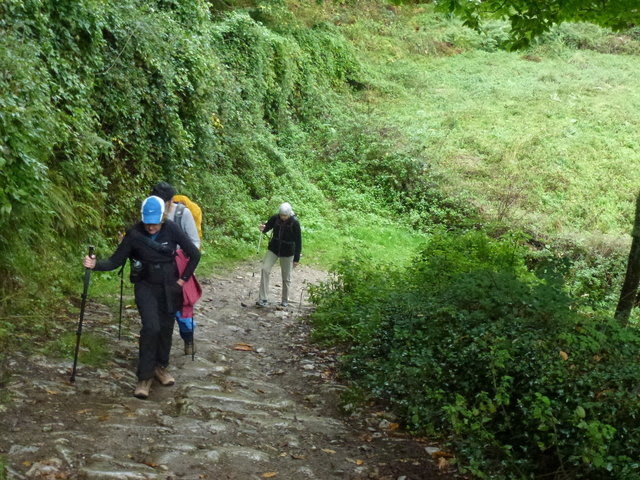
In August, I signed up for Walk in Beauty: A Pilgrimage of El Camino de Santiago, October 8-20, 2018. 

It is promised as a "transformational journey" - a big promise to be sure - but it aims to deliver by being lead by a woman named Valarie Brown, a facilitator at Parker Palmer's Center of Courage and Renewal. She is also a Buddhist priest, ordained in 2003 by Thich Nhat Hahn.

I am so excited, I can't hardly sit still.

Just today, I got my "prep package" so I'm ready to walk the 7-10 miles per day, from San Sabastian to Santiago, Spain, the mythical burial place of St. James, who is credited with bringing  Christianity to Spain.

San Sabastian is described as "a lovely seaside metropolis located in the Basque region of the northern Atlantic coast, boarding France, widely considered one of the best places to eat in the world, and home of some of the world’s best restaurants."

Oh, I'm so in. And, yes, I plan to get recipes. 

It continues: "This Pilgrimage to Santiago takes you through beautiful forests, charming villages, and historic towns and cities such as Bilbao, Santillana del Mar, Comillas, Cangas de Onis, and Oviedo. Taking the Northern Route to Santiago de Compostela, this 164 kilometer/102 mile journey, is divided into eleven inspiring walking stages and includes a visit to the Caves of Altamira, a UNESCO World Heritage Site.

The Pilgrimage Resource Guide is packed full of information about walking clothes, shoes, packs as well as books, music, films, etc.

My group of 10 will also have three opportunities, from now until the end of September, to have three Zoom Conference times, so that we can see each other and talk with each other and begin to know who we are individually and collectively and begin to bond.

 The terrain of the walk, they say, will be 
"varied: rural paths, walking trails, small villages, coastal beaches and hilly terrain. Please start slowly and gradually build speed and endurance. This pilgrimage is not a race. We will walk a moderate to slow pace, perhaps three miles per hour, with plenty of time to stop to enjoy the landscape, fellow pilgrims and the local scenery."

You will need only a day pack with essential supplies. Your heavy luggage will be transported to our paradores or country farmhouse inn. The Spanish honor siesta time and we will pause each day for a lovely lunch in a local cafe. Additionally, we have the comfort of a private van, stocked with healthy snacks at our disposal."
So, before you judge me, let me just say that I ain't 20 no more. Neither am I in my 30s or 40s. I've even passed my 50s. So, wait till you're that age before you judge me too harshly. In April, I begin a major birthday so it feels the absolutely right time to make this kind of pilgrimage.

I did walk around my local grocery store with two 5 pound bags of sugar in my backpack. That was when I realized I couldn't do this on my own without some help and began to look for alternatives.

Anyone who knows me knows that I've been planning this for five years. Unfortunately, in those five years, Ms. Conroy had abdominal serious surgery and damn near died. Then, she had both knees replaced. I just couldn't leave her while she was recovering and recuperating. 

Guess what? She, like everyone else, only has two knees. I know, right? So, unless an emergency arises, I'm off from October 8-20, 2018 to Santiago, Spain, for the pilgrimage to prepare for what will undoubtedly be the last quarter of my life.

One of my beloved spiritual guides, Sr. Rosina, OSH, advised me that every journey has three parts. It begins with clarification. Once one is clear about why the journey is necessary, one enters the phase of preparation. After one has prepared, one is able to move more fully into participation.  


When I was on Advent retreat, I got clear about why I needed to do this Camino. Now, comes the preparation so that I am ready to fully participate in the journey. 

I ask your prayers as I begin the preparation phase of this journey.  It's not going to be easy. In fact, it will take enormous commitment and dedication. It will be exactly the kind of preparation I need in order to fully participate in this journey.

Some of the questions I will be taking with me on this juourney include:
What do I need to take with me on the last quarter of my life's journey?
What do I need to leave behind?

What is essential?

What is luxury? 
What is necessary? 

Can I trust my body to have the stamina it needs to complete this journey? 

Who am I, now that I am no longer young and as strong as I once was?

Who is God for me? Has God changed in the same ways I have - physically, intellectually, emotionally,  and spiritually? 

Who are my people? Can I trust in the kindness of strangers?

What is God calling me to do/be as I begin this last quarter of my life?
Part of my preparation will be to begin to live with these questions so that I can walk with them in the hope of walking deeper into the questions in order to find answers. 

I hasten to add that I don't for a minute believe that I will finish the Camino with an answer to these questions. 

That's not what matters. What matters is to be able to make friends with the questions and to learn to love them. 

So, dear friends, that is my prayer request to you: 

Help me to walk with these questions so that I can learn to love them.

Thank you. I so deeply appreciate it. 

I will post more updates as they arrive. 

As they sing in Spain at Christmas:
"Walking, we go walking toward the sun.
Walking, we are walking toward freedom."

Saturday, December 23, 2017

Prophets of Advent IV: Bathsheba the Righteous


Bathsheba is the fourth woman named in the lineage of Jesus recorded in the first chapter of Matthew. (Matthew 1:6)

Her story is told in the Hebrew Scripture of the Second Book of Samuel. Like, Tamar, Rahab and Ruth, her scriptural sisters before her, she comes with a complicated, troubled past. And, like her sisters, Bathsheba also acts righteously, although the biblical narrative about her is often tarnished in the telling by her extramarital affair with King David.

Bathsheba was the wife of Uriah, one of King David’s generals. David had made quite a name for himself having slain “18,00 Edomites in the Valley of Salt” (2 Sam 8:13). 

The very next chapter contains an endearing story of Samuel that ought not be missed. David takes in Mephibosheth, the crippled son of his dearest friend Jonathan and grandson of Saul. Mephibosheth eats at David’s table and is treated like “one of the king’s own sons”. 

The story makes abundantly clear the love between Jonathan and David. It is an interesting prelude to the story of the darker side of the King in this next chapter of his life. 
Bathsheba’s husband, Uriah, is near Rabbah on the front lines of the battle with the Ammonites. 

David, on the other hand, is back at home, feeling invincible. 

Even though it was “the time when kings go out to battle,” (2 Samuel 11) David decides to stay home. Perhaps this sense of invincibility is the reason he makes no secret of his lust for Bathsheba, sending his men to fetch her after he sees her bathing on her rooftop.

Like the story of most women, opinions about Bathsheba vary widely on a continuum between two extremes. She was either a temptress who seduced David or she was an innocent victim and David raped her. 

No matter. Both the culture and law of the ancient times in which she lived were stacked against her. If she succumbs to David, she is guilt of adultery. Deny him and she is refusing the King. 

Either way, both actions are punishable by death. Either way, she knows the ancient shame of women which continues to haunt women to this day.

The whole illicit affair probably would have gone unnoticed except that Bathsheba becomes pregnant. Now, David has to put on his big boy pants and become responsible. 

Except, of course, he doesn’t. He sends for Uriah to come home from the war to be with Bathsheba. It’s the only way to protect his reputation and save Bathsheba’s life.

It is believed that Uriah must have been onto David’s plot because he refuses to come home. (2 Samuel 11) His decision heaps judgment on David’s head. While David is relaxing at home, sleeping with other men’s wives, God’s ark is in a booth on the battlefield. He is not on the battlefield during “the time when kings go out to battle.”

And, just like that, the situation is no longer about Bathsheba and the pregnancy. 

It’s about the King’s authority. And, the King’s pride. 

David devises a plot to have Uriah and others killed in battle against the Ammonites by sending Uriah and others too close to Rabbah. David’s nefarious plot is successful and he does the "righteous" thing and marries Bathsheba.

But, what David has done “has displeased the Lord,” and God sends the prophet Nathan to rebuke him, predicting that the child will not live because of “the sins of the father” (2 Samuel 12:14). 

Even though David repents, the child dies.

Consider, then, the lowly estate of Bathsheba. Her husband Uriah is murdered and her first born son taken from her as recompense for David’s sin. For her whole life, she must endure side-glances and whispers and rumors of scandal and shame. 

How much grief and suffering must one woman bear for the sins of one man?

Eventually, Bathsheba bears another son, Solomon, of whom Scripture says, “the Lord loved him”. (2 Samuel 12:24). David even promised that Solomon would be his heir.

But, Bathsheba isn’t out of danger yet. When David is old and his house is in shambles, his son Adonijah tries to take over. If he becomes king, Bathsheba will be viewed as an adulteress and neither she nor her son Solomon will be recognized as “legitimate”.

The prophet Nathan understands well the implications not just for Bathsheba and Solomon but for all of Israel as well. He also understands that Bathsheba has special authority to intervene with David. 

Bathsheba appeals to David:
“My lord, you swore to your servant by the Lord your God, saying, “Solomon your son shall reign after me, and he shall sit on my throne.” And now, behold, Adonijah is king, although you, my lord the king, do not know it…And now, my lord the king, the eyes of all Israel are on you, to tell them who shall sit on the throne of my lord the king after him.” (I Kings 1)
Bathsheba cannot know at the time that Solomon’s reign will be the most peaceful and prosperous time of Israel’s history, and she does not know that the Savior of the world will be born through Solomon’s line. 

Bathsheba’s action saves her life and makes Solomon King, ensuring God’s favor on Israel. Bathsheba went to have four more sons with David (Solomon, Shimea, Shobab, and Nathan) and two of them are listed in New Testament genealogies. Joseph, Jesus’s earthly father, was a descendant of her son Solomon (Matthew 1:6) and his mother, Mary, was a descendant of her son Nathan (Luke 3:31).

So, when you light the fourth blue candle of your Advent wreath this evening, remember the story of one of the women in the genealogy of Jesus.

Remember Sister Bathsheba and how she transformed her lowly status of vulnerability and shame as well as the deep grief of the murder of her husband and death of her firstborn son into a vehicle of the redemption of Israel. 


Through her righteousness came not only the wisest leader of the most peaceful and prosperous time in that ancient land but also the Incarnation of Ancient Wisdom.

Remember and tell the story to your children that your children's children from generation to generation may know that the glory of God is the human person fully alive.

Holy God, as we begin to turn our eyes toward the lowly manger in Bethlehem where we await the birth of Jesus lying weak and vulnerable in the midst of the harshness of the world, help us to turn our hearts toward hope and trust in your goodness. 


Give us the strength and righteousness of Bathsheba that shame, vulnerability and grief may be transformed and through us wisdom and salvation may be born again. 

Amen.

Sunday, December 17, 2017

The Prophets of Advent III: Ruth of Moab

Ruth is the third woman named in the lineage of Jesus recorded in the first chapter of Matthew. Her story, told in the Hebrew Scripture of the Book of Ruth is familiar to many of us.  Well, at least the part where she refuses to leave her mother in law Naomi.

The fuller story of Ruth’s courage and faithfulness and tenacity to the family she married into leads her to begin an entirely new family, one which also leads to a religious conversion and will place her in the lineage of the House of David and elevates her lowly estate to an ancestor of the Messiah.

The story begins when a family of four, Naomi with her husband and two sons, leave Bethlehem to travel to Moab to escape the famine which has brought hardship and tragedy to the land and its people. It’s important to note that the nation of Moab was descended from Lot’s son of the same name. These families had been separated for many generations. Moab had a long history of conflict with Israel and intermarriage between the two countries was frowned upon.

Even so, Naomi’s sons marry Moabite women – Ruth and Orpah – but tragedy strikes and all three men die, leaving the women destitute in that ancient culture. With absolutely no hope for the future, the three women leave Moab and head back to Bethlehem where Naomi at least has family.

Along the way Naomi has a change of heart, and urges Orpah and Ruth to return to their families (releasing them from their marital obligations). Orpah turns around but Ruth stays, pledging the words which have become a familiar if not romantic part of wedding ceremonies “Wherever you go, I will go…your people shall be my people, and your God, my God” (1:16).

Unfortunately, no one in Bethlehem is able to help the three women so Ruth comes up with a plan to work gleaning in the fields which are owned by Boaz, a wealthy relative of Naomi’s late husband. 

Ruth’s hard work catches the attention of Boaz, who begins to take an interest in her welfare and offers her protection and extends her some privileges.

Ruth works there until the end of the barley and wheat harvest, which is about two months. Still, no one comes to help them. 

Naomi develops a plan to help Ruth secure a marriage proposal from Boaz and instructs her to go to him privately in the dead of the night. But Ruth appeals to Boaz, asking him to assume the ancient tradition of taking on responsibility for destitute relatives. Boaz is rightly impressed by Ruth’s character and loyalty to Naomi and agrees to her proposal.

Arrangements are made – with great delicacy and finesse since there is a closer relative who must be dealt with first and money, of course, is involved – but Ruth converts to Judaism and marries Boaz and they have a son, Obed. This makes Ruth an ancestor of David, Israel’s most illustrious king.

On this third Sunday in Advent, Ruth’s story also sets our eyes, like the shepherds and wise men from the East before us, toward Bethlehem.
  • It was in Bethlehem that Judah’s tribe settled (See Advent I: Tamar.)
  • It was to Bethlehem that Naomi returned with her daughter-in-law, Ruth, the Moabite, bringing reconciliation to two families separated for generations.
  • It was in Bethlehem that Ruth and Boaz (a descendant of Rahab - see Advent II) married and had a son, Obed.
  • It was in Bethlehem that Obed raised a family, even a grandson who would be king (and who would marry Bathsheba whom we will meet next week.)
  • It was to Bethlehem that Joseph traveled with his very pregnant wife, Mary.
  • It was in Bethlehem that Jesus, the Prince of Peace, was born
  • It was in the fields of Bethlehem that angels appeared to announce Jesus’ birth to the shepherds.
So, when you light the third – pink! – candle of your Advent wreath this evening, remember the story of one of the women in the genealogy of Jesus.

Remember Sister Ruth and her courage and strength, her valor and faithfulness to “the tie that binds” all human hearts in love over the ancient hurts that separate us. And, say a prayer for Sister Naomi whose generous heart took in her daughter-in-law even though she had many reasons that mitigated against that act of sacrificial love.

Remember and tell the story to your children that your children's children from generation to generation may know that the glory of God is the human person fully alive.

Holy God, as we begin to turn our eyes toward Bethlehem, help us to turn away from ancient fears and follow the light of Love which leads to hope and reconciliation. Give us the faithfulness and strength of Ruth to take the risks of love that we may become Children of Light and Hope and Love. 

Amen.

Sunday, December 10, 2017

The Prophets of Advent II: Rahab, Canaanite of Jericho

Rahab is the second woman recorded in the genealogy of Matthew ( Matthew 1:1-17)

She is called a prostitute in both Hebrew (Joshua Chapter 2 & Chapter 6.) and Christian (Hebrews 11:31) scripture, but the more we learn about human trafficking in ancient and modern times, the more we understand that this was most likely not a woman living a "lifestyle" of her own choosing.

What is clear is that she was three times an anawim - one of the social outcast beloved of God: a woman, a foreigner - and, a Canaanite of the city of Jericho at that - as well as a woman in the sex trade, probably then as it is now, not always a voluntary industry.

Rahab is also a woman geographically on the margins. The house in which she lives is on the outskirts of the city. Her rooftop was adjacent to the wall of the city. As the story unfolds, we will see that she uses her both her demographic and geographic locations to her distinct advantage.

Here's the story: Joshua, son of Nun, has led the Israelite army across the river Jordan. Before entering the land west of the Jordan River, Joshua sends out two spies to check out the city of Jericho, the most important and fortified Canaanite city in the Jordan Valley.

The king of Jericho heard that two Israelite spies were within his city and ordered them to be brought out to him. 

Rahab, the woman with whom the spies were staying, protected them by hiding them on her roof. 

She told them how the citizens of Jericho had been fearful of the Israelites ever since they defeated the Egyptians via the Red Sea miracle (some 40 years prior). She agreed to help them escape, provided that she and her family were spared in the upcoming battle. 

The spies agreed to her request, giving her three conditions to be met: 1) she must distinguish her house from the others by hanging a scarlet rope out of the window so the Israelites would know which home to spare; 2) her family must be inside the house during the battle; and 3) she must not later turn on the spies.

The two spies safely escaped the city and returned to Joshua. They reported to him that "the whole land was melting with fear".  

The Israelites crossed the Jordan into Canaan where they laid siege to the city of Jericho. The city was completely destroyed, and every man, woman, and child in it was killed. Only Rahab and her family were spared. 

Eventually, Rahab marries Salmon, an Israelite from the tribe of Judah. Her son was Boaz, the husband of Ruth. Joseph, the legal father of Jesus, is her direct descendant.

Rahab is not someone we would expect to defy a king, save Israelite spies, and play a part in God’s people taking the Promised Land. But this is exactly what happens.

Rahab is the first occupant of the foreign lands to show loyalty to Israel and Yahweh, and is welcomed in as a new member of the nation of Israel.

In Joshua 2:8-11, Rahab reveals herself as a prophet of God. She gives a declaration to the spies that Israel will successfully take over the land of Jericho.

The Israelites do not yet know this to be true, but her words bear weight with them and they carry her message back to Joshua.  Rahab’s foretelling of the work of the Lord causes Joshua to move into action.

Rahab plays the temporary savior to Israel by protecting the spies, declaring their victory, and eventually becoming part of the lineage of the House of David.

In traditional religious literature, much is made of the "fact" that Rahab is a prostitute whom God lifted high. She is more likely an oppressed and marginalized outcast, forced into human trafficking industry in order to survive, in whom God saw great potential and ability.

So, when you light the second blue Advent candle this evening, remember the story of Rahab, the Caaninite of Jericho.

Remember Sister Rahab and her ability to use her demographic and geogrpahic location, both concidered morally suspect and sinful, as courageous rescurer, bold prophet, and humble vehicle of the royal lineage of The Messiah.

Remember and tell her stoy to your children that your children's children, from generation to generation, may know that the Glory of God is the human person fully alive.

Holy God, give us the ability to use all that we have been given, no matter how humble or seemingly inadequate or inferior, to your glory and in service of your love for all your people. 


There will always be pie!


Advent II: There Will Always Be Pie!
A Sermon Preached at St. Martin in the Field, Selbyville, DE
(the Rev'd Dr.) Elizabeth Kaeton

I love Advent. I wish we could observe it without all of the razmataz of Madison Avenue, pushing Christmas carols and Holiday Cheer and, of course, the latest gadget or toy or jewelry or perfume or tool or article of clothing past the point of tolerance and sanity, but I’ve come to think of those things as just background music to a busy season of preparation.

Advent is a time for waiting and watching and, as this morning's prophets, Isaiah and John the Baptist, proclaim, "Prepare the way." 

This can sometimes turn into a time of melancholy, especially when the inevitable memories of Christmas Past come to visit. Sometimes, we can get lost in what was - or what will never be. 

Sometimes, waiting and watching means we get stuck in the impossible rather than look for the unexpected.

I have a friend who has gone through a rough patch. A few years back, her husband left her and her three children for another woman. It’s been really, really hard. She’s moved to a new home, gotten a new job, made new friends, put down new roots – none of those easy tasks.

We all thought she had come through the worst of it but we’ve noticed that, of late, she’s gotten a bad case of the holiday blues. 

Well, it started a bit before the holidays but the commercialization of Christmas wants us all to achieve the “picture perfect” holiday – which has absolutely nothing to do with all of the imperfections of the Nativity Story.

Depression is tricky to deal with. It can run the range from being annoying to just flat-out dangerous, and that can turn on a dime. You don’t want to ignore it, especially when you know it exists – and, especially when that can be your impulse.

A few of us got together on the Friday after Thanksgiving for a “Left Over Turkey Day”. We all brought our leftovers. I made a huge vat of turkey soup and a couple of Turkey Pot Pies. Others brought desserts and veggies. Everyone brought their own holiday cheer.

When it came time to eat. I asked for a pie server to slice and serve the pie. You know. It’s that triangular thingy that makes serving up slices of pie a whole heckuvalot easier.

One of her sons started rummaging around the utensil draws to find it.  “Mom!” he finally yelled in exasperation, “Where’s the pie server?”

“Oh,” she says, “I don’t have one.”

“You don’t have one?” he said incredulously. “Mom, we always used to have a pie server! Everybody has a pie server! Why don’t we have a pie server?”

“Well,” she says, “I knew I’d be moving here alone. I didn’t think I’d ever need it again.”

At which point, I found myself swirling around and saying, “Woman! Get a grip! Don’t you know? There will ALWAYS be pie! No matter how bad things can get, no matter if it’s even made up with the remains of Thanksgiving Day – my grandmother said it and I know it to be true – 

THERE WILL ALWAYS BE PIE.”

Here’s the thing: I didn’t know that I grew up poor until I was a teenager and studied sociology in high school. I’m a first generation immigrant and every member of my family worked in the mills and factories in New England.

We lived in a tenement apartment but we had a clean, safe, warm, dry roof over our heads.

Our clothes were all home made or hand-me-down but we had clothes - clean clothes. 

Our food came from my grandparents garden and the chickens and goats and pigs and rabbits they tended, but we never went hungry.

Even when times were tough, there was always pie. Ironically, my favorite was the one pie that was made to stretch the food in the cabinets and larder. 

It was my Grandmother's should-have-been-world-famous Onion Pie. 

My grandmother would sauté up some onions and garlic in butter. 

If she had it, she would add some thinly sliced potatoes. She would always try to add some slices of a hard boiled egg. Sometimes, she would add some grated cheese. She'd sprinkle it all with her seasonings. Then, she’d make one of her amazing, flaky pie crust and pour the onion mix into the crusts and bake.

Ohhhhhh. Muuuuhhhh Gudddd!!! It was double-deeeee-lishous!

And, for desert? Pie. Of course. Sometimes, they were made individually in washed out cans that had formerly held tuna. We’d have apple or peach or blueberry pie from the fruit my grandmother grew in her orchard which she canned and kept in the cellar.

No matter how bad things got, there’d always be pie.

So, here’s my Advent message to you. Granted, it's not the one that was foretold by John the Baptist, but it's in that same spirit.

Let’s just consider it a modern translation of the ancient Hebrew script from Isaiah about  "comforting my people" and “preparing the way”.

Advent is a time to prepare the way – to make a two-way path – to be able to both receive and give love and hope, comfort and joy, on the road to finding peace on earth, good will to absolutely everyone.

Advent is the time to prepare the way for miracles – for possibility in the existence of oppression – for hope in the face of despair – for light in the presence of darkness.

Advent is the time to prepare the way for good things – for ourselves and others – for the anticipation of and participation in the pure delight and of simple things and the joy of possibility.

Yes, like a sweet newborn babe, wrapped in swaddling clothes and laid in a manger.

There are also other simple things to anticipate and in which to participate. Like the feel of the first new-fallen snow of the season as it crunches under your boot or lands softly on your face or tongue.

Like Christmas cards or letters or, yes, even emails – but especially phone calls – from family and friends we haven’t seen or heard from  in years.

Like the smell of cinnamon and nutmeg in the holiday treats as they bake in the oven. Yes, like pie. A bit of goodness held together by two crusts. Some things gathered from the fruits of the earth and reconstituted to make a meal for more.

Advent is a time to proclaim that even in the midst and cold of winter, the goodness of God is promised to us. There are many signs and symbols of that promise: Splashes of the royal colors of gold and red, blue and purple – promising the arrival of the Prince of Peace; the lighting of each candle on the Advent wreath, one by one, against the darkness.

This year, I’m getting a special Christmas present for my friend. You guessed it: A pie server. Because, you know: No matter how bad things get, there will always be pie.

Even if you live alone. Even if you can’t imagine eating pie by yourself. Make a pie, anyway. If you don’t know how to make a pie, or don't have the energy to put one together, BUY ONE!! Don’t eat it alone if you don’t want to. Use it as an occasion to invite your friends.

It’s a natural born fact that you can’t be unhappy when there’s pie in the room. And, having a pie in the room makes you want to call your friends to share the pie. That’s just how pie works.

And, isn’t that how God’s love works? It’s like that kid’s song: “It only takes a spark to get a fire going…… That’s how it is with God’s love. Once you experience it, you want to pass it on.”

We know how the Advent story ends. Ready or not, Jesus will come.

Even so, let us prepare all our hearts to celebrate the excitement of anticipation, the certainty of hope, and the goodness of love.

Prepare the way! Jesus is coming!

And, yes, Virginia, there will always be Christmas!

Hold onto your pie servers! 

Because yes, Virginia, there will always be pie!

Amen? Amen!

PS: For those of you who asked, no, I don't have my grandmother's recipe. However, this one comes close to the recipe I remember.  There's also this one from Nigella Lawson I don't know what kind of cheese my grandmother used - probably a soft cheese like the Portuguese version of Mozzarella or maybe some Cheddar but you can use whatever you like. My grandmother sometimes added slices of hard boiled egg. The onions, as I remember, were yellow and sweet. And she used real butter. Of course. But, it wasn't like a quiche like Paula Dean makes. It was just straight up onions and garlic and maybe some slices of potatoes. And, it had a top and bottom crust. So, so, so good.

Sunday, December 03, 2017

The Prophets of Advent I: Tamar of Judah


Tamar is the first women mentioned in the genealogy record in Matthew 1:1-17.

Her story is sandwiched in between the story of Joseph being sold into slavery by his brothers in Genesis 37 and his encounter with Potiphar's wife in Genesis 39.

Tamar's father-in-law, Judah, was one of Joseph's older brothers. Her story really begins in Genesis 38, when Judah leaves his father's house and marries a Canaanite woman who bears him three sons.

Tamar had married Judah's eldest son, Er, who, we are told, so grievously offended God that he died before the two could have any children.

According to custom of that day and time, Tamar is entitled to an heir, so she was given to the next oldest son, Onan. Unfortunately,  Onan also does not live up to his obligations and he, too, dies an untimely death.

Judah has one more son but he is too young to marry. This places Judah in a dilemma and he actively seeks to get out of his obligation to Tamar.

It would have been acceptable for Judah himself to serve as a surrogate.  But rather than recognizing that the deaths of his sons are the consequence of their own choices, Judah blames Tamar (hmmm . . . do we recognize a pattern of behavior here?)

Judah goes against custom and sends Tamar to live as a widow in her father’s house. As time passes, Tamar realizes Judah is not going to do the right thing. In fact, he has chosen not to act at all, making no provisions for her future and putting his own family in danger of extinction.

In those days - as still is in some places in these days - women had no legal recourse when the men who controlled their destiny chose to mistreat them. So Tamar is faced with a serious choice: submit to Judah’s authority or come up with a way to conceive within his family.

Tamar devises a plan to trick Judah into helping her conceive a child. She disguises herself as a prostitute and Judah - well, what's a man to do? - takes "advantage" of her offered .... "services".

Tamar asks Judah for a good faith sign of his willingness to compensate her. Judah leaves her with his signet, cord, and staff. (This would be the Near Eastern equivalent of legal identification by today’s standards, and this evidence will prove her innocence later on, saving her life and the lives of her children.)

When it becomes obvious that Tamar is pregnant, Judah is incensed at the shame brought upon his family and calls for her to be burned.

When Tamar sends him his seal and staff, he realizes what has happened and admits that he is the father.  Not only that, Judah actually praises Tamar for her actions.

Of course, the story has been told by the church fathers as a story of "adultery" or "revenge" or "common prostitution" and, of course, Tamar is the one who is wicked.

Truth is, when you understand this story in the light of its ancient cultural context, you understand that what Tamar did, while perhaps morally suspect, was the only path open to her to seek justice for herself and to secure the inheritance of the family of David.

Tamar was then doubly blessed for realigning the House of Judah with God's purposes, giving birth to twin boys, Perez and Zerah, both of whom are named in Matthew's genealogy (Matthew 1:3).

So, when you light the first blue candle of your Advent wreath this evening, remember the story of one of the women in the genealogy of Jesus.

Remember Sister Tamar and her courage and tenacity, her intelligence and bold imagination which led to her ability to achieve justice for herself and her family.

Remember and tell the story to your children that your children's children from generation to generation may know that the glory of God is the human person fully alive.

“From Judah will come the cornerstone.” Zechariah 10:4a

Holy God, give us the strength and courage and bold imagination and intelligence of Tamar, that, when the path of justice has been blocked, we might find a way to overcome all obstacles, even if by risking travel on different - if even questionable - road.