Come in! Come in!

"If you are a dreamer, come in. If you are a dreamer, a wisher, a liar, a Hope-er, a Pray-er, a Magic Bean buyer; if you're a pretender, come sit by my fire. For we have some flax-golden tales to spin. Come in! Come in!" -- Shel Silverstein

Saturday, November 12, 2022

Camino: Coming Home Again


Coming home after Camino. From pilgrim to citizen again (and back)


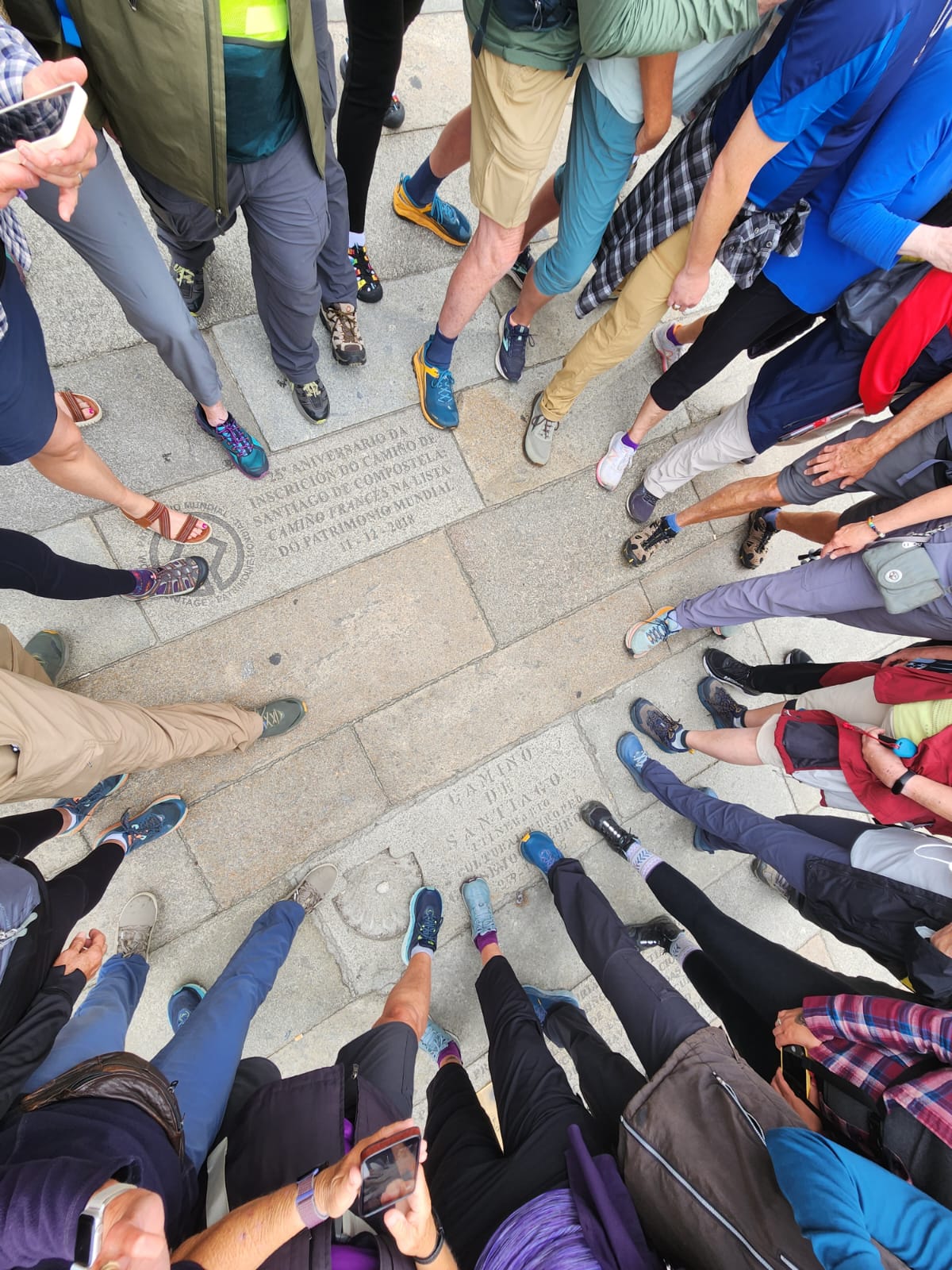
The realization hit me full force as I walked into the Cathedral piazza in Santiago de Compostela, Spain, for the first time in 2018: I am a pilgrim.

Not a hiker. Not a tourist. Not a visitor to holy places. A pilgrim.  

I have traveled with a sense of openness and adventure and curiosity. I have traveled, not just with my body but with my mind and heart, my soul and my spirit.

I have been part of a ‘moveable community’ of fellow pilgrims who bear witness to each other’s journeys. I recognize in the faces of other pilgrims the state of my own soul: I know, deep in the deepest place of knowing that, even though I still am who I am, I have been changed and transformed and will never again be the same. 


After I finished the Coastal Camino Portuguese in 2022, I was glad I planned to have a few days to decompress and rest after that great spiritual, emotional, mental, and physical high of having completed this amazing journey.

Soon enough – too soon – it was time to travel back home. That had been an aspect of the pilgrimage I hadn’t adequately planned for after my first El Norte Camino in 2018.  This time, I was better prepared to make the journey from pilgrim to citizen again.


I’d like to share with you what worked for me.


First, it’s important to practice being gentle with and kind to yourself. Re-entry is a very tender time. The excitement of returning home combined with the sadness of leaving can create what the Celts call “a thin space” – a spiritual time when heaven and earth come very close. Your heart has been wide open. This is a time to learn to put a protective fence around it. Not a wall, but a fence. With open spaces. And a gate. With a lock. On the inside, so you control what or who goes in and what or who goes out.


Be gentle and kind to yourself so you can be gentle and kind with others and be patient when yet another person says, “So . . . tell me about your hike!” and your impulse is to raise your voice and say in a tone and volume you didn’t intend, “It wasn’t a HIKE, it was a pilgrimage!”

Breathe. Deeply. And say, simply, “My pilgrimage was really incredible. Let me gather my thoughts a bit more before I share them with you.”


Which leads me to the second thought: Share your experience appropriately. Try to resist giving a PowerPoint Presentation to a large group of interested folk. Not for awhile, at least. Begin slowly, perhaps over a cup of tea or glass of Port Wine, with a trusted family member or friend or colleague. This is where keeping a daily journal on Camino can come in handy, but looking over your photo collection will also prompt memories.

As you look over your notes and/or your photos, you might want to explore something your wrote, some observation you made, some insight you had, some brief encounter with another pilgrim that feels right to share at that time.


It's more important to stay connected with the things you experienced on Camino than to try to share them with others. Practice awareness. Practice curiosity. Practice a sense of adventure. Practice keeping your body in tune with your mind and your emotions and your spirit. With that practice will come an awareness of when and with whom to share your experience.


Third, practice gratitude. This discipline is at the heart of every major religion and spirituality. The verse in that old song “Count your blessings, name them one by one,” is a good mantra to take into daily life.


The Buddha taught that gratitude is a reflection of someone's integrity and civility. Gratitude is the confidence in life itself. In it, we feel how the same force that pushes grass through cracks in the sidewalk invigorates our own life.

Three easy, practical ways to practice gratitude include to intentionally notice good things, look for them, appreciate them. Second, savor, absorb and pay attention to those good things. Finally, express your gratitude to yourself or someone else, or write it down.


Fourth, practice generosity. This is easier to do the better you get at practicing gratitude. Many people think first of financial generosity but that’s not the only expression of what is, essentially, a spiritual discipline. It may be going out of your way to smile and say hello to a person who seems down, or send a card or email or make a phone call to someone you haven’t heard from in a while.

It may mean holding back criticism – even if it is, in your estimation, deserved – and finding a way to frame your remarks in a more positive, productive manner. Or, it may mean committing yourself to contributing toward a scholarship fund so that someone who otherwise couldn’t afford to go on Camino.


For Christians, practicing generosity means to love without condition, lavishly, even as wastefully as the woman who anointed the head and feet of Jesus with expensive perfume. Sometimes, the greatest and most generous gift you can give in this busy, noisy, chaotic world is silence. Practice trusting silence to hold the potential for insights and healing


Fifth, practice curiosity. Quaker author and educator Parker Palmer has developed “Touchstones of Group Dynamics”; one of them is “When the going gets rough, turn to wonder”. Turn from reaction and judgment to wonder and compassionate inquiry. Ask yourself, “I wonder why they feel/think this way?” or “I wonder what my reaction teaches me about myself?” Set aside judgment to listen to others—and to yourself—more deeply. Ask yourself, “I wonder if what disturbs me most about this person is a quality I know to have in myself?”


Reflect on some of the conversations you had with other pilgrims. Practice asking the same questions of old friends as you did with Camino friends and ask yourself how you might listen more wholeheartedly.

Recall a steep hill you climbed or descended and ask yourself what you learned from that experience which might be applicable to the challenges and down times of your life. Where in your life might you slow down or soften? Where do you find laughter and joy? From the wisdom of the Dine or Navajo Nation chant, Walk in Beauty, what beauty is before, behind, above or below where you are right now?


These five are suggestions based on what I learned after both my Caminos. Try them on, one at a time, and see how they might work for you.


I am learning that “once a pilgrim, always a pilgrim”. I am a citizen of the world and a pilgrim of The Way. 


Buen Camino!

Ultreia et suseia!


 Camino.  

Camino: Home


Home.

Home.

It's something I've thought a lot about while I was on Camino. I didn't intend to. I was pretty focused on forgiveness. That was my intended work.

But the Camino knows better what the pilgrim needs.

I did a great deal of work on forgiveness, as a matter of fact. I even entered into the process of "The Camino Holy Year Plenary Indulgence" not because I care about or believe in purgatory much less the institutional church's claim and promise to keep you out of that alleged place of punishment.

Please note: I mean no disrespect to those who do believe in Purgatory and/or Plenary Indulgences. I entered into the process as a form of spiritual discipline that might be good for my soul no matter the intended outcome of the institutional church.

If you recall, in order to get this Plenary Indulgence in the Xaobeo Holy Year, one had to:

1. Complete the last 100 miles of The Camino.
2. Say the Apostle's Creed, the Our Father, and a Prayer of Intention for the Pope.
3. Receive the Sacrament of Reconciliation and Eucharist.
4. Enter the Holy Door (only open during the Xaobeo - Latin for James - Holy Year which falls every 5, 6, 5, and 11 years when the Feast of St. James - July 25th - falls on a Sunday) of The Cathedral of Santiago de Compostella within 15 days of having made a good confession, and having received absolution and communion.

I did all that plus all the internal spiritual work required and it was a good and a holy and an important thing.

But, this idea of 'home' kept visiting my thoughts.

Perhaps that is because that is one of the questions you ask and are likewise asked by fellow pilgrims on the Camino:

"And where is home for you?"

I admit that was a bit startled when two very different people at very different times answered, "Well, I'm from _____ (one was Australia, the other was France), but I feel most at home here, on El Camino."

I confess that I was startled because that sentiment resonated deeply with me. I have come to understand that I feel most at home while on the journey.

Perhaps that's why I've done The Camino twice. Both Coastal Routes: El Norte, and Coastal Portuguese.

Perhaps this is why of all the places I've lived in my life, here at Llangollen is where I've lived the longest but from which I've done the most traveling: Hawai'i. Thailand. Cambodia. Viet Nam. Scotland. Palestine. Egypt. Spain. Portugal.

Perhaps, here at Llangollen, I feel most secure so that I can be at home on the journey.

Perhaps I am more in touch now, especially with the work of Hospice, with the fragile, limited, transitory nature of our time here on what Eucharistic Prayer C in the '79 BCP calls "this fragile earth, our island home."

Perhaps 'home' and 'journey' are just metaphors for the spiritual life, the place of 'soul', and the place of 'work'. The place where our essence and purpose lie within us, and the place where we live out who we are and why we are here.

Here's the truth of it all: I am home. Now. I was home. Then. I am more at home now than I was before I left. And, I know I have many more miles to walk before I am finally home.

That's about as deep as I care to get this morning on Facebook.

Oh, except this: This artwork I've posted is a gift from Marley Camino to all of the Pilgrims who walk the Camino with her. The artist is Zamo Tamay, an Irish ink and paper artist from Belfast who has been commissioned to do this work.

At the base of the image of the Cathedral de Santiago de Compostella are these words: "Now everything is near. I have made wings for my feet."

I do not know the source - perhaps Zamo himself? - but they are said to be a spiritual reflection on Psalm 91, which some Rabbis teach that Moses composed while ascending into the cloud hovering over Mount Sinai, at which time he recited the psalm as protection from the angels of destruction.

Others say it is a reflection of the poem "Wasteland" by T.S. Elliott, which some say is a testimony to the enmeshed pattern of the human spirit and human culture - or the place we call our earthly "home".

Either way, the "wings for our feet" is a metaphor for faith. When we have faith, everything is near. The journey is our home - along with the place where we hang our hats.

So, well, there it is, then. Perhaps another cup of coffee is the most necessary thing now.

Off I go into a day where one does the things one does when one is "back home": Laundry. Relaxing. Reflecting. Coffee. And then, more laundry.

Ultreia et Suseia!

(Note: This is one of the more ancient greetings on The Camino, besides "Buen Camino". One pilgrim would greet another with "Ultreia " which means "Beyond!" The other pilgrim would respond, "Suseia" which means "And higher!" However, experts also say that the Calixtine (check it out) Code also used the word Ultreia to mean “Alleluia.” And so, for some "Ultreia et Suseia" was also an expression of hope that they would meet up again, here or perhaps one day in heaven. It is sometimes called "The Pilgrim's Flamenco Song.")

Camino: Back in Lisbon


 If you had said to me on the day of my priestly ordination, being the Feast of St. Luke, October 18, 1986, that I would be sitting in a cafe in Lisboa, Portugal, on my 36th Anniversary, enjoying a veloute of vegetable soup, some delicious bread with a choice of fig butter or amazing olive oil, and a glass of vinho verde, I would have laughed right in your face.

If you ask Ms. Conroy, she'd agree with me wholeheartedly.

We were so far in debt with student loans that if we thought about it for too long, one of us would break out in hives.

My salary as a University Chaplin at ULowell, MA was so low that, even with a part-time position of Priest In Charge at St. David's Episcopal Church, just over the border in Salem, NH, to supplement my income, we still qualified for food stamps.

And, the institutional church had not one scintilla of either concern or shame about that. The prevailing attitude was, hey, if you're a woman and you want to be ordained in The Episcopal Church, well, ya gets what ya gets and ya makes the best of what ya gets.

And, be grateful because, well, didn't we try to tell you?

We're all "independent contractors" in TEC, didn't you know? The IRS knows that. Clergy should, too. Better accept it and start acting like it.

Never mind.

There's a wonderful old gospel hymn that goes:

… Well, I wouldn't take nothin' for my journey now
Gotta make it to Heaven somehow
Though the devil tempt me and he tried to turn me around
He's offered everything that's got a name
All the wealth I want and worldly fame
If I could, still I wouldn't take nothin' for my journey now.

The process of discernment and the process of ordination were ones that were clarifying in more ways than the institution likes to define. I got very clear about who I am and who God made me and what God is calling me to be and do and, most often, that had little or nothing to do with the institutional church

There's a little exercise that the Church Deployment Office (CDO), now called the Office of Transitional Ministry (OTM), has clergy do. Well, at least, they used to. Heaven only knows what they do now.

The exercise was that you had to come up with a vision statement for your ordained ministry in one sentence.

I worked a long time on that exercise and, last time I checked, it had not changed. It is this:

"I seek to serve God and the people of God through The Episcopal Church as one who serves as a leader in a community of faith."

That's it. That's been my vision of the gift of ordination into which God has called me.

It's all about service. It's about honoring the priesthood of all believers (the laity) by being part of a community of faith in the ministry of servant leadership.

And, it's about The Episcopal Church as the vehicle of that ministry - not the goal or the purpose or even the point.

Jesus is the point. The body of Christ is the point. Not the institutional church - that's just the vehicle.

That has never changed. Not for me. It's been challenged and tested. It's been questioned and rejected. It's been celebrated and honored. But, it's never changed.

This Camino has provided further clarification and affirmation of my vision statement.

This Camino has provided ample evidence and affirmation that now is the time to do other kinds of servant leadership in other communities of faith.

The universe is calling me to other challenges, other ways of edifying the faith journies of other seekers, Christian and non.

There has never been a more important time to encourage religious curiosity and imagination, a time to appreciate a Theology of the Abundance of God and God's creation, and to move away from the Theology of Scarcity that infects so many congregations and clergy, including (and especially) bishops.

It is a critically important time for intelligent religious discourse that questions assumptions and challenges carefully constructed premises.

I think the problem with the "vitality" of the church is that we don't have enough servant leaders who are willing to take risks for the gospel, because all of the issues with which the church dealt in the 70s - the issues on which I cut my theological teeth - continue to be red-hot items of concern in communities of faith.

And, not too many are willing to take them on.

I thank God for the gift of Hospice Chaplaincy. Every day. Where I get to talk about Really Big Issues of Faith with people who are staring into The Abyss.

I'm also deeply grateful for the gift of being able, now, to be a member of a vibrant community of faith that is not afraid to take some risks for the Gospel of Jesus Christ.

I'm deeply, richly blessed.

Mind you, I have no idea how I got to this place in my vocation. How I got to be so lucky. How I got to be so well-placed. How I have so many opportunities, now, to do good work for Jesus. How I'm more willing to take the risks of the Gospel because the price of not doing it is more than my soul can bear.

I am just so very, very grateful to be where I am at this time in my life and vocation.

So, I'm just going to sit here, at this table, at an outdoor cafe in City Center of Lisboa, Portugal, reflecting some more on the past 36 years and what the future might hold.

The Camino has prepared me well for this next time of discernment.

As one of the verses of that old gospel hymn goes:

… Oh, there's nothin' in this world that'll ever take the place of God's love
All the silver and gold wouldn't buy a touch from above
When the soul needs healin' and I begin to feelin' God's power
Then I can say, thank the Lord, I wouldn't take nothing for my journey now.

Ultreia et suseia!

Camino: Santiago


Camino: Santiago October 13, 2022

 As you can probably tell from the date stamp on these posts, I am posting these last few days on the Camino almost a month after I left Spain and Portugal. 

It just became all too overwhelming for me. I posted on Facebook but that was really about as far as I got until I was able to absorb that I had actually made it. 

 Oh, I'm not talking about the physical journey. That was never really a question for me. By hook or by crook - or, more exactly, by foot or by van - I knew that I would get to Santiago. 

 The spiritual and emotional journey were far more complicated, the landscape far more difficult and dangerous.  

 I have other reflections to post but the actual day of arrival? Well, that's going to take more unpacking.  Even now, a month later.

 All I can really say is "Ultreia!" and "et susia"

Camino Day 11


 Camino day 11 (October 13)
10th Stage: O Millandoiro – Santiago de Compostela (6.4 km / 4 mi)

And so the ending begins and something new is about to happen. Today we walk into Santiago. Together. As a group. A strong group. A group of pilgrims who have grown very close to one another because we have shared our stories and our hopes and our dreams as well as our disappointments and our fears.

We have broken bread together at table after limping along together out on the trail. We have shared tears of joy and sorrow in small groups. We have walked along together in complete silence that was filled with meaning.

We have gasped together at the beauty of a flower or the way the sun was situated in the sky at that particular moment or rejoiced to see a bathroom up ahead (or an area in the woods that could be used as a bathroom) where relief was just a few meters away.

It has been an amazing journey in which some of us sought love and others sought forgiveness; some chased the illusive answers to the questions that have haunted them for decades; still others weren't sure why they were here except that there was an unavoidable pull - or push - or call to be here, to do this - for whatever reason.

I wept for joy when I saw the twin spires of the Cathedral of Santiago in the distance. Tonight at 7:30 there will be a special pilgrim's mass. Marley has made certain that the botofumerio will be lit in thanksgiving for our safe journey.

I am overwhelmed with gratitude.

I will write more later. I hope to have a session of Facebook live when we walk into Santiago. If I'm not too overwhelmed.

Our journey together is not yet over. Thank you for coming all this way with me.

Buen Camino, my friends. Buen Camino.

PS: Here’s to a 46-year journey with my Ms Conroy. It has been a Multo Bom Camino, my beloved! I will say a special prayer of thanksgiving during tonight’s mass at the Cathedral de Santiago.

Camino Day 10


Day 10 October 12
9th Stage Padron - O Milladoiro (18 km / 11.2 miles)

We are beginning to make our approach to Santiago. Valerie has very sensibly broken up the trek from Padron to Santiago. I'm not certain but I think there are several reasons for this.

The first, of course, is to continue to Walk in Beauty. "Savor" is a word Valerie uses often. Savor the beauty. Savor the moment. Savor the smell of fresh rosemary or eucalyptus. Savor the ache in your leg/feet. All of these things are part of the beauty of being alive, of being human.

You can't do that when you're pushing through one more mile. The goal is not a marathon. The goal is to learn what Camino has to teach you. The destination is the journey within.

The other reason, I think, is that this saves a good part of Day 11 to have time to do our interior group work in the morning. And, then, a 2-hour walk into the city together. That night, at 7:30 PM, we will have a Pilgrims' Mass and Botafumeiro followed by a fabulous "Farewell Dinner and surprise".

On our final morning (Day 12, Oct 14), after breakfast, we have a guided visit in Santiago. We say farewell and adios at 1 PM. Some of us want to go on to spend the next day in Finisterra. We'll see what we can arrange.

But, I'm getting ahead of my skis. As always.

Today is today. Today is a gift. Today is the present. Today is one more day to walk and consider more aspects of the journey I have been called to take.

Today, I am considering the many conversations I have had with my fellow Peregrino who are "deeply spiritual but not at all religious," many of whom are former Roman Catholics. Their scars are deep. Some are still fresh.

I suspect God has mercy and compassion on each and every one of us as we struggle to get deeper into our own souls so that we might be closer to God.

Buen Camino.

Camino Day 9


Camino Day 9 October 11
Vilanova de Arousa - Padron (by boat 28 km/17.4 mi)

Today is an unusual day for Camino. Today, while the interior work continues, we have a more physically, restful, relaxed day here in Vilanova de Arousa.

I've just returned from our interior work session in which we read and reflected on These words of wisdom from Natalie Goldberg

"Whether we know it or not, we transmit the presence of everyone we have ever known, as though by being in each other's presence we exchange our cells, pass on some life force, and then we go on carrying that other person in our body, not unlike the springtime when certain plants in fields we walk through attach their seeds in the form of small burrs to our socks, our pants, our caps, as if to say, "Go on, take us with you, carry us to root in another place" . . . This is why it is important who we become - because we pass it on."

That last line hit me. Hard. It found some place in me that has been longing for forgiveness - seeking forgiveness - from myself and others I have hurt (intentionally and unintentionally, knowingly and unknowingly, some I remember and others I simply can't, no matter how hard I try) and broke it open.

"This is why it is important who we become - because we pass it on."

There is an awesome responsibility in the sometimes randomness of who we are and who we are becoming. It requires living with greater intentionality rather than "dancing through life" like Fiyero, the character in Wicked.

There have been times in my life - perhaps yours, as well - when my preferred mode of being was with "eyes wide shut". I know, that's the title of the Kubrick movie which generally came to mean not recognizing or accepting the fullness of a woman's sexuality. But, the term means so much more than the sensationalized, "erotic thriller" movie version.

Eyes wide shut in the more expansive application means that a person refuses to see something in plain view, because of preconceived notions of what this something should look like.

Sometimes, this is used to describe a person who is naive. And, that may be the case in some situations. At a certain point, I was quite naive. And then, I wasn't. And yet, I still refused to see what was in plain view because I had been carefully taught - and carelessly accepted - what things should look like or be or become.

In the process, people were hurt. I did great damage to my self. To my authentic self. To my integrity. To my own soul.

However, as I discovered, telling the truth about yourself - your authentic self - is very expensive. It can cost you your life. The life you had carefully planned out. The love you thought you had from others - family and friends.

There were several times when I was lost on this Camino - twice yesterday on the beautiful "Road of Water and Rocks". Both times, there was a fork in the road and no yellow arrow to show me the way.

The first time, I encountered a local woman who was crossing the bridge. "Camino aqui?" I asked. She smiled gently and said, in Spanish, pointing to both roads, "Yes, here. And, there."

I looked at here puzzled. I understood what she said but, despite all my work, all my preparation, I was still seeing The Camino with Eyes Wide Shut. I refused to see what was in plain view - that there can be may paths but one way to Camino.

She looked at me kindly, pointed to the bridge, and said, "Aqui. Aqui. Es mas facil asi." And, when I looked up, I saw that the road to the right was steeper and rockier. She was right. The road to the left, over the bridge, was much easier.

The second time was deep in the woods. Again, another crossroad. This time, it was through the ruin of a water house. The path to the left lead down and seemed to follow the river. The path to the right lead up and I could not see what was beyond. Again, there were no yellow arrows to help me decide.

I waited about 5 minutes, hoping for another Perigrino to walk by. No one came. I kept looking around for a sign but found none.

Finally, I called Marco, one of our guides. I tried to explain where I was but Marco wasn't getting the image. "Look up, Elisabeth. Look up. What do you see?"

I thought, "Look up? I want to look down for an arrow, don't I? I want to see what's in front of me, right? What's ahead?"

But, I looked up. And, there, on a tree to my left, high above my head, someone had removed part of the bark of the tree and spray-painted a yellow arrow, pointing to the right.

"I see it," I said, "there it is! Up there! On the tree! A yellow arrow."

"Ah," said Marco, "and now you see: When you are on Camino and you are lost or think you are lost, look up. When you are on Camino and you are lost, the answer will not come from below. When you are on Camino and you are lost, the answer will not always be right in front of you. When you are on Camino and you are lost, always look up. When you are on Camino, the answer will always come from above."

So, this Camino day is the day for me to look up. I'm about to wander around the town and maybe do some shopping. At three o'clock we meet in the lobby to take the ferry to Padron, the place where the disciples of St. James took his remains to be buried, eventually, in the place called Santiago de Compostella.

I recently learned from a casual conversation with a woman from Belgium in Pontevedra that, although people assume that Compostella refers to "The Way of the Stars" that guided so many Peregrino, it may actually mean a "garbage heap" - from "compost" - on which the stars shone. The disciples of St. James may have buried his remains in the town dump to ensure that they would never be found.

Eyes Wide Shut.

Off I go, then. I do have another insight about the relationship between forgiveness and love but I will save that for another time. This is enough for now. Now is for walking around town and down to the water.

Now is for continuing to pick up all the pieces of my life and becoming more of who I am. Because we pass it on.

Buen Camino.

Monday, October 10, 2022

Camino: Day 8


The above reflection by Jan Phillips
 

Day 8: Monday, October 10
7th Stage Armenteira – Vilanova de Arousa (24 km / 14.9 mi)

Today will be a long but much more gentle day. There’s one little hill we have to climb. Not bad. Not bad at all.

Besides, there is a beautiful little church halfway down the hill, San Miguel de Deiro, in the little village of Arousa, which is also our checkpoint.

So, we’ll have water and grapes and bananas and, perhaps, a few pieces of chocolate and then stop over to explore one of those sweet village churches – this one established in the 9th century. I’m not sure if it houses an active church community, but our guides Bea (pronounced BAY-ya) and Marco will have the scoop and fill us in.

Can I just say a word about our team – Bea, Marco, and Jose Francisco – from Marley Camino?

That word would be this: Fabulous.

I mean that sincerely. The three are clearly professionals. They know their stuff. They know the Camino. They clearly love the Camino and are dedicated to making sure that everyone has at least as good a Camino as they have had.

This is their fifth or sixth Camino – on this particular way (the Coastal Camino Portuguese) – but Bea has been working for Marley Camino for 7 years and Marco for 9 years. Jose Francisco has been driving for them for 10 years and is a marvel. They have both done many of the routes – especially El Norte, the other coastal route.

They provided foot care (so important) and advise about the importance of tending to the body. They check in frequently. They encourage. They cheer on. They walk alongside and tell parts of their stories and ask you to share parts of yours. I have fallen in love with all three.

Yesterday, when I was on my own in the city, I did miss Bea and Marco, Jose Francisco, and, of course, our amazing guide, Valerie. That said, I had such a great day off the beaten Camino. I feel so ready to take on this day – so ready for all it has to teach me. So excited about all the things I’ll learn I didn’t know I needed to know.

At the end of this day’s journey, we will rest at another Parador and then start Day 9 by taking the ferry at Vilanova de Arousa to Padron, as we approach the final journey into Santiago.

Padron is reportedly the place where the disciples of San Iago came with his remains and then carried them inland. So, it's a place of veneration for many of the faithful.

I have wonderful butterflies of transformation fluttering in my stomach.

Here’s a wonderful meditation from Jan Philips which arrived yesterday just when I needed it most. It suits me quite well as I head into today and all it holds and promises.

Buen Camino!

Sunday, October 09, 2022

Camino Day 7: Evening notes

Bascilica de Santa Maria la Mayor


Sunday, October 9, 2022

Pontevedra, Galicia, Spain.

I went to church today.

It’s Sunday, and I’m an Episcopal priest, so that shouldn’t come as a great surprise.

There is a surprise, however, even for me. I was supposed to be on the Camino trail. Instead, another part of The Camino called to me. The part that wasn’t marked.

The more I thought about what I was going to be doing today – skipping the Very Large Hill – the more I realized that what I would be doing for ½ the day would be spending it inside the van. Reading. And, listening to Audible books. And, meditating. And, napping.

And, the more I thought about that, the more I thought I needed to go to church. And, explore more of Galicia – specifically, the “Pontevedra boa vila” – The Good City of Pontevedra.

So, I simply told my fellow Peregrino my plans which they blessed and I blessed them and the day opened up in different ways for us both.

I was a bit late for mass at Bascilica de Santa Maria la Mayor. Which was fine. I really didn’t understand a lot of what was said, although, thanks to “the shape of the liturgy” I could figure out my place in it – which was pretty much as an observer in a liturgical museum.

Now, the liturgy and music were – straight up, no question – perfection. Which was the problem. I don’t think liturgy is supposed to be perfect. I’m a really big proponent of the Ancient Rule of the Modern Acolyte: “It’s all fun and games until something goes wrong, and then, it’s hilarious.”

Respectful, of course. And there are clearly times for solemnity. But I have to say that it gives me the heebie-jeebies when everything is perfect.

I mean, I’ve been in some pretty stuffy nosebleed high Anglo-Catholic churches where the liturgy was pristine but it was also pretty clear that the humans were doing their best.

Like, when the crucifer was about to sneeze because the incense was especially pungent (get that image in your head – pretty hilarious, right?).

Or, when the wee-little person who was the boat bearer just couldn’t take her eyes off the bird which had flown into church through an open window and she was being gently but firmly guided by the hand of Thurifer on her shoulder to the altar.

Or, when one of the torch bearers had a face that looked like the last 100 miles of his life had been pretty rough – because they had – and yet there he was, in a lovely, white, clean, starched alb, holding the torch like it was the most significant, most expensive thing he had ever held in his thick, beefy hands – because it probably was.

You know, human stuff. It makes worship a bit more real. More accessible. More – dare I say it? – inclusive, and, I’m obviously not talking specifically about issues and language of gender.

This was none of those things. Which was fine. The language was enough of a barrier. And, I knew I wouldn’t be invited to Eucharist, and, in this case, I didn’t feel welcome enough to even consider breaking the(ir) rule.

It felt good just to be wandering around on my own. Listening. Listening. Listening. Following where I was being called – or lead – or, nudged.

In a pew under a beautiful picture of the Blessed Virgin Mary, I saw a momma teaching her young daughter how to bless herself. Over in one of the side pews, under an incredible sculpture of one of the stations of the cross, I saw a papa teaching his young son how to say the rosary.

This was all going on while “Father” was up there, prating on and on about whatever it was he was saying. I figured, if it wasn’t worth listening to in Spanish, it probably wasn’t worth trying to break my brain with translation.

Which got me thinking again about the institutional church. I honestly wonder why we work so hard to continue its survival. I mean, near as I can figure, many bishops are still coming ‘round, beating the dead twin horses of “vitality and sustainability” while showing absolutely no evidence of role modeling on the diocesan level, or providing any metrics to define or measure success.

They and their staff get all excited about “new models of ministry” but those who attempt them are pretty much like a tight-rope walker, high above the norm, carefully balancing with the long pole of expertise and political finesse, skill and creativity, and all without a net!

I don’t see too many in the institutional church contributing to the “vitality and sustainability” of Christianity. Indeed, it’s pretty much just the opposite. The institutional church, like most institutions, seems pretty much invested in its own life and longevity.

And the result? Well, it’s fairly predictable: mediocrity.

So, there I was, in the midst of this outrageously-expensive-to-repair, crumbling architecture which was originally designed to give glory to God through its beautiful shape and form, its art and liturgy and music while a mom and a dad were sitting in the pew, passing along the ancient forms of Christian praise and prayer to their children.

It was, I think, what the Camino called me to pay attention to today.

I was also able to get about 6 miles of walking in today, all around the city. Not bad. My feet don’t hurt. My calves are not pounding. My head doesn’t hurt.

It was a good day.

A good Camino.

A multo Buen Camino.

Camino Day 7 (October 9)


Camino Day 7 (October 9)

6th Stage: Pontevedra – Armenteira (23.4 km /14.5 mi)

I already know I’m not going to walk 14.5 miles today.

It’s not the miles or the kilometers.

It’s the hills. Or, more accurately, The Hill.

It starts at Comboro – about 11.5 km in a pretty standard Camino path with some “moderate elevation”. I’ve come to understand that “moderate elevation” means something entirely different when you are in your 40-50s than when you are in your 60-70s.

And then? And then it goes up. And, up. And, up. And, up, and then it crests just before Mirador do Loureiro and ends at Armenteira. (Do you see it there? On the map?)

I’m not having any of it. Not even one “up”. Nosireebob.

I will walk until it starts to go "up" and then I will ride in the van/bus and listen to one of my podcasts or Audible Books.

I just finished listening to “Finding Me” by Viola Davis on the airplane and in taxis. Sometimes, when we’re traveling in the van/bus, I’ve been listening to “Caste: The Origins of Our Discontents” by Silvia Wilkerson. It’s a stunning book. Everyone should read/listen to that very first chapter about spores. (Seriously.)

That should do me in good stead while other folks are climbing up that hill. Not all. Most will, though.

God bless them, one and all, but it ain’t me, babe. No, no, no, it ain’t me, babe. It ain’t me you’re lookin’ for, babe.

Not on that hill. Nosireebob.

Not to worry. I don’t listen to Audible books when I’m walking Camino but I see many who do. I don’t know how to concentrate on what The Camino has to say to me AND listen to an Audible Book.

I can listen to an Audible Book anywhere. I’m here on the Camino just this once.

I have come to understand that the Camino has many lessons to teach, one of them is to listen to your own body, which has its own intelligence and wisdom.

In many cultures, there is a strong belief that the body - the muscles and bones - hold memories, some you have experienced, some which your ancestors pass down to you through the composition of your blood and tissue and what we now call DNA.

When the psalmist sings that "I was knit together in my mother's womb" s/he's not making a case for the folks on the so-called "right to life". It is beautiful poetry for the way our bodies are fashioned with the yarn of creation and the fabric of our ancestors, all fused together with a spark of the Divine.

We have so much to learn from the bodies in which our spirits are "Estimado Cliente" - a dear guest. The Camino provides time and space - a classroom - where we can pay attention and learn from what St. Paul called "this earthen vessel."

My work is to listen. Listen. Listen. And then, to open the ears of my heart and hear deep into my soul. And, let what I have heard transform me.

So, here is the meditation which Valerie has given us for the day. It was written by Sham Tabrizi. It speaks of such deep truth that it made me gasp with I first read it.

It makes me weep every time I read it.
When I run after what I think I want,
my days are a furnace of stress and anxiety;
if I sit in my own place of patience,
what I need flows to me, and without pain.

From this I understand that what I want also
wants me,
is looking for me and attracting me.

There is a great secret here for anyone who
can grasp it.
May all the hills you climb today be ones you have the option to either take on or turn away from; may you find satisfaction and peace, insight and wisdom in either choice.

Buen Camino!

Saturday, October 08, 2022

Camino Day 6 October 8


Camino Day 6 (October 8)
5th Stage: Redondela – Pontevedra (21 km/13 miles)
 
Exhausted. There aren’t too many of us who aren’t exhausted. Yesterday’s hills knocked the stuffing out of several of us - me included. Three people didn’t come down for dinner, saying they needed rest and sleep more than food.
 
For me, it’s physical exhaustion, certainly, but the emotional, interior work is also a huge drain on the body. I'm told that this is one of the signs that you are doing the work The Camino called you here to do. 
 
This is a time to listen to your body, to listen to your thoughts. 
 
To listen to what others are saying to you. 
 
To listen to what you are saying to others.
 
To listen for the song that your heart is singing to your body and the song your body is singing to your heart in return. Is there harmony? Discord? Different verses of the same song?
 
This is a time to listen to your senses – the way the earth and air, the sun and sky smell and feel, taste and sound. 
 
This is a time to bless it all, to give thanks for it all, to praise God for it all. Which sounds a lot easier than it is, especially since your body may be hurting, your heart may feel heavy and your head may be exploding with so many thoughts. 
 
It is the work of The Camino. It begins - or continues - where you last left off because it all felt so daunting and unbearable.
 
It is holy work.
 
Valerie has prepared for us a “Blessing for the Senses” by John O’Donohue. I am happy to share it with you now.
 
May your body be blessed.
May you realize that your body is a faithful
and beautiful friend of your soul. 
 
And may you be peaceful and joyful
and recognize that your senses
are sacred thresholds. 
 
May you realize that holiness is
mindful, gazing, feeling, hearing, and touching.
May your senses gather you and bring you home.
May your senses always enable you to
celebrate the universe and the mystery
and possibilities in your presence here.
 
May the Eros of the Earth bless you.
 
QUESTIONS FOR REFLECTION: How will you bless your body today? What sacred thresholds will you cross today? How will you awaken your senses and your soul?
Buen Camino!

Camino Day 5 October 7

Camino Day 5 October 7:
4th Stage: Vigo-Redondela (14 km/8.6 miles)
 
The weather has been absolutely glorious. Almost perfect for walking. The sun did make it rather uncomfortable around 11 AM yesterday, but then the breezes from the sea rescued us. 
 
We will continue to walk the coast of Spain, the Atlantic Ocean, always to our left. It looks bluer here in Europe than it does in The States. The smell of seaweed and the salt in the air is also stronger, more pungent. At least, that’s how it seems to me.
 
Another day of quiet today. Silence is such a luxury, especially in our busy lives and especially noisy world, pressing in on us always with such urgency. I am so deeply grateful to have this luxury of time, to walk in silence and in beauty. 
 
Here is today’s meditation from Valerie. 
 
Urgency
Rosemerry Wahtola Trommer 
 
Again the urge
to bring gauze
to the broken world—
and medicine
and a plaster cast.
Again the urge
to fix things,
to heal them,
to make them right.
Again the chance
to do the work,
which is to look in,
to touch the pain
but not become it,
to see the world
exactly as it is
and still write it
a love letter,
to meet what is cracked
with clarity,
to mirror and grow
whatever beauty
we find.
 
Questions for reflection: How will you touch the pain but not become it? What love letter will you write to this broken world? How will you mirror and grow the beauty you find in the world?

Thursday, October 06, 2022

Camino Day 4


 Camino Day 4 - October 6
3rd Stage: A Guarda - Monasterio de Oia (12.9 km / 8 mi)

A Reflection

Having now left Portugal and arrived in Spain, I think I can say a little something about my experience of being in the country of my heritage.

I cried. A lot.

Not sobs. Well, not in public. That sometimes came unexpectedly when back in my room where I looked at this picture of my mother and her siblings (The Medeiros Clan 1956) which I brought with me on Camino.

In public, my eyes just started to sweat.

I cried every time I saw someone who looked like me.

I cried (and gasped a wee gasp that caught in my throat) every time I saw someone who looked like they might be related to me - a cousin, an aunt, an uncle, a sister, a brother.

I cried because they were so beautiful or handsome; because their language sounded like music; because their food looked and smelled so good; because their hair was beautifully, outrageously dark and curly; because their homes were so well constructed, their small lawns so well-manicured, their flowers and fruit trees so lovingly tended and pruned.

I cried because I remembered being a kid in Fall River, MA and being called “dirty Portugy” and some kids wrinkling up their noses at the food in our lunch boxes, pointing at our hand-me-down clothes and talking and smirking with their heads turned, behind their hands, and the way they laughed at our curly hair and dark skin and eyes, and their laughter as they mimicked our language.

I cried at the cruelty of children but the greater cruelty of their parents who knew better - had perhaps experienced it themselves - and still allowed it without saying a word. And then, they all walked together to church on Sunday and snickered at us as we walked to “our” church where the mass was spoken in Portuguese.

I cried because I was finally - finally - finally able to let go of most of the burning shame and the anger and forgive myself for being Portuguese and Azorean and …. different.

And then - finally - finally - finally I was able to forgive those who mocked me – us – for maybe they knew what they were doing but I can’t believe they knew how much damage they had done or how long it would last or what it would take to let go of it. Finally.

I’d like to believe that, anyway. I have to hold onto something good, even as I let go of a lot of some things that are bad. Very bad.

This Camino is, in large part, a journey of forgiveness, for me. To find it for myself. To ask forgiveness of others. To be able to forgive. To re-member.

Because I do believe that de Chardin was right. We are not human beings having a spiritual experience. We are spiritual beings having a human experience.

And, before I leave most this amazing planet, I’d like to be a good human. A better human. A whole human being with a soul that is healed or on its way to healing.

Which I think, starts with forgiveness. At least, it’s a good place to start.

In Portugal, the long journey into the soul, to find healing and wholeness, has begun.

So, I cried. A lot.

Today is a Day of Silence. We will do a "walking meditation" up the hill. It goes like this: One foot, "I am home." Second foot, "I am arriving."

I may cry. With joy.

Buen Camino.

Monday, October 03, 2022

The Camino: Day I And so, once again, it begins


When we lived in Cambridge, MA where we were going to seminary (I say we intentionally because when you have a vocation to family, seminary is a family endeavor), there was a very odd but quite delightful little man who roamed the streets named Brother Blue.

Brother Blue was the street name for one Dr. Hugh Morgan Hill, a gangly Black man who was an ordained minister and graduate of Harvard, Yale, and Union Theological Seminary, who told parables, life stories, and idiosyncratic retellings of Shakespeare’s plays.

His voice was deep and resonant and he had a commanding stage presence. He was equal parts entertainer, shaman, motivational speaker, and, as he liked to say, “holy fool.” Some described him as “the John Coltrane of storytelling”.


Brother Blue dressed, as you might imagine, all in blue. He usually wore blue sweatpants but sometimes jeans, a blue turtleneck, blue shoes and socks, a blue beret, and a blue denim jacket. Pinned or sewn into the shoulder area of the jacket were pins or banners or, sometimes, long ribbons of all the colors of the rainbow.

Brother Blue’s mission and ministry was as a prison minister and an itinerant storyteller. When he wasn’t visiting the inmates in “The Boston Birdcage”(which is now, ironically a very posh hotel in Cambridge, just down from Mass General Hospital) he walk all around the busy, bustling Harvard Square area, sometimes stopping in a large area in between stores and shops but mostly gathering under the big oak tree in the cemetery of Christ Church at Zero Garden Street or in the yard in front of First Parish Unitarian Universalist Church on Mass Ave.

He would begin small conversations with small numbers of folks which soon began to become a small crowd. At some point, he would pull back from the crowd and close his eyes and become quiet.

At that point, a reverent but expectant hush would fall over the crowd as we waited for the story he was going to tell to connect with him from the universe.


We never had to wait too long but it always felt like an eternity when a broad smile would cross his lips and his eyes would pop open and he would begin:

“Hello! I’m Brother Blue,” he would begin, moving his hands in like a magician, first close to his heart and then out to the crowd which had just as magically become a congregation.

“I’m here to tell a story from the middle of the middle of me to the middle of the middle of you.”

I don’t remember many of the stories he told. That wasn’t the point of telling the story. The story was only told to make a connection, to find a home, a place to live for a while before moving on to the next person who needed that connection.

Brother Blue regarded storytelling as a sacred duty and a path to universal harmony. “When you tell a story, you tell it to all creation,” he once said. “It’s cosmic. It never goes away.”


The other night at dinner, one of the Peregrina who will begin her journey with the rest of us today asked me, “When people ask you to describe The Camino, what do you tell them?”

I’ve been struggling to answer that question and the one which often follows it, “Why are you doing The Camino again?”

I think I have an answer – not THE answer, but AN answer. Here’s the short version:

The Camino is a sacred pilgrimage which is best done in community.

Yes, the pilgrimage ends in Santiago, where legend has it that the remains of St. James (San Iago) were found, but in many ways, the end of The Camino is just the beginning.

That sacred pilgrimage isn’t so much a place but a way. The way. That’s what The Camino means. The way. It is not even THE way as A way to connect with a part of yourself that is longing to be un-covered or dis-covered or re-covered.

And, I think, the Camino presents you with a way to reconnect with that part of yourself through the sacred stories of your life which will return to you as parables.

That can happen anywhere, I think, when done with intentionality, but it has happened most profoundly for me when I have created a sacred space and walked a sacred path where other faithful pilgrims once traveled.

And that is where Brother Blue comes in.

I think I’m here on this pilgrimage – again, but on a different route, from literally a different angle – to allow those stories I have forgotten or pushed down or ignored to return.

Some of them are painful stories. Some may well be lost to me forever, lived during a time when I was mostly unconscious because if I had been fully aware of the daunting task before me I would have been paralyzed and frozen in fear.


Some of those stories are stories of pain inflicted on me. Other stories are stories of pain I inflicted on others. I’m here to invite them all back ‘home’ – from the middle of the middle of me to the middle of the middle of the cosmos.

I am relying on Brother Blue’s promise that not only are these stories a ‘pathway to universal harmony’ but that “When you tell a story, you tell it to all creation,” he once said. “It’s cosmic. It never goes away.”

I need to re-member, re-cover, and/or dis-cover these stories because, ultimately, this is a journey to forgiveness.

I need to ask for forgiveness for things some of the stories some remember but I don’t. I need to forgive myself not only for the things I’ve done and left undone but don’t even remember doing – or not doing. I need to forgive others for the resentment and hate they hold in their heart for me.

But, mostly I need to forgive myself not just for not living up to my own expectations of myself and those others have had of me – which really has less to do with any ‘sin’ I have committed – but primarily for the ways in which I have fallen short of the reasons God created me and gave me most this amazing life.

I’m here to ask forgiveness and be forgiven and forgive. I’m here to begin to let go of all that which has bound me to anything which is unnecessary to sustain life. I’m here to lighten my burden so that when the angels come for me with my wings, I’ll be able to take flight and return to The One who called me into this life.

So, I am here. I am saying to the Universe, “Here am I,” just as the first human said to God when God asked, “Where are you?” If prayer is a response to God, then that is my prayer. I am saying with the first human and all the humans who have walked The Camino: “Here am I.”

I’ve placed myself on the path. I am trying to perform a death-defying act of getting out of my own way. I am on The Way. I am traveling to the “middle of the middle of me”.

And so, once again, it begins.


Saturday, October 01, 2022

Camino: Dinner in Porto


Squid pasta with shrimp and clams

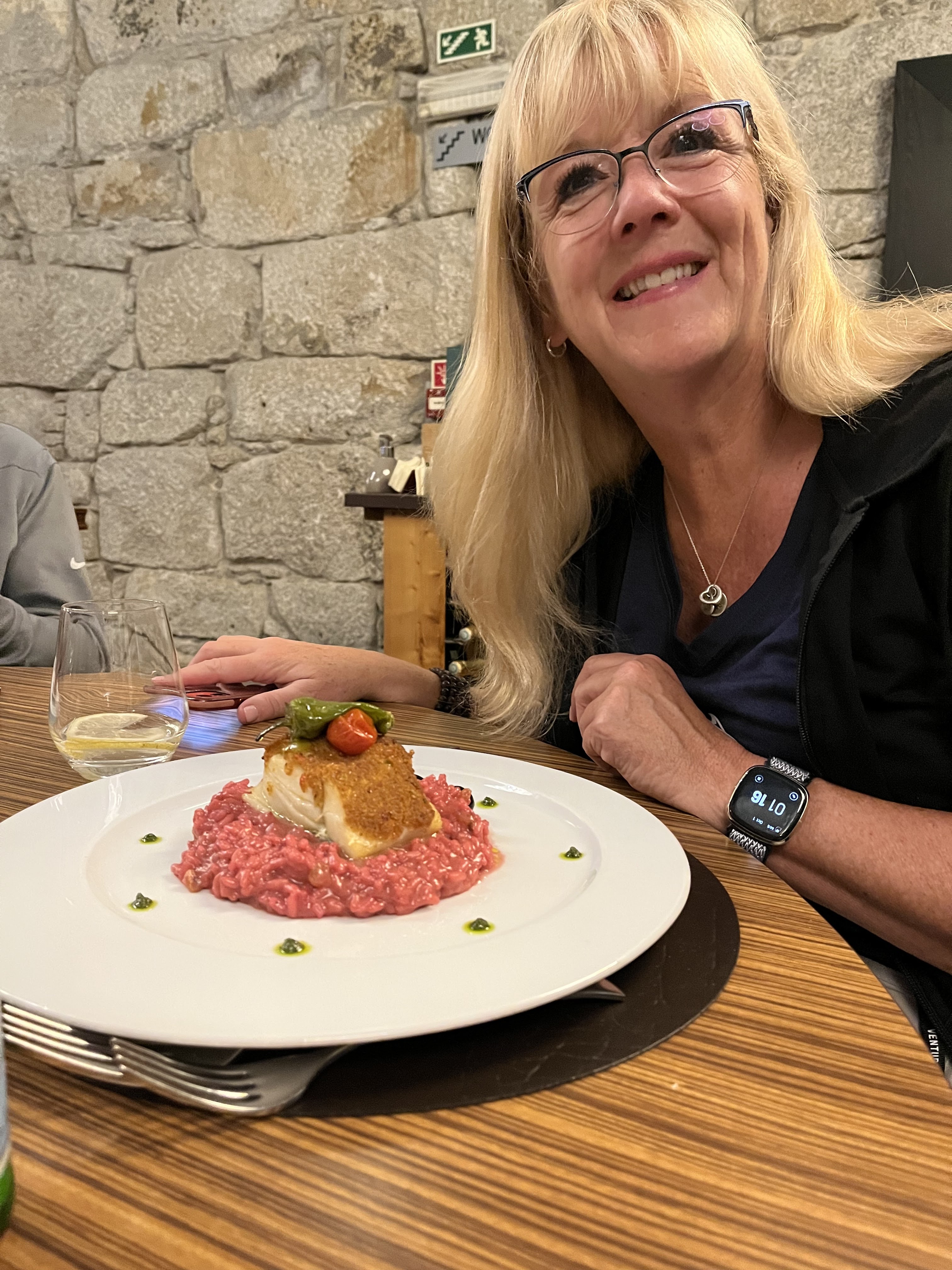
Dinner in Porto with two best friends I have never met before but will never forget. I had the Squid Pasta with shrimp and clams, and Mickey had the octopus with smashed potatoes and some veggie. Pam had the Baccalau with Risotto. We washed it all down with a bottle of Vinho Verde.
 
Then, for dessert, Mickey had a lemon-orange sorbet with a fabulous liquor. Pam and I shared a Tiramisu. OMG.

Friendships forged over such meals are destined to last forever. I love you, Porto!

Mickey had the octopus and smashed potatoes and a veggie. He looks happy, right? Mickey is a professor of psychology and religion at a Jesuit college

I had the squid ink pasta, shrimp and clams. OMG. To absolutely die for.

Pam had the Baccalau with Beet Risotto. Amazing (except, of course, for the bones; she wasn't expecting the bones).

We washed down our meal with a bottle of Vinho Verde.

Pam is a university professor of English and is active in Mothers Without Borders.


For dessert, Mickey had the lemon-orange sorbet with some kind of evil liquor they poured over it.
 

Pam and I shared a Tiramisu. How fabulous is that?


Tomorrow, we are off to the Duoro River Valley Wine Tour and then the rescheduled Fado concert and dinner. 

\

Oh, did I mention that the entire meal, soup to nuts, came to less than $30 Euro per person? 


Right.  


You know, right now, life is so damn good I can hardly stand it. This is what makes the hard times - when they come, and they always come -  a little easier to get through.

Camino: Dateline Porto, Portugal


My first view of Porto, across the bridge, at 6 PM

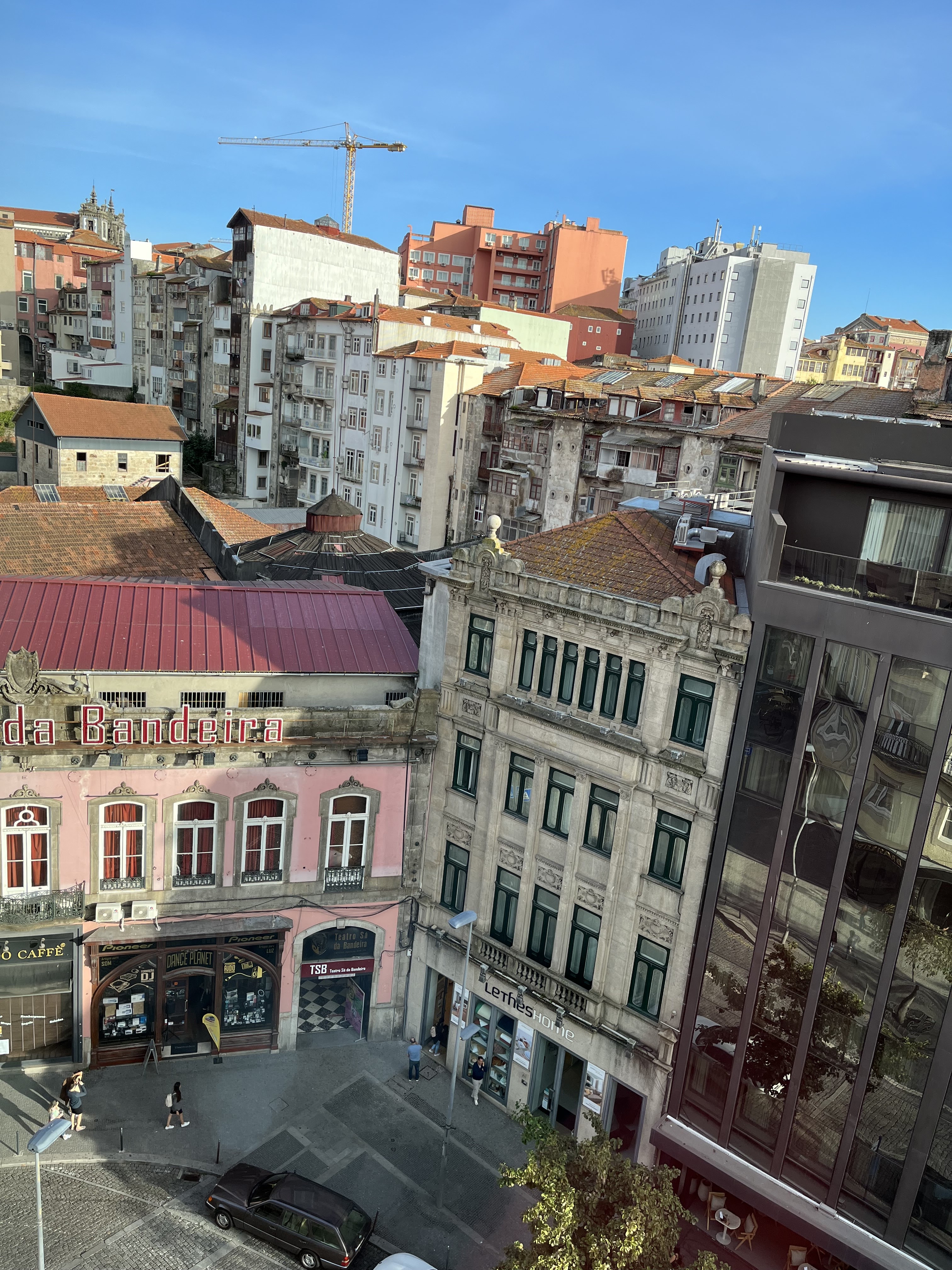
Good Saturday morning, comrades! It's the first day of October and I think the worst of jet lag is behind me. I am writing you from the beautiful city of Porto, Portugal where "a river runs through it" and the city is a very hip mixture of old European charm with modern international accommodation.

The church where I hope to attend mass early tomorrow morning is St. John's, which bills itself as "an International Church in the Anglican Tradition".

At least, I hope to attend early mass. Tomorrow morning at 9:30 AM, I am leaving with some pilgrims I just met to check out the Douro River Valley. 
 
We will be visiting two different wineries and doing some wine tasting at Quinta do Seixo - and having lunch there - and Quinta da Roeda. In between, we'll cruise the Douro River in a typical "Rabelo" boat.

I couldn't be more excited.


Today, I'm going to explore more of the city of Porto. I hope to meet up with the friend of a mutual friend for a bit of an afternoon tea.
 
Tonight, I meet up with my fellow Peregrino/a at 5:30 and we will walk to a theater not far from here to attend a wonderful (or so I hear) Fado Concert.

Fado pronounced: [ˈfaðu]; "destiny, fate") is a music genre that can be traced to the 1820s in Lisbon, Portugal, but probably has much earlier origins. Fado can be about anything but must follow a certain traditional structure. It is a form of music characterized by mournful tunes and lyrics, often about the sea or the life of the poor, and infused with a sentiment of resignation, fate and melancholy.
 
You can hear the influence of the Mores and the laments of the sea in every note.

Here's an example of my favorite Azorean singer Mariza singing one of my favorite Fados "Barco Negro"


It is the musical expression of "Saudade" that some who read this page or my blog may remember. It is a longing, symbolizing a feeling of loss (a permanent, irreparable loss and its consequent lifelong damage).

My grandmother played her guitara and sang Fado, something of which my grandfather was very proud, not only because of her beautiful voice and soulful playing but because, under the growing conservative regime that birthed the dictatorship of Salazar, and aided and abetted by the (Roman Catholic) church, at one point in time and in some towns, only men could sing Fado.


That my grandmother could sing it in this country was the manifestation of the freedom they sacrificed to attain for themselves and their children and their children's children.

But, there was always this longing for "the old country" - like the Israelites having been blessed with liberation from slavery and headed for The Promised Land but longing for the pomegranates in Egypt.

So, it's off into my day. I'm so excited to have conversations with people on the streets and in cafes. I want to learn more of why people from America seem to settle here.

I am already learning that Fr. Koumranian was right and "people is people" all over the world. My hostess at breakfast was a young woman named Rita, who talked about the Great Rush at 7:30 AM of "bus loads" of people - so many she couldn't seat them all at the same time. "So, what I'm going to do? I give them place in line. When one table finish, I fast clean, clean, clean and then another four people sit. Whew!"

I said, "Well, when you go home, you'll put your feet up and rest with a nice cup of tea."

"Oh no," said Rita. "My boy will say, "Mommy, Mommy, we go play ball. He's 5. His dad is . . . um . . . work until late today. So, I be Mommy and Daddy until tonight."


It was ever thus, eh Ladies?

Make it a great day, everyone.

Bom dia!

Barco Negro (Black (sail) boat) Translation
(The lament is "They are crazy")
 
In the morning, how I feared that you could find me ugly
I woke up trembling, laid on the beach's sand

But immediately your eyes told me the opposite
And the sun entered into my heart

Then I saw a cross stuck on a rock
And your black sailboat dancing under the light

I saw your hand waving goobye among the ready loose sails
Old women of the beach tell me that you will not come back

They are crazy... They are crazy...

I know, my love, that you, in fact, did not leave
because, everything around me tells me that you are always with me

You are in the wind, which spreads sand on the glass (of the windows)
You are in the water, that sings into the dying fire
You are in the warmth of the rest from empty seabeds
You are forever with me, into my heart/chest.